

Key Takeaways
- Sampling strategies in research select a manageable group to represent a larger population.
- Probability sampling supports generalization through random selection.
- Non-probability sampling suits qualitative and exploratory research.
- Method choice depends on goals, access, time, and budget.
- Larger samples usually reduce the margin of error, but bias can still occur if selection is flawed.
When conducting research on a group of people, collecting data from every individual in the group is rarely realistic. Instead, researchers work with a sample. A sampling method is the planned approach used to decide which members of the group will be included. It matters because the way a sample is chosen directly affects accuracy, credibility, and how well results reflect the whole group. That is why our experts usually pay close attention to sampling before the paper moves to analysis.
There are two main types of sampling methods. Probability sampling relies on random selection, giving each population member a known (and typically non-zero) chance of inclusion, which supports statistical conclusions. Non-probability sampling uses non-random selection based on access, judgment, or relevance, making data collection faster and more flexible.
Population, Sample, and the Narrowing Gap
Research usually begins with an ambition that’s a little too big for reality. You want to understand a group in full. In theory, you could study everyone. In practice, budgets, time, and access shut that down fast.
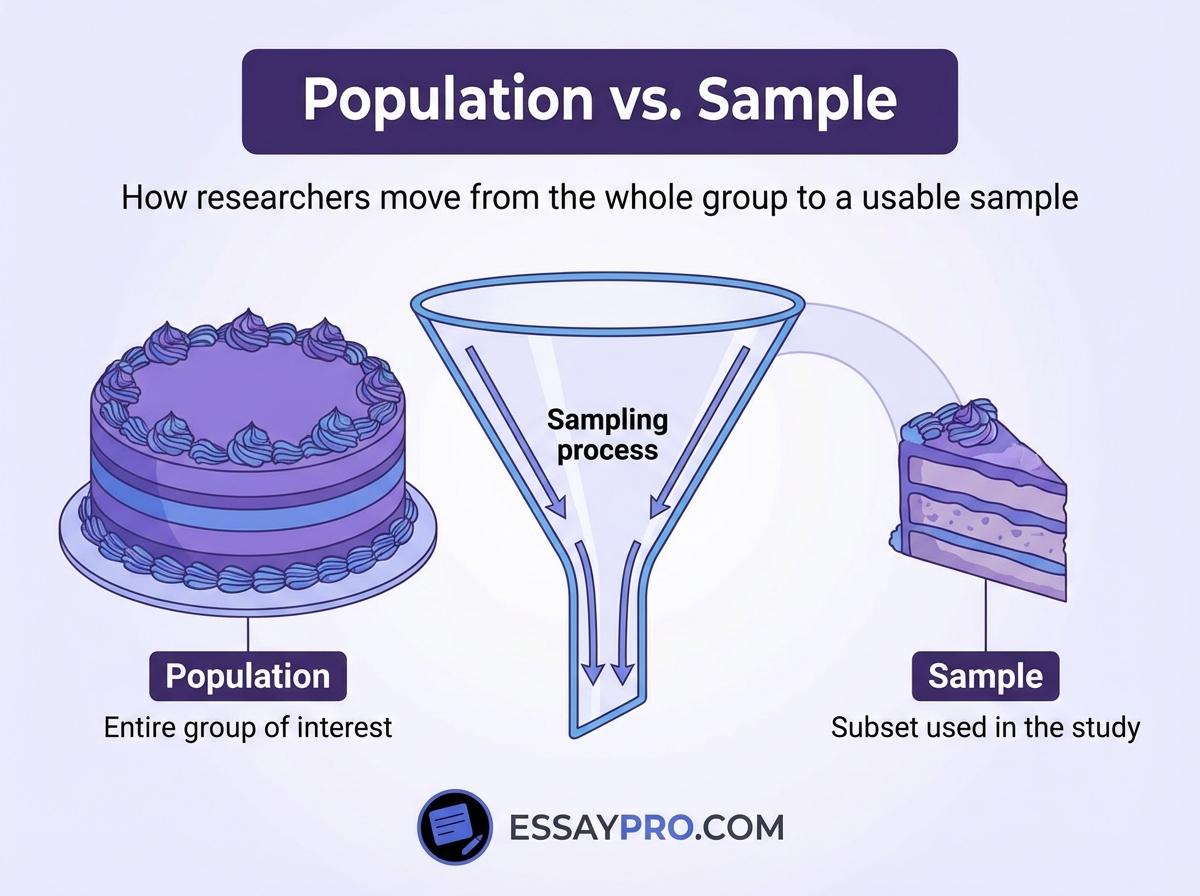
To make research possible, three core concepts step in:
- Population: the entire group you want to understand. This could be all university students, all registered voters, or every employee in a company. It represents the full scope of interest, even when it cannot be fully studied.
- Sample: a smaller group that actually participates in the study. Population size, how much variation exists within the group, and the overall research design all play a role. Different studies call for different levels of precision, which is why researchers often rely on sample size formulas or calculators.
- Sampling: the process used to decide who from the population becomes part of the sample. It determines who from the population becomes part of the sample, usually by working from a sampling frame, which is a list or source that identifies eligible participants, such as enrollment records, customer databases, or employee rosters.
For a clearer picture of how sampling fits into a full study write-up, read this methods section of research paper example.

Probability Sampling Methods
Probability sampling techniques rely on random selection, giving every population member a known chance of inclusion. This makes them ideal for quantitative research and the gold standard for limiting researcher bias. The next sections explain simple random sampling, systematic sampling, stratified sampling, and cluster sampling in detail.

Simple Random Sampling
Simple random sampling is the most straightforward method of selecting a sample. You start with a complete list of the population, then select people in a way that gives everyone the same chance. Because no one is favored, this method is often treated as the baseline for fairness in sampling.
This method fits best when the population is clearly defined and easy to reach, such as enrollment lists, employee records, and customer databases. In other words, situations where you can actually see the whole group laid out in front of you. It’s common in quantitative studies because the randomness makes later analysis cleaner and conclusions easier to defend.
Example: Picture a study on student stress at a large university. Every student gets a number. A random number generator selects 300 of them. Those students form the sample, not because they’re convenient or interesting, but because chance said so. That restraint is the point.
Systematic Sampling
Systematic sampling differs from random sampling by choosing a random starting point and then taking every fixed interval from a list. After that first choice, the process follows a steady rhythm rather than repeated random draws.
This approach works well with large, well-ordered lists. Selection moves in fixed steps instead of repeating random draws, so the sample spreads evenly across the population without slowing the process.
Example: Picture a database of 3,000 customers. A researcher picks a random starting point, then selects every 30th name. The list guides the selection, not personal judgment. As long as the list itself doesn’t repeat hidden patterns, systematic sampling stays efficient and dependable.
Stratified Sampling
Stratified sampling starts with the recognition that a population carries an internal shape. People cluster around shared traits that influence outcomes, and those patterns deserve attention before any names are drawn. The population is divided into identified subgroups built around similar characteristics that connect directly to the research question.
Selection then happens within each subgroup rather than across the whole population. Random choice is often used at this stage, which preserves statistical rigor while keeping each subgroup present in the final sample. This structure prevents dominant groups from overwhelming smaller ones and keeps the sample aligned with how the population actually looks.
Example: Consider a study examining job satisfaction inside a large organization. Managers, frontline employees, and contract staff experience work differently. The stratified sampling method draws from each group separately, producing a sample that reflects internal balance.
Cluster Sampling
Cluster sampling shifts the unit of selection away from individuals and toward groups. The population is broken into naturally occurring groups, and selection happens at the group level rather than name by name. Once clusters are chosen, researchers either study everyone in those clusters (one-stage) or randomly sample individuals within them (two-stage).
This approach shows up when populations stretch across space or systems that resist neat lists. Distance, logistics, and cost shape the method. By sampling whole clusters, researchers trade some precision for reach, gaining access to data that would otherwise stay out of reach.
Example: Imagine a nationwide study on classroom technology use. Simple random sampling would require listing and selecting individual students across the entire country, while cluster sampling skips that bottleneck by randomly selecting schools and studying everyone inside them, so the study can move forward without getting trapped by scale or distance.
Non-probability Sampling Methods
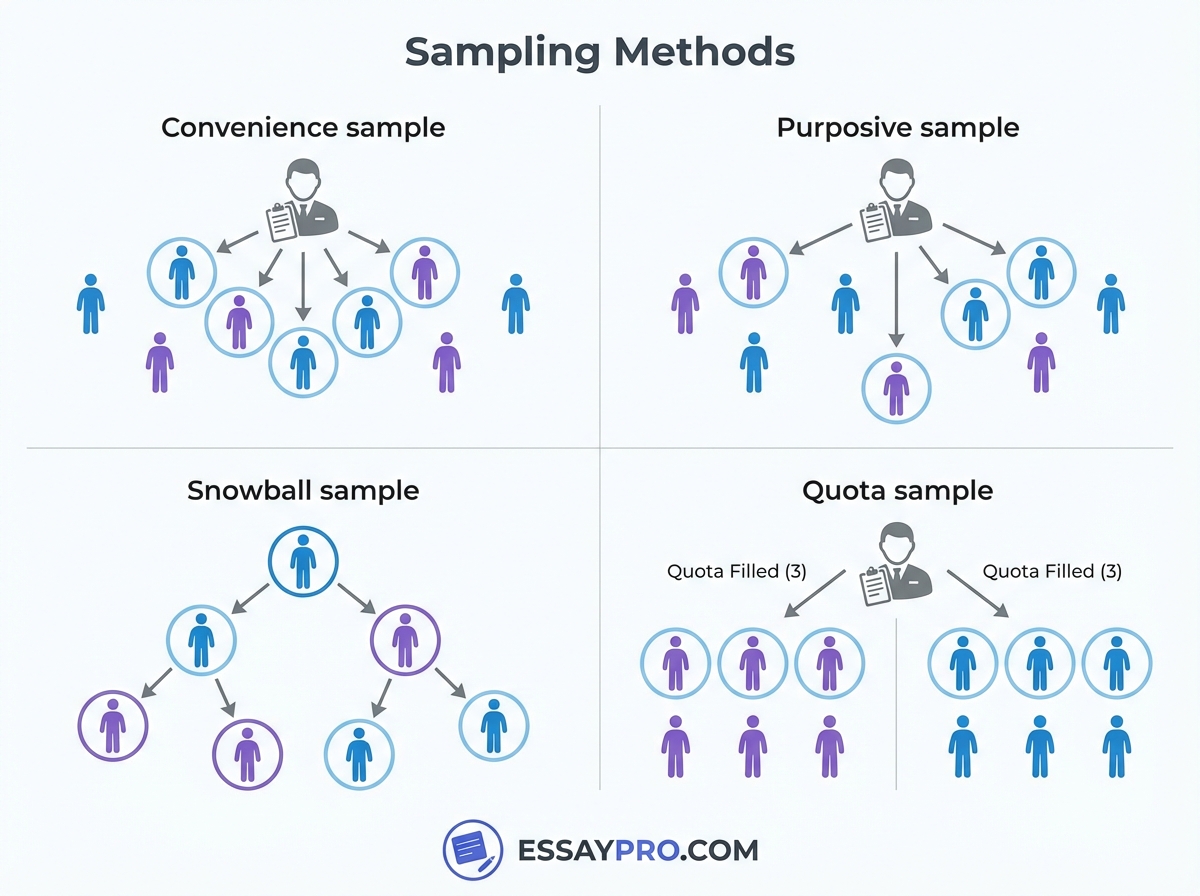
Non-probability sampling techniques rely on non-random selection and are often used in qualitative or exploratory research. The next sections cover convenience sampling, voluntary response sampling, purposive sampling, snowball sampling, and quota sampling.
Convenience Sampling
Convenience sampling selects participants based on immediate availability and access. Participants are included because they are easy to reach in a given setting, allowing the sample to form quickly without formal selection procedures.
This method shows up early in research, especially when ideas are still taking shape. It’s common in classroom studies, pilot projects, and observational work where speed matters and the goal is insight rather than precision. Convenience sampling helps researchers see what might be happening before asking how often it happens.
Example: Imagine a researcher curious about how students manage deadlines. Instead of tracking down a full roster, they speak to students studying in the campus library that afternoon. The results don’t describe everyone, but they reveal patterns worth exploring further.
Voluntary Response Sampling
Voluntary response sampling allows participants to self-select into a study. Instead of being chosen by the researcher, people decide on their own whether to take part, usually in response to an open call, survey link, or public invitation. The sample forms from those who feel motivated enough to respond.
This approach appears often in feedback studies, public opinion work, and exploratory research where the aim is to hear voices that feel compelled to speak. It tends to surface strong reactions, clear frustrations, or deeply held views. What it captures well is intensity, not balance, which makes it useful for identifying themes rather than measuring how common they are.
Example: Consider an online poll about changes to a streaming platform. Users who feel strongly, either pleased or annoyed, are far more likely to reply. Their responses reveal patterns worth studying, even if many users remain silent.
Purposive Sampling
Purposive sampling means participants are chosen because they fit the question being asked. The sample is built around relevance, not chance or convenience.
Instead of asking who is nearby or who responds first, the researcher asks who actually knows what’s going on. Experience becomes the entry ticket. This is why the method shows up so often in qualitative work, interviews, and exploratory studies where understanding comes from proximity to the issue rather than numbers on a spreadsheet.
Example: Imagine a project examining how hospitals handle sudden crises. Interviewing people far from those decisions adds noise. Talking directly with senior nurses or administrators changes the texture of the data. Their accounts carry weight because they’ve been inside the process, watching decisions unfold as they happen.
Snowball Sampling
Snowball sampling builds a sample through connections rather than lists. One participant leads to another, then another, as trust and familiarity do the work that lists and databases cannot.
This approach comes into play when the group you want to study doesn’t announce itself clearly, such as informal networks, sensitive communities, and niche roles. Access arrives through relationships, not recruitment ads. Snowball sampling fits exploratory and qualitative research where reaching the right voices matters more than counting how many voices there are.
Example: Imagine researching gig workers who operate entirely through word of mouth. There’s no directory to start from. One person agrees to talk, then points you toward someone they know, who connects you with someone else. The sample takes shape through shared circles, revealing patterns that only surface once people feel safe enough to pass the invitation along.
Quota Sampling
Quota sampling builds a sample by filling predefined slots rather than leaving selection entirely open. The researcher decides in advance how many participants are needed from specific groups, then recruits people until each quota is met.
This method shows up when balance matters, but full random selection isn’t practical. It’s often used in market research, opinion studies, and exploratory work where certain perspectives must be present for the results to make sense. Speed and control sit at the center of the method. Once a quota is filled, recruitment for that group stops.
Example: Picture a study on media behavior that needs equal input from younger and older adults. The researcher keeps collecting responses from each group until both quotas are full, regardless of who responds first. The final sample reflects intentional structure, shaped by planning rather than chance.
Probability and Non-Probability Sampling Compared
The difference between probability and non-probability sampling comes down to how participants enter the study. Probability sampling relies on random selection, which supports generalization and statistical testing. Non-probability sampling relies on access, judgment, or self-selection, which prioritizes speed, feasibility, and early insight. One emphasizes representativeness, the other practicality. Both exist because research goals vary.
Limits and Errors in Sampling
Even when the right sampling method is chosen, mistakes can still creep in:
- Selection bias: Happens when some population members have a higher chance of being included due to access, visibility, or the way the sample is drawn. Even a well-planned method can tilt if the sampling frame leaves people out.
- Non-response bias: Appears when selected participants do not respond or drop out. The sample may look sound on paper, yet the missing voices quietly reshape the results.
- Practical constraints: Even with a strong method, real-world limits (time, access, participation) can distort the sample.
Choosing the Right Sampling Method
Below is a decision guide to help match your sampling method to your research goal:
- If you are studying opinions or reactions to a public issue: Voluntary response sampling can surface strong viewpoints, though it should be framed as exploratory.
- If you are running a pilot study or working with no budget: Convenience sampling works, as long as you clearly acknowledge the limits and potential bias.
- If your population is hidden or hard to identify: Snowball sampling becomes the most effective option, since access depends on personal networks rather than lists.
- If your population is large and geographically spread out: Cluster sampling reduces cost and logistical strain while still allowing structured data collection.
- If speed matters more than precision: Non-probability sampling methods offer faster data collection, especially when early insights are the priority.
For fresh ideas on what to investigate next, review this list of education research topics and ideas for students.
Choosing the Correct Sample Size
The correct sample size depends on how precise your results need to be. Two factors drive this decision: margin of error and confidence level. The margin of error shows how much your results might vary from the true population value, while the confidence level reflects how certain you want to be in those results.
Larger samples reduce uncertainty. As the sample size increases, the margin of error shrinks, making estimates more stable and reliable. Smaller samples cost less and are easier to manage, but they come with wider margins and less precision. The right balance depends on the research goal, available resources, and how much accuracy the study requires.
Upgrade to Human-Written
Invest in quality you can trust. EssayPro pairs you with expert writers for results you’ll feel confident submitting.
Final Thoughts
Sampling shapes everything that follows in a research study. The method you choose determines who is heard, which patterns appear, and how far your conclusions can travel. Strong sampling is rarely perfect, but it is always intentional. When the approach matches the research goal, the results become clearer, more defensible, and easier to interpret.
FAQs
What Is Sampling?
Why Use Sampling Methods?
What Is a Probability Sampling Method?
What Is a Non-Probability Sampling Method?
Can You Use More than One Sampling Method in a Single Study?

Mariam Navrozashvili
She has a Master’s degree in English Literature and brings a deep understanding of storytelling, critical analysis, and language structure to her work. On EssayPro Blog Mariam writes guides on literary analysis, essay composition and language studies to help students improve their writing skills. In her free time she likes to read classic novels and discuss literary theory.


.webp)