
An appendix is a separate section placed at the end of a paper, used for material that supports the main discussion but would make the body too crowded if included there. When writing an appendix in a paper, the point is not to add random extra pages. The section should give readers access to information that helps them understand your work more fully. An appendix may include:
- raw data
- interview questions
- survey results
- charts or tables
- images, documents, or forms
- long calculations
- sample materials
This article explains what an appendix is, why writers use it, how it should be formatted, and what an example of an appendix in a paper can look like in an actual academic assignment.
What Is an Appendix in a Paper?
An appendix in writing is a final section of a paper that contains relevant supporting material too detailed, lengthy, or visually interruptive for the main body. It usually gives the reader access to evidence, background details, research tools, or additional documentation that connects directly to the topic.
The length of an appendix depends on what the paper needs, so one page may be enough, although longer research projects can require several pages. A useful appendix still needs a label, a title, and a clear reason for being included.
By the way, you should also learn how to write a methods section for a research paper if you want to submit structured work.
Your Paper Can Improve
Work with an expert who can organize your draft, fix weak sections, and refine the final version.

What Is the Purpose of an Appendix in a Paper?
The purpose of an appendix is to keep the main paper focused while still giving readers the supporting material they may need. Academic papers often rely on details that are useful but too bulky for regular paragraphs. An appendix solves that problem by placing those details in a separate, easy-to-find section. Research paper writing services recommend using appendices for the following reasons:
- Keep the main paper readable. Long tables, transcripts, questionnaires, or data sets can slow down the discussion and make the argument harder to follow.
- Show how the evidence was collected. Survey questions, interview guides, observation notes, and raw results help readers understand the research process behind the paper.
- Support a point with extra proof. A chart, image, form, or document can strengthen a claim without forcing the paragraph to explain every detail.
- Follow assignment requirements. Some instructors expect research tools, calculations, sample materials, or supplementary documents to appear in an appendix.
- Let readers check important details. The appendix gives them a clear place to review information that supports the paper but does not need full discussion in the body.
How to Structure an Appendix?
The main parts of an appendix are the title, contents list, page numbers, relevant information, formatting, labels, and short notes that explain what each item does. The length of the appendix depends on the amount of material your paper needs.
Every appendix should contain:
A Clear Title: Use a direct title that names the material inside the appendix.
Example:
- Appendix A: Survey Questions
- Appendix B: Interview Transcript
- Appendix C: Statistical Tables
Table of Contents: Add a table of contents when the appendix includes several items or many pages. This helps readers move through the section quickly.
Example:
Table of Contents
A. Survey Questions
B. Interview Responses
C. Data Tables
D. Consent Form
For a short appendix with one item, you can skip this part unless your instructor requires it.
Page Numbers: Page numbers are useful when your paper refers to a specific table, chart, transcript section, or document. Number the appendix pages clearly and use the same numbering system required by the assignment or citation style.
Example:
Appendix A
Page 1 of 4
Relevant Information: Useful appendix content can include survey forms, raw data, charts, interview questions, transcripts, images, consent forms, and long calculations. If the paper never refers to the material, leave it out.
Example:
Appendix B: Interview Questions
- What challenges did participants report during the first week?
- How did participants describe their access to support?
- What changes did participants suggest?
Proper Formatting: Format the appendix according to the required style guide. Keep font, spacing, margins, headings, and citation style consistent.
Example:
Appendix C: Data Table
Table C1
Participant Responses by Age Group
[insert table here]
APA, MLA, and Chicago each have slightly different rules, so follow the style assigned for the paper.
Clear Labeling: Label each appendix and each item inside it. Use a simple system that is easy to follow.
Example:
Appendix A
Figure A1: Classroom Seating Layout
Table A1: Survey Results by Grade Level
Clear labeling also makes in-text references easier, such as “see Appendix A” or “see Table B1.”
Concise Explanation: Add a brief explanation before complex material. Tell the reader what the item shows and why it is included.
Example: Appendix D: Sample Interview Transcript
This transcript shows how one participant described the research process. It is included to support the discussion of participant experience in Section 3.
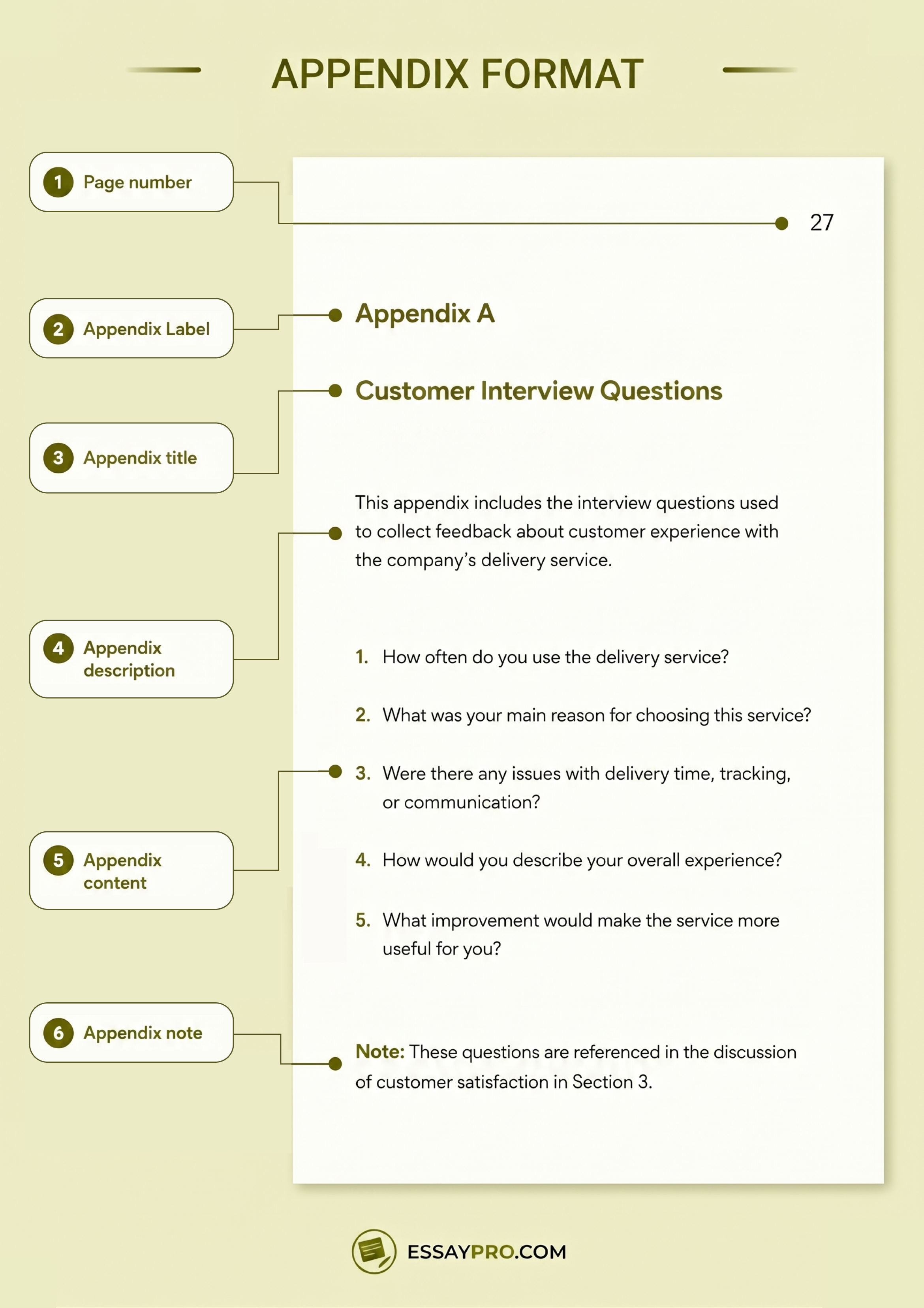
General Appendix Format
Appendix formatting should help the reader move through extra material without having to guess where each item belongs. The exact setup depends on the citation style, assignment instructions, and type of material included, although most appendices follow a similar academic order. Before you adjust the details for APA, MLA, or Chicago, use these general rules as the base:
- Place the appendix after the reference list, works cited page, or bibliography.
- Start each appendix on a separate page, even when the section is short.
- Label every appendix clearly, using titles such as Appendix A, Appendix B, and Appendix C.
- Add a specific title below the label so the reader knows what the section contains.
- Keep the same font, spacing, margins, and general page setup used in the paper.
- Number appendix pages according to the required style guide or your instructor’s directions.
- Label each table, chart, figure, image, transcript, and document inside the appendix.
- Refer to every appendix somewhere in the body of the paper.
- Add brief explanations when the material needs context.
- Leave out anything that does not support a point already discussed in the paper.
How to Write an Appendix in Different Styles?
Writing an appendix in a paper becomes easier once you know which citation style your assignment requires. APA, MLA, and Chicago all allow appendices, but each one handles placement, headings, labels, and source details in its own way. The next sections explain the rules for each style in practical terms, so read carefully whether you decide to pay for research paper or draft one yourself.
How to Do an Appendix in APA?
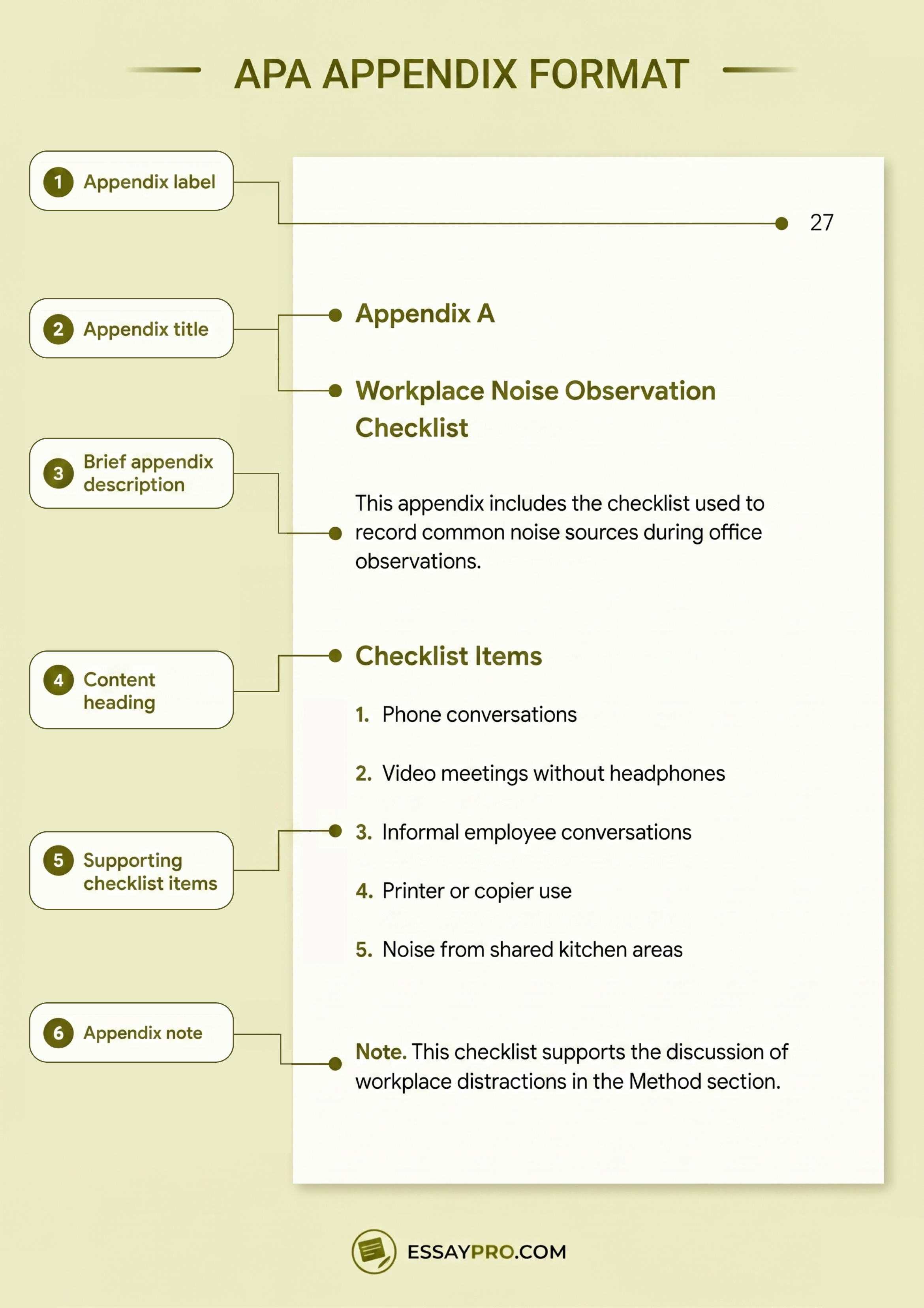
An APA appendix follows the APA 7th edition, the current version used for most student papers and academic writing. In this style, the appendix usually appears after the References page and contains supporting material that would interrupt the main discussion if placed inside the body. That material may include survey questions, data tables, interview materials, figures, sample documents, or extended examples. A useful APA appendix example should look clean, clearly labeled, and connected to the paper through an in-text reference. Follow these rules when formatting APA appendices:
- Place the appendix after the References page.
- Start each appendix on a new page.
- Center and bold the appendix label at the top of the page.
- Use Appendix when the paper has one appendix.
- Use Appendix A, Appendix B, and Appendix C when the paper has more than one.
- Add a descriptive title under the appendix label.
- Refer to each appendix in the main text before the reader reaches it.
- Keep the same font, spacing, margins, and page layout used in the rest of the paper.
- Label tables and figures with the appendix letter, such as Table A1 or Figure B1.
- Cite borrowed material even when it appears only in the appendix.
- Keep the appendix limited to supporting material, not new claims or analysis.
The infographic below can show the basic APA appendix layout, including the label, title, page setup, and placement of a sample table or figure.
How to Do an Appendix in MLA?
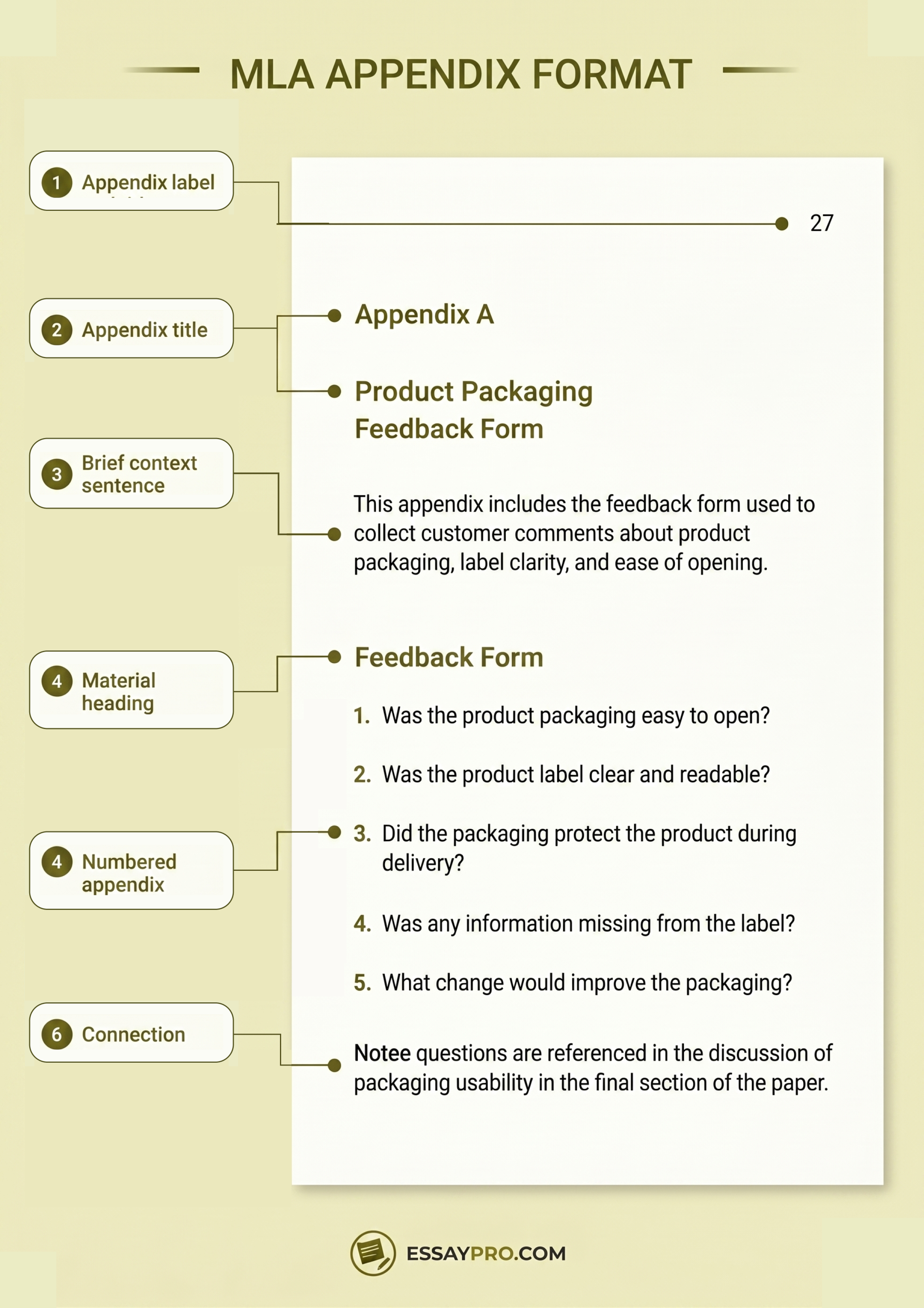
An MLA appendix follows the MLA Handbook, 9th edition, and in most student papers it comes after the Works Cited page, unless the assignment sheet gives a different order. When you are creating an appendix in MLA, the section should still look like part of the paper. The title, page header, spacing, and labels need to match the rest of the document, because a strong MLA appendix example should be easy to read and easy to connect back to the essay. Here's the set of rules:
- Place the appendix after the Works Cited page, unless your instructor gives another placement rule.
- Begin the appendix on a new page.
- Use Appendix as the title when the paper includes only one appendix.
- Use Appendix A, Appendix B, and Appendix C when the paper includes several appendices.
- Add a descriptive heading after the appendix label, such as Appendix A: Interview Questions.
- Keep the same margins, font, line spacing, and general page setup used in the paper.
- Include the last name and page number in the header if that header appears throughout the assignment.
- Refer to the appendix in the essay before the reader reaches the final pages.
- Label any tables, images, figures, transcripts, forms, or other materials clearly.
- Cite outside material included in the appendix.
- Keep explanations short, since the main discussion belongs in the body of the essay.
The infographic below can show the basic MLA appendix layout, including the page header, title, appendix label, and sample supporting material.
How to Do an Appendix in Chicago?
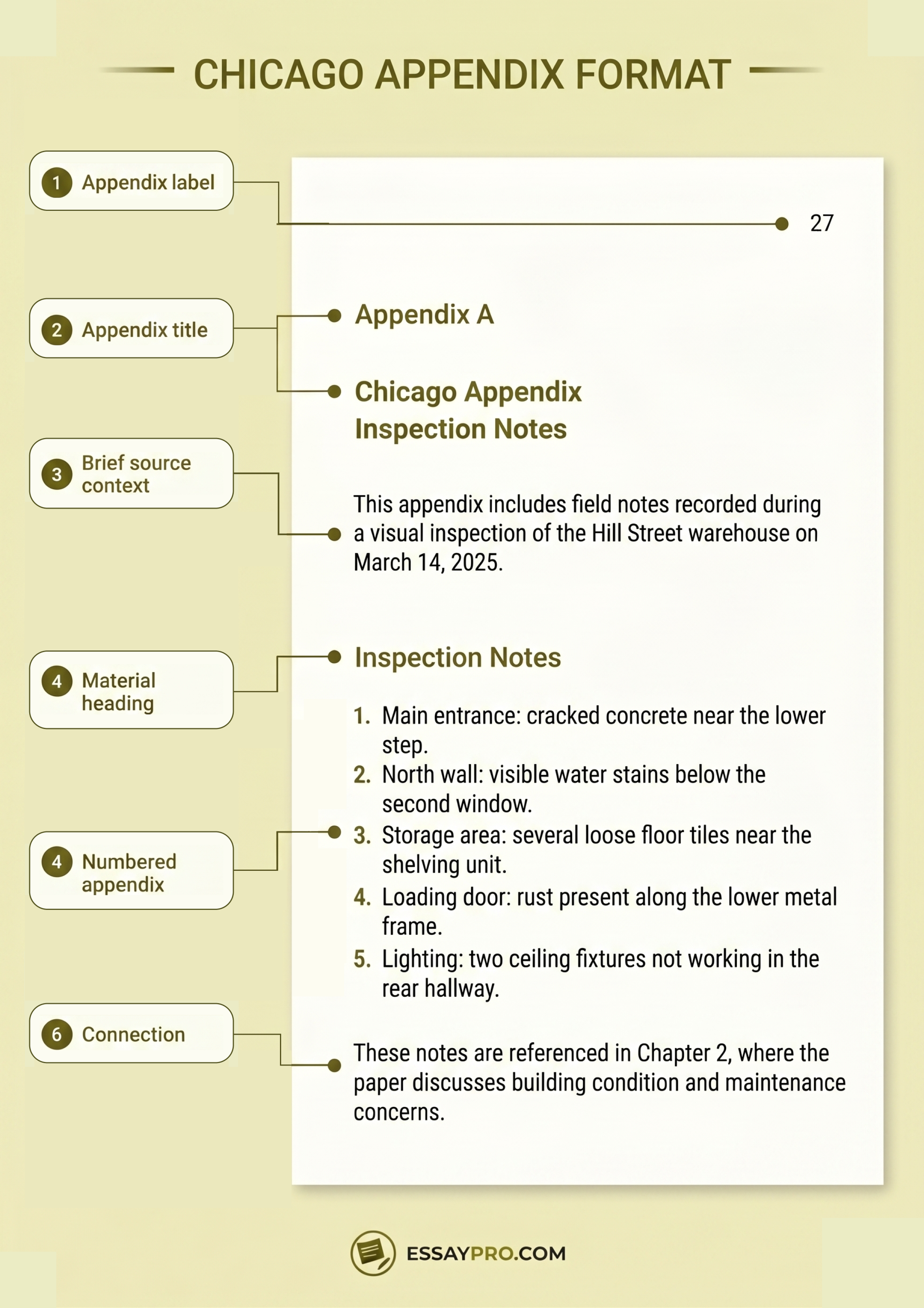
A Chicago appendix follows The Chicago Manual of Style, 18th edition, and it is often used in research papers that contain detailed supporting material. History papers, theses, and source-heavy assignments may use appendices for archival records, maps, timelines, tables, translations, interview excerpts, or primary-source documents. A clear Chicago appendix example should help readers check the material behind the discussion without interrupting the main sections of the paper. Handle your Chicago-style appendices like this:
- Place the appendix after the main text and before the bibliography, unless your instructor or department requires another order.
- Begin each appendix on a new page.
- Use Appendix when the paper has one appendix.
- Use Appendix A, Appendix B, and Appendix C when the paper has more than one appendix.
- Add a specific title after the appendix label, such as Appendix B: Archival Documents.
- Keep the font, margins, spacing, and page numbering consistent with the rest of the paper.
- Mention the appendix in the main text so the reader understands why the material is included.
- Label tables, figures, maps, images, records, and documents clearly.
- Cite sources using the same Chicago system used in the paper, either notes and bibliography or author-date.
- Add source details or permissions for reproduced images, archival documents, and other borrowed materials when needed.
- Use a short note before longer documents, tables, or source excerpts if the reader needs context.
The infographic below can show the basic Chicago appendix layout, including placement, labeling, page setup, and examples of source notes.
Here's our separate guide on how to write a report as well.
How to Reference an Appendix in Your Text?
An appendix only works when the reader knows it exists in the first place. Every appendix must be pointed to inside the main body at the moment the supporting material becomes relevant. Place the reference immediately after the sentence that relies on it. Short and direct signals work best.
For example, The complete questionnaire is provided in Appendix A. Tables and figures follow the same pattern: Detailed outcomes appear in Appendix B, Table B2. Each appendix must be mentioned at least once in the main body. Referencing appendices is necessary to make sure they are not overlooked during evaluation.
If you'd rather have a professional from EssayPro handle all parts of your paper (including appendices, of course), you can just visit the platform and ask, 'Write my paper for me!'
Submit Stronger Work
Our writers can help you turn rough notes into a clear, properly formatted paper.
Bringing Everything Together
Appendices include material that supports the argument without slowing the paper down. Correct placement, consistent labeling, and clear references keep everything connected. When handled well, appendices strengthen credibility and improve readability at the same time.
Managing appendix details can be time-consuming, especially near submission deadlines. EssayPro offers a reliable report writing service for students who need help aligning structure and formatting.
FAQs
What Does an Appendix Look Like?
Does Appendix Count Towards Word Count?
Where Does an Appendix Go in a Paper?
Is it "Appendices" or "Appendixes"?
Do You Add an Appendix to a Table of Contents?

Daniel Parker
is a seasoned educational writer focusing on scholarship guidance, research papers, and various forms of academic essays including reflective and narrative essays. His expertise also extends to detailed case studies. A scholar with a background in English Literature and Education, Daniel’s work on EssayPro blog aims to support students in achieving academic excellence and securing scholarships. His hobbies include reading classic literature and participating in academic forums.