

Key Takeaways
- A strong essay title names the subject, narrows the angle, and matches the actual argument.
- APA, MLA, and Chicago can change title placement, capitalization, and formatting rules.
- Title case usually capitalizes major words, plus the first and last words.
- Vague or gimmicky titles make the paper look weaker before the introduction starts.
The essay title is the short line that makes the first impression on the reader before they even get to the introduction. That is why these few words have arguably the most important job in a paper: they should name the subject, hint at the angle, and sound interesting enough to make the reader want to keep going. If you came to this article to learn how to title an essay, the simple main rule is to make it specific and honest about the work's real focus.
There is also the formatting side to this, besides the contents, and this changes depending on what citation style you're using and what the title includes. In this article, I'll cover what the essay title has to achieve through formatting guidelines and clear examples.
Purpose of an Essay Title
A title for essay gives readers their first clear signal about the paper. It doesn't need to spoil the whole paper in the first few seconds, but the readers must still know where they are about to enter. A strong title has to:
- Draw the reader's attention toward the subject
- Give readers a clear hint about the essay’s main idea.
- Prepare them for the tone of the paper
- Suggest what makes this essay different from others on the same topic
These rules are also not absolute because the right title also depends on the situation. For example, if you're submitting an essay to a professor who has to read it, you don't need a flashy title. But if you're publishing a blog or sending it to an essay contest, you have more wiggle room to come up with a catchy heading (as long as it still connects to the actual essay).

General Rules for Essay Titles
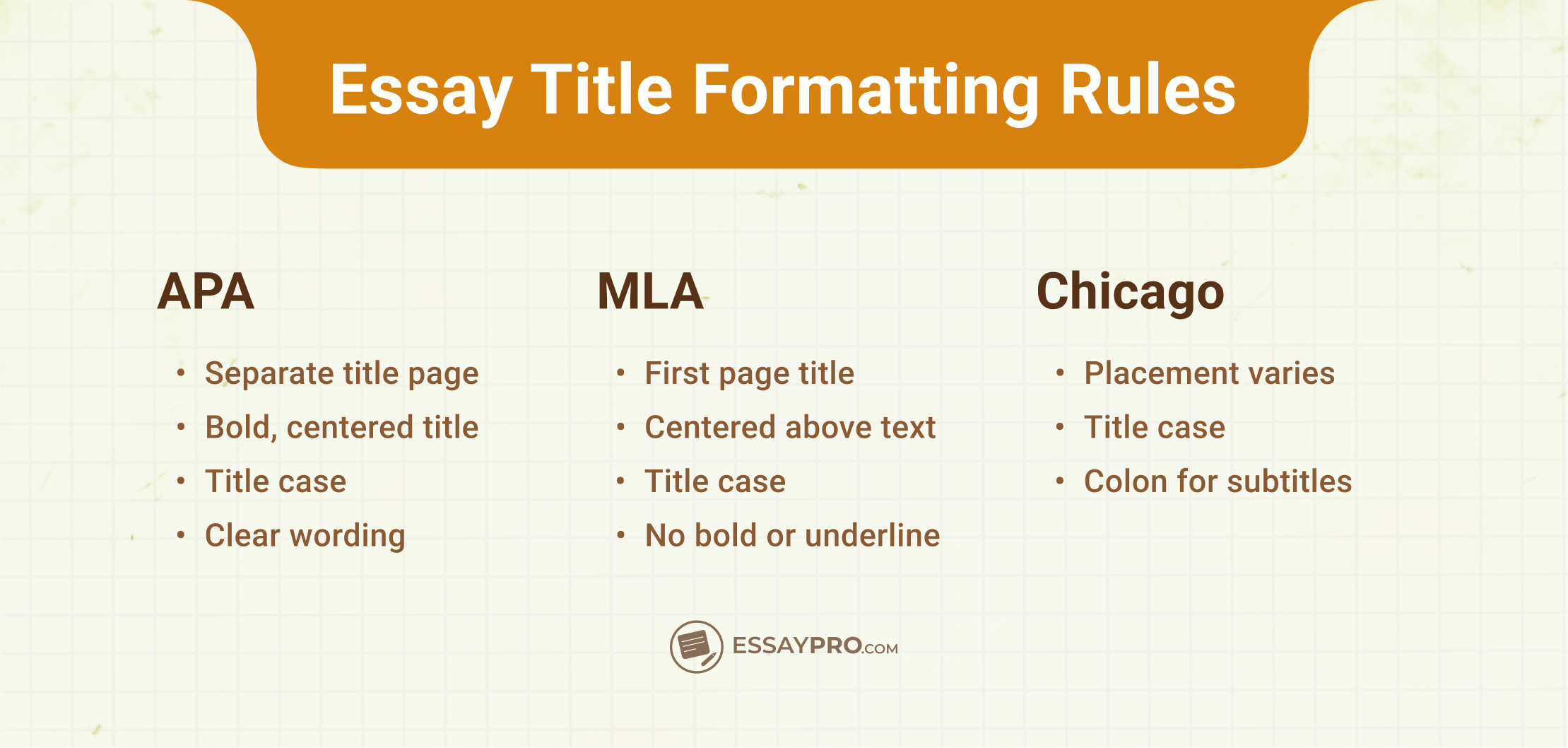
Essay titles are subject to formatting rules just as much as the rest of the papers are. Essay title format changes depending on whether you're using APA, MLA, or Chicago. The wording still matters, of course, but placement, capitalization, italics, and punctuation matter too.
Essay Titles in APA Format
APA format usually gives the title its own space on a separate title page. The title appears bold, centered, and written in the title case. That means the first word, the last word, and major words receive capital letters. APA titles tend to work best when they sound specific and measured.
Example: Sleep Quality and Academic Performance Among First-Year College Students
This title works because readers know the subject, the focus, and the group being discussed. APA does not reward mystery. A vague title like A Study of Sleep leaves too much work for the reader.
Essay Titles in MLA Format
An MLA essay title is usually centered on the first page, just above the opening paragraph. MLA does not usually ask for a separate title page, unless the teacher says so. Your own essay title should appear in plain text without boldface, underlining, or quotation marks.
Example: Fear and Control in Get Out
This example teaches you two things: general MLA formatting rules and how to write a movie title in an essay: italicized, with all the main words capitalized.
Essay Titles in Chicago Style
Chicago style is common in history, literature, and humanities papers, where titles often need to sound precise and academically grounded. Use title case, follow your assignment’s placement requirements, and keep the wording clear enough for readers to understand the paper’s focus at first glance. Longer Chicago-style titles often include a subtitle after a colon, which helps connect the broader subject with the paper’s narrower argument.
Example: The Archive and the City: Public Memory in Postwar Europe
Here, the first part introduces the general subject, while the second part shows the exact direction of the paper.
Questions like how to write a book title in an essay often come up in the same conversation about formatting rules, so feel free to check out our article on this subject.
How to Title an Essay in 3 Steps
A simple way to title your essay is the topic + specific angle + key idea format. It should ideally start with a broad subject, followed by a narrowed-down explanation that better reflects the paper's main point.
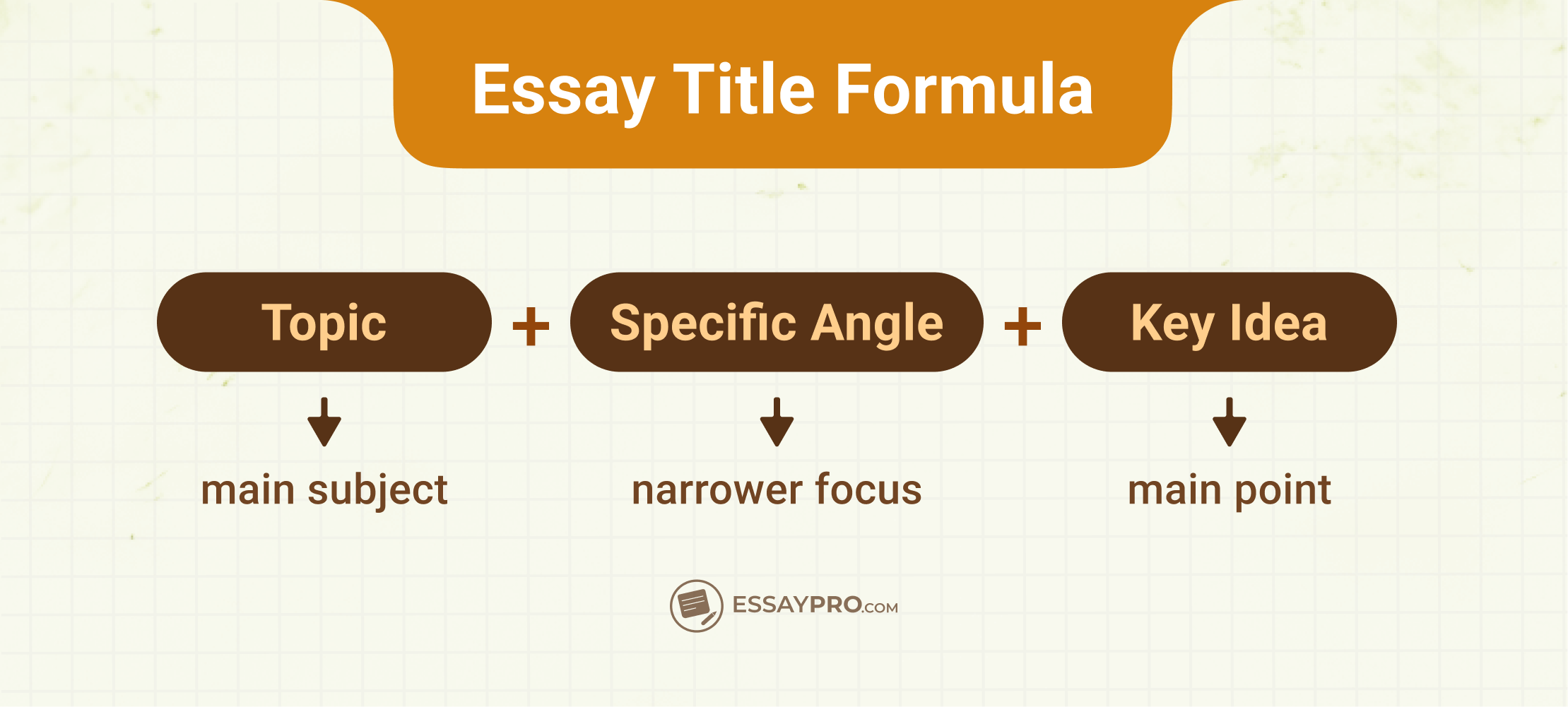
Let's look at the real examples. School Lunches. Overly broad, with the potential reader having no idea what the essay could possibly be about. Now think about Why Short Lunch Periods Hurt Student Focus. This one names the issue, and additionally, a specific angle that points toward the main claim.
The same process is applied to any topic in any subject. If your paper is about school uniforms, ask what part of the issue you discuss. Cost? Discipline? Student identity? Then write a title that hints at that.
I do fully understand if this sounds like too much work, and if you'd rather have a professional handle it, you can always use EssayPro to buy essay online.
How to Come up with a Title for an Essay?
To write the title of an essay, look at your thesis, the repeated keywords in your body paragraphs, and the type of paper you are writing. Then choose a structure that fits the job: a two-part title, a question, a keyword-based title, or a short quote with a clear subtitle.
Use a Two-Part Title With a Colon
I have often used two-part titles when I wanted the heading to explain the topic clearly but still sound engaging. In this format, you use the first part to introduce the main idea. The part after the colon narrows down the scope to the exact focus of the paper.
Weak: Plagiarism in College
Better: Borrowed Voices: Plagiarism and Academic Pressure in College Writing
Pro tip: Cover the first part of the title and read the words after the colon only. If it does not explain the paper’s focus, rewrite that part first.
Turn the Main Idea into a Question
The question title, I've found, works when the essay answers a real problem. The question should be specific enough to guide the reader toward your argument. Broad questions usually sound weak because they point to nowhere useful.
Write the question your essay answers, then remove extra words. Make sure the title matches your thesis and does not promise a topic your paper barely covers.
Too broad: Is Education Fair?
Stronger: Should Schools Replace Letter Grades with Written Feedback?
A strong heading gives readers a clear issue so they know the essay will discuss grading and feedback, not education in general.
Build the Title Around Keywords
A keyword-based title is often the safest choice for academic writing. It helps readers understand the subject right away, especially in research papers or formal assignments.
Look at your thesis, assignment prompt, and topic sentences. Find the words that repeat because those usually show the real focus. Then combine one broad term with one specific angle.
Title formula: Broad topic + specific issue + group, place, or context
Example: Food Deserts and Public Health in Low-Income Urban Communities
This is an example of an essay title built around clear keywords. It names the topic, the field, and the group discussed in the paper.
Use a Short Quote With a Clear Subtitle
A quote-based title can work for literature papers, history essays, and personal essays. The quote should come from a text, speech, interview, or moment that matters in the paper. Do not choose a line only because it sounds elegant.
Pick a short phrase that connects directly to your argument. Then add a subtitle that explains the topic in plain language.
Weak: A Room of One’s Own
Better: 'A Room of One’s Own': Space and Female Independence in Woolf’s Essays
The better version works because the quoted phrase is connected to the source, and the subtitle tells readers what the paper will examine.
Pro tip: A quote title needs a subtitle unless the quote already makes the essay’s subject clear. Most of the time, it does not.
Essay Title Examples
Good titles are clear before they try to be clever. They give readers the subject, hint at the angle, and match the tone of the assignment. Strong title ideas for essays are usually specific enough that they could belong to one paper only. A title about ‘nature’ says almost nothing. A title about abandoned orchards, city heat, or family recipes already gives the reader a sharper preview.
Analytical Essay
- Salt, Silence, and Survival in Coastal Fishing Villages
- How Abandoned Shopping Malls Reflect Changing American Habits
- The Symbolic Role of Weather in Southern Gothic Fiction
- Ritual and Power in Traditional Wedding Ceremonies
- The Hidden Logic Behind Museum Exhibit Design
Argumentative Essay
- Why Cities Should Protect Old Markets Instead of Replacing Them
- The Case for Limiting Cruise Ships in Historic Coastal Towns
- Why Food Labels Should Include Farm Labor Conditions
- Public Parks Need Stronger Protection Against Private Development
- Why Fast Fashion Brands Should Pay for Textile Waste
Persuasive Essay
- Local Bakeries Deserve a Place in Modern Neighborhood Planning
- Cities Should Turn Empty Office Buildings into Housing
- We Should Stop Treating Repair as a Lost Skill
- Every Town Needs More Public Benches
- Farmers’ Markets Should Accept More Local Food Assistance Programs
College Application Essay
- The Day I Fixed a Broken Radio
- What Beekeeping Taught Me About Patience
- A Map of Every Place My Family Has Cooked Dinner
- The Red Notebook I Carried Through Three Summers
- How One Rainy Market Day Changed My Plans
Compare and Contrast Essay
- Handmade Bread and Factory Bread as Stories of Time
- Street Markets and Supermarkets in Everyday Community Life
- Old Train Stations and Modern Airports as Public Spaces
- Printed Cookbooks and Recipe Apps in Family Kitchens
- Small Farms and Rooftop Gardens in Urban Food Culture
Essay Title Capitalization Rules
Most essay titles use title case, which means you capitalize the first word, the last word, and all major words in the title. Major words include nouns, verbs, adjectives, adverbs, pronouns, and longer prepositions. Short function words usually stay lowercase unless they appear at the beginning or end.
For example, The Cost of Silence in Family Businesses uses capital letters for the main words, while of and in stay lowercase.
In title case, these words usually stay lowercase:
- Short prepositions: in, on, at, by, for, of, to, with
- Articles: a, an, the
- Coordinating conjunctions: and, but, or, nor, for, so, yet
Style guides can vary slightly, especially with longer prepositions. If your teacher asks for MLA, APA, or Chicago, follow that format first.
What to Avoid When Titling Essays
A weak title usually fails in one of two ways: it says too little or tries too hard. Titles like My Essay, Technology, or Climate Change are too broad because they do not show the paper’s angle. A title should tell readers what part of the subject you discuss.
Avoid dramatic wording that the essay cannot support. The Truth About Human Nature sounds huge, and most class papers cannot cover it. Also, skip jokes, slang, random quotes, and long titles packed with extra phrases. If the title needs a full sentence to make sense, tighten it.
The safest test is simple: your title should match the paper you actually wrote.
If you're about to run out of time or energy, you can always get on EssayPro and ask us, 'Write my essay for me.'

Essays Due Soon?
Hand the hard part to expert sand get back a polished, ready-to-submit paper on time!
Final Thoughts
A good essay title gives readers the subject, the focus, and the tone before the introduction begins. The best titles are specific, accurate, and formatted correctly. Start with the main idea, narrow the angle, check the required style guide, and remove anything vague or decorative. A title should make the paper feel intentional before the first paragraph starts.
FAQs
What Is an Essay Title?
What Is a Good Title for an Essay?
How to Write a Title in an Essay?
Should I Capitalize Words Like 'the' or 'of' in My Title?
Should My Essay Title Be in Quotation Marks or Bold?

Daniel Parker
is a seasoned educational writer focusing on scholarship guidance, research papers, and various forms of academic essays including reflective and narrative essays. His expertise also extends to detailed case studies. A scholar with a background in English Literature and Education, Daniel’s work on EssayPro blog aims to support students in achieving academic excellence and securing scholarships. His hobbies include reading classic literature and participating in academic forums.
%20(1).webp)
.webp)
.webp)