
An informative essay is a structured academic paper that explains a topic clearly through facts, evidence, and neutral analysis. If you want to learn how to write an informative essay, the process starts with one simple question: what does the reader need to understand by the end? After that, the work becomes more manageable.
Quick writing process:
- Topic Selection: Choose a focused subject with enough reliable material.
- Source Gathering: Collect credible books, articles, studies, or academic sources.
- Outline Compilation: Place your main ideas in a clear order.
- Objective Drafting: Explain the topic without turning the paper into an opinion piece.
This article walks through the structure, writing steps, examples, and an informative essay sample that shows how the pieces fit together.
What Is an Informative Essay?
An informative essay is a factual, organized, and clear explanation of a specific topic. The writer uses definitions, background information, examples, evidence, and context to help the reader better understand the topic. The goal of an informative essay is to educate the reader about the topic objectively, without opinions.
Professors ask students to complete an informative essay because they want to see how well students can handle information. Can you gather accurate information? Can you differentiate between a quality source and a poor source? Can you clearly communicate an idea without random facts? These are skills that will be valuable in all areas of study, not just in writing.
The purpose of an informative paper differs from other types of writing. Persuasive writing, for example, tries to convince the reader of something, argumentative supports a particular view, and narrative writing creates a meaning through a story. An informative essay, on the other hand, simply aims to teach. Take a look at a quick cheat-sheet for different types of papers:
Characteristics of Informative Essay
A strong informative essay gives the reader a controlled explanation of a subject. It avoids dramatic claims and padded wording. Each paragraph should answer a clear question about the topic, and each source should explain something specific.
- Clear Topic Focus: The essay stays centered on one defined subject instead of drifting into side issues.
- Neutral Explanation: The writer presents information fairly and avoids language that sounds argumentative.
- Relevant Evidence: Each source should clarify the topic and support the paragraph’s main idea.
- Organized Paragraph Logic: Every paragraph should develop one point that connects clearly to the thesis.
- Precise Academic Language: The wording should stay specific, readable, and useful for the reader.


Overwhelmed by Informative Essay?
Our experts will write a flawless, unbiased paper for you.
The Standard Informative Essay Outline
The structure of an informative essay usually follows the traditional five-paragraph format: one introduction, three body paragraphs, and one conclusion. Each section should answer a different need: What is the topic? What does the reader need to know? What should the reader remember? Let's walk through the whole process of writing an informative essay outline.
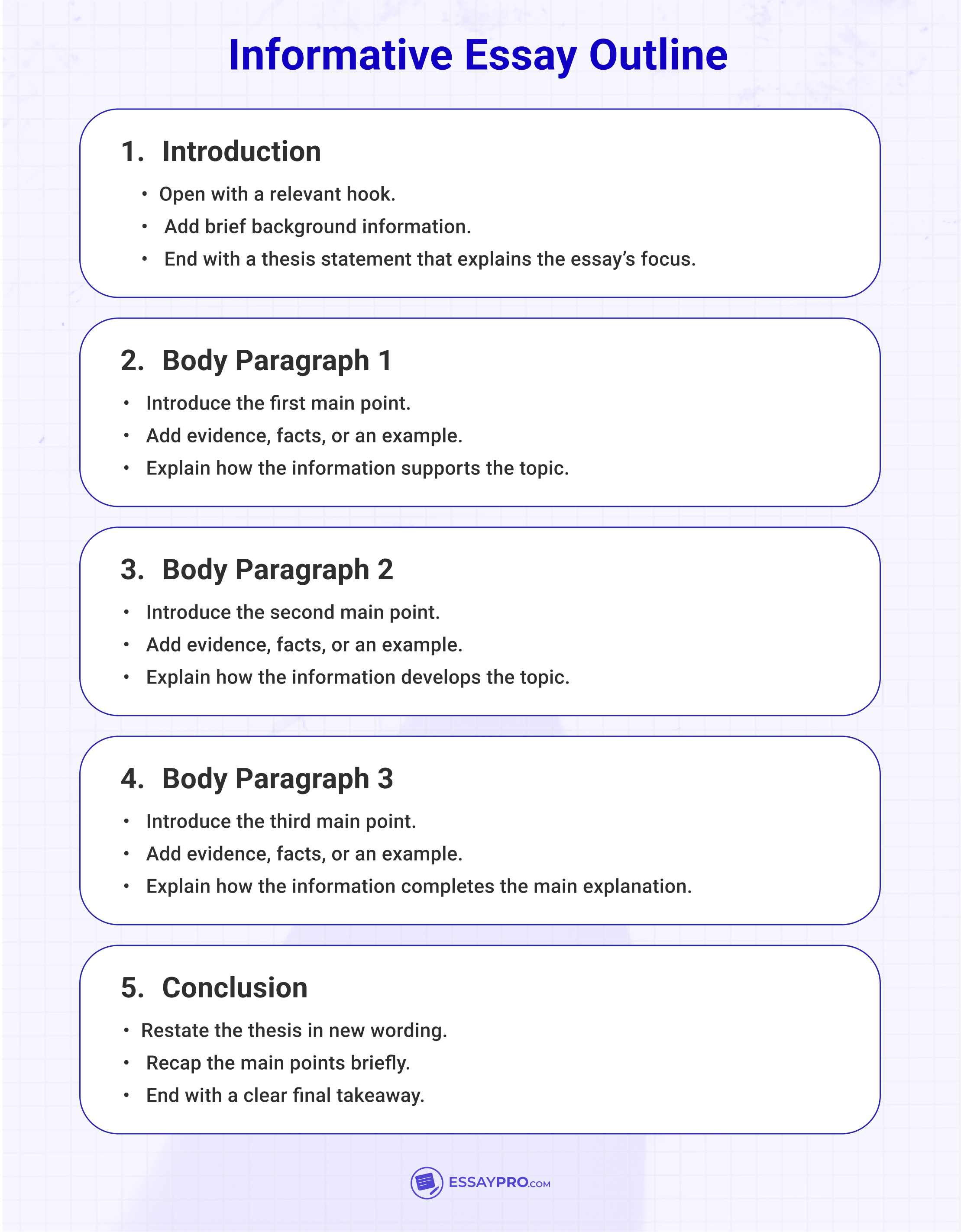
I. Introduction
The first way to get a reader to care about and understand the topic is through the introduction of an informative essay. It should be straight to the point, use an interesting hook at the start, provide context, and hint at the direction. Here's a look at closer details of how to start an essay:
- Hook: The first sentence must be something engaging (a relevant fact, quote, or observation), and persuade them to continue reading. Not everything that is interesting will apply to the topic, so keep this in mind and keep the hook relevant.
- Background: Give the reader some context for the essay and define the included terms.
- Thesis Statement: The thesis statement should be the last sentence of the introduction and should state what is being explained in this essay.
II. Body
The body paragraphs of an informative essay carry the real purpose of the paper. Each paragraph should develop one idea with supporting evidence. The reader should not leave the essay wondering how one piece of evidence connects to the others and how all of those connect back to the thesis.
- Topic Sentence: These clearly tell the reader what the following paragraph will be about/
- Evidence: Evidence to support the topic would include facts, examples, data points, definitions and/or expert opinions, etc. You must use reliable sources when you are writing an academic essay.
- Explanation: You must explain the meaning and the purpose of your evidence and clarify to your reader how it is related to your subject.
- Transition: Each paragraph must include a transition to allow the reader to move on to the next paragraph. All transitions must be simple and logical.
III. Conclusion
In the conclusion of an informative essay, the information explained in the entire paper must be summarized, along with its significance. The conclusion should not leave the reader with the idea that there was no space to address all of the information provided.
- Restated Thesis: The original thesis must be restated using different words.
- Main Point Review: Briefly recap the key ideas covered in the body paragraphs. Keep this short and purposeful.
- Final Thought: Leave the reader with a clear takeaway. This can be a broader insight, a practical implication, or a simple statement about the topic’s importance.
How to Write an Informative Essay Step by Step
Learning how to write an informative essay becomes easier when you treat the paper as a careful explanation. The process starts with a focused topic, moves through research and outlining, and ends with revision, proofreading, and citations. Each step helps the reader understand the subject without opinion taking over.
Step 1: Select a Neutral Topic
The topic of an informative essay should be something clearly explainable, without asking you to provide a debate prompt; Also, the topic should have sufficient and credible information available for you to research.
Select unbiased informative essay ideas that can be narrowed down into a process, issue, event, method, or concept. For example, the topic "Remote Patient Monitoring in Elderly Care" gives you a clearer choice than "Health Care".
It is essential first to identify the subject, identify the specific direction for your essay, and verify that there is enough credible data to support your work; after, create a working focus sentence.
Example: This essay explains how remote patient monitoring helps healthcare providers track chronic conditions in elderly patients.
Step 2: Research the Topic Carefully
An informative essay must present factual evidence. Therefore, before you write, you need to know what the topic means, which terms matter, and what evidence can explain it well. That does not mean collecting random quotes. It means finding information that actually helps the reader understand the subject.
Use academic articles, textbooks, government pages, reports, or sources your professor accepts. As you read, save definitions, dates, data, examples, and expert explanations. Keep the citation details with each note. That small habit prevents a messy scramble later.
For example, if your topic is remote patient monitoring, useful notes might include a definition of the technology, common devices used in care, and one study showing how monitoring affects hospital visits.
Step 3: Create an Informative Essay Outline
The informative essay format usually includes an introduction, body paragraphs, and a conclusion. The outline helps you decide what each part will do before you start drafting. Without that plan, many essays repeat the same idea in different words.
Begin with your working thesis. Then choose the main points that will explain the topic in a logical order. Each body paragraph should cover one part of the explanation. Do not place every interesting fact into the outline. Choose details that serve the topic.
A basic outline might look like this:
- Introduction: Define remote patient monitoring and present the main focus.
- Body Paragraph 1: Explain how the technology works.
- Body Paragraph 2: Describe its use in chronic condition management.
- Body Paragraph 3: Discuss benefits and practical limits.
- Conclusion: Summarize what the reader should understand.
Step 4: Write the First Draft
When you begin writing an informative essay, follow the outline closely, but do not freeze over every sentence. The first draft should turn your plan into full paragraphs. At this stage, clarity matters more than style.
Start the introduction with a relevant opening sentence. Add enough background for the reader to understand the subject. End with a thesis that states what the essay will explain. In the body paragraphs, begin with a topic sentence, add evidence, and explain how that evidence connects to the main point.
A paragraph should not drop a statistic and move on. If you use a fact, explain what it shows. If you include an expert idea, explain how it helps the reader understand the topic.
Step 5: Edit for Focus and Flow
Editing is the process of checking the paper’s logic. Read each paragraph and ask what it adds. If a sentence repeats an earlier point, revise it or remove it. If a paragraph includes two separate ideas, split it or refocus it.
Check the thesis first. Then compare every body paragraph against it. The connection should be clear without extra explanation. After that, look at transitions. A transition should guide the reader into the next idea with normal language, not a forced phrase.
If you're thinking, "Who can edit my essay and improve its overall flow?", professional editing can help refine the structure, clarity, and wording of your draft.
Weak: “This is very important for many reasons.”
Better: “This matters because regular monitoring can help providers respond before symptoms become severe.”
Step 6: Proofread the Final Version
Proofreading comes after editing because sentence-level polish should happen once the structure is already in place. At this stage, check grammar, punctuation, spelling, word choice, and citation formatting. Read the draft slowly so you can spot repeated phrases and stiff sentences. Academic writing must be formal, but you must not lose authenticity and readability at any point. Pay attention to small errors around source use. A missing page number, an incorrect author name, or an unfinished reference entry can weaken an otherwise solid paper.
Step 7: Add Citations Correctly
Citations show where your information came from and help the reader trust the essay. They also protect your work from plagiarism. Use the required citation style, such as MLA, APA, or Chicago, and apply it consistently.
Add in-text citations after borrowed facts, statistics, quotations, and specific ideas. Then include the full source details on the works cited or reference page. Every in-text citation should match a final entry. That is not a decorative rule. It is part of the paper’s academic structure.
Informative Essay Example
A good informative essay example should show the topic clearly, explain each point in order, and keep the tone neutral. The writer should sound informed without pushing an opinion. For this sample, the topic is how urban tree canopies reduce heat in crowded neighborhoods, which gives the essay a specific, research-friendly focus.
[Introduction]
City heat does not spread evenly across every neighborhood. In crowded urban areas, streets with little shade often become much hotter than nearby blocks with more trees. This difference affects sidewalks, parked cars, apartment buildings, and the people who move through those spaces each day. Urban tree canopies help reduce this heat by blocking sunlight, cooling the air through leaf moisture, and lowering the temperature of nearby surfaces. Understanding how tree cover works helps explain why some city streets feel more livable during hot months.
[Body Paragraph 1]
The first way urban tree canopies reduce heat is through shade. Tree branches and leaves block direct sunlight before it reaches pavement, walls, benches, and vehicles. This matters because asphalt and concrete absorb heat quickly during the day. Once those surfaces grow hot, they release warmth back into the air for hours. A shaded sidewalk usually stays more comfortable because less sunlight reaches the ground in the first place. In neighborhoods with long rows of mature trees, people can walk, wait for buses, and sit outside with less exposure to intense surface heat.
[Body Paragraph 2]
Trees also cool the air through a natural process called transpiration. During transpiration, leaves release water vapor into the air. This process helps lower surrounding temperatures in a way that feels similar to light cooling after a brief summer rain. The effect may seem small around one tree, yet several blocks of tree cover can make a noticeable difference. This is one reason urban planners often study tree canopy coverage when they look at heat risk. The cooling effect comes through daily biological activity, not mechanical equipment, which makes trees a practical part of city climate planning.
[Body Paragraph 3]
Tree canopies also affect buildings and energy use. When trees shade windows, roofs, and outer walls, less heat enters the structure. As a result, indoor spaces may stay cooler during the hottest part of the day. This can reduce the need for constant air conditioning, especially in older buildings with weak insulation. Tree placement matters here. A tree near a blank wall may help, but a tree that shades a sun-exposed window can have a stronger effect. In this way, urban greenery becomes part of how neighborhoods manage heat inside and outside the home.
[Conclusion]
Urban tree canopies reduce heat through shade, transpiration, and building protection. Their value becomes clearest in dense neighborhoods where pavement, traffic, and closely packed buildings raise temperatures during summer. Trees cannot solve every heat problem in a city, yet they give neighborhoods a measurable way to make streets and homes more comfortable. A strong informative essay explains this kind of topic by moving through the evidence step by step, so the reader finishes with a clear understanding instead of a pushed opinion.
By the way, if you're in the exhausting process of applying to colleges, you can use our admission essay writing service and impress the committee.
Informative Essay Writing Tips
To do well on an informative essay, each paragraph should serve a distinct purpose. If you do so, the reader will have a better understanding of the topic when finished. To write well, you must maintain a clean structure throughout the paper and use high-quality evidence to prove everything you say.
- Make the thesis state the exact explanation: It is important that the statement is descriptive of the essay's content. E.g.: This essay describes how trees located in urban areas help to cool neighborhoods by creating a canopy that provides shade and increases humidity.
- Separate definition, cause, effect, and example: The purpose of using clean separation is for the reader to easily understand the logic and, generally, the information being presented.
- Explain evidence immediately: When providing supporting evidence, immediately explain what it demonstrates and why the reader should pay attention to it.
- Use examples only when they add clarity: An example should make the idea easier to understand, not fill space.
Stuck on Your Informative Essay?
From source gathering to the final draft, get expert help at any stage of your essay.
Mistakes to Avoid in an Informative Essay
Weak informative essays tend to lose the flow of the information. Even if you have enough research and plenty of documented facts, without the right organization and explanation, your writing still won't hold up. Here are the most common mistakes students make and how you can fix them:
- Adding evidence before the point is clear: A paragraph should begin with the idea, then bring in evidence. Fix it by writing a direct topic sentence first.
- Using loaded language (obviously, terrible, best, must) in the essay. To make a point without bias, replace it with neutral language.
- Letting sources take over the paragraph: Lead with explanation, then use supporting evidence, then explain the importance of the evidence within the paragraph's context.
- Repeating the introduction in the conclusion: The conclusion of an informative essay should recap the main point, along with what you want the reader to remember.
And keep in mind that if the writing/editing/proofreading processes ever get too overwhelming, order essay from EssayPro and take a break.
Final Thoughts
Informative essay writing works best when the paper stays focused on explanation. The topic should be clear, the research should come from reliable sources, and the outline should give each section a real purpose. The introduction sets up the subject, the body paragraphs explain the main points with evidence, and the conclusion brings the information together without adding a new argument. A strong informative essay does not try to impress the reader with heavy language. It explains the subject carefully, uses examples where they help, and keeps opinion out of the way.
FAQs
How to Structure an Informative Essay?
How to Start an Informative Essay?
What Does an Informative Essay Look Like?
How Do You Write an Informative Essay?
How to Write a Conclusion Paragraph for an Informative Essay?

Adam Jason
is an expert in nursing and healthcare, with a strong background in history, law, and literature. Holding advanced degrees in nursing and public health, his analytical approach and comprehensive knowledge help students navigate complex topics. On EssayPro blog, Adam provides insightful articles on everything from historical analysis to the intricacies of healthcare policies. In his downtime, he enjoys historical documentaries and volunteering at local clinics.

.webp)