
Key Takeaways
- A term paper argues a specific thesis supported by credible research, not a summary of what others have said.
- Narrow the topic before starting. A focused question produces a focused paper.
- Write body sections before the introduction. The argument shapes the opening, not the other way around.
- Evidence without analysis is just description. Explain what each source means for the argument.
- Revise for structure first, then proofread. Doing both at once means neither gets done properly.
A term paper is a lengthy research-based academic assignment that makes up a large percentage of your course grade, which you submit at the end of the semester. You will be writing a term paper to demonstrate how well you can independently research a topic, develop an argument around that topic, and express what you’ve learned using proper organization in an academic format.
In this article, we explain what a strong term paper is, how to properly format it, how to write a term paper step by step, some mistakes you should avoid, and examples to help you before you begin writing your own.
What Is a Term Paper?
A term paper is an academic assignment that asks students to research a topic extensively, formulate an argument, and support their ideas using credible evidence from various sources. Term papers require continued research and formal writing.
Good term papers have one simple objective: they evaluate if a student can work with scholarly sources without assistance. Can they develop an argument over the course of a long research paper? And can they convey their findings in clear language using a formal structure?
How long is term paper?
Term papers typically range from 1500-5000 words, depending on the class and teacher. Those in graduate school will likely see longer papers.

Essays Due Soon?
Hand the hard part to expert sand get back a polished, ready-to-submit paper on time!

Planning Your Term Paper
Properly planning out your paper will save you considerably more time than most people think. Below is everything you need to go from selecting your topic to creating a working outline before you start writing a solid term paper. If you follow these steps in sequence, your time at the drafting stage should be smooth.
Step 1: Choose and Narrow Your Topic
Begin with the assignment prompt and make a note of the limits of the topic you are being asked to write about. Then select a particular aspect of that topic instead of a general idea. Here’s an example:
Broad: "Antibiotic resistance"
Narrow: "How overprescription of broad-spectrum antibiotics in outpatient settings contributed to MRSA rates in the UK between 2015 and 2022"
Step 2: Do Some Preliminary Research
Spend about an hour researching to verify that enough information will be available to you to write the paper, and that someone hasn’t already done the same topic to the point that you cannot add to the conversation.
Step 3: Write Your Working Thesis
Compose a one or two-sentence thesis statement that succinctly sums up what your paper will argue. This can be refined later, but it should lay out your paper’s main argument clearly. Example of a working thesis vs a final one:
Working: "Carbon pricing has failed to reduce EU industrial emissions because companies can afford to pay the penalties."
Refined after research: "EU carbon pricing policies have underperformed emissions targets primarily due to permit over-allocation and exemptions granted to energy-intensive industries between 2018 and 2024."
Step 4: Create An Outline
Map out all of your paper’s main sections. Jot down what points each body will cover, which sources will be used to back up those points and verify that there is a logical flow to your paper as it progresses through each section.
Does your outline follow the standard format? Introduction, Background/previous research sections, Main Argument sections, Counterargument(if necessary) and Conclusion? If so, make sure each point you plan on making links back to your thesis.
Term Paper Format
Before diving in headfirst to writing, it’s useful to know what the finished product should look like. Term paper format guidelines: papers generally conform to either APA, MLA, or Chicago style formats, but always double-check the assignment instructions, as getting this wrong can mean a lot of extra work at the end.
- Font – Times New Roman or Arial
- Size – 12pt
- Spacing – Double
- Margins – 1 inch (all sides)
- Page Numbers – Top right corner
- Title Page – Contains title and details about the student and course. Included in most formatting styles.
- Headers – Used to denote different sections for longer papers.
- References / Works Cited page – All sources cited within the text should be listed here.
- In-text citations – formatting varies by style guide.
Term Paper Structure
Regardless of discipline, the structure of a term paper is similar. Some sections may be expanded upon while others may be omitted completely, depending on the topic you’re writing about and how many words you’re required to write.
Title Page
The Title page includes the title of your paper, your name, the course name, the instructor's name, the institution, and the date it’s due. Formatting will differ depending on the citation style you’re using.
Abstract
A summary of the paper, ranging from 150 to 250 words. The Abstract will briefly cover the research question, methodology, key findings, and conclusion. Some classes require this, but many at the undergraduate level do not. Check if you need one.
Introduction
The introduction will introduce the topic you’ve selected. Give enough background information so that your reader can understand the argument you’re about to present. Finish the section with a concise thesis statement.
Literature Review
A summary of current research directly related to your topic. This section demonstrates what is already known about your subject, where gaps in knowledge exist, and how your paper fits amongst the existing body of research.
Methodology
This includes details on how you collected and analyzed data for empirical papers. For argumentative or analytical papers, this will detail your approach to gathering information and assessing its credibility.
Body / Main Argument
The body of your paper will contain several sections, each focusing on a primary point that supports your thesis. Evidence and analysis are used to expand on each point. Avoid having your argument jump around from point to point.
Conclusion
Restate your thesis, taking into account what was discovered in your paper. Summarise your key findings. Finish with a closing statement that addresses the larger implications of your research.
References
A list of all works cited in your paper.
If you are short on time, you can also buy term paper support tailored to your subject and requirements.
How to Write a Term Paper?
Writing your term paper can be simple when you approach it as a series of small tasks, rather than one huge chunk of text looming between you and a deadline. Below is everything you need to know, starting with the first draft and finishing with handing it in.
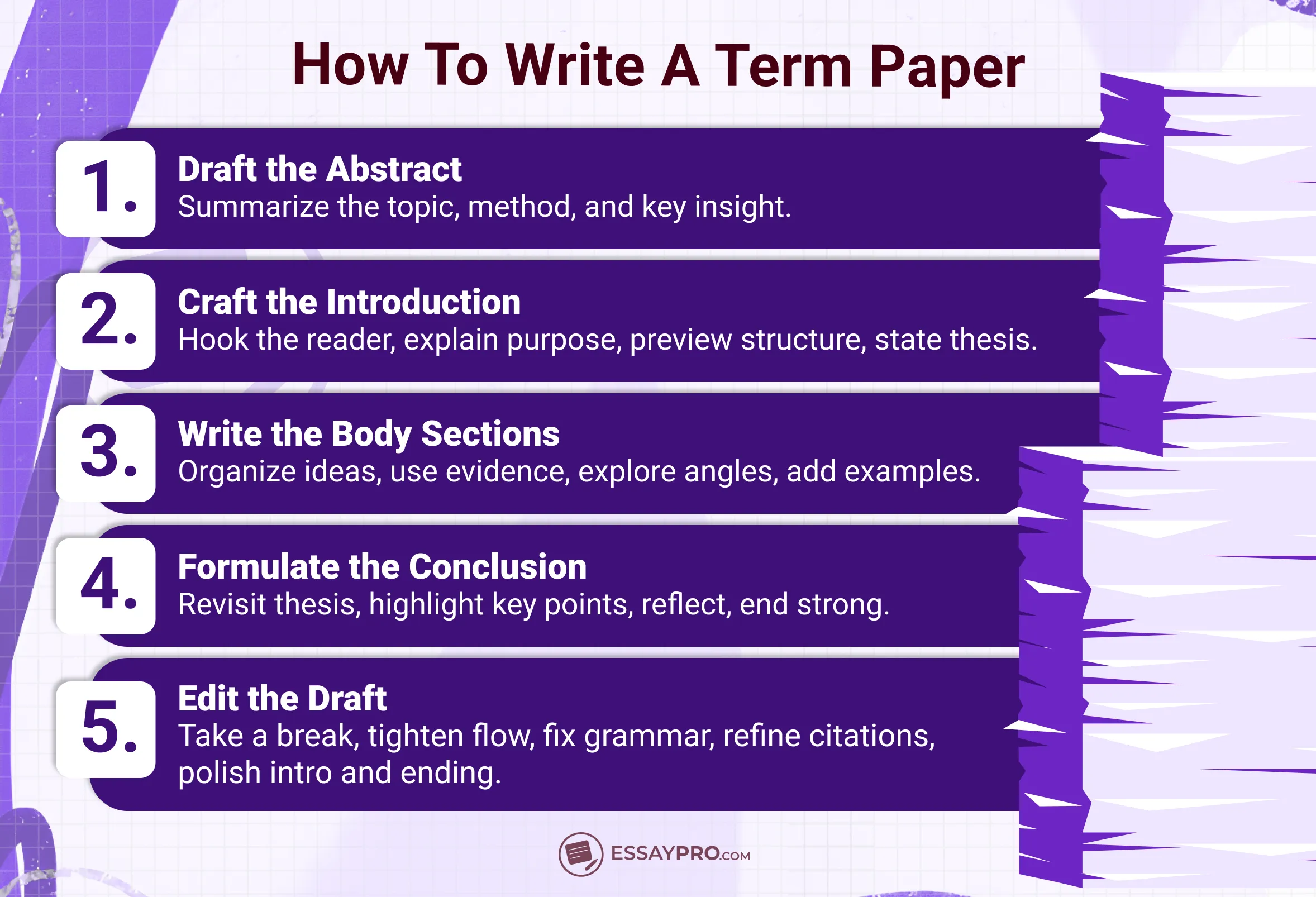
1. Begin with the outline, not the introduction
Most students open a blank document and try to write the introduction first. The problem is, those introductions tend to be vague and unfocused. That’s because students try to write them before the argument of the paper is developed. Draft the outline first. Map out the main sections, jot down what each will cover and argue, and ensure that everything flows logically before writing your first paragraph.
2. Write the body sections before the intro/conclusion
After completing your outline, write the body sections before writing the introduction or conclusion. Start each section with a clear topic sentence outlining the main point, follow it with supporting evidence from your sources, and then explain what that evidence means for your argument.
Example: One of the major flaws of carbon pricing as implemented to date has been the inconsistent application across industrial sectors. …
Follow the example sentence with a citation, then add an explanation in your own words about why that fact/data proves or supports the point you’re making in the topic sentence. Let your analysis do the work. Don’t expect your readers or instructor to interpret your evidence for you. The analysis is where you earn credit.
3. Write the introduction after the body
Writing the introduction is easy once the body of the paper is complete. You already know what your paper argues and how you got there. Open with something that sets the stage for your topic. Provide a brief overview of the debate. Finish with your thesis statement.
PRO TIP: Create a Venn diagram of your sources. Summarise each source in a sentence, then list ways they overlap and where they conflict. Building your Literature Review from the Venn diagram helps ensure you address how each article relates to others in the field and identify the gap your paper fills.
4. Draft the literature review
Summarise each of the paper’s key sources, then explain how they relate to the argument you are making. Don’t just summarise what the sources say. Synthesize how those sources connect to one another, where they agree, where they differ, and what gap your paper is filling.
5. Write the conclusion
Reword the thesis statement. Briefly summarize the major arguments made in your paper. Finish with a sentence on the broader significance of your results. Example: Unless carbon pricing initiatives are adapted to account for cross-sector variability… The conclusion should not feel like “oh, there’s more?” Imagine you are gently landing the reader back on the ground after they’ve been through your research. Don’t make them want to read the next paragraph.
6. Write the abstract last
Abstracts are between 150 and 250-word summaries of your paper. They include your research question, your approach, your findings, and your conclusion. Remember to write it at the end, so it actually reflects what is in your paper instead of what you planned to write in step 1.
7. Revise, then proofread
These are two separate things. Revision is making sure the paper flows, the argument makes sense, and each section is fulfilling its purpose. Proofreading is catching grammatical errors, fixing citations, and checking spelling. Both are essential, so do them separately.
Students managing multiple deadlines sometimes use term paper writing services for help with drafting and editing.
Term Paper Language
Language used in a term paper should remain formal and specific. Informal word choices, first-person opinion statements, and broad generalizations all dilute the scholarly voice needed for the format. Below is a list of common language scenarios in a term paper and sample phrases to use for each.
Term Paper Example
A strong term paper maintains its central argument from beginning to end. It develops its evidence methodically, presenting ideas one at a time rather than bouncing between them. It uses formal language consistently throughout. Every section has a clear role to play and connects to the sections before and after it. Below is a term paper sample of each individual section doing its job.
Title: Carbon Pricing in the European Union: Policy Design, Sectoral Exemptions, and the Limits of Market-Based Emissions Reduction
Abstract: This paper examines the effectiveness of carbon pricing as an emissions reduction tool within the European Union, with particular attention to the sectoral exemptions that limit its reach. Drawing on policy analysis and recent emissions data, the paper argues that inconsistent application across industries has significantly constrained the mechanism's overall impact. The findings suggest that without structural reform to address these exemptions, carbon pricing alone is unlikely to meet the EU's stated climate targets.
Introduction: Carbon pricing has been positioned as a central pillar of the European Union's climate strategy since the launch of the Emissions Trading System in 2005. The underlying logic is straightforward: by placing a cost on carbon emissions, the mechanism creates a financial incentive for industries to reduce their output. In practice, however, the relationship between pricing and emissions reduction has proven more complicated than the policy framework anticipated. This paper argues that sectoral exemptions embedded in the current design have significantly reduced the mechanism's effectiveness and that meaningful reform is needed before carbon pricing can deliver on its stated purpose.
Literature Review: Existing research on the EU Emissions Trading System has produced a mixed picture. Several studies have documented measurable reductions in covered sectors, particularly in power generation, where the pricing signal has consistently influenced investment decisions. Others have identified a persistent problem with over-allocation of permits in the early phases of the scheme, which suppressed the carbon price below the level needed to drive significant behavioral change. More recent scholarship has focused on the growing divergence between covered and non-covered sectors, with transport and agriculture in particular remaining largely outside the pricing mechanism despite accounting for a substantial share of total EU emissions.
Methodology: This paper draws on a combination of EU emissions data published between 2018 and 2024, policy documents from the European Commission, and peer-reviewed analysis of carbon pricing outcomes across comparable international schemes. The approach is analytical rather than empirical, evaluating the internal consistency of the policy framework against the available evidence on its outcomes.
Main Argument: The most significant structural limitation of the EU carbon pricing system is the partial coverage of the industrial sector. Energy-intensive industries, including steel, cement, and chemicals, have historically received a proportion of their permits free of charge rather than purchasing them through the market. This free allocation reduces the effective carbon cost faced by these industries and limits the financial incentive to invest in cleaner production processes. Data from the European Environment Agency shows that emissions reductions in fully covered sectors have consistently outpaced those in sectors benefiting from partial exemptions, suggesting that the pricing signal functions where it is applied but that its reach remains too narrow to drive economy-wide transformation.
Conclusion: The EU carbon pricing system has demonstrated that market-based mechanisms can drive meaningful emissions reductions when applied consistently and at a price level sufficient to influence investment decisions. The evidence reviewed in this paper suggests, however, that the current framework falls short of that standard in key sectors. Addressing the sectoral exemptions that limit the mechanism's reach is not a marginal adjustment. It is a prerequisite for carbon pricing to function as the policy instrument it was designed to be.
References: European Environment Agency. (2023). EU Emissions Trading System data viewer. EEA. European Commission. (2022). Fit for 55: delivering the EU's 2030 Climate Target on the way to climate neutrality. Publications Office of the EU. Narassimhan, E., et al. (2018). Carbon pricing in practice: A review of existing emissions trading systems. Climate Policy, 18(8), 967–991.
Sources for a Term Paper
The strength of your term paper is determined by the strength of your sources. Scholarly journal articles, academic books, and government/institution publications are all excellent sources. Check out ProQuest and Google Scholar, for example.
Wikipedia and general website entries are not accepted as course sources, but they can be useful for getting you started. For most classes, teachers will expect you to use at least 5-8 quality sources, depending on your paper’s length. Consult the assignment guidelines for details and be sure that every source you mention in your paper is included in your reference list.
Criteria Professors Use to Grade Term Papers
Every school has different requirements, but most teachers are looking at the same things when they grade your term paper:
- Thesis and Argument: Is your thesis statement clear, concise, and argued consistently throughout your paper
- Research: Are your sources credible? Are they relevant to your topic? Are you integrating them into your paper, not just quoting them?
- Organization: Does your paper flow? Do you have a strong intro and conclusion?
- Analysis: Do you tell your reader what your evidence means?
- Formatting: Did you format your paper consistently with the assigned style guide
- Writing Quality: Is your paper written in a formal tone? Is your writing precise? Are there any grammatical errors?
6 Term Paper Mistakes to Avoid
The vast majority of issues seen while writing term papers result from students making the same mistakes. Look out for these before you hand yours in:
- Procrastination. You can’t produce a term paper in one week. Researching your topic and producing multiple drafts should be an ongoing activity. Papers written at the last minute are guaranteed to exhibit the panic in which they were created.
- Overly broad thesis. If your main argument is suitable for any paper about your topic, you should refine it further.
- Failure to analyze your sources. Stating what your source says is not analysis. Analysis is explaining what that source says about your argument.
- Inaccurate referencing. Using inconsistent citation styles or forgetting references on your reference list loses you easy marks.
- Ignoring the literature review. Eliminating or skimping on this section of your paper shows you haven’t properly engaged with your research.
- Writing your introduction too early. You won’t have a fully formed argument until you’ve finished writing. The introduction will show that if you try to write it first.
Every strong paper starts with a focused thesis statement that clearly defines the main argument or purpose.
Must-Do Checklist
Work through this before submitting:
- The thesis is specific, arguable, and presented in the introduction.
- Each body section opens with a clear topic sentence connected to the thesis.
- Every claim is supported by a cited source.
- Evidence is followed by analysis rather than just being presented.
- The literature review engages with existing research rather than just describing it.
- The conclusion restates the thesis without copying it and closes with a purpose.
- All in-text citations match the reference list exactly.
- The formatting follows the required citation style throughout
- The abstract accurately reflects what the paper contains.
- The paper has been revised for argument and structure before being proofread for errors.
Working with an experienced essay writer can help improve organization, clarity, and academic formatting.
Essays Due Soon?
Hand the hard part to expert sand get back a polished, ready-to-submit paper on time!
Final Words
Remember, you do not write a good term paper in one sitting. Follow an outline, brainstorm before you start, and edit correctly. Students who do these three things will find that they are happy with their work. And meanwhile don’t forget to check out our list of dissertation topics to find inspiration for your paper.
FAQs
How Long Should a Term Paper Be?
How to Start a Term Paper?
How to Write a Term Paper Outline?
How to Format a Term Paper?
How Do You Write a Term Paper?

Sopho Miller
is an experienced content writer who specializes in digital marketing, business, and academic topics. With a Master’s degree in Digital Marketing, she combines her expertise with a practical approach to create clear, engaging, and educational content. She crafts detailed guides and resources that support students in their academic journey. Outside of work, Sopho stays current with the latest industry trends and regularly attends workshops to further sharpen her skills.