

Academic research papers often feel difficult because students stall between steps. They choose a topic but are not sure if it is workable, or they can't tell when the preliminary research is enough after they gather some sources.
This guide breaks down the exact steps to write a research paper into manageable tasks, so each decision from topic choice to final revision leads directly to the next. A research paper is an academic assignment built around a question, a body of sources, and your own judgment. If you’re learning how to write a research paper, the first thing to understand is the kind of thinking it asks for. A regular essay may grow out of your opinion or a close reading. A research paper needs investigation. You read, compare, question, sort evidence, and build a claim that can stand up under pressure. That takes planning, source evaluation, notes, structure, citation, and revision.
This article walks through the process: definition, first steps, outline, drafting, and practical tips.
What Is a Research Paper?
A research paper is a structured academic work that answers focused research question with evidence. The purpose of a research paper is to show that you can examine a topic carefully, use credible sources, and explain what those sources reveal. Any research paper needs a clear point, a logical path, and analysis that connects the evidence back to your main idea.
A regular essay often explains what you think about a topic. A research paper asks you to investigate the topic first, then build a claim based on evidence.
The main characteristics of a research paper are:
- Focused research question: the paper answers a specific question, not a broad subject.
- Credible outside sources: the argument depends on academic, professional, or reliable published material.
- Clear thesis: the paper makes a main claim based on the research.
- Evidence-based analysis: each major point connects facts, data, examples, or expert views to the thesis.
- Formal structure: the paper usually includes an introduction, body sections, conclusion, and citations.
- Source documentation: every borrowed idea needs proper citation in the required style.
Write With Support
Turn research notes into a clear academic draft with help at every difficult stage.

How to Start a Research Paper?
The first steps of writing a research paper are mostly about narrowing the work before drafting begins. You may not have a strong argument yet, and that is fine. At the start, your job is to find a topic that can support a real paper.
- Review the Assignment Requirements: Begin with the assignment sheet. Note the required length, citation style, source count, deadline, topic limits, and formatting rules. These details affect almost every later choice, especially how much evidence you need and how detailed your outline should be.
- Choose a Researchable Topic: Next, choose a topic with enough available research. A huge topic will push you into a vague summary. A very narrow topic can leave you with weak sources or repeated evidence.
- Conduct Background Reading: Then do background reading of library databases, government pages, academic journals, and reputable publications. At this stage, look for repeated terms, major debates, common causes, useful statistics, and gaps in the discussion.
- Develop a Research Question: After that, turn the topic into a research question. A good question tells you what to investigate, which sources matter, and what your thesis will eventually need to answer.
Why Choosing the Right Topic Is Important?
Your topic decides what sources you can use, what question your paper answers, and how specific your thesis can be. If the topic is too broad, the paper turns into a summary. If it is too narrow, you may not find enough evidence.
Strong research topics for college students are easily developed into a clear research question and allow you to gather enough credible sources you can later analyse. The following steps, such as drafting a thesis and planning body paragraphs become easier afterward.
How to Conduct the Study for Your Research Paper?
The research process turns a broad idea into usable material for a paper. Before writing your research paper, you need to understand the topic, choose reliable sources, record the details you may cite, and sort everything into clear groups. This work keeps the draft focused instead of chaotic.
Understand the Topic
Start with basic context. Read a few reliable overview sources so you know the main terms, debates, dates, people, theories, or problems connected to the subject. At this stage, you are not collecting every quote you see. You are building enough background knowledge to avoid shallow claims.
Pay attention to repeated ideas. If several sources mention the same issue, it may become part of your paper. If one source raises a question that others ignore, that may give you a more original angle. Good research starts with noticing what keeps coming back.
Choose Reliable Sources
Once you understand the topic, look for sources that can actually support an academic argument. Use library databases, scholarly articles, books, government reports, reputable news analysis, and professional organizations. A random blog post may help you understand a term, but it should rarely carry the weight of your evidence.
Check who wrote the source, where it was published, when it appeared, and what kind of evidence it uses. A strong source has authority, clear reasoning, and enough detail to help you say something specific. Keep a mix of sources if the assignment allows it. One article may give data, another may explain context, and another may offer expert interpretation.
Record Key Details
Research gets messy fast if you trust your memory. Save citation details as soon as you find a useful source. Write down the author, title, publication, date, page number, URL or DOI, and the citation style your teacher requires.
Take notes in your own words. When you copy exact wording, place it in quotation marks immediately so you do not confuse it with your own phrasing later. Also, note why each piece of information matters. A quote without a purpose becomes clutter. A note with a clear use can become evidence in a body paragraph.
Organize the Research
After you collect enough material, sort your notes by idea rather than by source. Group evidence under possible body paragraph topics, such as background, causes, effects, arguments, limitations, or solutions. This helps you see what your paper can actually prove.
Look for gaps as well. Maybe you have five sources for one point and almost nothing for another. That tells you where to research more or where to narrow the claim. Organization is the point where scattered notes begin to act like a paper.
How to Write a Research Paper Outline and Thesis?
A strong paper usually becomes easier once the outline and thesis are clear. These two parts work together. The thesis states the paper’s main claim. The outline gives that claim a structure strong enough to carry evidence without collapsing into repetition or random source summaries halfway through the draft.
A thesis is the central argument of the paper, stated in one or two sentences. It tells the reader what you are arguing and what kind of evidence the paper will use to support that argument.
Start with your research question. Then ask yourself what conclusion the evidence keeps pointing toward. That conclusion becomes the basis of the thesis. A useful thesis usually includes:
- the specific subject
- the main argument
- the reason the argument matters
- the main points the paper will examine
Bad thesis example: Grocery store layouts influence shoppers.
Why: This sounds more like a topic than an argument. It tells the reader the paper will discuss grocery store layouts, yet it never explains what about those layouts matters. A writer could wander into pricing, music, refrigeration design, shopping carts, or customer demographics without ever leaving the thesis behind.
Good thesis example: Grocery stores place staple items such as milk and eggs deep inside the store to increase aisle exposure, encourage impulse purchases, and turn routine shopping into a longer buying path.
Why: The second thesis gives the research a job. It explains the strategy behind the layout and points toward the kind of evidence the paper should include, such as customer movement patterns, retail psychology, and impulse buying data. The reader already understands what the body paragraphs will need to prove.
An outline for a research paper helps you organize evidence before drafting full paragraphs. Without an outline, many papers start repeating points, dropping random quotes into sections, or drifting away from the thesis after page two. The outline prevents that slow slide into chaos.
Start by placing the thesis at the top. Then break the paper into major sections. Each body section should support one part of the thesis. Under each section, add:
- the main point of the paragraph
- supporting evidence
- source references
- analysis or explanation you plan to include
Do not treat the outline like a prison wall because it can change at any point during drafting. The outline exists to keep the paper readable while your ideas evolve. And while you're at it, you will need to learn how to make abstract in research paper soon enough, so it's better to start now.
Topic: Why grocery stores place essential items deep inside the store
I. Introduction
- Brief context on grocery store layout
- Research question about shopper movement and product placement
- Thesis statement on how store design shapes buying behavior
II. Store Layout and Customer Movement
- Placement of milk, bread, and eggs away from entrances
- How longer walking paths increase product exposure
- Evidence from retail design research
III. Impulse Buying and Shelf Positioning
- Endcap displays near high-traffic aisles
- Checkout-area products and last-minute decisions
- Examples of low-cost items placed for quick purchases
IV. Psychological Triggers in Grocery Shopping
- Bright produce sections near entrances
- Smell, lighting, and color as mood cues
- How familiar routines make shoppers less aware of the layout strategy
V. Conclusion
- Summary of how layout affects shopper behavior
- Final point on why everyday store design deserves closer attention
If you're interested in more detailed instructions about formatting guidelines and outline drafting, check out our guide on creating an APA research paper outline.
How to Write a Research Paper?
Once the research is organized, the paper itself becomes much easier to manage. Many students freeze at the drafting stage because they expect the first version to sound polished immediately. Realistically, a strong draft usually appears in layers. You gather evidence first, shape the structure second, and refine the wording later. Here are the main steps to write a research paper clearly and efficiently:
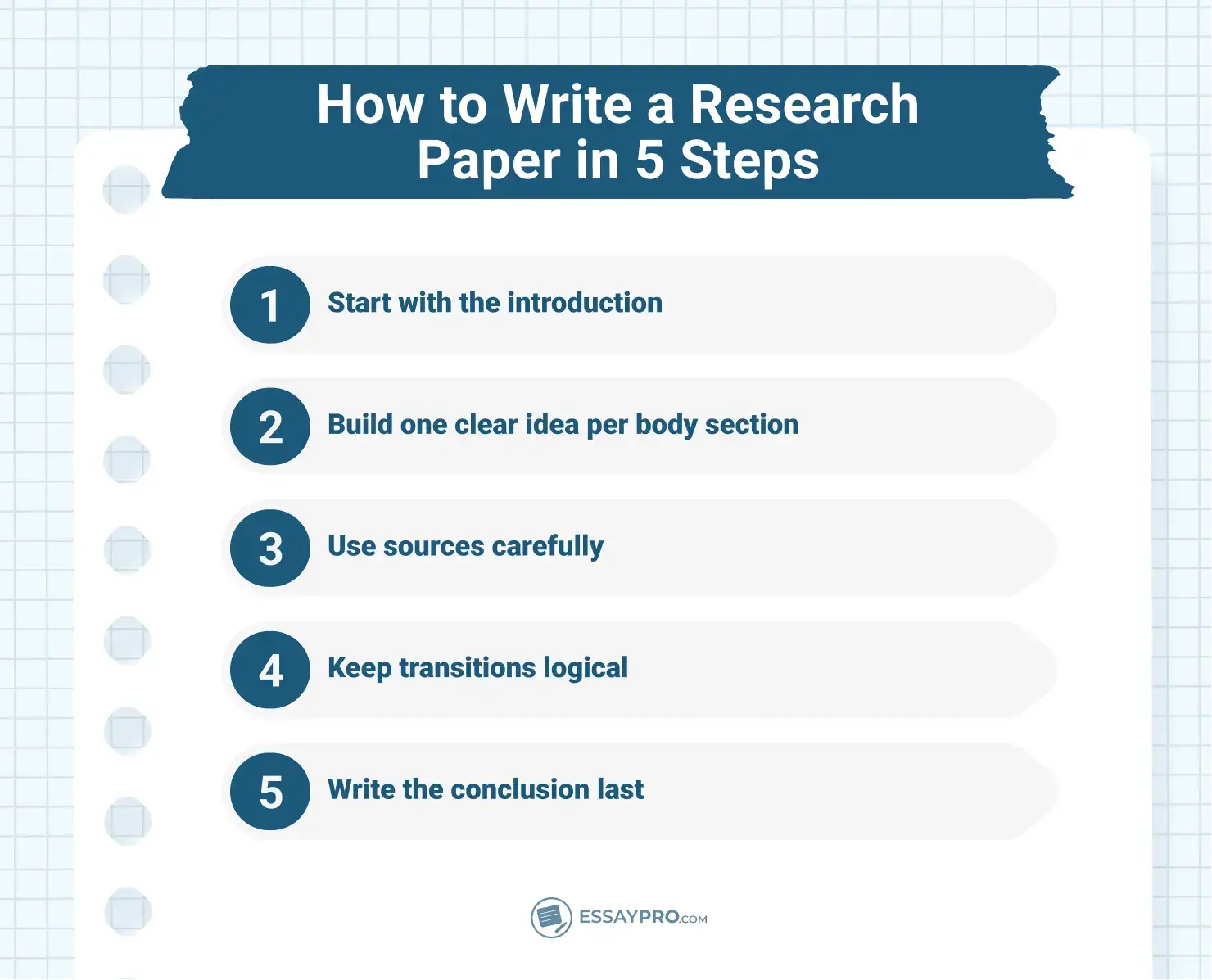
- Start with the introduction: Give a brief context for the topic, explain the research question, and present the thesis. Keep the opening focused. Long historical detours usually weaken the momentum.
- Build one clear idea per body section: Each section should support one part of the thesis. Open with a topic sentence, add evidence, then explain why that evidence matters. Many weak papers stop at the summary. Analysis is the part that actually proves the argument.
- Use sources carefully: Quotes should support your reasoning, not replace it. After adding a quote or statistic, explain its significance in plain language. A paragraph filled with evidence and no interpretation feels unfinished.
- Keep transitions logical: The paper should move naturally between ideas. Readers should understand why one section follows another without feeling dragged across unrelated points.
- Write the conclusion last: Restate the main argument in a sharper way, summarize the findings, and leave the reader with a final insight connected to the research question.
If you're too confused with the details or simply don't have enough time to write a full-length paper, you can always ask EssayPro to write my research paper for me and take a well-deserved break.
The Biggest Research Paper Mistakes (And How to Avoid Them)
Certain errors that might seem unimportant could cost you points. The research paper writing tips below will help you spot problems early and correct them before submission:
Strong Example of Research Paper Writing
Let's take a look at an example of a strong paragraph:
Extended heat advisories were associated with a measurable increase in emergency room admissions for heat-related illness among adults aged 65 and older in Phoenix during the summer of 2021. Public health records show a 14% increase in admissions during advisory periods compared with baseline weeks (Marquez et al., 2022). This pattern indicates that prolonged nighttime temperatures, rather than daytime highs alone, limited recovery and increased risk for older residents.
This research paper example works because the claim appears first, the evidence follows naturally, and the explanation clarifies why the data matters. The source supports the argument, but the reasoning stays with the writer. This is also a principle that every experienced philosophy essay writer follows when developing clear and persuasive academic arguments.
Deadlines Getting The Best Of You?
Connect with a professional writer in just a few minutes so you can stop stressing about your academic life.
Do Professors Allow AI While Writing a Research Paper?
Rules about AI use in academic research papers differ, but the expectations are usually based on the same logic. You might be allowed to use AI tools with surface-level tasks, such as brainstorming angles and fixing minor grammatical errors. These only help you polish your work without replacing your reasoning. Professors usually have a problem when students use AI for producing arguments, choosing sources, or creating citations because those are the tasks reserved for the writer.
You can follow a practical guideline here: if AI changes how you argue or what evidence you rely on, it crosses the line. If the boundaries feel unclear at any point, it's always better to carefully check requirements or simply ask a question.
In case you're short on time but would rather avoid using AI tools, you can rely on human help and pay someone to write a research paper.
Final Thoughts
A strong research paper starts with a focused topic that you turn into a concrete research question. That question will help you during source selection, and also guide you as you develop your thesis. Organizing research by ideas makes analysis easier, while outlining creates structure before drafting begins. Writing the body sections first allows the argument to take form, and careful source integration keeps the writing natural. When each paragraph is tested against the thesis and tools are used only to support clarity, the final paper reads as purposeful, coherent, and well-reasoned.
FAQ
What Is a Research Paper?
What Does a Research Paper Look Like?
How to Start a Research Paper?
How to Write a Thesis for a Research Paper?
How to Write a Research Paper Outline?

Daniel Parker
is a seasoned educational writer focusing on scholarship guidance, research papers, and various forms of academic essays including reflective and narrative essays. His expertise also extends to detailed case studies. A scholar with a background in English Literature and Education, Daniel’s work on EssayPro blog aims to support students in achieving academic excellence and securing scholarships. His hobbies include reading classic literature and participating in academic forums.