To write a movie review, you have to explain how a film works and judge its quality based on clear evidence. Students often watch a movie, but a review requires more than a simple opinion. It involves observing the plot, characters, acting, and direction, then explaining how those elements shape the viewer’s experience.
This article explains the basics of writing a movie review step by step. Students will learn how to take notes, structure a review, summarize the story without spoilers, analyze key scenes, and present clear opinions supported with examples.
How to Write a Film Review
Writing a movie review essay includes five parts: a clear introduction, a spoiler-free plot setup, scene-based analysis, an evidence-backed evaluation, and a final verdict. The goal is not to retell the movie, but to explain how specific choices (acting, directing, cinematography, editing, and sound) shape the overall impact. A clear opinion appears throughout the review and is supported with concrete examples that show why the movie succeeds or fails.
Movie Review Examples
Once you know how to review a movie and learn the most valuable tips to handle this assignment, it is time to look at some movie review examples to get you on the right track.
Check out the following pieces by our service to see which of these movie review essay examples you might want to keep at hand when working on your own assignment:
Pre-Writing Process
Before writing a movie review essay, gather the information that will support your analysis. Here’s how to prepare to write a truly good film review essay:
- Watch the film at least once, preferably twice. Use the first viewing to follow the story and tone. Use the second to track craft choices such as pacing, editing, and performance details.
- Take notes on scenes, dialogue, and technical details. Write down moments that stand out while you watch. Important scenes, memorable lines, lighting choices, camera angles, or music cues often reveal how the film creates mood and meaning. These notes later become concrete examples in the review.
- Research the director, screenwriter, release year, and main cast. Basic production information helps place the film in context. Knowing who made the movie and when it was released can explain stylistic choices or creative decisions that appear throughout the story.
- Consider what the film is trying to communicate. Think about the ideas behind the story. Many films raise questions about relationships, identity, society, or personal change. Recognizing this purpose helps the review move beyond summary.
- Analyze how the movie works as a whole. Look at how acting, cinematography, editing, music, and set design combine to shape the experience. A strong review explains how these elements work together and how they influence the viewer.
Tip: When a scene stands out, note the timestamp or approximate minute in the film. Later, when you start writing the review, you can easily return to that moment and study it more carefully. This makes your analysis much more precise because you can look again at the acting, dialogue, or camera work instead of relying on memory.
How to Write Movie Review Essay Step by Step
Writing a film review means more than simply describing a film. Here’s a step-by-step approach that helps you build a quality review according to our service.
.png)
Choose a Strong Title
A strong essay title can immediately shape how readers approach your movie review writing. Instead of choosing a vague headline, try opening with an idea that captures the film’s main impression or argument.
- Start with a striking observation. A bold opinion or surprising statement quickly signals your perspective. Example: 'A stunning visual spectacle that struggles to tell a convincing story.'
- Use comparison to a real event or another film. Connecting the movie to something familiar gives readers context right away. Example: 'Like a modern comic book epic, this film builds a vivid world yet forgets to give its characters real depth.'
- Summarize the judgment in one clear sentence. Some reviewers present the entire evaluation up front. Example: 'Great performances cannot fully rescue this uneven but interesting film.'
- Add brief context about the film. Mentioning background information can make the title more engaging. Example: 'A director’s ambitious return to classic science fiction storytelling.'
Tip: After finishing your movie review writing, revisit the essay title and adjust it to reflect your final argument.
Write an Introduction
When writing a movie review essay, start by identifying the film clearly so readers know exactly what you are discussing. Include the title, the director, the release year, and the genre. A short line about the premise can help as well.
Right after that, a film reviewer should make their position clear. Readers usually want to know what you think of the film early on, otherwise they keep searching for the point of the review.
Example opening opinions:
- Positive example: 'Paul Thomas Anderson’s 2026 political drama One Battle After Another turns a chaotic historical moment into a gripping and unexpectedly emotional film.'
- Negative example: 'Paul Thomas Anderson’s One Battle After Another arrives with ambition and star power, yet the film struggles to hold its sprawling story together.'
- Mixed example: 'With striking performances and moments of tension, One Battle After Another shows flashes of brilliance even as the narrative occasionally drifts.'
Create a Clear Thesis for the Review
Every strong review has one central claim about the film. When writing a good film review, identify the element that shaped your overall impression, such as the acting, direction, story structure, or visual style. Turn that observation into one sentence that states your evaluation and hints at the reasons behind it. The rest of the review should support that claim with specific scenes or filmmaking choices.
Example thesis: Despite impressive visuals and strong performances, the film struggles with slow pacing and an unfocused story.
Explain the Film’s Plot Without Spoilers
Keep this section super tight. A paragraph is usually enough. Focus on the setup and discuss who the main characters are, what’s at stake, and what kind of story this is. In this part, you’re not walking the reader through every scene. You’re helping them understand the basic arc, so your later analysis has context. Avoid major spoilers. If your assignment requires discussing a twist or ending, add a clear spoiler warning and keep the spoiler discussion brief.
Examine the Film in Detail
Once the basic plot is clear, the review should slow down and examine the movie itself. When writing a good movie review, this is the moment where the writer starts asking questions about the choices behind the film. What actually made the experience work or fall apart?
- Acting. Watch how the actors carry their roles. Do the performances feel natural, or do certain moments seem stiff? Do the actors make their characters believable enough that the audience cares about what happens to them?
- Direction and technical elements. Think about the director’s decisions. How does the camera move through important scenes? Do the cinematography, editing, or special effects add tension and atmosphere, or do they feel distracting?
- Script and narrative. Look at how the story unfolds. Does the plot move at a steady pace? Do the conversations between characters sound like real people talking, or like lines written only to push the story forward?
- Tone. Pay attention to the overall mood. Does the film keep a consistent feeling, or do certain scenes suddenly change the atmosphere?
- Music and sound. Notice what happens when the soundtrack enters a scene. Does the music strengthen the emotion or suspense?
Each observation should connect to a specific moment in the movie. Concrete examples make the analysis convincing.
Share Your Personal Evaluation of the Film
Now add your evaluation from the viewer’s perspective. What stayed with you? What bothered you? Where did the film meet your expectations, and where did it go somewhere unexpected? This section brings in your perspective, your preferences, and your voice.
Also, personal doesn’t mean unstructured. Keep your points clear, and tie them back to what you observed in the analysis. Your reaction carries weight when it's grounded in detail.
Tip: After watching the movie, wait a little before writing your opinion. The scenes or ideas that stay in your mind after some time often reveal what truly worked or failed in the film.
Close the Review
The last paragraph should answer a simple question: after everything you’ve discussed, was the movie worth watching? When writing review essay on a movie, the conclusion usually returns to the main judgment and states it clearly one more time. Some reviewers also briefly note who the film might appeal to or whether it stands out among recent releases.
Examples of closing lines:
- Positive: 'With confident direction and powerful performances, the film manages to turn a chaotic story into one of the year’s most compelling dramas.'
- Negative: 'Despite an interesting premise, the movie never develops the story enough to make its emotional moments convincing.'
- Neutral: 'The film offers several strong scenes, though the uneven pacing may leave some viewers uncertain about its overall impact.'
Edit and Proofread the Review
Before submitting the review, read it again carefully. Even a thoughtful movie review can lose credibility if the text contains spelling mistakes, awkward sentences, or unclear ideas. A quick revision helps clean up those problems.
Start by checking the structure. Make sure the introduction presents the film and your opinion clearly, the analysis refers to specific scenes, and the conclusion reflects your final judgment. If a sentence feels confusing when you read it aloud, it probably needs rewriting.
Then scan for grammar, punctuation, and small wording issues. These details matter because readers tend to trust writing that feels clear and polished.
Need Help With Your Movie Review Essay?
Save time and get a well-structured review with clear analysis and strong arguments.

Movie Review Format
A simple template helps organize ideas and keeps the film review format clear and easy to follow. Before you begin writing, set up the document with basic formatting so the review looks clean and readable.
Movie Review Template
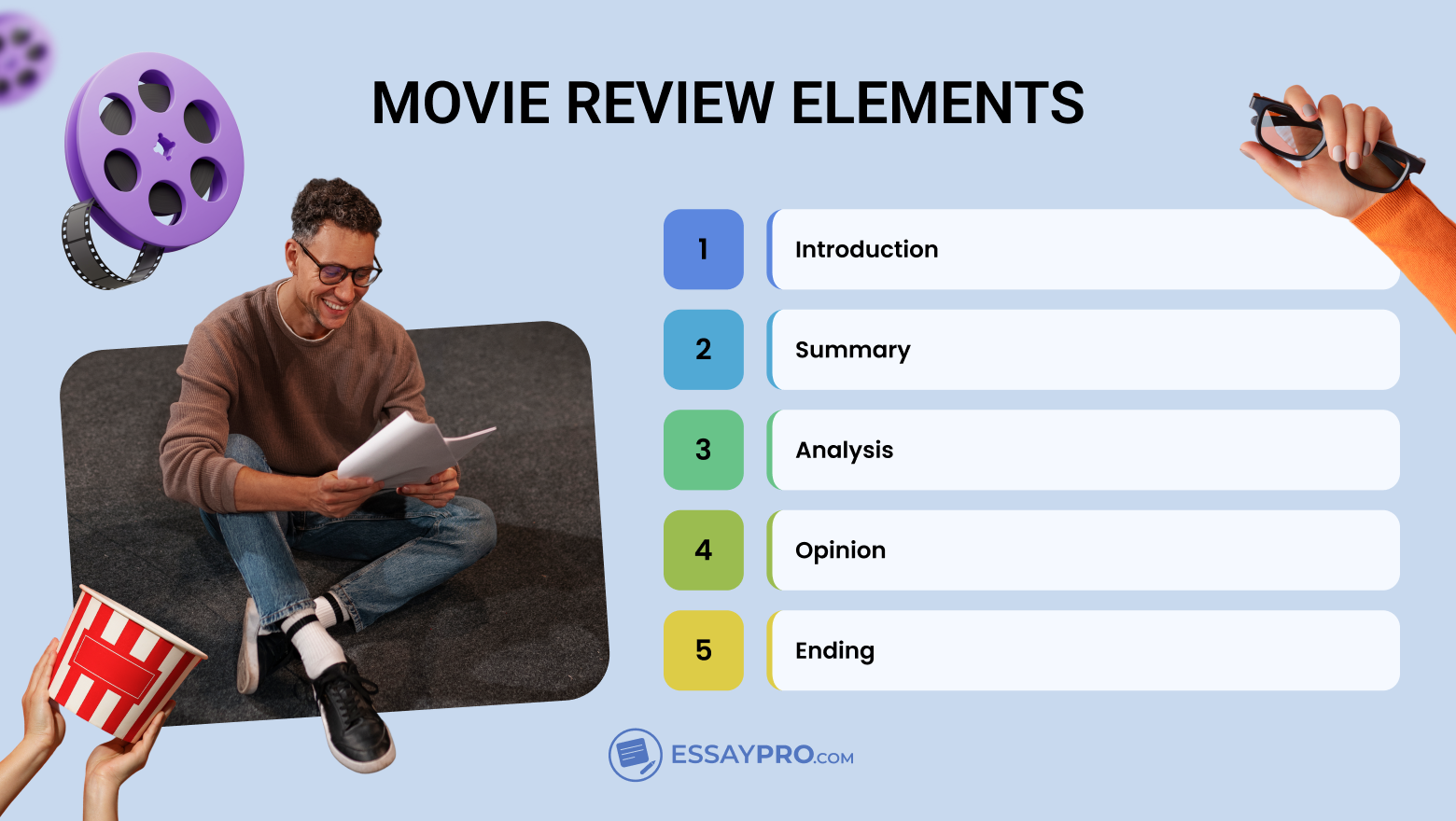
The sections below show the typical organization used when writing a movie review essay for college:
- Introduction: Title, release year, director, genre, and a clear thesis stating the reviewer’s overall judgment about the film.
- Summary: Brief plot overview including the main characters, setting, and central conflict without revealing major twists or the ending.
- Analysis: Evaluation of key filmmaking elements such as acting, directing, cinematography, sound, pacing, and visual style.
- Opinion: Personal evaluation of the film supported with concrete examples from scenes, performances, or storytelling choices.
- Ending: Final verdict on the movie with a short reflection on its overall impact and who the film might appeal to.
Useful Phrases for Writing a Film Critique
Certain phrases help structure a review and make the analysis easier to follow. When writing a film critique, these expressions can guide the reader through your introduction, summary, analysis, and final judgment.
Introduction phrases
- “This film, directed by…”
- “The movie tells the story of…”
- “One of the most interesting aspects of the film is…”
- “The film immediately establishes…”
Plot summary phrases
- “The story follows…”
- “The main conflict begins when…”
- “At the center of the plot is…”
- “The film introduces several key characters, including…”
Analysis phrases
- “One of the strongest elements of the film is…”
- “The director uses cinematography to…”
- “A particularly memorable scene occurs when…”
- “The acting adds depth to the characters because…”
Evaluation phrases
- “The film succeeds in…”
- “One weakness of the movie is…”
- “The pacing becomes slower during…”
- “This moment highlights the film’s central theme.”
Conclusion phrases
- “Overall, the movie leaves the viewer with…”
- “The film ultimately succeeds because…”
- “Despite several flaws, the movie remains…”
- “In the end, the film offers…”
Helpful Tips for Writing Movie Reviews
A few small habits can make a movie review much clearer and more convincing:
- Be specific. Avoid vague statements. Instead of saying “the acting was good,” point to a moment that proves it. For example, describe a scene where an actor’s reaction quietly changes the tension of the story.
- Let your voice show. Reviews feel more engaging when the writer’s perspective is visible. Readers want to hear what you noticed and why it mattered to you.
- Think about the audience. A review written for a blog can sound conversational. A school assignment usually needs a more structured tone.
- Use real examples from the film. Mention particular scenes, dialogue, or visual choices. These details help readers understand your point.
- Edit before submitting. Read the review again and smooth out awkward sentences or small mistakes. Even strong ideas need clear writing.
Common Mistakes to Avoid in Movie Reviews
When crafting movie review essays, a few common mistakes tend to weaken the review:
- Making claims without proof. Saying a film is “great” or “terrible” does not tell the reader much. Point to a scene, a performance, or a moment that shows why you think that.
- Writing only about your feelings. Personal reactions belong in a review, yet the discussion should still focus on the film itself. Readers expect some explanation of how the movie works.
- Using too much technical language. Film terms can help, yet filling the review with jargon makes the writing harder to follow.
- Forgetting basic information. Readers should know the title, director, and release year early in the review.
- Retelling the whole plot. A review that only summarizes the story leaves little room for real analysis.
Writing a Film Review for Class?
Get support with structure, analysis, and editing so your review reads clearly and professionally.
The Bottom Line
Learning how to review a movie takes practice. The more films you watch and analyze, the easier it becomes to notice details and explain your opinion clearly. If you’re short on time or need help structuring an assignment, simply ask EssayPro, ‘write my essay for me’ and our authors will polish the final draft before submission.
FAQs
How to Write a Movie Review Essay?
What Is the Format of a Movie Review?
How Do You Start a Good Movie Review?
How Long Should a Movie Review Be?
Should You Include Spoilers in a Movie Review Essay?
Can You Get Professional Help With Writing a Good Review of a Movie?

Adam Jason
is an expert in nursing and healthcare, with a strong background in history, law, and literature. Holding advanced degrees in nursing and public health, his analytical approach and comprehensive knowledge help students navigate complex topics. On EssayPro blog, Adam provides insightful articles on everything from historical analysis to the intricacies of healthcare policies. In his downtime, he enjoys historical documentaries and volunteering at local clinics.
.webp)
.webp)