

An analytical essay explains how a subject works, what its details mean, and why those details matter. Instead of retelling a story or listing facts, you make an interpretation and support it with evidence.
To write an analytical essay, choose a focused question, develop an arguable thesis, collect relevant evidence, and explain how that evidence supports your claim. Organize each body paragraph around one point, then revise the essay for accuracy and logical flow.
This guide walks you through each step, with an outline, examples, and a revision checklist.
What Is an Analytical Essay?
An analytical essay examines a subject by breaking it into parts and explaining the relationships between them. Its central purpose is to defend an interpretation—not simply describe the subject.
You can analyze a novel’s symbolism, a film’s sound design, a speech’s persuasive techniques, a historical document’s assumptions, or patterns in a dataset. Your assignment determines the subject, the evidence you need, and whether outside research is required.
A strong analytical essay includes:
- An arguable thesis: A specific interpretation that requires evidence.
- Relevant evidence: Quotations, scenes, observations, documents, or data.
- Analysis: An explanation of how the evidence supports your interpretation.
- Logical organization: A sequence of points that develops your argument.

Analytical Essay Due Soon?
Hand the hard part to expert sand get back a polished, ready-to-submit paper on time!

Difference Between Summary and Analytical Essay
The difference between summary and analysis is the question each answers:
Summary provides necessary context. Analysis explains the significance of that context.
For a different kind of assignment, our guide on how to write a reflection paper explains how to examine personal experience and learning.
Analytical Essay Outline
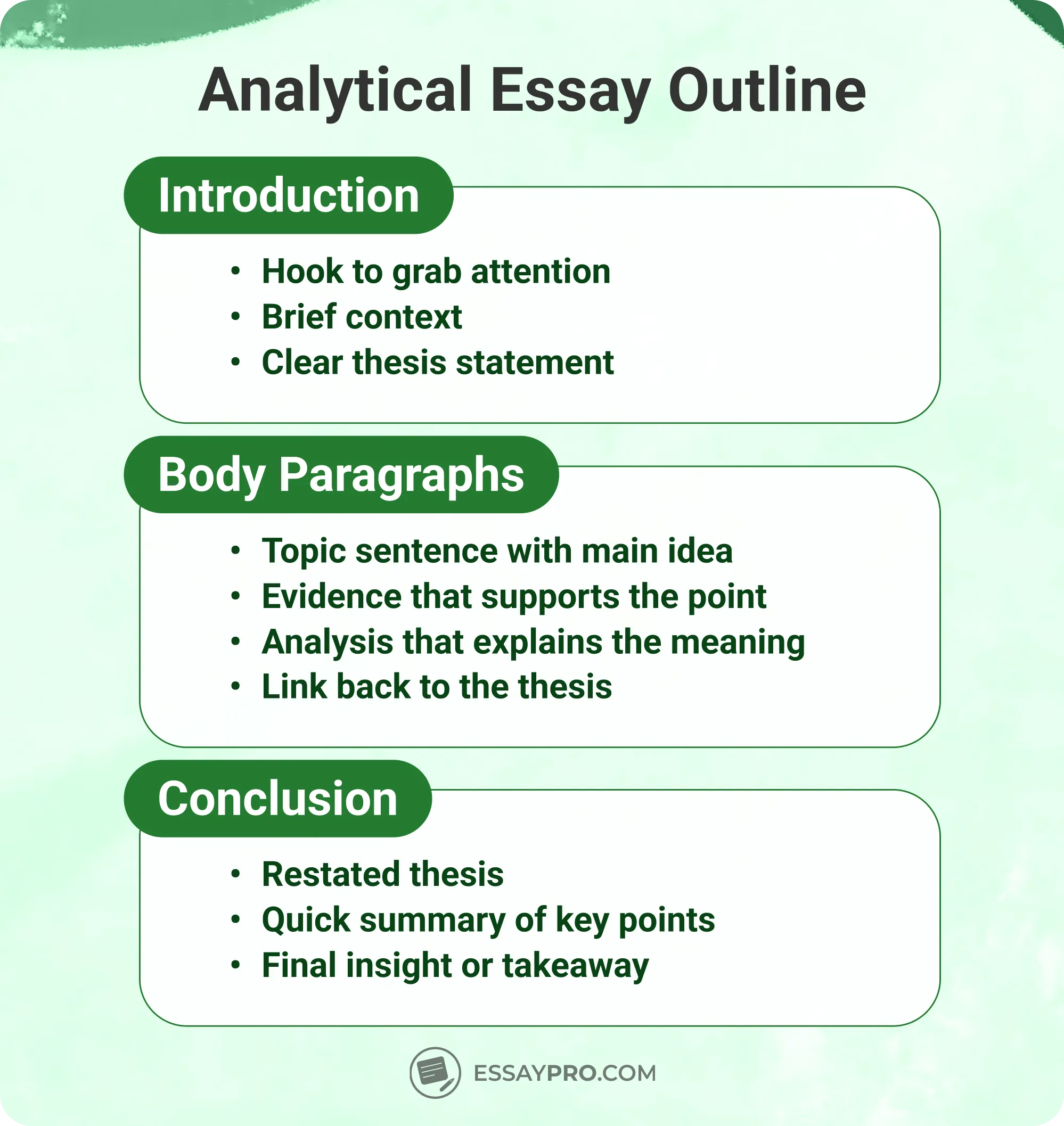
An analytical essay usually has an introduction, body paragraphs, and a conclusion. The number of body paragraphs depends on the argument and the assigned length; three is a useful starting point, not a requirement.
Use this outline to plan each paragraph’s claim and supporting evidence before drafting.
I. Introduction
- Opening: Introduce a relevant tension, problem, or observation.
- Context: Identify the subject and give readers the background needed to understand your claim.
- Thesis: State your focused interpretation and the reasoning you will develop.
II. Body Paragraph 1: First Supporting Point
- Topic sentence: Make a claim that supports the thesis.
- Context and evidence: Introduce a relevant quotation, detail, or example.
- Analysis: Explain what the evidence reveals and how it supports the paragraph’s claim.
- Connection: Establish the relationship between this point and the next.
III. Body Paragraph 2: Second Supporting Point
- Topic sentence: Develop another part of your argument.
- Context and evidence: Provide specific support.
- Analysis: Examine the evidence rather than repeating it.
- Connection: Show how this point extends or complicates the first.
IV. Body Paragraph 3: Third Supporting Point or Counterargument
- Topic sentence: Present another supporting claim or a competing interpretation.
- Context and evidence: Supply the details needed to evaluate it.
- Analysis: Explain why your interpretation remains persuasive or how the evidence requires you to refine it.
- Connection: Bring the argument toward its conclusion.
V. Conclusion
- Synthesis: Restate your thesis in light of what the body has established.
- Significance: Explain what your analysis helps readers understand.
- Closing insight: End with an implication grounded in the essay, not new evidence.
Analytical Essay Outline Example
Here is an example of an outline for an essay about the green light in The Great Gatsby:
- Introduction: Identify Fitzgerald’s novel and argue that the light connects Gatsby’s desire for Daisy to an idealized future.
- Body paragraph 1: Analyze Gatsby’s reaching gesture and the distance across the water in Chapter 1.
- Body paragraph 2: Examine how the light loses its special significance during Gatsby’s reunion with Daisy in Chapter 5.
- Body paragraph 3: Analyze how the final paragraph connects Gatsby’s dream to a broader pattern of pursuing an elusive future.
- Conclusion: Explain how the symbol exposes the tension between imagined fulfillment and lived reality.
How to Write an Analytical Essay Step by Step
Begin by checking the prompt. Identify what you must analyze, the required length, the citation style, and any research requirements. Pay attention to instructions such as “compare,” “evaluate,” or “analyze the author’s use of imagery”: they define the task your thesis must address.
Then choose an accessible source and follow the six steps below. You will move between them as your interpretation develops; new evidence can change an early thesis.
Step 1: Choose a Source You Can Examine Closely
Choose a subject narrow enough to examine within your word limit. “Power in literature” is too broad for a short essay. “How one story’s narrator presents authority” gives you a focused question and identifiable evidence.
If you can choose your source, look for features worth examining:
- A story with repeated images or an unreliable narrator.
- A speech with distinctive appeals to its audience.
- A film with meaningful choices in editing, lighting, or sound.
- A historical document with a clear purpose and intended audience.
- A dataset suited to the question your assignment asks.
Read or watch the complete source before committing to your focus. A striking passage can suggest a topic, but the surrounding work helps you judge its significance.
Check that you can return to the source and identify passages, pages, scenes, or timestamps. Use the assigned edition or version. If you are analyzing a film’s sound, work from the film itself rather than a transcript.
Step 2: Ask Questions
Annotate details that repeat, conflict, change, or stand out. Turn those observations into questions about how the source works.
Useful analytical questions include:
- What pattern appears, and where does it change?
- How does the narrator’s perspective shape the information readers receive?
- What does a contrast reveal about a character, argument, or theme?
- How do specific words, images, sounds, or structural choices affect meaning?
- Which details complicate the most obvious interpretation?
Avoid questions that lead only to factual answers. “Who wrote the novel?” supplies context; “How does the novel’s imagery connect desire with distance?” opens an argument.
Example: In The Great Gatsby, Gatsby reaches toward the green light in Chapter 1, its significance changes in Chapter 5, and it returns in the novel’s ending.
Ask: How does the light’s changing role connect Gatsby’s private desire to the novel’s treatment of aspiration?
Step 3: Create an Arguable Thesis
Your thesis should answer your analytical question with a claim that needs evidence. Name the subject, offer an interpretation, and explain its significance.
A useful drafting pattern is:
Through [specific feature or technique], [the source] presents [your interpretation], revealing [why it matters].
Use the pattern to clarify your thinking, then revise it into natural prose.
Weak thesis: The green light is an important symbol in The Great Gatsby.
This names a topic but does not explain what the symbol does.
Stronger thesis: In The Great Gatsby, the green light transforms Daisy into a distant promise of fulfillment; its changing significance reveals the gap between Gatsby’s imagined future and the reality of their reunion.
The stronger version gives the essay something to demonstrate: the connection between distance, idealization, and disappointment.
Treat your first thesis as provisional. If your evidence contradicts it, revise the claim rather than forcing the source to fit.
Step 4: Collect Evidence
Gather evidence that supports, challenges, or refines your thesis. For literary analysis, examine the language of the text. For film analysis, record visual and sound details. For historical analysis, identify the document’s creator, audience, date, and purpose.
Keep an evidence log:
Record page numbers from your edition as you work. For films, record timestamps; for online sources, save publication details and the relevant URL.
Use outside scholarship when the assignment requires it or when it helps establish context. Keep your interpretation distinct from a critic’s argument, and cite quotations, paraphrases, and borrowed ideas in the required style.
Step 5: Analyze Instead of Retelling
After presenting evidence, explain how it works. Do not assume a quotation proves your claim by itself.
Move through three questions:
- What specific detail matters?
- What does that detail suggest in context?
- How does that interpretation support or complicate the thesis?
Compare these responses to the same scene:
Summary: Gatsby stretches his arms toward the green light across the water.
Analysis: Gatsby’s reaching gesture gives his desire a physical form, while the water keeps its object at a distance. Because the light marks Daisy’s dock, it connects his longing to her without bringing her into the scene. Fitzgerald presents desire as an act of reaching toward something visible but separate from Gatsby’s immediate reality.
The analysis examines the gesture, setting, and symbol. It does not merely report the action.
Be precise about authorial choices. Explain what a technique does in the work rather than claiming to know the author’s private intention.
Step 6: Build Each Paragraph Around One Point
Each body paragraph should develop one main claim. That claim can require several related pieces of evidence, but the paragraph needs a clear focus.
Use this sequence:
Claim → Context → Evidence → Analysis → Connection
Here is a model body paragraph:
Gatsby’s reunion with Daisy exposes how much meaning he has invested in her absence. In Chapter 5, Nick observes that the green light’s “colossal significance” has vanished now that Gatsby is with her. The word “colossal” emphasizes the scale of Gatsby’s emotional investment: a small light has carried an enormous expectation. Once Daisy is physically present, the light no longer performs the same symbolic role. This change supports the idea that Gatsby’s longing depends partly on distance and imagination, not simply on Daisy herself.
Notice that the paragraph does not recount the entire reunion. It selects one detail and explains its relevance.
Arrange paragraphs according to your argument’s logic. You might follow a symbol’s development, move from cause to consequence, or establish an interpretation before addressing a counterargument. Use transitions that name the relationship between points, such as “This contrast becomes clearer when…” or “The later scene complicates that pattern…”
Step 7: Revise Your Argument
Revise the reasoning before polishing individual sentences. A grammatically clean essay still needs a coherent argument.
Create a reverse outline: write a one-sentence description of what each body paragraph establishes. Then check whether those claims form a logical sequence.
Ask:
- Does the thesis answer the assignment?
- Does each paragraph advance or test that thesis?
- Is every quotation or factual claim accurate?
- Have I explained how each piece of evidence supports my interpretation?
- Have I addressed important contradictory evidence?
- Does the conclusion explain the argument’s significance?
- Are citations and source details complete?
Next, edit for clarity. Cut repeated claims, unnecessary plot summary, vague wording, and unsupported generalizations. Check sentence structure, spelling, punctuation, and formatting last.
Example: If a paragraph only recounts Gatsby and Daisy’s reunion, keep the context necessary for your argument and develop the analysis of the light’s changed significance.
If you want professional help with these steps, you can buy essay online from our writers.
Analytical Essay Examples
The following short examples demonstrate how a thesis, evidence, and interpretation work together. Their labels identify each paragraph’s function; remove those labels in a submitted essay unless your instructor requests them.
For your own paper, add citations in the assigned style and verify quotations, page numbers, or timestamps against the source you use.
Analytical Essay Example 1
Topic: How Sound Design Shapes Moral Tension in No Country for Old Men
Introduction
[Opening] In No Country for Old Men, danger often becomes audible before it becomes visible. [Context] The Coen brothers’ film follows a pursuit involving stolen money, a relentless killer, and a sheriff struggling to understand the violence around him. [Thesis] By using little musical scoring and emphasizing ordinary sounds, the film makes viewers listen for threats while withholding the emotional reassurance of a conventional suspense soundtrack.
Body Paragraph 1
[Topic sentence] The opening places Sheriff Bell’s reflections against a landscape that resists his attempt to explain it. [Evidence] His voice accompanies images of open country, with wind and other environmental sounds rather than a prominent musical theme. [Analysis] The voiceover offers a human account of crime and change, but the landscape remains larger than that account. The restrained soundscape makes Bell’s uncertainty part of the viewing experience: his words provide a perspective without establishing control.
Body Paragraph 2
[Topic sentence] The gas station scene turns small sounds into signals of danger. [Evidence] During Chigurh’s conversation with the proprietor, pauses, the handling of a wrapper, and the coin toss stand out without a suspense score directing the audience’s response. [Analysis] These ordinary actions become disturbing because the conversation has made their stakes uncertain. The quiet keeps attention on Chigurh’s questions and the proprietor’s hesitation, allowing a routine exchange to become a threat.
Body Paragraph 3
[Topic sentence] The motel confrontation uses sound to make the viewer share Moss’s limited knowledge. [Evidence] Chigurh’s tracking device and the sounds around the room help establish an approaching threat before Moss can fully see it. [Analysis] Listening becomes a practical means of survival. Instead of receiving a complete view of the danger, viewers interpret fragments alongside Moss. The scene’s tension develops from that incomplete information.
Body Paragraph 4
[Topic sentence] The ending preserves uncertainty rather than resolving it through music. [Evidence] Bell recounts his dreams in a quiet domestic setting, and the film ends without a triumphant musical resolution. [Analysis] The change from pursuit to conversation does not deliver a clear restoration of order. Bell’s account invites interpretation, while the restrained sound leaves his uncertainty intact.
Conclusion
[Synthesis] The film’s sparse score and attention to environmental sound make listening central to its suspense. [Significance] Those choices also reinforce Bell’s difficulty in finding a stable explanation for violence. [Closing insight] Sound does not tell viewers that order has returned; it leaves them attending to a world the characters cannot fully interpret.
Analytical Essay Example 2
Topic: How Restrained First-Person Narration Exposes Self-Deception in The Remains of the Day
Introduction
[Opening] Stevens’s measured voice makes his account sound controlled even when the events he describes challenge his judgment. [Context] In Kazuo Ishiguro’s The Remains of the Day, the butler recalls his service to Lord Darlington during a journey through England. [Thesis] Stevens’s professional language and selective explanations reveal how he uses duty to avoid responsibility and intimacy, while his eventual admissions expose the cost of that avoidance.
Body Paragraph 1
[Topic sentence] Stevens’s account of the dismissal of two Jewish maids reveals the conflict between obedience and moral judgment. [Evidence] He carries out Lord Darlington’s order despite Miss Kenton’s objection and later acknowledges that he had reservations. [Analysis] The separation between private disagreement and public compliance is crucial. Stevens treats his subordinate position as a reason not to act on his judgment, allowing professional duty to become a defense against responsibility.
Body Paragraph 2
[Topic sentence] His description of his relationship with Miss Kenton similarly translates intimacy into professional terms. [Evidence] When she finds him reading a sentimental novel, he explains the reading as a way to improve his command of English. [Analysis] The explanation preserves his identity as a disciplined servant while diverting attention from emotional interest. Readers recognize a personal vulnerability that his account tries to contain.
Body Paragraph 3
[Topic sentence] The journey creates opportunities for Stevens’s professional identity to come under pressure. [Evidence] At a village gathering, other people initially mistake him for a gentleman, and the conversation turns to dignity and political participation. [Analysis] These encounters place his assumptions beside alternative ideas of worth and responsibility. The contrast makes his reliance on service to a powerful employer appear less secure.
Body Paragraph 4
[Topic sentence] His final meeting with Miss Kenton breaks through the restraint without erasing its consequences. [Evidence] After she speaks about imagining a life with him, Stevens admits that his heart is breaking. [Analysis] This direct emotional statement contrasts sharply with his earlier evasions. He recognizes the loss, but recognition arrives after their opportunity for a shared life has passed.
Conclusion
[Synthesis] Stevens’s restrained narration exposes self-deception through the gap between his explanations and the events he recounts. [Significance] His late admissions show that professional control cannot protect him from the consequences of his choices. [Closing insight] Ishiguro makes emotional recognition powerful precisely because the narrator has spent so much of his story resisting it.
Analytical Essay Example 3
Topic: How World War I Propaganda Posters Framed Participation as a Personal Duty
Introduction
[Opening] A recruiting poster can turn a public demand into an apparently personal encounter. [Context] British and American World War I posters used direct address, national symbols, family scenes, and commands to encourage participation. [Thesis] These visual and verbal techniques framed wartime service as a test of individual loyalty, linking national obligations to the viewer’s identity and relationships.
Body Paragraph 1
[Topic sentence] Direct address makes a general recruiting message feel individually targeted. [Evidence] Alfred Leete’s 1914 Kitchener design presents the British military leader pointing outward and looking directly at the viewer. [Analysis] The gesture appears to single out whoever stands before the image. Rather than explaining military policy, the design turns recruitment into an encounter between authority and an addressed individual.
Body Paragraph 2
[Topic sentence] National imagery strengthens the connection between personal action and public duty. [Evidence] James Montgomery Flagg’s 1917 “I Want You for U.S. Army” poster depicts Uncle Sam wearing a star-patterned hat and pointing at the viewer. [Analysis] Uncle Sam personifies the nation, so the speaker’s demand appears to come from the country itself. The emphasis on “YOU” makes the requested action personal rather than abstract.
Body Paragraph 3
[Topic sentence] Family imagery frames participation as a choice with consequences for personal identity. [Evidence] Savile Lumley’s 1915 British poster “Daddy, what did YOU do in the Great War?” depicts a father with his children and imagines a future question about his wartime role. [Analysis] The domestic setting brings national service into family life. By asking the viewer to imagine explaining himself afterward, the poster uses anticipated judgment to make present action feel urgent.
Body Paragraph 4
[Topic sentence] Imperative language narrows the distance between seeing the poster and acting on it. [Evidence] Flagg’s poster follows its direct appeal with “Nearest Recruiting Station,” identifying the next step. [Analysis] The wording moves from personal address to practical instruction. It treats enlistment as the expected response and directs the viewer toward a place where that response can occur.
Conclusion
[Synthesis] These posters combine direct address, national personification, family judgment, and instructions to present participation as a personal obligation. [Significance] Their persuasive structure connects individual identity to national service. [Closing insight] The designs make a large-scale war effort intimate by asking each viewer to imagine being personally answerable for a response.
Tips for Writing an Effective Analytical Essay
Our writers use these habits to keep analytical essays focused and readable:
- Organize by reasoning, not a fixed formula. Begin with the point readers need to understand first, then build toward more complex claims.
- Quote selectively. Choose the words necessary for your analysis rather than reproducing an entire passage.
- Explain the mechanism. Replace “This creates an effect” with an explanation of how a specific detail produces that effect.
- Use literary present tense for textual analysis. Write “Gatsby reaches toward the light.” Use past tense for historical events, such as “Fitzgerald published the novel in 1925.”
- Keep necessary summary brief. Give enough context to make the evidence understandable, then interpret it.
- Test alternative readings. Consider whether another explanation fits the evidence better.
- Use precise transitions. Show whether the next paragraph extends, contrasts with, or complicates the previous point.
- Write the introduction after clarifying the argument. Once the body is drafted, revise the opening so it introduces the claim the essay actually supports.
Common Mistakes in Analytical Essay Writing
Use this checklist to identify weaknesses during revision.
- Retelling instead of interpreting. If a paragraph mainly reports events, identify the detail that matters and explain its significance.
- Dropping quotations into the essay. Introduce each quotation, cite it, and analyze the language or idea relevant to your claim.
- Naming a topic instead of making a thesis. Replace “This essay discusses symbolism” with a claim about what the symbolism reveals.
- Making claims broader than the evidence. Narrow the argument to the sources and details you have examined.
- Ignoring contradictory evidence. Address details that challenge your interpretation and revise the thesis when necessary.
- Mixing unrelated points. Split a paragraph when it begins developing a different claim.
- Leaving evidence without context. Identify who speaks, where a scene occurs, or how data were collected before interpreting the material.
- Confusing interpretation with fact. Support a reading with evidence; verify historical claims and source attributions separately.
- Adding new evidence in the conclusion. Develop evidence in the body and use the conclusion to synthesize its implications.
Analytical Essay Due Soon?
Hand the hard part to expert sand get back a polished, ready-to-submit paper on time!
Wrapping Up
Writing an analytical essay means moving from observation to interpretation to argument. Choose a focused question, write an arguable thesis, and collect evidence you can examine closely. Make each paragraph explain not only what the source presents, but how its details support your claim.
Before submitting, reverse-outline the draft, check your evidence and citations, and make sure the conclusion answers “Why does this interpretation matter?”
If you need help working toward a deadline, you can ask us, “write my essay for me,” and discuss your assignment requirements with one of our writers.
FAQs
What Is the Purpose of an Analytical Essay?
What Are the Elements of an Analytical Essay?
How to Structure an Analytical Essay?
What Is an Analytical Essay Example?
How to Write an Analytical Essay?
What is an Analytical Essay?

Daniel Parker
is a seasoned educational writer focusing on scholarship guidance, research papers, and various forms of academic essays including reflective and narrative essays. His expertise also extends to detailed case studies. A scholar with a background in English Literature and Education, Daniel’s work on EssayPro blog aims to support students in achieving academic excellence and securing scholarships. His hobbies include reading classic literature and participating in academic forums.