

A reflection paper is a written response that explains how a text, lesson, event, or personal experience changed your thinking. Unlike an analytical essay, for example, the process of writing a reflection paper has room for your opinion, but it still needs a clear point you will defend.
Where many students lose control of the paper is the balance between their feelings and actual analysis: a summary followed by vague emotions is not reflection. You need to choose one meaningful response and explain it so the reader understands your thinking. In this article, you’ll learn how to write a reflection paper with structure, examples, and practical steps.
What Is a Reflection Paper?
A reflection paper is an academic response that connects personal insight with careful analysis. You may respond to a book, lecture, film, class activity, workplace moment, or life experience. The purpose is to explain what the subject revealed to you and why that realization matters. Your opinion belongs in the paper, of course, since it’s a reflection, after all. It still needs details, context, and a clear line of thought. Examples of a reflection paper can include:
- A paper about how one repeated image in a novel changed your view of grief.
- A response to a documentary that made you question how schools handle mental health.
- A personal reflection about your first week in a new city and what it taught you about independence.
Types of Reflection Paper
The main types of reflection papers usually fit into educational, professional, and personal categories. Each one asks you to think honestly, yet the lens is slightly different. Let’s look at each type in more detail and see the examples for them.
Educational Reflection
This type requires you to reflect on what you learned from a lecture, reading, assignment, experiment, a field observation, or class participation.
Example: How a classroom debate about school uniforms changed my view of personal freedom.
Professional Reflection
This type of reflection examines your experiences at a workplace, internship, volunteer opportunity, training experience, or practical situation.
Example: What I understood about patience after assisting a confused client during a busy front-desk shift.
Personal Reflection
This type asks you to reflect on a real-life experience that has influenced how you view yourself or others.
Example: The afternoon I stayed quiet during a friend’s problem and realized listening takes more courage than advice.
Course Reflection Paper
Looks at something you learned in class and explains why it changed your thinking.
Example: Realizing that feedback on a rough draft can be more useful than a final grade.
Book Reflection Paper
Focuses on how a book made you think about a theme, character, or problem.
Example topic/theme: How one character’s silence made guilt feel heavier than confession.
Project Reflection Paper
Explains what you learned while working through a project, especially the messy parts.
Example: What a late group project taught me about planning before panic starts.
Interview Reflection Paper
Breaks down what an interview helped you understand about a person, job, issue, or field.
Example: What a nurse’s routine showed me about emotional work in healthcare.

Reflection Paper Due Soon?
Hand the hard part to expert sand get back a polished, ready-to-submit paper on time!

Reflection Paper Format
In many courses, instructors expect you to format your reflection paper using standard MLA guidelines. Assignment instructions always take priority, so checking with your professor remains essential when details feel unclear.
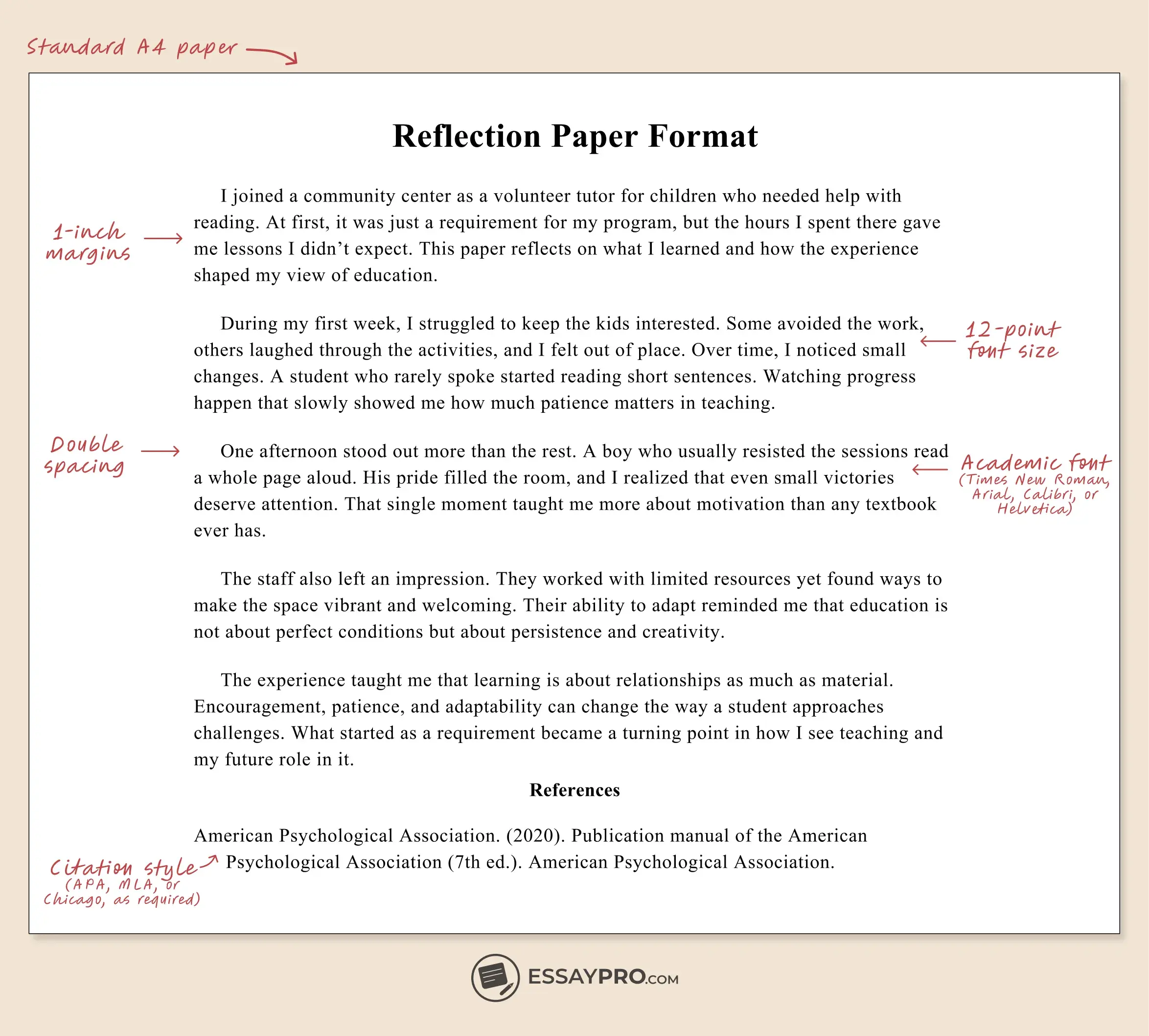
MLA format usually calls for:
- Times New Roman set to 12-point size.
- Double-spacing throughout the entire paper.
- One-inch margins on all sides of every page.
- A left-aligned header on the first page.
- A page header in the top right corner.
- A Works Cited page at the end of the paper.
Reflection Paper Template
A template for reflection paper helps you keep the paper clear and organized. Each section should build naturally into the next instead of repeating the same idea in different words.
- Introduction: “In this paper, I reflect on [experience, text, lesson, or event] and explain how it changed my understanding of [main idea].”
- Body 1: “The experience showed me [what happened]. At first, I reacted by [initial thought or feeling].”
- Body 2: “This experience connects to [concept, belief, or issue]. After thinking about it more carefully, I realized [analysis or deeper reflection].”
- Body 3: “One important lesson I learned was [lesson learned]. This may affect the way I approach [future action, mindset, or behavior].”
- Conclusion: “As a result, I learned [main takeaway]. This reflection helped me understand [final insight].”
How to Start a Reflection Paper?
Starting a reflection paper requires careful analysis rather than a simple summary. On the other hand, a focused opening will make the entire paper much easier to control.
- Identify the experience, reading, or topic that anchors the reflection paper. Name it clearly. Place it within the course and explain why it mattered in that academic setting.
- Identify specific moments or concepts that prompted a shift in understanding or raised questions. Consider feedback, observations, or theoretical tensions that challenged prior assumptions or revealed gaps in understanding.
- Assess what those moments reveal about your learning. Look for growth in skills or gaps you noticed during the process. Reflection gains academic value when it traces intellectual development.
- Shape a clear thesis statement that captures the central insight of the paper. Keep the language direct and tied to course concepts.
- Write the first paragraph with restraint. Introduce the subject and your perspective without forcing conclusions. Let the opening establish purpose while leaving room for analysis to unfold later.
Writing a Reflection Paper Outline
Just like reflective essay outline, a reflection paper outline usually follows three core parts that shape both the thinking and the final structure of the paper. Each part plays a distinct role. Together, they prevent the writing from sliding into storytelling or loose commentary and keep the reflection anchored in academic reasoning.
Context
Context explains what you are reflecting on and why it matters for the course. This section identifies the experience, reading, or concept and situates it within the academic setting. It avoids retelling events in full. It sets boundaries so the reader understands what will be examined and why.
A clear context paragraph establishes the analytical approach by defining scope and relevance early. For instance, a reflection on a group project might briefly state the project’s purpose and connect it to course goals. This kind of grounding gives the reader enough orientation to follow later course material integration without turning the opening into a background summary.
Example:
In this paper, I reflect on a usability audit I conducted on a subscription-based fitness app as part of a Human-Computer Interaction course. The audit focused on identifying dark patterns in onboarding and cancellation flows, directly connecting to the course unit on ethical interface design and user autonomy.
Body Paragraphs
Body paragraphs do the main work of the paper. Each paragraph addresses one idea, moment, or insight and develops it through evaluative analysis. Description appears only when it helps explain meaning or supports a claim.
Strong body paragraphs rely on evidence-based observations drawn from experience, readings, or class discussion. They show synthesis of ideas by linking what happened with academic concepts. A typical paragraph introduces a specific moment, examines it using critical analysis, and explains what that moment revealed during the evaluation phase of reflection.
Example:
During the audit, I observed that the app required four screens to cancel a subscription, while sign-up could be completed in one. Applying the concept of dark patterns discussed in the course, I analyzed this design choice as an instance of friction asymmetry. This observation revealed how interface structure can subtly influence user behavior without explicit coercion.
Conclusion
The conclusion states what the reflection shows after analysis. It summarizes learning, notes changes in understanding, and explains why those changes matter. This section often points toward reflective practice by describing how the insight gained will shape future academic or professional decisions.
Example:
This analysis reshaped how I evaluate usability decisions in digital products. I learned to assess interfaces not only for efficiency but also for ethical impact. Going forward, I plan to incorporate ethical checkpoints into design reviews to ensure user choice remains transparent and accessible.
How to Write a Reflection Paper?
A reflection paper becomes much easier once you stop treating it like a summary with feelings attached. If you’re just now figuring out how to write a reflection paper, keep reading this section, where we break down each section sentence by sentence.
1. Choose a Strong Topic
Every good topic starts with a single moment. This might be an event in a book, a comment you heard while in class, a mistake you made at work, or something that just keeps coming back to your life. If your paper covers a range of topics, it will likely be flat. As long as you limit yourself to one subject, you can give your essay enough deep thought.
Example: Instead of writing about my volunteer experience, focus on the conversation that made me rethink how often people hide financial stress.
2. Organize Your Thoughts Before Writing
First, write down a description of the event. Second, describe your immediate feelings about the event. And third, express what you learned after you have had some time to reflect on it. These original notes allow you to see how the event is different from the reaction you have to it.
Example: For a reflection on public speaking, your notes might move like this: I was nervous before the presentation, and my voice shook during the first minute. Afterward, I realized preparation helps, but it does not erase discomfort completely.
3. Figure Out the Opening
The introduction to the paper should provide the reader with enough context about the experience without describing it in detail. A good opening names the event and then points toward the main idea you will cover in your paper. The first line should feel controlled and avoid unnecessary drama. Here’s a brief guide:
- Subject - what you are reflecting on.
- Context - what happened or what it’s about.
- Reaction - what you felt, noticed, or questioned.
- Main insight - what the reflection will explain.
- Focus sentence - the point your paper will follow.
Example: “During my first group presentation in psychology class, I expected the speech itself to be the hardest part. The real problem appeared earlier, when our group avoided making clear decisions.”
4. Write Body Paragraphs
The purpose of each paragraph in the body is different and should be focused. For example, one paragraph might be used to describe the environment where the event took place, the next paragraph to describe your reaction, and the next one to reflect on how your thoughts have changed. The use of details (quotes, scenes, awkward pauses, assumptions, etc.) makes your reflections seem real.
Example: If your paper focuses on a novel, one paragraph can discuss a character’s choice. The next can explain why that choice changed your understanding of responsibility.
5. Add Analysis, Not Just Feelings
Reflection papers do need to contain emotion, but it should not be their only strength. Once you have identified an emotion, describe to the reader what prompted it, then connect it to a larger idea. The best reflection papers pause on one specific uncomfortable reaction and ask about what the reflection reveals about the writer.
Example: “I felt embarrassed after the peer review. Part of that embarrassment came from a simple mistake of thinking effort was enough for a clear draft. My classmates’ comments showed me where the logic became hard to follow.”
6. Write a Strong Conclusion
The conclusion should describe the original insight more clearly than the introduction. An effective closing does not always include a life lesson, but rather a transformation in your thinking as a result of your experience, as well as why that change is important. Short and specific conclusions usually come across more honestly than long and vague ones.
Example: “That assignment did not turn me into a confident speaker overnight. It helped me understand that confidence often grows after the first uncomfortable attempt, one clumsy sentence at a time.”
Tips for Writing a Reflection Paper
Writing a reflection paper asks you to reflect on a personal observation through clear claims and defensible analysis. The tips below will help improve academic performance:
- Interpret Experiences: After stating what occurred, immediately explain what it shows about learning, theory, or skill development. If a sentence ends with a description, it has stopped too early.
- Lead with Claims: Before drafting a body paragraph, decide what it needs to demonstrate. Write the claim first, then select the experience that supports it.
- Apply Course Terms: Academic markers look for the correct use of concepts, models, and frameworks. Introduce terms where they clarify analysis, and apply them accurately.
- Control Evidence Placement: Put analysis before examples. A brief observation works best when it follows a claim and functions as support rather than as the main content of the paragraph.
- Revise through the Rubric. Read the assessment criteria line by line and edit your writing accordingly. Strengthening analysis and clarifying connections often improve grades more than adding new material.
When deadlines pile up or structure becomes a problem, you can buy essay from EssayPro’s experts.
Reflection Paper Examples by Type
A good sample reflection paper should show a clear situation, an honest reaction, a deeper analysis, and a specific lesson learned. Below we’ll look at 5 examples of different types to make that structure easier to see.
Reflection Paper on a Book
Writing a reflection paper on a book means choosing one clear thread in the text and following your response to it. The paper should not walk through the plot chapter by chapter. It should explain how a theme, scene, character choice, or line changed the way you understood the book.
- Book Focus - Name the book and narrow the reflection to one idea. A theme like guilt, freedom, loyalty, fear, or identity gives the paper a cleaner direction.
- Key Moment - Choose one scene, quote, conflict, or character decision. Give enough context so the reader understands the moment without getting a full plot summary.
- Personal Response - Explain what you noticed first. Maybe the scene made you uncomfortable, changed your sympathy for a character, or raised a question you kept returning to.
- Deeper Meaning - Connect that response to the book’s larger message. This is where you move past “I liked it” and explain what the text helped you see.
- Final Insight - End with the idea you understand better now. Keep it specific to the book and your thinking.
Reflection Paper on a Course
When writing a course reflection paper, you look at how one class changed your knowledge, habits, or confidence. A strong course reflection chooses the lesson, assignment, discussion, or feedback moment that made the course feel useful in a concrete way.
- Course Focus - Name the course and identify the main learning point. Choose one idea that carries real weight, not a general statement about learning a lot.
- Learning Moment - Describe the lecture, assignment, class activity, reading, or feedback that triggered the reflection. A small classroom moment can work well if it reveals something clear.
- Initial Reaction - Explain what felt confusing, surprising, frustrating, or useful at first. This helps the reader see where your thinking began.
- Growth Point - Show how your view changed as the course continued. Mention the exact skill, concept, or habit that developed.
- Practical Use - Explain how you might use that learning later. Link it to future classes, workplace decisions, communication, research, or problem-solving.
Reflection Paper on a Project
A reflection paper on a project should focus on the work behind the final result. The grade or finished product is only part of the story. The stronger material usually comes from planning choices, wrong turns, group tension, revisions, research limits, or the moment you realized the project needed a new direction.
- Project Goal - Explain what the project was meant to accomplish. Keep this short, so the paper does not turn into a project report.
- Process - Describe your role and the main steps you took. Mention what worked smoothly and what needed adjustment.
- Challenge - Choose one problem that shaped the project. It could be weak research, unclear roles, time pressure, a technical issue, or a disagreement.
- Response - Explain what you did when the problem appeared. Be honest about hesitation, mistakes, or changes in judgment.
- Takeaway - Show what the project taught you about planning, collaboration, communication, patience, or independent work.
Critical Reflection Paper
Writing a critical reflection paper means thinking beyond personal experiences. You still include your own response, but the goal is to question an idea, practice, text, policy, or experience. The paper should examine assumptions, evidence, context, and possible consequences.
- Main Issue - Identify the idea or experience you are questioning. State the issue clearly, so the reflection has a strong center.
- Assumption - Explain what you believed at first. This gives the paper movement because the reader can see what changed.
- Evidence - Use a detail, reading, observation, case, or classroom concept that complicated your first view. One strong example is better than several thin ones.
- Critical Analysis - Explain why the issue deserves closer thought. Consider power, fairness, limitations, context, or the gap between theory and real life.
- Changed View - End with what you now understand more carefully. The point does not have to be neat. A good critical reflection can finish with a sharper question.
Personal Reflection Paper
A personal reflection paper uses a real experience as the starting point, then turns it into a focused insight. It should feel honest, but it still needs control. The writing works best when one clear moment carries the meaning.
- Personal Moment - Choose one experience that still feels meaningful. A conversation, a mistake, a move, a conflict, or a first attempt can give you enough material.
- Context - Give the reader the situation without explaining your whole life story. Set up the place, people, and stakes.
- Emotional Reaction - Describe what you felt at the time. Stay precise. Nervousness, shame, relief, pride, or confusion can all work if you explain the cause.
- Realization - Show what you understood after the moment passed. This is the part that turns memory into reflection.
- Future Meaning - Explain how the lesson may affect your choices, relationships, confidence, or behavior later.
Mistakes Students Make in Reflection Papers
You will make many mistakes when writing a reflection paper, and sure, that is part of the process, but some errors will instantly make you lose credibility. Keep reading the article to learn what to avoid as you write a reflection paper.
- Writing a diary entry - Personal thoughts need structure and analysis.
- Overexplaining the event - Some students spend three paragraphs describing what happened and one sentence explaining why it mattered.
- Forcing a huge lesson - A small insight often feels more believable.
- Using vague emotions - Words like “inspired” or “confused” mean very little unless the paper explains what caused the reaction.
- Repeating one idea - Each paragraph should add something new.
- Dropping course terms randomly - Mentioning theories or concepts is not enough. The paper needs to show where they actually appeared in practice.
Reflection Paper Due Soon?
Hand the hard part to expert sand get back a polished, ready-to-submit paper on time!
The Last Word
A reflection paper succeeds when it treats experience as material for analysis rather than something to recount. The work begins with a defined focus and places that focus firmly inside a course or professional framework. From there, the paper develops through theory, disciplined language, and evidence that supports clear claims. Structure keeps ideas from drifting. Analysis gives the writing academic weight. Reflection earns value when it explains learning, tracks change in understanding, and shows how ideas connect to formal expectations.
When structure or analytical depth becomes difficult to manage, outside support can make the process easier. If you're considering whether to pay to write paper, EssayPro can provide reliable academic assistance.
FAQs
What Does a Reflection Paper Look Like?
How to Start off a Reflection Paper?
How Do You Write a Reflection Paper?
How to Make a Good Reflection Paper?
How to Write a Reflection Paper Example?

Daniel Parker
is a seasoned educational writer focusing on scholarship guidance, research papers, and various forms of academic essays including reflective and narrative essays. His expertise also extends to detailed case studies. A scholar with a background in English Literature and Education, Daniel’s work on EssayPro blog aims to support students in achieving academic excellence and securing scholarships. His hobbies include reading classic literature and participating in academic forums.

.webp)