
Key Takeaways
- Figurative language adds meaning beyond literal words through comparison, sound, exaggeration, reference, or symbolism.
- Strong examples make ideas easier to picture and remember without overexplanation.
- All figure of speech examples in this article have specific jobs, so the best choice depends on the sentence’s purpose.
Figurative language gives words extra meaning beyond their literal sense. Though the words remain the same, the figurative meaning allows the reader to understand the underlying image and/or emotion, creating the unique, memorable characteristics of otherwise simple sentences. Figurative language is commonly used in writing essays, creating stories, composing poems, developing speeches, as well as in everyday conversation, sometimes even without us being aware that we are using a figure of speech.
In this article, we’ll provide figurative language examples for different types, each with clear definitions and insider tips that will teach you how each device works.
What Is Figurative Language?
Figurative language expresses meaning using an image, a comparison, an exaggeration, a sound, or a suggestion. It helps writers describe ideas that literal language can make flat or too vague.
A few of the most common figures of speech are metaphors (The classroom was a zoo before the teacher arrived), simile (Her smile was as bright as morning sunlight), and personification (The old house groaned during the storm). I’ll explain 13 different figures of speech in the following section
If you need to learn figurative language to write better papers, start by understanding how many sentences are in a paragraph before you move to the creative side.
Your Paper, Sharper
Work with expert writers who can clean up your ideas and make every paragraph easier to follow.

Common Figurative Language Examples
The easiest way to understand figurative language is by viewing its effects on real sentences. Below are types of figurative language and examples to show you how to recognize them in actual writing.
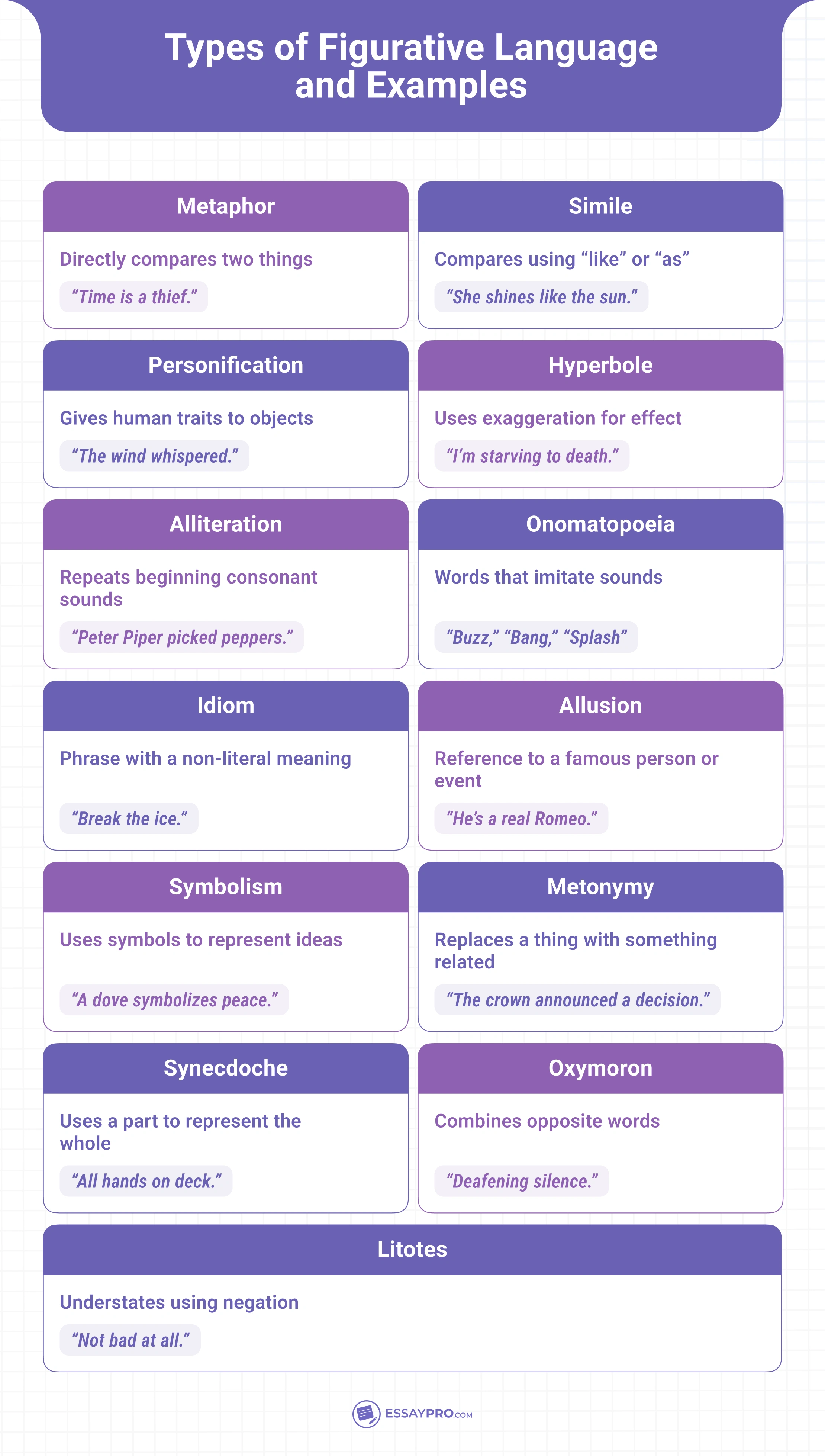
This free figurative language examples PDF gathers clear examples of common figures of speech used in writing and literature. Keep it nearby as a quick reference when reviewing figurative language or selecting examples for essays and assignments.
1. Metaphors
A metaphor describes one thing as another thing. It does not use “like” or “as” to hint at the comparison. It is direct instead, which allows the image to reach the reader faster and more effectively
Examples:
- Her patience was a locked drawer after the third interruption.
- The city was a furnace by noon.
- His apology was wet cardboard.
- The old library was a sleeping animal in the rain.
- Fear became a stone in her throat.
Why This Works: A metaphor works because it makes an idea feel concrete. Instead of explaining the emotion at length, the writer gives the reader an image they can understand instantly.
Pro Tip: If the image sounds clever yet leaves the reader confused, your metaphor needs a simpler object or a sharper emotional link.
2. Simile
A simile compares two things like a metaphor does, but it puts a brief word between the two objects, such as “like,” for example. Such figurative language phrases are simple to build and easy to understand.
Examples:
- The hallway was as silent as a theater after the final scene.
- His thoughts scattered like receipts in the wind.
- The baby’s laugh was like a bell under sunlight.
- Her voice felt as thin as paper in the quiet room.
- The deadline hung over him like a storm cloud.
Why This Works: A simile gives the reader a clear comparison without forcing the image too hard. The words “like” and “as” create a small bridge between the idea and the picture.
Pro Tip: Avoid worn-out similes such as “busy as a bee” or “cold as ice.” Choose images that match the exact mood of the sentence.
3. Personification
The point of a personification is to give an inanimate object the same feelings and qualities that a human being would have. It makes lifeless things feel more active within a sentence, making the imagery more vivid.
Examples:
- The floorboards complained under every step.
- Morning dragged itself through the curtains.
- The kettle screamed on the stove.
- Doubt sat beside him during the interview.
- The garden begged for rain.
Why This Works: Readers naturally understand human behavior. Once an object acts like a person, the scene feels easier to picture.
Pro Tip: Use personification when the mood is important. A “complaining” floor creates a different feeling than a “creaking” floor, even though both describe the same sound.
4. Hyperbole
Hyperbole uses exaggeration for emphasis. The statement is not meant as a literal fact, but it rather aims to make a feeling or a reaction sound larger than it is, so the reader understands its intensity.
Examples:
- I have read this sentence a thousand times.
- Her backpack weighed more than a refrigerator.
- He waited in line for an entire century.
- The test drained every thought out of his skull.
- She had enough homework to cover the kitchen table twice.
Why This Works: Hyperbole works because exaggeration can capture emotional truth. The sentence sounds extreme, yet the feeling behind it still makes sense.
Pro Tip: Do not overuse hyperboles. Too much exaggeration can make serious writing feel childish, so save it for moments that need strong emphasis or humor.
5. Alliteration
Alliteration repeats the same beginning sound in nearby words. This repetition gives the entire line a rhythm or beat, kind of like a song does. True alliteration is all about sound, so "city" and "cat" do not alliterate because they begin with different sounds.
Examples:
- The silver snake slipped through the sand.
- Maya mailed messy maps on Monday.
- The cold coins clinked in Caleb’s coat.
- Bright birds bounced between bare branches.
- The tiny train tapped along the track.
Why This Works: Alliteration makes a phrase stick because of the repeated sound that gives it a rhythm. This way, words feel more connected and easier to remember.
Pro Tip: Place alliteration on the words you want readers to notice most. For example, “cold coins clinked” works because the repeated c sound lands on the key image and sound.
If you can’t figure out how to end any of your academic papers, learn what effective essay conclusion examples should look like.
6. Onomatopoeia
Onomatopoeia uses words that imitate real sounds. These examples of figurative language are easy to recognize because the words sound like the noises they describe.
Examples:
- The bacon sizzled in the pan.
- The door closed with a loud bang.
- Bees buzzed near the porch light.
- The clock went tick-tock in the hallway.
- Rain pattered against the window.
Why This Works: Onomatopoeia brings sound into the sentence. The reader does not just understand what happened; they can almost hear it.
Pro Tip: Use onomatopoeia when the exact sound helps the reader picture the action. Thud suggests weight, snap - a quick break, and buzz points to a steady insect-like sound.
Take a look at the homonyms examples if you want to expand your knowledge of different literary devices even further.
7. Idioms
An idiom is a common phrase whose meaning cannot be understood through the literal meanings of its individual words. They are usually so ingrained in the language that, most of the time, everyone understands exactly what they mean, regardless of whether they’re native speakers.
Examples:
- Break the ice means to make people feel more comfortable.
- Hit the nail on the head means to say something exactly right.
- Under the weather means feeling sick.
- Spill the beans means to reveal a secret.
- A piece of cake means something is very easy.
Why This Works: Idioms work because they carry shared cultural meaning, which is the same for everyone. The phrase is already familiar, so the reader understands the idea quickly.
Pro Tip: Use idioms carefully in academic writing. They can make prose feel natural, but too many can make the tone too casual.
8. Allusion
An allusion is a direct or indirect reference to a well-known person, place, text, event, myth, or work of art. The writer expects the reader to recognize the reference and bring that meaning into the sentence.
Examples:
- He met his Waterloo during the final debate.
- Her science project became a real Frankenstein’s monster.
- The company opened Pandora’s box with that careless announcement.
- He had the strength of Hercules during the rescue.
- Their romance had the tragedy of Romeo and Juliet.
Why This Works: Allusion adds meaning through recognition. One reference can bring in an entire story, warning, mood, or historical memory.
Pro Tip: Choose allusions your readers are likely to know. A brilliant reference loses power when the audience needs a search engine to understand it.
9. Symbolism
Symbolism uses an object, color, place, action, or image to represent a larger idea. Strong symbolism needs a clear connection between the concrete thing and the meaning behind it. In such figurative language examples, the symbol looks simple at first, but it has a meaning beyond its literal one.
Examples:
- A white dove represents peace.
- A broken mirror represents bad luck or a fractured self-image.
- A wedding ring represents commitment.
- A red rose represents romantic love.
- A locked door represents secrecy or blocked access.
Why This Works: Symbolism gives abstract ideas a physical form. Instead of naming a concept directly, the writer lets an image carry that meaning.
Pro Tip: Make the symbol visible inside the scene. A symbol works best when readers can picture it clearly and understand why it matters.
10. Metonymy
Metonymy replaces the name of something with a related word or idea. The replacement must have a close, familiar connection to the thing it means.
Examples:
- The White House announced a new policy.
[The U.S. president or administration announced it.] - Hollywood loves a comeback story.
[The film industry loves it.] - The crown addressed the nation.
[The monarch addressed the nation.] - The pen can challenge the sword.
[Writing can challenge military power.] - Wall Street reacted nervously to the report.
[The financial industry reacted nervously.]
Why This Works: Metonymy works because the related word conveys the whole idea. “The White House” sounds cleaner than “the people who work in the U.S. presidential administration.”
Pro Tip: Use metonymy only when the connection is widely understood. A private symbol that only you understand will confuse readers.
11. Synecdoche
Synecdoche uses part of something to refer to the whole, or the whole to refer to one part. It is close to metonymy, but the relationship is specifically part-whole.
Examples:
- We need more hands on this project. [“Hands” means workers.]
- Nice wheels. [“Wheels” means a car.]
- The captain counted every sail in the harbor. [“Sail” means boat.]
- The school hired three new faces this semester. [“Faces” means people.]
- Italy won the match. [The whole country name refers to its sports team.]
Why This Works: Synecdoche gives the sentence a tighter focus. One part stands in for the whole thing, so the image feels quick and easy to grasp.
Pro Tip: Check the relationship before you label it a synecdoche. If the word is a physical part of the thing it represents, you are probably dealing with synecdoche.
12. Oxymoron
An oxymoron places two opposite or conflicting words together. The tension between the words creates a phrase that sounds strange at first, then makes sense in context.
Examples:
- Deafening silence
- Bittersweet memory
- Living dead
- Original copy
- Open secret
Why This Works: In an oxymoron, words push against each other. That clash can express a mixed feeling, a strange situation, or an idea with built-in tension.
Pro Tip: Use oxymorons when the contradiction is the point. “Bittersweet memory” works because some memories can feel warm and painful at the same time.
13. Litotes
Litotes uses understatement by denying the opposite of what the writer means. It often makes praise, criticism, or judgment sound restrained.
Examples:
- The exam was not easy. [The exam was difficult.]
- Her answer was not wrong. [Her answer was correct or partly correct.]
- He is not a bad singer. [He is a good singer.]
- That was no small mistake. [That was a serious mistake.]
- The movie was not unpleasant. [The movie was fairly enjoyable.]
Why This Works: Litotes sounds measured. The writer avoids a loud statement, and that restraint can make the sentence feel sharper.
Pro Tip: Use litotes for a controlled tone. It works well for dry humor, polite criticism, or a sentence that needs quiet emphasis.
Learn good transition words for first body paragraph to write flowing papers every time.
Deadline Coming Fast?
Get reliable writing help before your assignment turns into a midnight problem with no plan.
Final Thoughts
Figurative language helps writing feel clearer and more memorable. A strong figure of speech can turn a plain idea into an image readers understand right away. When the wording fits the sentence naturally, the meaning feels sharper, and the line stays with the reader longer.
FAQs
What Does Figurative Language Mean?
What Are Some Examples of Figurative Language?
Where Can Figurative Language Examples Be Found?
How Is Figurative Language Used in Literature?
What Types of Figurative Language Are There?
Why Do Writers Use Figurative Language?
How to Use Figurative Language Examples in Writing?

Mariam Navrozashvili
She has a Master’s degree in English Literature and brings a deep understanding of storytelling, critical analysis, and language structure to her work. On EssayPro Blog Mariam writes guides on literary analysis, essay composition and language studies to help students improve their writing skills. In her free time she likes to read classic novels and discuss literary theory.
.webp)
.webp)