

Key Takeaways
- A persuasive essay takes a clear position and argues it using evidence, emotion, and credibility together.
- Structure matters more than most students give it credit for.
- Knowing the difference between persuasive and argumentative writing saves a lot of lost marks.
- A solid persuasive essay takes most students between 2 and 4 hours from planning to finished draft.
Writing to convince someone is a skill, and a persuasive essay is basically your main tool for that. In simple terms, it is a piece of writing where you take a position and build a case for it using logic, evidence, and reasoning. You will need this type of essay in school, college applications, debates, and even professional settings.
In this article, we cover everything you must know about how to write a persuasive essay including the structure, the key elements, and the steps to actually write one that works.
What Is a Persuasive Essay?
A persuasive essay is a written argument where the goal is to bring the reader over to your side. It should show how you support your opinion in a way that feels logical and hard to dismiss. This type of essay is common in high school and university coursework, standardized tests and also in academic competitions. You might run into it in journalism and opinion writing as well.
How long should a persuasive essay be?
Most persuasive essays run between 500 and 2,000 words, well, depending on the assignment. A typical five-paragraph school essay sits around 500 to 800 words. For college-level work, 1,000 to 2,000 words is pretty standard. With this in mind, always check your specific requirements first.
Need a Complete Essay Written?
Save time and get a well-structured persuasive essay tailored to your topic and requirements.

3 Rhetorical Pillars: Ethos, Pathos, Logos
Aristotle described three ways to persuade people, and these still help us understand why some arguments work and others don’t. When we help students with writing persuasive essays, we often return to these ideas because they highlight something simple but easy to miss: the best essays don’t rely on just one method.
- Ethos is about proving credibility. It’s why the reader should trust the person making the argument. That trust can come from showing expertise, quoting trustworthy sources, or from how the argument is put together. If an essay lacks good sources, it makes the reader think the writer didn’t do enough research.
- Pathos connects with the reader’s feelings or interests. It helps make the issue feel real instead of just abstract. Used carefully, it pulls the reader in; used too much, it can seem like the writer is trying to manipulate instead of being honest.
- Logos is the logic behind the argument. It includes facts, data, and clear reasoning that hold the argument up once the emotional appeal fades. Arguments based only on emotion often fall apart when looked at closely.
Strong essays use all three. Putting too much emphasis on one leads to writing that can feel cold, overly emotional, or shaky without enough support.
If your assignment involves combining sources, see how to write a synthesis essay for a clear breakdown of that format.
Persuasive Essay Outline with the Standard Template
Before writing anything, having a clear outline in place saves a lot of time and reorganising later. A persuasive essay structure typically moves through five main elements: a hook that earns attention, a thesis that states the position clearly, body paragraphs that build the case, a counterargument that addresses the opposition, and a conclusion that ties everything together.
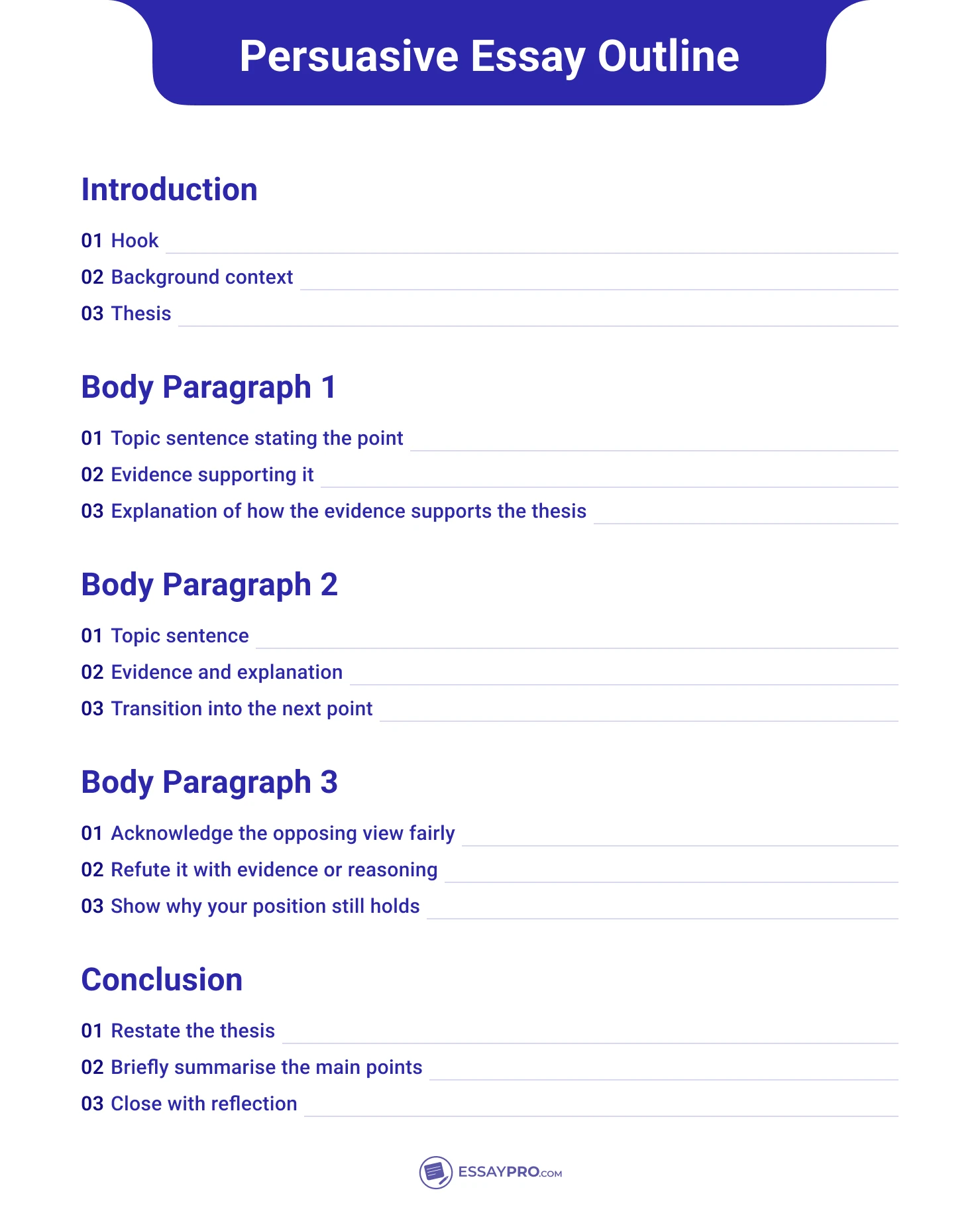
Introduction
- Hook: an opening that pulls the reader in
- Background context: enough for the reader to understand what is being argued
- Thesis: a clear, specific statement of your position
Body Paragraph 1: Strongest Argument
- Topic sentence stating the point
- Evidence supporting it
- Explanation of how the evidence supports the thesis
Body Paragraph 2: Second Argument
- Topic sentence
- Evidence and explanation
- Transition into the next point
Body Paragraph 3: Counterargument and Rebuttal
- Acknowledge the opposing view fairly
- Refute it with evidence or reasoning
- Show why your position still holds
Conclusion
- Restate the thesis in light of what the essay has argued
- Briefly summarise the main points
- Close with a sentence that gives the reader something to think about
Pro Tip: The counterargument paragraph trips up more students than any other part. Acknowledging the opposing view does not weaken the essay. Done properly, it does the opposite. It shows the reader that you have thought the issue through from more than one angle, which makes the overall argument feel more credible and harder to dismiss.
Here is a template for persuasive essay outline:
If you are still choosing a subject, explore our list of persuasive essay topics for relevant ideas.
How to Write a Persuasive Essay in 6 Steps
Many students start writing before they are clear about what they are arguing or who they are writing for. That often leads to essays that feel unfocused. Following these six steps can help you avoid that and write a persuasive essay effectively.
Step 1: Choose Your Position
Decide which side you are on before you start writing. Essays where the writer clearly believes in their position tend to come across better than those where the writer seems unsure. If the topic is assigned, take a moment to figure out which side has stronger points, and follow your persuasive essay format from there, even if it’s not your initial gut feeling.
Step 2: Know Your Audience
Without a clear audience in mind, your writing can end up feeling generic. Knowing this matters more than most students realize. Try to understand who will read your essay, what they already believe and the kind of evidence needed to convince them. What questions or doubts might they have? Addressing all of these makes every other step easier.
Step 3: Write a Strong Thesis
Your thesis is probably the most important sentence in the persuasive essay structure. If it’s vague, the whole essay can feel vague. The more specific your thesis is, the more focused your supporting paragraphs will be.
Try this formula: Although [Counterargument], [Your Position] is true because of [Reason 1] and [Reason 2].
For example: Although some say social media keeps teens connected, using it too much causes more harm than good because it disrupts sleep and raises anxiety.
Mentioning the opposing view first shows you’ve thought about different sides and sets up two clear reasons your body paragraphs will explain.
Step 4: Build the Body Paragraphs
Each paragraph should have one main point. Don’t mix several ideas at once. Start with the point, then share evidence to back it up and only after that, explain what the evidence means in your own words.
This last part is important. A quote or statistic alone does not make the argument and you need to show how it supports your thesis. Otherwise, the paragraph feels incomplete.
For example, you could start with “Teens who spend over three hours a day on social media report more sleep problems than those who don’t.” Then after citing a study, explain why that matters for your argument and how it connects to your thesis.
Step 5: Address the Counterargument
Bring up the strongest point from the other side somewhere in your essay, often near the end of the body paragraphs. Not including this can make your essay seem too simple, and readers might already be thinking about those objections.
When you acknowledge and respond to the counterargument, your essay feels more thoughtful and honest.
For example: “Some argue social media helps teens feel less alone, especially those who struggle with face-to-face friendships. That may be true. But if most time is spent scrolling without real interaction, the impact might be different.”
Do not dismiss the other side too quickly but rather show it fairly, then explain why your view still holds.
Step 6: Write the Conclusion
Your conclusion should wrap up the essay but not just repeat everything word for word. Restate your thesis in a new language, briefly touch on your main points, and finish with a sentence that feels like a clear end. A weak conclusion can sound like a list while a strong one leaves the reader with a sharp final thought.
For example: “The real question is not if social media has value, but whether the way many teens use it now takes more than it gives.”
This kind of ending sums up the argument and gives the reader one clear idea to remember rather than overreaching.
If you’re short on time, ask us - write my paper online, and get expert support shortly.
Persuasive Essay Examples
A good essay does not just state an opinion loudly. It builds a case, anticipates objections, and uses language deliberately to bring the reader along rather than pushing them into a corner. The persuasive essay examples below show what that looks like in practice. Each one includes the introduction and a body paragraph so you can see how the thesis sets up what follows and how the argument develops from there.
Sample 1: Why Schools Should Start Later on Mondays
Introduction:
Most students drag themselves to school on Monday mornings feeling like zombies. The weekend sleep schedule throws off our internal clocks, and suddenly we are expected to be alert and ready to learn at 7:30 AM. Schools should consider starting classes two hours later on Mondays to give students time to adjust back to the weekday routine. This small change could improve grades, reduce stress, and make Monday actually productive instead of just something everyone suffers through.
Body:
Research shows that teenagers need about 9 hours of sleep but most only get around 6 or 7 on school nights. The problem gets worse on Mondays because students stay up later on weekends. Their bodies are still in weekend mode when that Monday alarm goes off. Starting school later just on Mondays gives everyone a chance to transition without completely messing up the whole week's schedule.
Student performance drops significantly on Mondays compared to other weekdays. Teachers often complain that students seem checked out during first period on Mondays, and test scores from Monday exams tend to be lower than tests given mid week. If we push the start time back students would actually retain more information instead of sitting in class half asleep. The quality of learning matters more than just showing up early.
Some people worry that a late start on Mondays would interfere with parents' work schedules or cut into after school activities. But many companies already offer flexible schedules, and sports practices could simply shift back by an hour or two on that one day. The benefits to student wellbeing and academic success outweigh these minor scheduling adjustments.
Why This Works: This essay works because it addresses a problem that every student and teacher can relate to right away. The zombie comparison in the opening grabs attention without being too dramatic while the argument builds logically by first explaining the science behind teenage sleep patterns, then showing the real consequences through test scores and classroom behavior. The focus stays narrow on just Mondays rather than trying to overhaul the entire school schedule, which makes the proposal feel more achievable.
For full assistance, our persuasive essay writing service can help you build strong arguments and structure your paper clearly.
Example 2: Art Classes Should Count Toward STEM Requirements
Introduction
STEM education gets all the attention these days with schools pushing math and science as the path to future success. But we are ignoring something important here. Art and design thinking are becoming critical skills in technology and engineering fields. Schools should allow students to count advanced art courses toward their STEM requirements because the line between art and technology has basically disappeared in the modern workplace.
Body
Look at any tech company today and you will find designers working right alongside engineers. Video game development needs 3D artists and animators just as much as it needs programmers. Architecture combines artistic vision with mathematical precision and engineering principles. Even app developers rely on UI/UX designers to make their products actually usable. Treating art as separate from STEM does not reflect how these fields actually work together anymore.
Students who take digital art, graphic design, or animation courses learn problem solving skills that mirror what they would get in traditional STEM classes. Creating a 3D model requires understanding geometry and spatial relationships. Graphic design involves working with ratios, proportions, and color theory which has a scientific basis. Photography students calculate exposure using mathematical formulas. These are not just creative activities, they involve real technical knowledge.
The argument against this usually goes that STEM needs to stay pure and focused on hard sciences. But that thinking is outdated and honestly kind of harmful. We end up with engineers who can build things but have no sense of human centered design. We get programmers who write functional code that nobody wants to use because it looks terrible. Keeping art separate from STEM creates graduates who are only half prepared for actual careers in technology.
Why This Works: This example succeeds because it challenges a widely accepted idea about education without being confrontational. The essay also flips the typical objection by showing that keeping art separate actually hurts STEM education rather than protects it. This reframing technique is powerful because it turns the opposition's strongest point into support for your argument.
Example 3: Restaurants Should List Recipe Sources on Menus
Introduction
When you order food at a restaurant you get a description of the dish but rarely any information about where that recipe actually came from. Chefs constantly borrow techniques and dishes from other cultures, which is fine, but diners deserve to know the origins of what they are eating. Restaurants should be required to include brief source notes on their menus explaining the cultural or regional background of their dishes. This simple addition would educate customers and show respect for the communities whose food traditions are being served.
Body
Food has deep cultural meaning that goes beyond just taste and ingredients. A recipe often represents generations of tradition and carries historical significance for the people who created it. When restaurants serve these dishes without any context it strips away that meaning and treats food like it just appeared out of nowhere. Customers miss out on understanding what they are actually experiencing, and the culture behind the food gets erased in the process.
This is not about limiting what chefs can cook or restricting culinary creativity. Nobody is saying that only Italian people can make pasta or that Korean chefs cannot open French restaurants. What we are talking about is basic transparency and credit. If a chef learned a technique from their grandmother who immigrated from Lebanon, that is worth mentioning. If a dish is a traditional recipe from a specific region in Thailand, diners should know that. It takes maybe one sentence on a menu.
Restaurant owners might push back saying this adds complications to menu design or that customers do not care about this information. But we see more and more diners asking questions about food sources, farm names, and preparation methods already. People want to know the story behind their food. Adding cultural context is just an extension of that existing trend toward transparency. Plus it could actually help restaurants stand out and build deeper connections with their customers rather than just serving anonymous fusion dishes.
Why This Works: This essay tackles a topic that people might not have considered before, which immediately makes it interesting. The approach is balanced because it clearly states that cultural exchange in cooking is acceptable while still advocating for proper credit. The personal touch about a grandmother's recipe adds emotional appeal without overdoing the pathos.
Persuasive vs. Argumentative Essays: The Key Difference
Both essay types get mixed up all the time, and honestly, that is understandable since they both involve making a point and backing it up. But how they go about it is where things start to differ.
A persuasive essay is personal and it wants to win you over. An argumentative essay is more measured while laying out evidence, considering other views and letting the logic speak.
Persuasive and argumentative essays share similarities. Check out how to write an argumentative essay for key differences and structure.
Get Help with Your Persuasive Essay
Work with experts to build clear arguments, choose strong evidence, and structure your paper effectively.
The Bottom Line
Persuasive writing often feels tougher than it actually is, especially before you really understand what it is asking for. You need to know what you’re arguing about, who you’re trying to convince, and then build your case in a way that tackles what your reader might disagree with.
Having a good structure is important and the rhetorical triangle helps too. But honestly, the biggest change comes from doing your thinking before you start writing, not while you’re doing it. It definitely gets easier the more you do it, so go ahead and start practicing.
FAQs
How to Start a Persuasive Essay?
How to Structure a Persuasive Essay?
How to Make a Persuasive Essay?
How to Write a Good Persuasive Essay?
Can You Use I in a Persuasive Essay?

Ana Ratishvili
Ana is a professional literary writer with a Master’s Degree in English literature. Through critical analysis and an understanding of storytelling techniques, she can craft insightful guides on how to write literary analysis essays and their structures so students can improve their writing skills.