
PICOT nursing question examples structure clinical thinking by spelling out the Patient, Intervention, Comparison, Outcome, and sometimes Time. This framework turns everyday nursing concerns into questions that research can answer. For example: In adults with type 2 diabetes experiencing poor glycemic control (P), does nurse-led lifestyle education (I) improve HbA1c levels (O) compared with standard follow-up visits (C) over twelve weeks (T)? Questions like this help nurses connect evidence directly to patient care.
We understand how fast coursework can pile up when you're a nursing student, especially when you have to balance your long shifts with written assignments. EssayPro can help out in stressful moments like those.

Nursing School Getting Overwhelming?
Delegate your tasks to EssayPro professionals and focus more on patient care.

Using The PICOT Framework In Nursing Practice
The main reason the PICOT framework exists is precision. It helps nurses ask questions that research can actually answer and practice can use. With a clear structure in place, literature searches become faster and conclusions become easier to defend in clinical discussions.
Each element plays a specific role:
- P – Population: The group at the center of care. This might reflect age, diagnosis, risk level, or care setting.
- I – Intervention: The action, treatment, or practice change being evaluated.
- C – Comparison or Control: The usual approach or an alternative strategy used for reference.
- O – Outcome: The clinical result, such as reduced complications, improved recovery, or better patient comfort.
- T – Time Period: The length of observation used to measure change. This component stays optional in some assignments.
Let's take a look at a specific example:
In hospitalized older adults at risk for falls (P), does hourly nurse rounding (I), compared with routine rounding schedules (C), reduce fall incidents (O) during a three-month period (T)?
Read also: Political essay topics.
How To Create A Nursing PICOT Question Step By Step
Any strong example of PICOT question is formed after a few focused attempts. The ideas usually take shape through a few steps that tighten the scope.
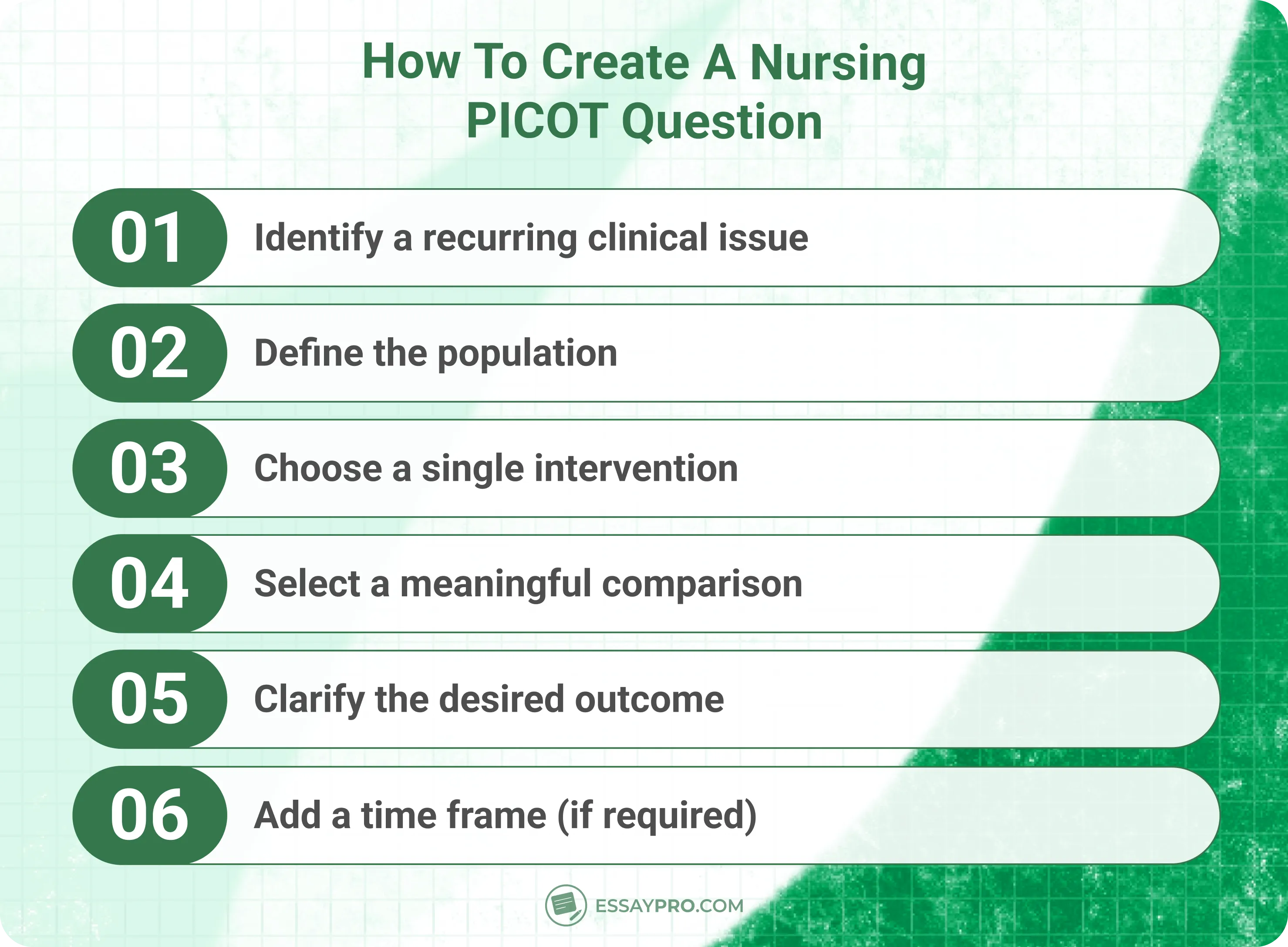
- Identify a recurring clinical issue: Choose a problem nurses see often that affects patient care or daily work.
- Define the population clearly: State exactly who the patients are so the question stays focused.
- Choose a single intervention: Focus on one treatment or practice that can be studied clearly.
- Select a meaningful comparison: Use standard care or a common alternative as the reference point.
- Clarify the desired outcome: Decide which result is the most important, such as fewer complications or improved recovery.
- Add a time frame when required: Include a realistic period for measuring change when the assignment calls for it.
Here is a clear example:
In postoperative orthopedic patients (P), does early ambulation within 24 hours of surgery (I), compared with ambulation after 48 hours (C), reduce the incidence of deep vein thrombosis (O) during the hospital stay (T)?
A few common missteps tend to weaken PICOT questions:
- Framing the question around a general patient group without specifying age, condition, or care setting.
- Including more than one intervention or practice change.
- Selecting outcomes that sound academic but have little impact on real nursing decisions or patient care.
- Writing the question in imprecise language that leaves room for multiple interpretations.
A List of 35 Good Nursing PICOT Question Examples
The sections below group PICOT questions by purpose, with clear explanations, simple templates, and realistic examples commonly used in nursing coursework and clinical research.
If you're just starting out in your journey and want to know more details, check out our article on how long does it take to be a doctor.
Intervention
A PICOT question on intervention refers to the impact of a specific nursing action or treatment on patient outcomes. These questions are common in practice-focused research because they connect directly to what nurses do during care.
Template:
What effect does introducing _________ (I) have on _________ (O) among _________ (P) compared with _________ (C) during _________ (T)?
When _________ (I) is used as part of care for _________ (P), how does _________ (O) change over _________ (T) relative to _________ (C)?
Examples:
- In adult ICU patients (P), how does daily sedation interruption (I) compared to continuous sedation (C) affect ventilator days (O) during hospitalization (T)?
- In patients with chronic heart failure (P), what is the effect of nurse-led education programs (I) on hospital readmissions (O) compared with standard discharge teaching (C) within six months (T)?
- In adult patients receiving chemotherapy in an oncology nursing unit (P), does nurse-led symptom monitoring (I) improve treatment tolerance (O) compared with standard check-ins (C) during one treatment cycle (T)?
- In pediatric asthma patients (P), what is the effect of inhaler technique training (I) on symptom control (O) compared with routine instruction (C) within three months (T)?
- In long-term care residents (P), how does scheduled toileting (I) compared to as-needed toileting (C) affect incontinence episodes (O) over eight weeks (T)?
Diagnosis
PICOT research question examples in this category focus on how well a test, tool, or assessment identifies a condition. These questions help nurses evaluate accuracy and reliability during early detection.
Template:
How accurately do _________ (I) identify _________ (O) in _________ (P) when measured against _________ (C)?
When assessing _________ (P), what level of diagnostic accuracy does _________ (I) achieve for detecting _________ (O) over _________ (C)?
Examples:
- In older adults presenting with acute confusion (P), are delirium screening tools (I) compared with routine nursing observation (C) more accurate in identifying delirium (O)?
- In emergency department patients with chest pain (P), are high-sensitivity troponin tests (I) compared with standard troponin assays (C) more accurate in diagnosing myocardial infarction (O)?
- In patients with suspected urinary tract infection (P), are urine dipstick tests (I) compared with urine cultures (C) more accurate in identifying infection (O)?
- In newborns at risk for jaundice (P), are transcutaneous bilirubin measurements (I) compared with serum testing (C) more accurate in detecting hyperbilirubinemia (O)?
- In adults with suspected sleep apnea (P), are home sleep studies (I) compared with in-lab polysomnography (C) more accurate in confirming diagnosis (O)?
Etiology/Risk Factor
Etiology-related PICOT questions investigate the causes or contributing factors associated with health problems. Nurses use these questions to understand why certain conditions develop or worsen.
Template:
In _________ (P), does exposure to _________ (I) increase the risk of _________ (O) compared with _________ (C)?
Among _________ (P), how does _________ (I) influence the development of _________ (O)?
Examples:
- In hospitalized older adults (P), does prolonged immobility (I) increase the risk of pressure injuries (O) compared with regular repositioning (C)?
- Among patients with type 2 diabetes (P), how does poor medication adherence (I) influence the development of peripheral neuropathy (O)?
- In night-shift nurses (P), does rotating shift work (I) increase the risk of sleep disorders (O) compared with fixed day shifts (C)?
- In pediatric patients (P), does secondhand smoke exposure (I) increase the risk of recurrent respiratory infections (O)?
- Among surgical patients (P), how does obesity (I) influence the risk of postoperative wound infection (O)?
Check out our list of satire topics if you need to write an amusing, yet thought-provoking paper.
Upgrade to Human-Written
Reliable, confidential, human-crafted papers — EssayPro has your back 24/7.
Prevention
PICOT question ideas that handle prevention look at strategies that reduce the chance of disease or complications. Mental health PICOT question examples fall into this group, for instance, especially when early screening is involved.
Template:
In _________ (P), does _________ (I) reduce the incidence of _________ (O) compared with _________ (C) within _________ (T)?
Examples:
- In hospitalized psychiatric patients (P), does structured suicide risk screening (I) reduce suicide attempts (O) compared with routine assessment (C) during admission (T)?
- In adolescents with anxiety disorders (P), does school-based counseling (I) reduce symptom escalation (O) compared with no formal intervention (C) over one academic year (T)?
- In nursing home residents (P), does vitamin D supplementation (I) reduce fall rates (O) compared with no supplementation (C) over six months (T)?
- In postpartum women (P), does early depression screening (I) reduce symptom severity (O) compared with delayed screening (C) within twelve weeks (T)?
- In oncology patients receiving chemotherapy (P), does prophylactic antiemetic therapy (I) reduce nausea episodes (O) compared with rescue therapy alone (C) during treatment cycles (T)?
Prognosis/Prediction
Prognosis PICOT questions focus on future outcomes and disease progression. These questions support planning, education, and long-term care decisions.
Template:
In _________ (P), how does _________ (I) affect the likelihood of _________ (O) over _________ (T)?
Examples:
- In patients with early-stage chronic kidney disease (P), how does blood pressure control (I) affect progression to renal failure (O) over five years (T)?
- In stroke survivors (P), how does early rehabilitation participation (I) affect functional independence (O) within one year (T)?
- In patients with heart failure (P), how does medication adherence (I) affect hospitalization frequency (O) over twelve months (T)?
- In individuals with mild cognitive impairment (P), how does cognitive training (I) affect progression to dementia (O) over three years (T)?
- In trauma patients (P), how does injury severity score (I) affect long-term mobility outcomes (O) after discharge (T)?
Quality Of Life/Meaning
PICOT question examples in nursing about quality of life examine how care affects daily living, comfort, and emotional well-being. Ideas in this group emphasize this area because patient experience shapes care quality.
Template:
In _________ (P), how does _________ (I) influence quality of life (O) compared with _________ (C) over _________ (T)?
Examples:
- In patients with advanced cancer (P), how does palliative care involvement (I) influence quality of life scores (O) compared with standard oncology care (C) during treatment (T)?
- In adults with chronic pain (P), how does mindfulness-based therapy (I) affect daily functioning (O) compared with medication management alone (C) over twelve weeks (T)?
- In assisted living residents (P), how does structured social programming (I) influence emotional well-being (O) compared with unstructured activities (C) over six months (T)?
- In dialysis patients (P), how does flexible scheduling (I) affect perceived life satisfaction (O) compared with fixed schedules (C) within one year (T)?
- In individuals with spinal cord injury (P), how does peer support participation (I) influence independence perception (O) over time (T)?
Therapy
Therapy PICOT questions evaluate treatment effectiveness and guide evidence based care choices. These questions often inform clinical protocols and nursing interventions.
Template:
In _________ (P), does _________ (I) improve _________ (O) compared with _________ (C) within _________ (T)?
Examples:
- In patients with major depressive disorder (P), does cognitive behavioral therapy (I) improve symptom severity (O) compared with medication alone (C) within twelve weeks (T)?
- In patients recovering after hip replacement (P), does twice-weekly physical therapy (I) improve mobility scores (O) compared with once-weekly therapy (C) during rehabilitation (T)?
- In children with attention deficit hyperactivity disorder (P), does behavioral therapy (I) improve classroom behavior (O) compared with pharmacologic treatment alone (C) over one school term (T)?
- In patients with chronic obstructive pulmonary disease (P), does pulmonary rehabilitation (I) improve exercise tolerance (O) compared with standard care (C) within three months (T)?
- In stroke patients (P), does task-oriented therapy (I) improve upper limb function (O) compared with traditional exercises (C) during inpatient recovery (T)?
Wrapping Things Up
PICOT questions bring order to evidence based practice. They help nurses translate everyday clinical concerns into focused questions that research can answer clearly. Across treatment decisions, diagnostic choices, risk factors, prevention efforts, prognosis, and patient experience, the framework keeps attention on what truly matters for patient outcomes.
Medical writing can still feel overwhelming, even with the best guides and instructions. EssayPro's writers can take over when you're short on time or energy.
Nursing School Can Be Demanding
Because we understand this, EssayPro professionals offer students a hand with their papers.
FAQ
What Is An Example Of A PICOT Question For The Flu Vaccine?
What Is An Example Of A PICOT Question For Nursing Shortage?
Where Can I Find Examples Of PICOT Questions?
How Can I Adapt A PICOT Question Example To Match My Topic?
What Is An Example Of A PICO Question For Infection Control?

Adam Jason
is an expert in nursing and healthcare, with a strong background in history, law, and literature. Holding advanced degrees in nursing and public health, his analytical approach and comprehensive knowledge help students navigate complex topics. On EssayPro blog, Adam provides insightful articles on everything from historical analysis to the intricacies of healthcare policies. In his downtime, he enjoys historical documentaries and volunteering at local clinics.