

Picking an argumentative essay topic sounds easy until you try to commit to one. Most ideas either feel too obvious or collapse the moment you look for evidence. A solid argumentative essay topic carries tension. You can argue it, support it, and still expect pushback. That balance is what makes the writing work.
In this article, we’re giving you unique argumentative essay topics that actually hold up. You’ll see what makes a topic usable, where weak ideas fail, and how to choose something you won’t regret halfway through your draft.
What Is a Good Argumentative Essay Topic
A good argumentative essay topic gives you something you can actually prove. It points to a clear claim, has enough research behind it, and focuses on a defined situation instead of a broad idea. You should be able to identify what you’re arguing, who it affects, and what kind of evidence supports your position before you even outline the essay. For clearer instructions on how to organize your paper, see our guide to argumentative essay structure.
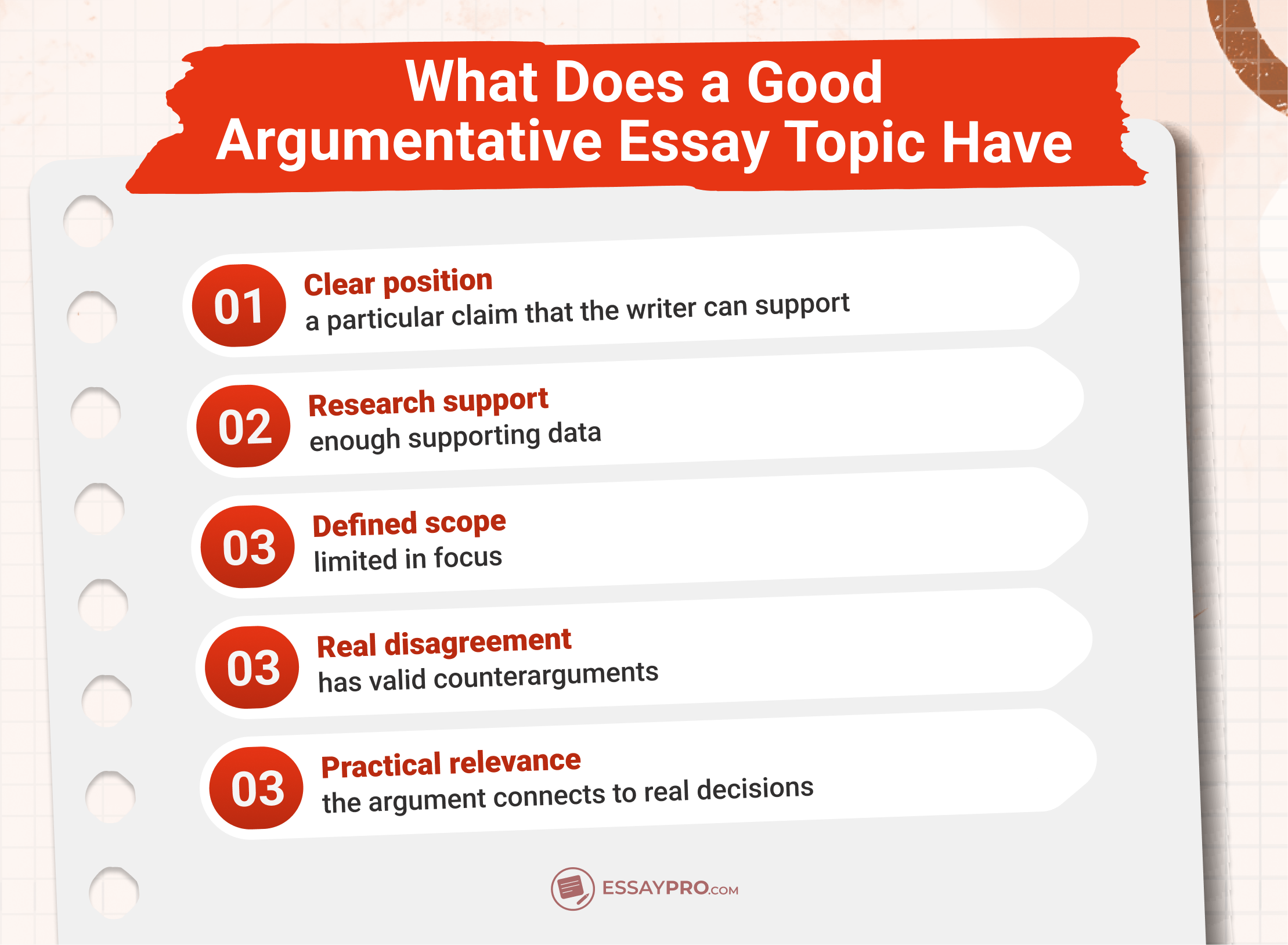
Take a look at what strong topics for argumentative essay writing tend to share:
- Clear position - A good topic produces a particular claim that the writer can support
- Research support - Has suitable supporting data (e.g., statistics, examples) that are relevant to the claim
- Defined scope - Limited in focus to a single issue or condition
- Real disagreement - The claim has valid counterarguments
- Practical relevance - The argument made by the writer connects to real-world decisions or systems.
A quick comparison makes this easier to see.
Weak topic: Online learning is ineffective.
Strong topic: Should universities allow students to replace final exams with long-term project portfolios in theory-based courses?
The right argumentative essay writing service will catch this difference and build your papers according to the academic standards.
Deadline Closer Than It Looks?
Send your topic, and get a structured essay that actually argues something and holds together under counterarguments

Best Argumentative Essay Topics for 2026
We didn’t pull the topics in this article out of thin air. Most of them come from small changes in our everyday life that not enough people notice, because that’s where good arguments start. These topics are built to give you enough direction to write with confidence, without boxing you into something rigid
- Are productivity tracking apps quietly redefining what academic success looks like?
- The influence of “study-with-me” livestreams on attention span and discipline.
- Should universities require disclosure when AI tools are used in assignments?
- Why are anonymous online reviews often more important than verified expertise?
- Has personalized algorithmic content reduced students’ exposure to opposing viewpoints?
- Should group projects include individual grading based on tracked contributions?
- The habit of recording everyday moments instead of experiencing them directly
- Can “quiet quitting” exist in academic environments, and how should institutions respond?
- Does early personal branding limit genuine career exploration for students?
- Do flexible deadlines improve academic performance or weaken time management habits?
Argumentative Essay Topics by Academic Level
Students often struggle with picking the right level of complexity. A topic that works for a college paper can be too much in high school, and something too simple won’t hold up under deeper analysis. That’s why these argumentative essay topics for students are grouped by level.
Decided to buy argumentative essay instead of writing it yourself? You’ll still benefit from understanding what kinds of topics are appropriate for different educational levels.
Good Argumentative Essay Topics for College
- Should gig-economy companies offer full employment benefits to long-term workers?
- Do apps collecting biometric data infringe on people's privacy?
- Do short-term rental companies create a shortage of housing in large cities?
- Governments need to regulate the use of deepfake technology in political campaigns.
- Does 'Cancel Culture' limit everyone from having a voice online?
- Should luxury brands be held accountable for their environmental impact?
- Is remote working hindering long-term career development?
- Should social media companies be accountable for spreading misinformation?
- Does the use of algorithms in hiring reinforce discrimination?
- Should governments put restrictions on how technology corporations own data?
Argumentative Essay Topics High School
- Public figures facing backlash for old online posts raise questions about long-term accountability
- Is the thrill of participating in viral challenges excessive for teenagers?
- Are influencers sufficiently regulated in the promotion of products across social media?
- Are teenagers currently feeling pressured by what they own, especially regarding technology?
- Should parents be allowed access to their teenagers' social media accounts?
- Has the constant entertainment decreased the attention spans of younger people?
- Fast fashion companies are being criticized for promoting excessive consumption.
- Is competitive gaming reaching the same level of intensity as traditional sports?
- Should teenagers who are making money through social media content creation adhere to stricter guidelines?
- Is publicly shaming people via social media effective in holding them accountable?
Argumentative Essay Topics for Middle School
- Setting daily limits on video gaming can help children develop healthy habits.
- Is it appropriate to post pictures of other people without their permission on the internet?
- Do you think that pets should be permitted in parks?
- Toy commercials play a significant role in influencing a child's preferences.
- Families should be required to recycle at home as a standard practice.
- Reading from printed material compared to a digital format is a completely different experience.
- Should children be able to have their own social media accounts?
- Children are influenced to behave and interact with others by watching cartoons.
- Families do better when they limit screen time while eating.
- How often should children spend time outdoors?
Argumentative Essay Topics for Teenagers
- Managing their own part-time jobs helps teenagers understand money.
- Are unrealistic lifestyle expectations created by social media?
- Should teenagers decide what kind of online identity they want at age 18?
- How does working a part-time job before graduating high school improve your character?
- Are online friendships equally important as traditional friendships?
- Is the continued use of social media decreasing the number of interactions offline?
- Traveling independently develops a sense of responsibility in a teenager.
- Is it worth it to publicly share your thoughts regarding anything, considering that you may be criticized?
- Establishing an online presence at a young age can increase your chances of success in the future.
- Are teenagers impacted more by global trends than local culture?
If, by any chance, your assignment requires presentation and not just drafting, we also have a speech writing service you can use.
Argumentative Essay Topics by Subjects
Sometimes the issue isn’t the level but rather the angle. You know the subject you want, yet every idea sounds recycled or too broad to handle. That’s where targeted topics for argumentative essay writing make a difference.
Technology Argumentative Essay Topics
- Smart home devices are quietly reshaping how personal privacy is defined inside private spaces
- Should companies be required to design technology that limits addictive user behavior?
- The push for faster software updates is reducing product stability for everyday users
- Are wearable devices turning health tracking into unnecessary self-surveillance?
- Digital payment systems are accelerating the decline of cash in ways that exclude certain populations
- Should governments restrict the use of facial recognition in public transportation systems?
- The expectation of constant connectivity is changing workplace boundaries and personal time
- Are “smart cities” increasing efficiency at the cost of individual control over data?
- Subscription-based software models are limiting long-term ownership of digital tools
- Should tech companies be responsible for extending the lifespan of consumer devices?
Need more guidance on how to connect arguments logically, from reason to consequence? Check out our detailed guide on cause and effect essay structure.
Argumentative Essay Topics About AI
- AI-generated content is redefining what counts as original work
- Should AI systems be allowed to make decisions in high-risk areas like criminal sentencing?
- The use of AI in hiring processes introduces hidden bias through training data
- Are AI companions affecting how people form real emotional connections?
- Should artists be compensated when their work is used to train AI models?
- AI tools are accelerating misinformation by making content generation easier and faster
- Is it ethical to use AI to recreate the voices of real people without consent?
- The reliance on AI for decision-making is reducing human accountability in organizations
- Should there be global regulations controlling how AI systems are developed and deployed?
- AI-assisted writing tools are changing how individuals develop their own communication skills
Argumentative Essay Topics About Education
- Standardized testing has limited how students' abilities are measured.
- Should more schools decrease homework loads?
- The grading system emphasizes results over understanding.
- Are gap years now a better path than before?
- Should attendance policies be flexible to accommodate employed students?
- Is the rise in online learning changing the value of traditional classes?
- Will requiring financial literacy classes in all grades help students learn about money?
- Is academic competition shaping unhealthy priorities in students today?
- Are extracurricular activities more important than academics for college acceptance?
- Schools are expected to teach students for a job that hasn't been created yet.
Social Media Argumentative Essay Topics
- Is social media having more of an effect on shaping opinions than traditional media?
- Should social media platforms limit the visibility of extreme viewpoints?
- Is there pressure to maintain a social media presence and to present oneself online?
- Are private messaging features making people less accountable for their inappropriate behavior on social media?
- Are social media trends driving consumer purchase behaviors faster than they normally would?
- Should there be stricter requirements to verify your age for access to an established social media platform?
- Is the culture of going viral changing how people define success?
- Are content creators responsible for the actions of their audience?
- Does social media blur the lines between private life and public performance?
- Should users be given control over how the algorithm curates what they see in their feed?
Psychology Argumentative Essay Topics
- Therapy language is being used more routinely and has changed how people respond to their everyday feelings.
- Should there be stricter guidelines for mental health diagnoses to prevent the over-labeling?
- Social isolation can negatively affect an individual's long-term emotional development.
- Are personality assessments accurate enough to determine career choice?
- The availability of self-diagnosis via the internet is creating a shift in mental health awareness.
- Should all places of employment be required to offer mental health resources as part of employment standards?
- "Burnout" has become a defining feature of today's workplace culture.
- Are the coping strategies people are using and sharing on social media always good for their long-term mental health?
- Childhood experiences will provide the basis for explaining adult behavior.
- Should emotional intelligence be formally evaluated in the professional environment?
Healthcare Argumentative Essay Topics
- Rising healthcare costs are changing how people delay or avoid treatment
- Should pharmaceutical companies be allowed to set drug prices without stricter regulation?
- Preventive care programs deserve more funding than emergency treatment systems
- Are private healthcare systems creating unequal access to basic medical services?
- Telemedicine is reshaping how patients interact with doctors on a routine basis
- Should hospitals be required to disclose treatment costs before procedures?
- Medical tourism is growing as a response to domestic healthcare expenses
- Are wearable health devices reliable enough to influence medical decisions?
- Universal healthcare policies could shift long-term public health outcomes
- Should patients have full control over access to their medical records?
Mental Health Argumentative Essay Topics
- The language of mental health is becoming more common in everyday conversations
- Should mental health screenings be required in workplaces?
- Self-help content online is shaping how people approach emotional struggles
- Are mental health apps providing real support or creating dependency?
- Therapy culture is influencing how people define personal boundaries
- Should insurance plans cover long-term therapy without strict limitations?
- Social expectations are changing how people express stress and burnout
- Are digital spaces making it harder to disconnect from emotional triggers?
- Mental health awareness campaigns are shifting public perception of treatment
- Should schools introduce structured mental health education at earlier stages?
Argumentative Essay Topics About Immigration
- Immigration policies are directly shaping labor markets in major economies
- Should countries prioritize skilled workers over humanitarian admissions?
- Border control strategies are influencing international relations
- Are strict immigration laws effective in reducing undocumented migration?
- Cultural integration policies affect how communities adapt over time
- Should undocumented immigrants have access to public services?
- Economic contributions of immigrants are often underestimated in policy debates
- Are immigration quotas limiting long-term economic growth?
- Family reunification policies shape migration patterns across generations
- Should citizenship processes be simplified for long-term residents?
Social Issues Argumentative Essay Topics
- Income inequality is affecting access to basic opportunities across societies
- Should governments regulate housing markets to prevent price inflation?
- Public transportation systems influence economic mobility in urban areas
- Are community policing strategies effective in building public trust?
- The rise of remote work is changing social interaction patterns
- Should minimum wage laws be adjusted based on regional living costs?
- Digital access is becoming a necessary condition for participation in society
- Are public spaces becoming less accessible due to commercialization?
- Social movements are shaping how institutions respond to public pressure
- Should governments implement stricter policies to reduce homelessness?
Criminal Justice Essay Topics Argumentative
- Sentencing laws are influencing long-term prison populations
- Should non-violent offenses receive alternative forms of punishment?
- The use of surveillance technology is expanding within law enforcement
- Are rehabilitation programs more effective than traditional incarceration?
- Bail systems are creating unequal outcomes based on financial status
- Should juveniles be tried as adults in serious criminal cases?
- Wrongful convictions highlight gaps in the justice system
- Are plea bargains undermining the fairness of trials?
- Private prisons are shaping how incarceration systems operate
- Should law enforcement agencies adopt stricter accountability measures?
Environmental Argumentative Essay Topics
- Climate policies are influencing how industries adapt to new regulations
- Should governments enforce stricter limits on industrial emissions?
- Renewable energy adoption is reshaping national energy strategies
- Are individual lifestyle changes enough to impact environmental outcomes?
- Deforestation is affecting biodiversity on a global scale
- Should corporations be held financially responsible for environmental damage?
- Urban development is reducing natural ecosystems in growing cities
- Are carbon offset programs effective in reducing emissions?
- Water scarcity is becoming a critical issue in certain regions
- Should plastic production be restricted at a global level?
Sports Argumentative Essay Topics
- Professional sports salaries are increasing faster than other industries
- Should college athletes receive financial compensation for their performance?
- Technology is changing how sports performance is measured
- Are performance-enhancing substances still a major issue in modern sports?
- Gender divisions in sports are being re-evaluated across competitions
- Should refereeing decisions rely more heavily on automated systems?
- Youth sports programs influence long-term athletic development
- Are extreme training methods affecting athlete health over time?
- Sports sponsorships shape public perception of brands
- Should athletes be held to higher standards of behavior off the field?
Pop Culture Argumentative Essay Topics
- Streaming platforms are reshaping how audiences consume entertainment
- Should celebrities be held accountable for their influence on public behavior?
- Fan communities are shaping the success of media franchises
- Are remakes and reboots limiting originality in film and television?
- Viral trends are influencing how quickly content becomes outdated
- Should public figures separate personal opinions from their professional roles?
- Music streaming algorithms affect how artists gain recognition
- Are award shows still relevant in modern entertainment culture?
- Influencer culture is changing how brands connect with audiences
- Should online platforms regulate controversial content in entertainment?
Other Argumentative Essay Ideas
Some ideas work precisely because they don’t fit neatly into a subject label. It means the angle is specific, maybe a bit unexpected, and grounded in real behavior instead of textbook categories. This section covers exactly that, and even if you decide to use writing services, it will still help you to know what themes are actively being discussed right now.
Unique Argumentative Essay Topics
- The rise of digital “decluttering” reflects changing attitudes toward ownership
- Should people be allowed to edit or delete their past online posts without a trace?
- Subscription fatigue is influencing how consumers evaluate value in services
- Are loyalty programs actually shaping long-term buying behavior?
- Voice assistants are changing how people search for and process information
- Should companies limit how often they update app interfaces?
- The expectation of instant replies is reshaping communication norms
- Are online ratings systems reliable enough to influence major decisions?
- Digital avatars are becoming extensions of personal identity in online spaces
- Should public Wi-Fi access be considered a basic service in urban areas?
Debatable Argumentative Essay Topics
- Public apologies from brands are becoming part of marketing strategy
- Should companies be required to respond to negative customer reviews?
- The concept of “overwork” is being normalized in competitive environments
- Are digital detox trends actually improving well-being?
- Workplace surveillance tools are increasing employer control over employees
- Should tipping be replaced with fixed service charges in all industries?
- The gig economy is reshaping expectations around job stability
- Are user agreements designed to discourage people from reading them?
- Influencer collaborations are blurring the line between recommendation and advertisement
- Should online platforms limit how often users can refresh content feeds?
Funny Argumentative Essay Topics
- Should people be judged for rewatching the same show multiple times?
- The “seen but not replied” message creates unnecessary social tension
- Are group chats becoming harder to manage than actual friendships?
- Should voice messages replace texting in everyday communication?
- The obsession with aesthetic coffee photos says more than people admit
- Is it acceptable to leave a shopping cart in the wrong place?
- Are food delivery apps encouraging people to avoid basic cooking skills?
- Should autocorrect mistakes be considered part of someone’s personality?
- The unwritten rules of elevator behavior deserve more attention
- Is it rude to watch videos without headphones in public spaces?
Easy Argumentative Essay Topics
- Daily routines help people stay organized and productive
- Should people limit how much time they spend on their phones?
- Watching movies at home is changing entertainment habits
- Is it better to plan your day in advance?
- Listening to music while working can improve concentration
- Should people try to reduce unnecessary spending?
- Outdoor activities support better physical health
- Is keeping a daily schedule helpful for managing time?
- Sharing responsibilities at home creates a better balance
- Should people take breaks during long periods of work?
Half-Written Draft? No Direction?
Hand it over. We will shape your idea into a focused argument with real evidence and a clean structure.
The Last Word
A strong argumentative essay begins with a clear decision on the topic. This decision sets the limits for your paper, along with what kind of arguments and evidence you’ll need. When the idea is well-chosen, the rest (your claim, structure, examples) line up a lot faster.
When you choose the topic, make sure to keep the scope tight and make sure disagreement exists. Choose something grounded in real situations. Get that part right, and the rest of the essay stops feeling forced.
FAQs
How Do I Choose a Unique Topic That Hasn't Been Overused?
What Makes a Topic Debatable for an Argumentative Essay?
What Are the Best Topics for an Argumentative Essay?
What Are Good Argumentative Essay Topics?

Daniel Parker
is a seasoned educational writer focusing on scholarship guidance, research papers, and various forms of academic essays including reflective and narrative essays. His expertise also extends to detailed case studies. A scholar with a background in English Literature and Education, Daniel’s work on EssayPro blog aims to support students in achieving academic excellence and securing scholarships. His hobbies include reading classic literature and participating in academic forums.

.webp)