
A logical fallacy is an error in reasoning that makes an argument fall apart under scrutiny. The straw man fallacy swaps a person's real point for a weaker version that is easy to knock down. The ad hominem fallacy goes after the speaker's character and leaves the actual claim untouched. Both distort a debate while dodging the real issue.
Those two are just the start.
This guide sorts the 15 most common reasoning errors into plain categories and gives clear examples of each one. Learn to spot them and any debate, essay, or late-night argument becomes far easier to win.
What Is a Logical Fallacy?
A logical fallacy is a broken argument that clear reasoning can expose as false. The errors fall into two categories.
- A formal fallacy fails because its logical structure does not hold, so the conclusion cannot follow from what came before it
- An informal fallacy fails because of a problem in its wording, content, or the situation around it, even when the shape of the argument looks fine.

15 Types of Logical Fallacies
15 logical fallacies account for most reasoning errors in debate:
- Ad Hominem
- Straw Man
- Red Herring
- Equivocation
- Slippery Slope
- Hasty Generalization
- Appeal to Authority
- False Dilemma
- Bandwagon
- Appeal to Ignorance
- Circular Argument
- Sunk Cost
- Appeal to Pity
- Causal Fallacy
- Appeal to Hypocrisy
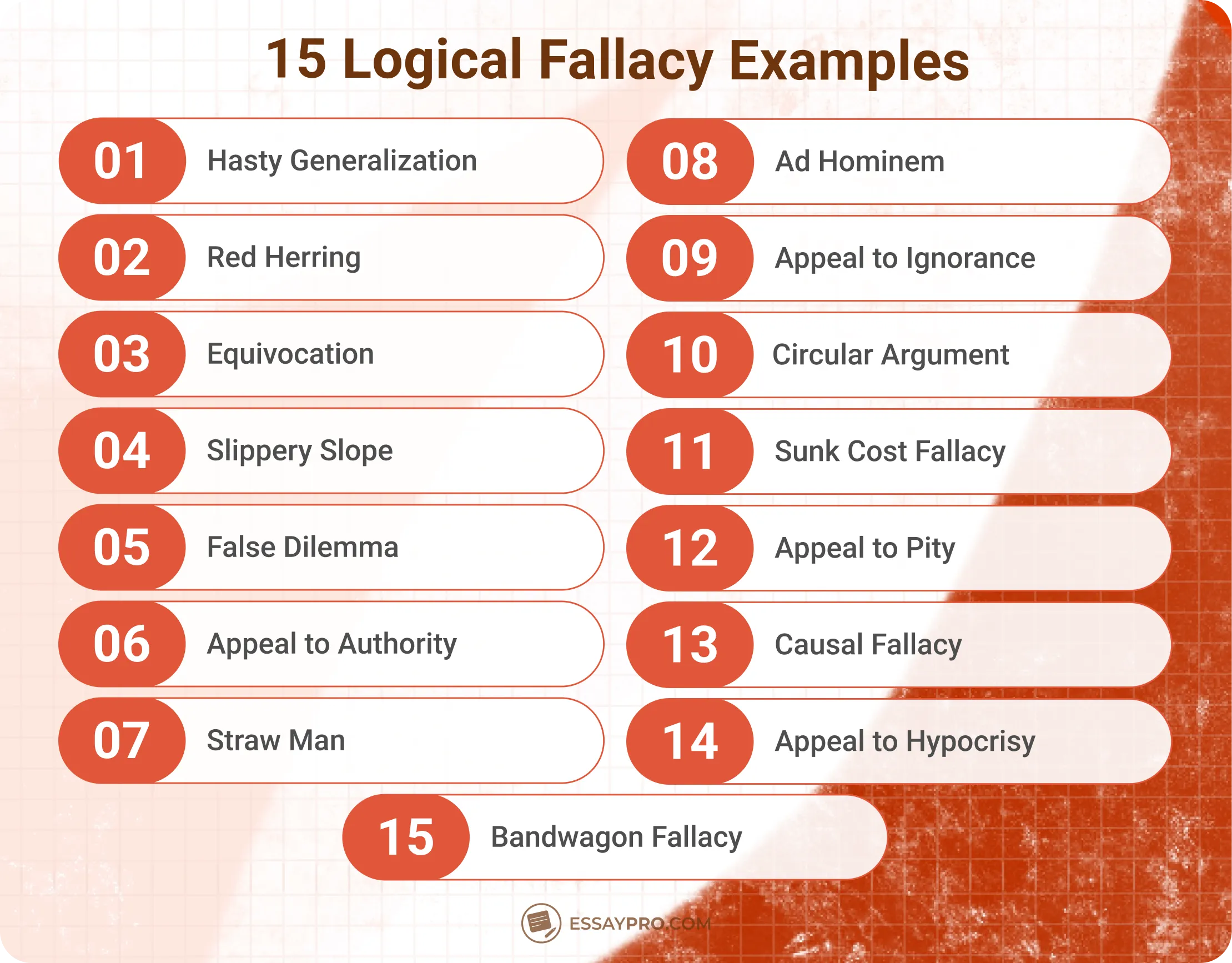
Most of the common fallacies are informal:
- Hasty Generalization: reaches a broad conclusion based on limited evidence.
- Red Herring: pulls the discussion toward a different point.
- Equivocation: shifts the meaning of a key term during the argument.
- Slippery Slope: takes a small action and predicts an exaggerated outcome.
- False Dilemma: presents a situation as having only two possible choices, while additional paths exist.
Now, let's get into the list of examples of fallacies in more detail.
Ad Hominem Fallacy
An ad hominem fallacy answers a claim by attacking the person who made it instead of the point itself. The rejection hangs on someone's character, background, appearance, or another trait that has no connection to the matter under discussion. It runs rampant in politics, where it goes by the nickname "mudslinging," and it counts as an unethical move because it lets a speaker turn an audience against an opponent without ever engaging the real question.
- A city councilor presents three years of traffic data to back a new bike lane. An opponent dismisses all of it by pointing out the councilor failed his driving test twice.
- During a thesis defense, a student walks through survey results on sleep and memory. A committee member brushes the findings aside by saying the student looks too tired to understand rest.
Straw Man Fallacy
A straw man fallacy replaces someone's actual position with a distorted, usually more extreme version, then attacks that easy target and claims a win.
A straw man is a harmless scarecrow, a limp stand-in that anyone can knock over, and it stands for a claim the opponent never made. Beating the fake version lets the attacker look far stronger than a fair fight would allow.
- A researcher recommends two extra weeks of testing before launch. A colleague fires back that the researcher wants to stall the launch forever and bankrupt the company.
- A parent suggests capping screen time on school nights. The reply accuses them of wanting to ban every gadget in the house.
Red Herring Fallacy
A red herring fallacy drops a side issue into the discussion to pull focus off the original question. The detour usually rides on some minor fact that barely touches the real matter, which makes it a handy way to steer talk toward safer or easier ground. Not every red herring is deliberate, though. A speaker can wander onto an irrelevant point by accident and drag the whole conversation sideways without meaning to.
- A tenant asks why the heating has been broken for three weeks. The landlord responds by listing how many neighbors pay their rent late.
- A finance lead raises the department's overspending. The manager answers with a warm speech about how hard the team worked over the holidays.
Equivocation Fallacy
An equivocation fallacy leans on a word or phrase used in a slippery way, so the speaker says one thing while meaning another. The same word carries two senses, and the swap between them muddies the conclusion. In a joke or a bit of wordplay it does no harm. The trouble starts in a speech, a debate, or a report, where the double meaning is built to make an audience accept something the plain facts would not support.
- A sign reads "Fine for parking here." One reading means a penalty. The other means parking is acceptable, and the two senses get treated as one.
- A candidate campaigns on "change," and voters hear real reform. Later the candidate explains that every administration brings change because staff turn over and time passes.
Slippery Slope Fallacy
A slippery slope fallacy claims that one small step will necessarily set off a chain of events ending somewhere disastrous. It starts from an ordinary, harmless action and insists it must lead to unlikely or downright absurd outcomes, all without a shred of evidence that the links would ever connect. The alarm sounds convincing precisely because the intervening steps go unexamined.
- A library considers a ten-cent late fee. The objection warns it will grow to cover every checkout until only wealthy patrons can afford to read.
- A company weighs one work-from-home day a week. Someone argues nobody will ever return, the office will be sold, and the culture will disappear.
Hasty Generalization Fallacy
A hasty generalization draws a broad conclusion from a sample far too small to support it. One or two cases get treated as proof of a rule. Part of why it spreads so easily is that people disagree on how much evidence counts as "enough," and that bar shifts with the setting. A scientific claim demands far more backing than a debate over house chores, so the same thin evidence that fails in a lab can pass unnoticed in casual conversation.
- A traveler has rude exchanges with two shopkeepers in a new city and concludes the whole city is unfriendly.
- A manager interviews three recent graduates who fumble a technical question and decides the entire graduating class is unprepared.
Appeal to Authority Fallacy
An appeal to authority fallacy props up a claim with a famous name whose weight does not belong on the topic. An expert opinion can count as real evidence, so the problem starts when that authority gets stretched past its limits, invoked without proper credentials, or applied to a field the person knows nothing about. At that point the name is doing the persuading, not the facts.
- A champion swimmer endorses a brand of vitamins, and shoppers assume the pills must work because she takes them.
- A physics professor declares a particular economic policy the correct one, and the audience accepts it on the strength of his title.
False Dilemma Fallacy
A false dilemma fallacy squeezes a complex situation into two choices when several more exist. The middle ground vanishes, and one side gets framed as the only sane option. The tactic works by polarizing an audience, since a forced choice between two extremes pushes people toward the answer the arguer wants. It turns up often in politics, where it becomes a way to pressure the public into backing a single position and treating everything else as unthinkable.
- A manager tells the team they either work the weekend or the client walks, ignoring the option of a revised deadline.
- A campaign ad insists voters can back the new stadium or watch the town's economy die, with no other path on the table.
Bandwagon Fallacy
A bandwagon fallacy treats popularity as proof, arguing that an idea must be right because so many people already accept it. Headcounts replace reasons. The flaw is that wide agreement says nothing about whether a claim is actually true. Crowds get things wrong all the time, whether through confusion, poor information, or plain stubbornness, so the number of believers offers no guarantee about the belief.
- A shopper buys a skincare product because it has half a million likes, taking the follower count as evidence it works.
- A student adopts a position in a class debate once she sees most classmates raise their hands for it, not because the argument convinced her.
Appeal to Ignorance Fallacy
An appeal to ignorance fallacy calls a claim true because no one has proven it false, or false because no one has proven it true. Missing evidence gets mistaken for an answer. The sly part is how it flips the burden of proof, pushing the job of disproof onto everyone else rather than resting it on the person making the claim. The same empty logic can even be used to defend two opposite conclusions at once.
- A supplement seller insists the product has no side effects because no study has ever reported one.
- A coworker argues the office is haunted since nobody has been able to explain the strange noises at night.
Circular Argument Fallacy
A circular argument fallacy uses its own conclusion as the proof for that conclusion. The reasoning loops back on itself and never brings in outside support. A statement of that kind leans on a claim as both its starting premise and its ending point, so it only wears the costume of an argument. Strip away the loop and all that remains is the original assumption, repeated.
- A manager says the policy is mandatory because everyone is required to follow it.
- A reviewer calls the novel a classic because classics are the books that end up on lists like this one.
Sunk Cost Fallacy
A sunk cost fallacy keeps a person committed to a losing choice because of the time, money, or effort already poured in. The past spending drives the decision instead of what makes sense now. "Sunk cost" is the economic term for money or effort that has already gone out the door and cannot be clawed back. Since none of it returns either way, letting it steer the next move only piles new losses on top of old ones.
- A startup pours six more months into a product no one is buying because it already burned two years building it.
- A moviegoer sits through a film she stopped enjoying an hour ago because she paid full price for the ticket.
Appeal to Pity Fallacy
An appeal to pity fallacy tries to win agreement by stirring sympathy rather than offering reasons. Emotion does the work the evidence should be doing. The aim is to tug at an audience's feelings hard enough that the actual merits of the case fade into the background. Once the sympathy takes hold, the listener judges the emotion in front of them instead of the argument on the table.
- A student asks for a passing grade by describing how hard his semester has been, saying nothing about the quality of the assignment.
- A contractor requests final payment for shoddy work by explaining how badly his business needs the money.
Causal Fallacy
A causal fallacy assumes one event caused another with nothing to show the two are actually linked. Sequence or coincidence gets mistaken for cause. The label works as an umbrella for a few related errors. One is false cause, where a conclusion about the cause gets drawn without enough evidence to back it. Another is the post hoc error, where something is tagged as the cause simply because it happened first.
- Sales climb the same week a store repaints its entrance, and the owner credits the paint for the jump.
- A runner wears a new pair of socks, sets a personal best, and decides the socks made the difference.
Appeal to Hypocrisy Fallacy
An appeal to hypocrisy fallacy, also called tu quoque, deflects criticism by accusing the critic of the same fault instead of answering the point. The original issue gets buried under the counterattack. The whole move is an effort to dodge blame, using the other side's apparent inconsistency to cancel out the criticism and steer attention away from the matter that was raised.
- A doctor advises a patient to quit smoking, and the patient shoots back that the doctor is overweight, so the advice can be ignored.
- A senator is challenged on missed votes and replies that his opponent skipped plenty of sessions too, never addressing his own record.
How to Use Logical Fallacies Right
Spot a logical fallacy by taking the argument apart in four steps: separate its pieces, name the unspoken assumption, restate it plainly, and check the evidence. Each step exposes a different weak point where flawed reasoning hides.
- Break the argument into separate parts. Put the claim on its own line, the supporting explanation on another, and the conclusion below them. Two gaps jump out:
- The conclusion reaches further than the support allows.
- The claim has no real backing at all.
- Look for the hidden step. Most arguments lean on an assumption nobody states. Ask what the reasoning needs to hold together, then write that assumption in plain words and test it.
- Rephrase the argument in clear language. Say it back in the simplest terms, as if explaining it to someone new to the topic.
- Test the evidence for specific detail. Strong support points to something you can trace:
- Numbers, dated events, named sources, direct quotes.
- Vague or purely emotional backing signals a shaky conclusion.
Final Word
Logical fallacies are reasoning errors that make an argument collapse under scrutiny, and the 15 here cover the ones you'll meet most in debate. Spot them by breaking an argument into parts, naming its hidden assumption, restating it plainly, and checking whether the evidence holds.
FAQs
What Is a Logical Fallacy Example?
What Is an Example of a Logical Fallacy?
What Example of Logical Fallacy Do We Use in Daily Conversations?
Which Logical Fallacy Is Often Used in Social Media Debates?
What Is an Example of Logical Fallacy False Dilemma?

Annie Lambert
specializes in creating authoritative content on marketing, business, and finance, with a versatile ability to handle any essay type and dissertations. With a Master’s degree in Business Administration and a passion for social issues, her writing not only educates but also inspires action. On EssayPro blog, Annie delivers detailed guides and thought-provoking discussions on pressing economic and social topics. When not writing, she’s a guest speaker at various business seminars.