Any college essay format focuses on structure before style. Keep one-inch margins, double-space the text, and use a readable 12-point font such as Times New Roman. Indent each paragraph by half an inch. Add a header with your last name and page number in the top-right corner. On the first page, include your name, your instructor’s name, the course, and the date in the top-left.
Professional essay formatting guides the reader's attention and shows that you take your work seriously. If you'd rather spend time actually writing instead of formatting, EssayPro can take over the technical details. Whenever you're short on time and need a service to write essays for money, this is the perfect option.
What Is Essay Format?
Essay format is a set of rules that tells you how to organize and present your writing. These essay formatting guidelines cover everything from page layout to citation style. The goal is to make your ideas easy to follow and visually consistent. It usually includes:
- The structure: introduction, body, and conclusion.
- The layout: font type, size, margins, and line spacing.
- The citation style: how you reference sources, like APA, MLA, or Chicago.
These details might seem technical, but they determine how your paper looks and reads. Especially in longer essays, a consistent format makes your main points clear and professional.
AI Messing Up Your Citations and Formatting?
Our pros handle the layout so your paper looks flawlessly academic.

Essay Format Structure
Every essay follows a logical sequence: introduction, body paragraphs, and conclusion. Strong writing formats guide the reader's interest through your main ideas step by step. The main parts of most essays, including the argumentative essay structure, include:
- Introduction
- Present the topic clearly.
- Give background information.
- State your thesis statement or main point.
- Body Paragraphs
- Start with a topic sentence.
- Add supporting evidence such as facts, data, or examples.
- Explain how the evidence supports your thesis statement.
- Conclude each paragraph with a concise summary.
- Conclusion
- Restate your thesis in new words.
- Summarize key points in the final paragraph.
- End with a final thought or call to action.
Check out our guide on how to write an essay introduction if you need to start your paper off strong.
General Essay Formatting Guidelines
Every strong essay follows a strict academic writing format. It begins with a title page and an abstract, followed by a table of contents. The introduction sets the tone, the body paragraphs carry your main ideas, and the conclusion brings the point back in focus. A complete bibliography then closes the work.
Now, let's take a look at each section:
How to Format an Essay: Simple Explanation
Now that you know what an essay format is and what parts an academic paper usually includes, take a look at the organized list below and follow the steps on how to format an essay correctly:
- Use standard font size 12, usually Times New Roman.
- Set one-inch margins on all sides.
- Double-space the entire text.
- Indent the first line of each paragraph.
- Include a header with your last name and page number.
- Add a title centered at the top of the first page.
- Follow the required citation style for your course, like MLA or APA.
- Check for spacing, alignment, and consistent headings.
MLA Format Essay (Modern Language Association)
The MLA format is one of the most widely used standards by scholars and academic writers worldwide. But what is MLA format for an essay? This essay format is designed to support scholarly text and research in the field of literature and humanities. Its features cater to the needs of these disciplines, emphasizing clear presentation, accurate attribution of sources, and structured argumentation.
The following table shows how you are expected to structure your text when writing in MLA format:
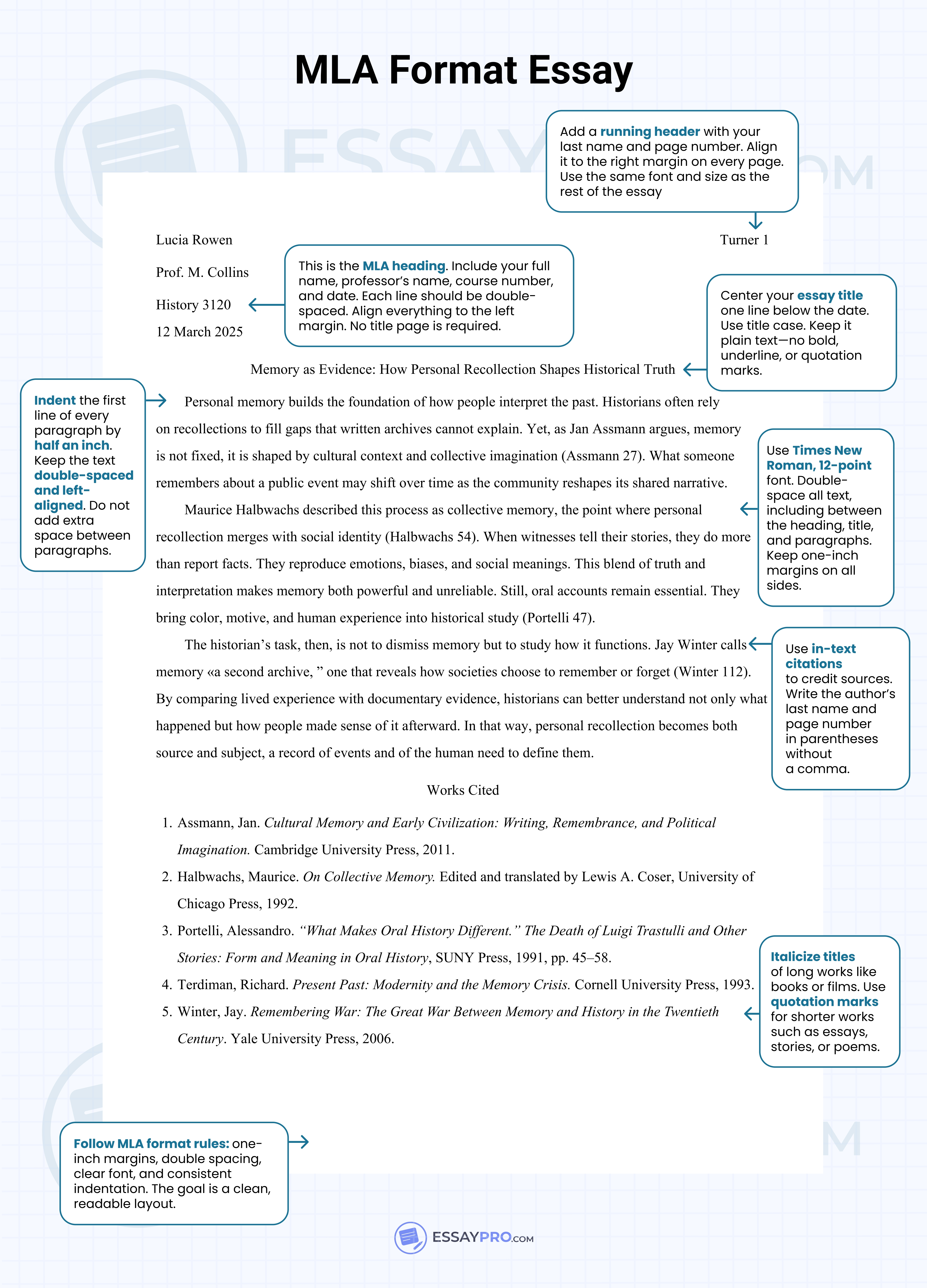
Take a look at a sample MLA header to get a better idea about how your format for essay should look.

MLA Essay Format Example
An essay in MLA format opens with a simple header: your last name and the page number aligned in the top right corner of every page. On the first page, your details come first: name, instructor, course, and date. The title sits centered on the next line, clean and unembellished. One line below, the main text begins, with each paragraph indented half an inch. The entire document stays double-spaced, written in a clear, professional font such as Times New Roman at size 12.
APA Essay Format (American Psychological Association)
The APA format essays are widely used for research papers on topics such as education, psychology, and social science. One of the benefits of using this formatting is that it has a consistent structure that allows readers to focus on the content of the essay. This clear citation system ensures that all sources are properly accounted for, eliminating any form of plagiarism. This formatting also focuses on core elements like methodology, results, and data analysis to ensure that all information in the text is presented accordingly.
Take a look at the table below for more details:
You can clearly see how the parts play out in the essay writing format sample below:

APA Essay Format Example
An APA-style essay begins with a title page that holds the paper’s title, your name, and your university. Each line is centered and double-spaced to keep the layout clean and balanced. The main text follows with one-inch margins on every side, written in Times New Roman, size 12, and spaced evenly throughout. At the top of each page, a page number appears on the right. Professional papers also include a shortened title in all capital letters on the left. Within the paragraphs, in-text citations use the author’s surname followed by the year of publication, keeping every reference precise and traceable.
APA vs MLA: Differences
APA and MLA are two of the most popular types of formatting used worldwide. While both determine the way the content is organized, they possess distinct differences. The APA format is used mainly for topics in the literature and humanities disciplines, while the MLA format is used for topics in education, psychology, and social sciences.
Here's a breakdown of how each of these styles differs from the others:
- In-text citation: When using MLA style, place the last name of the author and page number in parentheses, but when using APA format, insert the last name of the author, a comma, the publishing year, a comma, and a “p.” and the page number.
- Bibliography: The bibliography section of an MLA-styled text is referred to as the Works Cited Page. The authors and titles listed in this section of the text are listed alphabetically. When citing multiple works from the same author, list all the works alphabetically and state the author's name once. Subsequent works are listed with three hyphens: a period, a space, the name of the title, and a period. The bibliography section of an APA-styled text is called 'References.' APA style requires that authors be listed alphabetically and their works chronologically. When citing multiple works from the same author, list them chronologically, but include the author's name in all listings.
- Title of Articles: For MLA-styled text, place the title of the text in quotation marks and capitalize all major words. On the other hand, APA format only requires the first word to be capitalized.
- Spacing: MLA style requires double spacing in the header and body, while APA requires double spacing on the title page and main body.
Chicago Essay Format
The Chicago style essay format was created by the University of Chicago to bring order to academic writing. This format appears most often in history, literature, and the arts, where evidence and context matter as much as argument. Chicago offers two systems: the Notes and Bibliography style uses footnotes to cite sources, while the Author-Date system keeps references in parentheses within the text. Each method serves the same goal: making research easy to follow and sources easy to verify.
The table below describes the main principles of the Chicago format essays:
Take a look at the standard essay format according to the Chicago Style.

Chicago Essay Format Example
The title page of a Chicago-style essay stands separately and is followed by double-spaced body text. You write with a 12-point Times New Roman font, and maintain one-inch margins on every side. Paragraphs start with a half-inch indent to maintain uniform structure. Page numbers are put in the top corner of each page, whereas citations appear either as footnotes or endnotes, based on which of the two versions you're using. A detailed bibliography at the end lists the sources in alphabetical order.
Other Essay Formats
While the APA, MLA, and Chicago style essay formats are some of the most popular formatting styles used worldwide, there are other formats that can still be applied to literary texts. That's where the IEEE and AMA formats come in.
Institute of Electrical and Electronics Engineers (IEEE)
The IEEE format is widely used in engineering, computer science, and technology research. It features numbered in-text citations linked to a reference list, ensuring precision. The advantages of this style include clear citation of technical sources, conciseness, compatibility with research publications and conferences, and promoting consistency in presenting technical and scientific findings globally.
American Medical Association (AMA)
The AMA (American Medical Association) format is primarily used in medicine, health sciences, and biological research. It employs superscript numbers for in-text citations linked to a numbered reference list. Advantages include concise citation, a focus on evidence-based content, and standardization for medical journals, ensuring credibility and facilitating accurate referencing in scientific communication.
Reliable, Human-Written Papers
EssayPro pairs you with expert writers for results you’ll feel confident submitting.
The Final Word
To format your essay well, start with order and end with consistency. Layout, spacing, and citations are what hold the paper together. Each style has its own logic, but they all aim for the same thing: clarity. A well-formatted essay looks polished and reads smoothly, leaving no distraction between the reader and your main ideas.
When those details feel hard to manage, EssayPro can step in. All you have to do is leave us a note: 'Rewrite my essay!' and our professionals will take over both the drafting and formatting processes.
FAQs
What Is Essay Format?
How To Format A College Essay?
How Do I Structure An Essay?
Which Font And Spacing Are Appropriate For An Essay?
What Mistakes Should I Avoid When Formatting My College Essay?

Adam Jason
is an expert in nursing and healthcare, with a strong background in history, law, and literature. Holding advanced degrees in nursing and public health, his analytical approach and comprehensive knowledge help students navigate complex topics. On EssayPro blog, Adam provides insightful articles on everything from historical analysis to the intricacies of healthcare policies. In his downtime, he enjoys historical documentaries and volunteering at local clinics.
- Basic Essay, Literature Review and Report Structure. (2024, January 15). https://www.jcu.edu.au/students/learningcentre/during-the-study-period/academic-writing/basic-essay-structure
- Hillier, A. (n.d.). LibGuides: How to write an essay: Essay structure. https://libguides.newcastle.edu.au/ https://libguides.newcastle.edu.au/how-to-write-an-essay/essay-structure
- Strategies for Essay Writing. (2019). https://www.harvard.edu/. https://writingcenter.fas.harvard.edu/pages/strategies-essay-writing