
A case study is an academic analysis of a real situation examined in depth to understand a specific problem and the response to it. Across different subjects, the focus is narrow, specific, and fully evidence-driven. This guide will teach you how to draft an effective case study using straightforward instructions. Here, you will find:
- A practical case study format for students you can use as a reference
- A step-by-step writing guide that mirrors academic expectations
- Subject-specific examples across common disciplines
- A free outline template you can reuse across assignments
EssayPro’s experts can give you a hand with different assignments across all levels and subjects. You can even connect with our dissertation writing services if you’re moving on to the higher stages in your education.
Case Study vs. Research Paper: Key Differences for Students
A case study and a research paper ask students to think in different ways. A research paper explores a broad academic question through theory and credible sources. A case study analyzes one specific real-world situation and explains how a concrete problem was addressed.
Pro tip: Case studies often use more direct language to explain decisions and outcomes, while research papers expect more formal phrasing and heavier citation density.
Case Study 3-Act Formula
A clear case study follows a simple structure. It presents a problem, explains what was done about it, and shows what happened as a result. The three-act formula helps keep the analysis organized and prevents the case from turning into a loose collection of facts.
Act I: The Problem
This section explains what is being studied and why it matters. It identifies the subject, describes the situation, and states the exact problem. The reader should understand who is affected, what is going wrong, and why the issue requires attention. The purpose is to define the problem clearly and set boundaries for the rest of the case.
Act II: The Solution
This section explains the response to the problem. It describes the actions taken, the methods used, and the reasoning behind those choices. Research methods, interventions, policy changes, or design decisions belong here. Every step should connect directly to the problem defined earlier. The purpose is to show how the problem was addressed in practice.
Act III: The Result
This section shows what changed after the solution was applied. It presents outcomes using data, observations, or measurable results. The focus stays on evidence rather than opinion. The purpose is to demonstrate whether the solution worked and how the results relate to the original problem.
Pro Tip: In marketing case studies, Act III functions as social proof. It shows a real outcome tied to a recognizable problem, which builds trust through demonstrated success rather than claims.
Here’s a quick formula:
Problem (Act I) > Solution (Act II) > Result (Act III) > Conclusion.
Meanwhile, if deadlines are getting close, feel free to use EssayPro’s essay writing service!
Analysis of Case Studies Feeling Impossible?
Get professional insight and deep analysis instantly.

The Standard Case Study Format (8 Essential Parts)
The typical case study format gives your paper an internal logic that readers can follow without effort. Each section answers a different question about the case and signals academic control. This structure supports analysis, evidence use, and decision-making. It also helps students manage complicated material without losing focus, which matters when deadlines tighten. This section includes a detailed breakdown of a case study format for students with all its essential parts.
1. Executive Summary
The executive summary is a compressed version of the entire case. It identifies the subject, states the main problem in one or two clear sentences, summarizes the method used, and presents the final outcome. When an executive summary is required, instructors may use it to quickly assess clarity and direction before reading the full paper. Strong summaries emphasize conclusions and implications rather than background detail.
Pro Tip: Write this section last once you’ve already drafted the rest of the paper.
2. Background & Context
This section is important for case studies and almost all kinds of custom essays alike. It states the case within its real environment. It explains who is involved, when events occurred, and which conditions shaped decisions. Organizational structure, market conditions, institutional rules, or social factors often belong here. Well-developed context prevents shallow conclusions by showing the pressures and limitations that influenced every action.
3. Problem Identification (The “Challenge”)
Problem identification isolates the central issue and defines it with evidence. This section explains how the problem emerged, who was affected, and why it required intervention. Data points, documented complaints, performance gaps, or observed failures help anchor the problem in reality. Precision here protects the entire analysis from drifting off course.
4. Analysis & Evaluation
Analysis explains why the problem existed and how its components interacted. This section interprets data, applies relevant theories, and examines causal relationships. Patterns, constraints, and contributing factors receive careful attention. The format of case study analysis requires logical progression, which is why students often ask for help with essay at this stage.
5. Proposed Solutions
Proposed solutions translate analysis into action. Each recommendation should respond directly to a cause identified earlier and reflect realistic constraints. Discussion of feasibility, resource demands, and anticipated impact strengthens credibility. This section shows judgment rather than creativity alone.
6. Implementation Plan
The implementation plan explains how the solution would be carried out in practice. It explains sequencing, responsibility allocation, timelines, and resource use. Clear operational detail shows how decisions moved into execution and where adjustments occurred during the process.
7. Results & Recommendations
This section presents measurable outcomes and explains their significance. Data trends, performance shifts, or observed changes demonstrate impact. Recommendations build on these results and point toward future actions. This section often carries the strongest evaluative weight.
8. References & Appendices
References document every source that informed the case, following the required citation style with accuracy. Appendices store extended data, instruments, or technical material that support the analysis while keeping the main narrative readable and focused.
How to Write a Case Study in 5 Steps
Writing a case study follows a clear process, even though the final product may look different across academic, medical, or business contexts. The work moves through investigation, interpretation, and presentation. Think of this section as a practical case study outline that keeps you oriented while still leaving room for judgment and nuance.
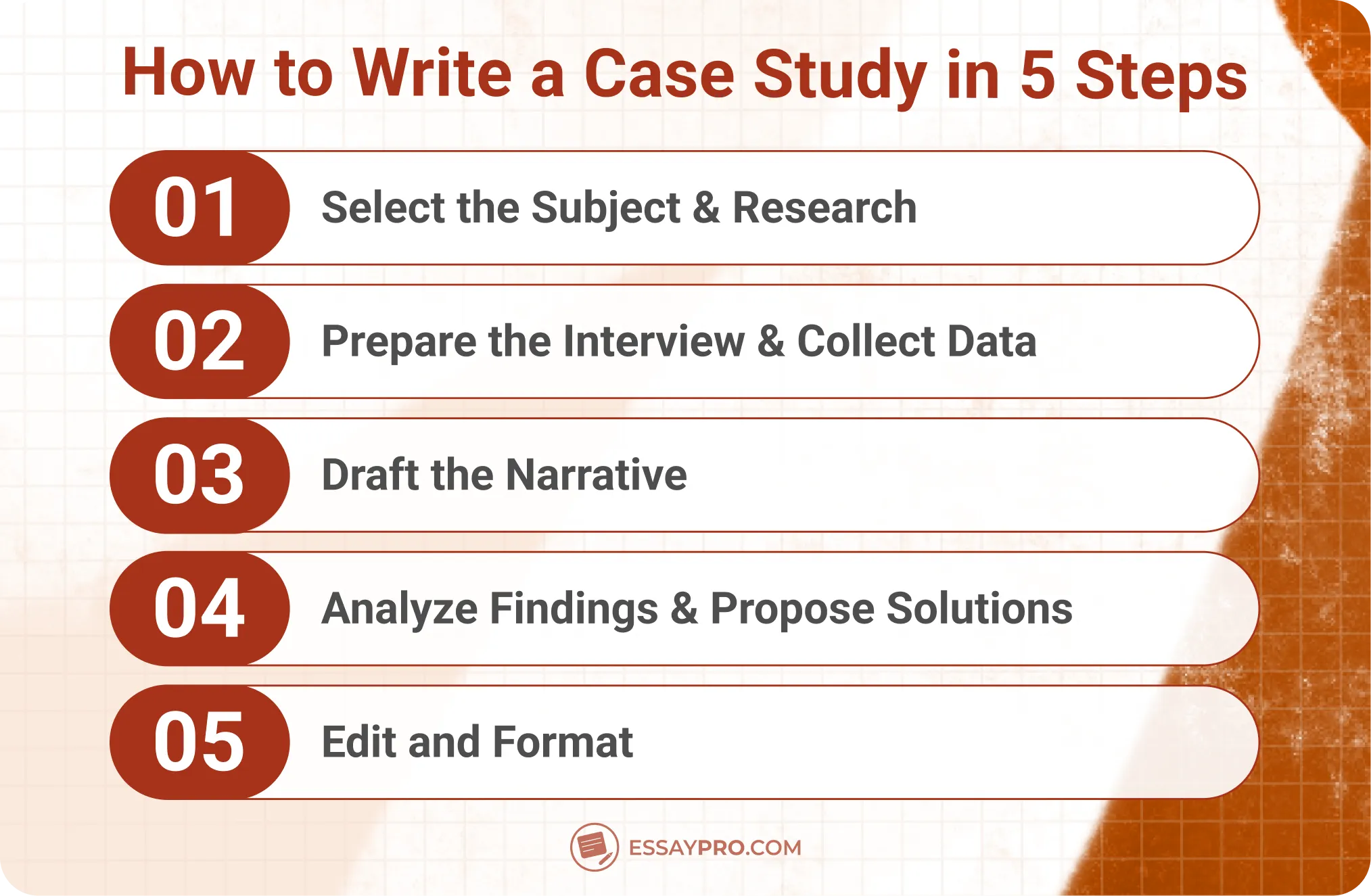
Step 1: Select the Subject & Research
Start by choosing a subject that genuinely represents the problem you want to analyze. A strong case offers enough depth to examine causes, decisions, and outcomes without forcing speculation. Early research should establish context, confirm relevance, and reveal whether the issue can be analyzed meaningfully. Past reports, academic articles, and credible news coverage help you understand how the case unfolded over time.
Pro Tip: Looking up similar studies through Google Scholar often sharpens focus and saves hours of unfocused reading.
Checklist:
- Does this subject have enough reliable data to support analysis?
- Is the problem clearly defined and limited in scope?
Step 2: Prepare the Interview & Collect Data
Case studies gain strength through direct evidence. Interviews, internal documents, surveys, or observational data reveal how decisions were made and how people involved understood the situation. Open-ended questions encourage explanation rather than short confirmation. Permission and ethical use of information matter, especially in academic or healthcare settings. Recording interviews and using transcription tools improves accuracy and preserves details that handwritten notes often miss.
Checklist:
- Have you secured consent to use interviews or internal materials?
- Do your questions invite explanation rather than short answers?
Time-Saving Tip: Record your interviews and use an AI transcription tool.
Step 3: Draft the Narrative (The Storytelling Aspect)
Drafting organizes evidence into a coherent case study structure. This stage turns research into a readable narrative built around the problem, the response, and the outcome. Drafting a case study means shaping information so the reader understands urgency, reasoning, and change. Your draft should include an introduction, background and context, the reason the case was chosen, key findings, an evidence-based conclusion, and references.
Checklist:
- Is the central subject easy to identify throughout the draft?
- Does the narrative move logically from problem to resolution?
Pro Tip: Just get your thoughts out on paper at this stage and don’t worry about perfect grammar.
Step 4: Analyze Findings & Propose Solutions
Analysis explains causes rather than restating events. Evidence from earlier steps should connect to theories or frameworks taught in your course. Proposed solutions need to respond directly to identified causes and respect practical limits such as cost, time, or organizational capacity. Tools like SWOT analysis help organize thinking and expose weak assumptions before they reach the final draft.
Checklist:
- Do findings clearly support your proposed solution?
- Are recommendations realistic and evidence-based?
Step 5: Edit and Format (APA/MLA/Chicago)
Editing refines clarity, tone, and accuracy. Formatting ensures compliance with the required citation style (often APA, MLA, or Chicago). Figures, tables, and charts need proper labels, and references must align with in-text citations. Citation generators speed up formatting, yet manual review prevents common errors that cost points. Reliable research paper writing service can also help you take care of the formatting details if you’d rather focus on the actual writing process.
Checklist:
- Are citations consistent across text and references?
- Does formatting match the assigned style guide exactly?
Pro Tip: Use a citation generator, but always double-check the "In-Text" citations manually.
Case Study Writing by Discipline
Each discipline shapes case study writing around its own priorities, evidence standards, and professional goals.
Business Case Studies example (The ROI Focus)
Business case studies examine decisions through the lens of performance and financial impact, with emphasis on outcomes that inform future strategy.
- Primary focus: Strategic decisions and measurable business impact
- Key question: How did this decision affect performance and outcomes?
- Essential metrics: Revenue, costs, growth rates, ROI, market share
- Common frameworks: SWOT, PESTLE, cost-benefit analysis
- Tone: Professional, analytical, results-oriented
Case Study Examples Psychology
Psychology case studies analyze behavior within a defined context to understand patterns through established psychological theory.
- Primary focus: Individual or group behavior within a specific context
- Key question: Why did this behavior or response occur?
- Essential data: Observations, assessments, interviews, test results
- Formatting: APA style with strong ethical safeguards
- Tone: Objective, careful, theory-grounded
Medical & Nursing Case Studies (The Clinical Focus)
Medical and nursing case studies examples document patient care with attention to clinical reasoning, interventions, and outcomes over time.
- Primary focus: Patient care, clinical reasoning, treatment outcomes
- Key question: How was the condition assessed and managed?
- Essential parts: Patient history, symptoms, interventions, outcomes
- Key emphasis: Care planning and patient response
- Tone: Formal, factual, ethically precise
Engineering & Tech Case Studies (The Technical Focus)
Engineering and tech case studies evaluate how technical solutions perform under real operational constraints.
- Primary focus: Systems, designs, or technical solutions
- Key question: How did the solution perform under constraints?
- Essential data: Specifications, test results, performance metrics
- Key emphasis: Functionality, efficiency, reliability
- Tone: Technical, precise, evidence-driven
Still confused about properly structuring your work? Ask for help from our custom case study writing service.
Human-Written, Zero AI
Get stress-free academic help from someone who truly understands your struggle — a real EssayPro writer.
Free Case Study Template
Take a look at the straightforward case study template below to see what each section should include.
Final Thoughts
Writing a strong case study starts with a clear problem and a defined subject. It requires context that explains why the situation matters, data that shows what actually happened, and analysis that explains why events unfolded the way they did. A solid case follows a standard structure: research, drafting, analysis, and revision, and adapts its focus to the discipline.
If your deadlines are getting too close and you’re short on time, there is no shame in asking for help. Just reach out to EssayPro and tell us, ‘write my case study for me,’ and we’ll get started on your paper right away.
FAQ
How Many Pages Should a College Case Study Be?
How Do You Write a Case Study With No Interview?
What Is the Most Common Mistake in Case Study Writing?
What Is the Case Study Format?

Daniel Parker
is a seasoned educational writer focusing on scholarship guidance, research papers, and various forms of academic essays including reflective and narrative essays. His expertise also extends to detailed case studies. A scholar with a background in English Literature and Education, Daniel’s work on EssayPro blog aims to support students in achieving academic excellence and securing scholarships. His hobbies include reading classic literature and participating in academic forums.
- Daines, R. (2024). LibGuides: Qualitative & Quantitative Research Support: Case Study. https://resources.nu.edu/researchtools/casestudy
- Fallin, L. (n.d.). LibGuides: Other assessments: Case studies. https://libguides.hull.ac.uk/other/cases
- How to write up your case study. (n.d.). Student Academic Success. https://www.monash.edu/student-academic-success/excel-at-writing/annotated-assessment-samples/business-and-economics/buseco-writing-case-studies/how-to-write-up-your-case-study