
An academic essay develops a focused idea through clear reasoning, relevant evidence, and analysis. Depending on the assignment, it may explain a concept, interpret a text, argue a position, or reflect on an experience.
To write an academic essay, read the assignment, choose a manageable topic, research it, develop a thesis, and organize your evidence into paragraphs. Then revise the argument, check your citations, and proofread.
This guide explains academic essay types, structure, formatting, and the writing process. Academic essay examples show how a thesis develops through supporting paragraphs into a conclusion.
What is an academic essay?
An academic essay is a structured piece of writing that answers a question or develops a central idea for an academic audience. Its purpose is to demonstrate your understanding of a subject and your ability to explain, interpret, or evaluate evidence.
The assignment determines the essay’s scope, audience, and approach. A literary analysis may closely examine one passage; a history essay may draw on several primary and secondary sources.
Strong academic essays share these characteristics:
- Focused scope: The topic fits the assignment’s word count and available evidence.
- Clear purpose: The essay answers a specific question or addresses a defined problem.
- Central idea: A thesis gives the paper direction and connects its sections.
- Relevant evidence: Sources, examples, observations, or textual details support the discussion.
- Analysis: The writer explains how the evidence supports each point.
- Logical organization: Paragraphs build a sequence readers can follow.
- Appropriate style: Precise language, accurate citations, and careful editing meet the expectations of the course.

Leave the writing to us
Our team delivers original, well-argued essays tailored to your exact prompt.
Types of academic essays
Essay categories describe a paper’s main purpose, and assignments often combine them. An argumentative essay, for example, may include description and explanation. Identify the task words in your prompt, such as analyze, compare, explain, or evaluate, before choosing your approach.
Narrative essay
A narrative essay uses a sequence of events to develop an insight. In college courses, it often appears as a personal narrative, reflective essay, or account of a learning experience.
Select an experience with a clear focus, establish the setting, and organize the events so readers can follow them. Explain what the experience revealed and how your understanding developed.
An academic essay example about, say, leading a group project could examine how you learned to delegate responsibilities.
Xintian Tina Wang on storytelling in essays and applications discusses storytelling techniques relevant to narrative and reflective writing.
Descriptive essay
A descriptive essay creates a clear impression of a person, place, object, or experience. Specific sensory details and deliberate organization help readers understand the subject.
When learning how to write a descriptive essay, choose details that contribute to one dominant impression.
For example, a description of a laboratory could follow the path from the entrance to the workstations, using details about light, sound, equipment, and movement. Organize those observations around a purpose, such as showing how the room supports careful experimentation.
Expository essay
An expository essay explains a subject through facts, examples, and logical organization. It may define a concept, compare approaches, explain a process, or examine causes and effects.
Choose focused essay topics that you can explain within the assigned length.
For example, “How municipal drinking water is treated” provides a process to explain. Define unfamiliar terms, arrange the stages in order, and cite sources for technical information. The thesis should identify the explanation’s central idea or organizing principle.
Persuasive essay
A persuasive essay aims to convince an audience to accept a position or take action. It uses evidence, reasoning, audience awareness, and appropriate rhetorical appeals.
A paper asking a college to extend tutoring hours should establish the need, explain the proposed change, and address practical concerns such as staffing and cost.
Choose persuasive essay topics that give you a clear audience and a specific position to defend.
Argumentative essay
An argumentative essay advances a debatable claim and supports it with evidence and analysis. It also examines relevant counterarguments and explains how they affect the thesis.
For example, an essay about open educational resources could evaluate textbook costs, accessibility, and instructional quality. The writer would need to define the proposal, assess credible sources, and respond to objections.
Persuasive and argumentative assignments overlap. Follow your instructor’s expectations for research, counterarguments, and rhetorical style.
Academic essay format
Academic essay formatting depends on the assignment and required style guide. Check the prompt for font, spacing, page numbering, title-page, and citation requirements before setting up your document.
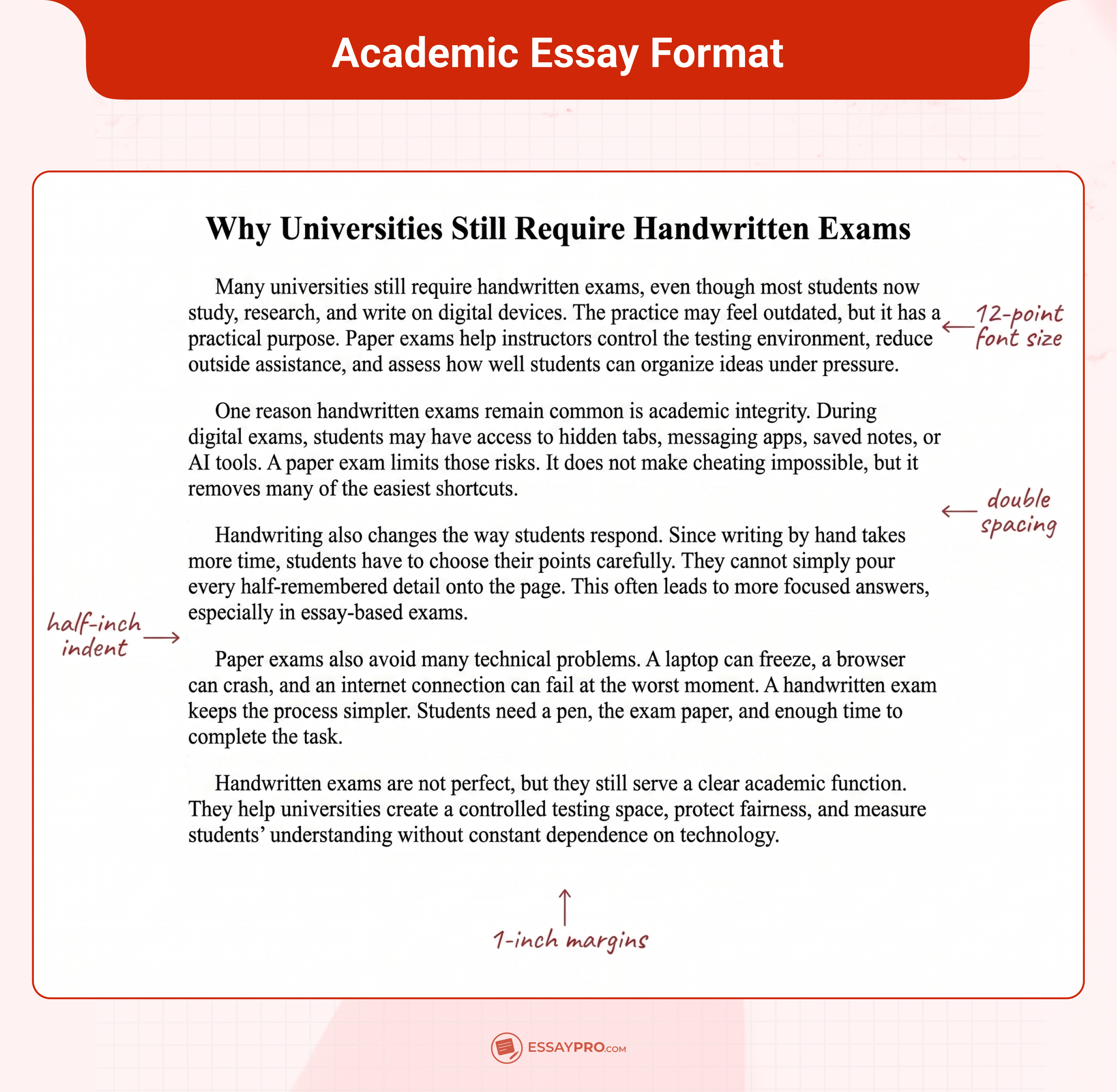
Use these guidelines to check the main elements:
- Font: Use a readable font permitted by the required style. MLA accepts a legible font with clearly distinguishable regular and italic text. APA permits options including 12-point Times New Roman, 11-point Arial, and 11-point Calibri.
- Spacing: MLA and APA student papers generally use double spacing throughout, including the source list. Chicago formatting varies by document element and instructor requirements.
- Margins: MLA and APA use one-inch margins on all sides.
- Paragraph indentation: Standard prose paragraphs in MLA and APA usually begin with a half-inch first-line indent.
- Page numbers: MLA uses the writer’s last name and page number in the upper-right header. APA student papers use a page number in the upper-right header.
- Title: MLA usually places the title on the first page beneath the student and course information. APA student papers generally have a separate title page.
- Citations: Use the assigned citation system consistently. Include an in-text citation or note where required, plus a corresponding source-list entry.
- Headings: Use headings when they help readers navigate the paper, following the required style’s hierarchy.
Set up the document before drafting so that its layout stays consistent. Apply a hanging indent to source-list entries and check that every in-text citation leads readers to the correct entry.
Academic essay outline
An outline connects your thesis to the evidence you plan to discuss. Write a working thesis first, list the points needed to support it, and assign evidence to each point.
A five-paragraph essay is a useful introductory model. Longer academic essays need enough paragraphs to develop their claims, examine evidence, and address complications. Let the assignment and argument determine the number of paragraphs.
Use this adaptable academic essay outline:
- Introduction
- Opening: Establish the subject or problem.
- Context: Supply essential background and define key terms.
- Thesis: State the essay’s central claim or controlling idea.
- Main Body
- First supporting point: Present a claim, provide evidence, and explain its significance.
- Next supporting points: Develop the argument in a logical sequence.
- Counterargument or complication: Examine an important objection, alternative interpretation, or qualification when relevant.
- Connections: Show how each paragraph advances the thesis.
- Conclusion
- Return to the thesis: State the argument in light of the analysis.
- Synthesis: Explain how the main points work together.
- Final implication: Identify what readers can understand or conclude from the discussion.
For each body paragraph, record the source and any available page or other location marker alongside your evidence. For an unpaginated source, save enough identifying information to find the passage again. This makes quotations easier to check and citations easier to complete.
How to start an academic essay?
Start by identifying what the assignment asks you to do. Note the required length, source requirements, citation style, deadline, and grading criteria. Turn the topic into a question you can answer within those limits.
The sample essay below develops through these planning stages:
- Broad subject: Abraham Lincoln’s Gettysburg Address.
- Focused question: How does Lincoln connect remembrance of the dead to the responsibilities of the living?
- Working thesis: Lincoln uses the nation’s founding principles, the soldiers’ sacrifice, and an appeal to unfinished work to turn remembrance into civic responsibility.
Read the speech closely and mark passages relevant to the question. Group those passages by function: establishing the political stakes, explaining the soldiers’ authority, and assigning responsibility to the audience. These groups become the body paragraphs.
When drafting the opening, follow the principles of how to write an essay introduction: establish the issue, give essential context, and state a clear thesis.
Choose an opening technique that fits the assignment:
- Quotation: Introduce a brief passage you will interpret or connect directly to your argument.
- Fact: Present a verified detail that establishes the topic.
- Statistic: State the figure with its population, location, and date or study period, and cite the source.
- Focused question: Ask the question the essay will answer, then move toward your thesis.
Introduction example:

The final sentence establishes both the interpretation and the order of discussion. Its three supporting ideas give the writer a practical plan for the body.
Draft the introduction once you have a working argument, then revisit it after writing the body. Adjust its scope and wording to match the analysis you actually develop.
How to write the body of an academic essay?
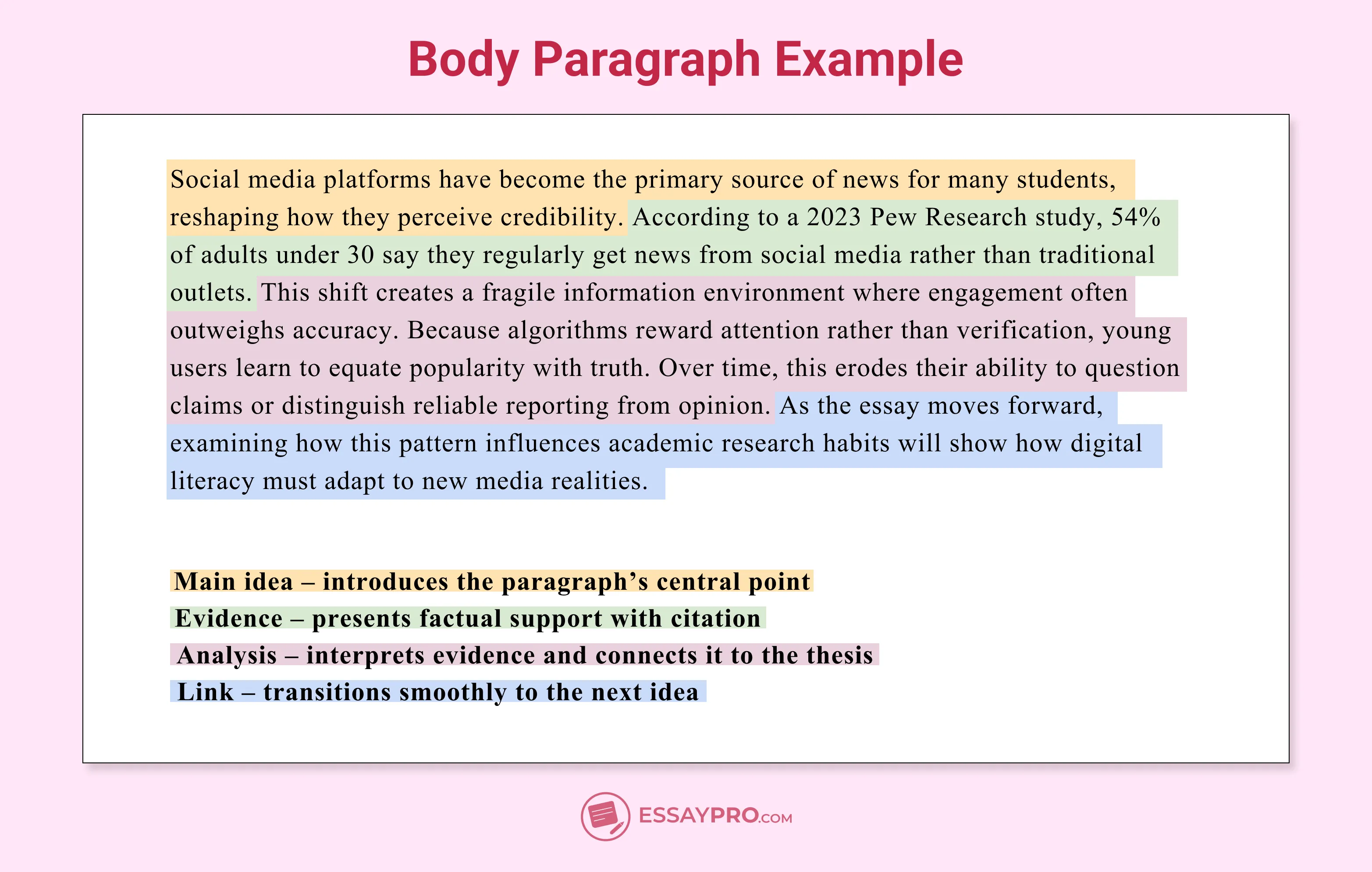
Each body paragraph should develop one main point and explain its role in the essay’s argument. Draft from your outline, keeping your sources and notes available so you can cite evidence as you write.
Use this sequence:
- Topic sentence: State the paragraph’s main point.
- Evidence: Present a relevant quotation, finding, example, observation, or textual detail.
- Analysis: Explain how the evidence supports the point. Identify the details that justify your interpretation.
- Connection: Show how the point contributes to the thesis.
- Transition: Establish the relationship to the next paragraph.
Body paragraph example:
Choose sources suited to the question. A literary essay relies heavily on the text being analyzed; an empirical claim may require research studies or official data. Check authorship, publication context, methods, and relevance.
In the complete sample below, the first body paragraph connects Lincoln’s language about the founding to his question about the nation’s survival. Its analysis explains the relationship between the quoted phrases and the paragraph’s claim.
The second body paragraph examines the repeated negative construction “we can not.” The analysis explains how this wording limits the living speakers’ ceremonial authority and gives greater authority to the soldiers’ actions. That explanation supplies the reasoning connecting quotation and interpretation.
When addressing a counterargument, represent it accurately, examine its evidence, and explain your response. A qualification may help you make the thesis more precise. In a close-reading assignment, an alternative interpretation of a key passage can serve this purpose.
How to end an academic essay?
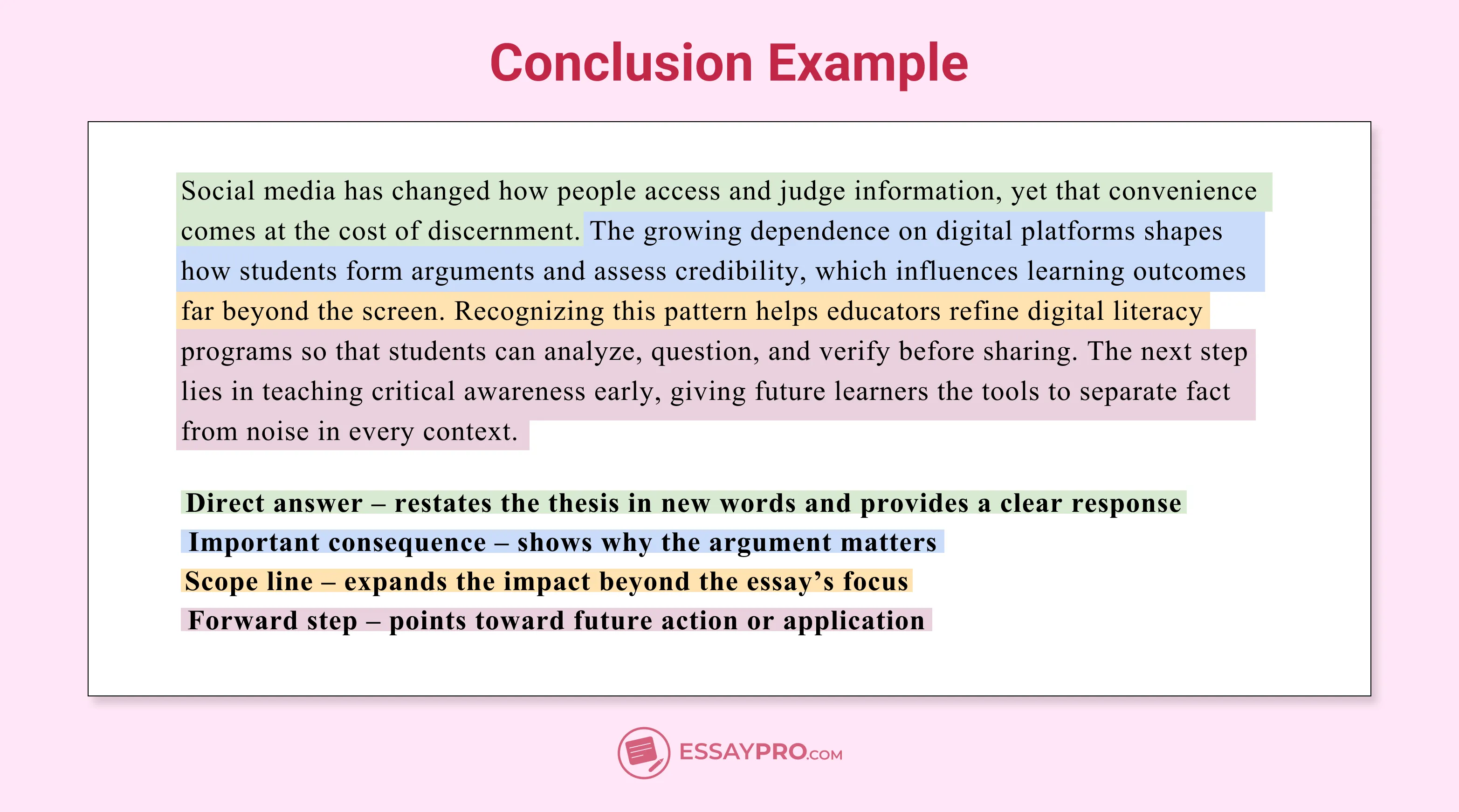
This is the last part of how to write an academic essay. The conclusion explains what your analysis has established. Return to the thesis with the benefit of the evidence you have discussed, then show why the argument matters.
A strong conclusion does four things:
- Returns to the thesis: Follow the same sequence as the body. In the sample you’ll see below, that means founding principles, sacrifice, and responsibility, and how those points work together to support remembrance as an ongoing public commitment.
- Makes the final implication specific: Tie it to your argument. For said essay, the implication concerns the audience’s responsibility for representative government; a general statement about the importance of famous speeches would leave that interpretation unfinished.
- Keeps substantial new evidence in the body: If drafting the conclusion reveals a claim that needs support, return to the relevant body paragraph and develop it there.
- Reads against the introduction: For a short essay, one conclusion paragraph is often sufficient. During revision, read the opening and ending together so the question or claim raised at the start is resolved through the analysis.
Conclusion example:
Academic essay example
The following short academic essay demonstrates a thesis, focused body paragraphs, textual evidence, and a conclusion. The paragraph labels identify each section’s function; remove them in a submitted essay.
The sample uses MLA ninth-edition citation style and the Bliss copy of the Gettysburg Address, a handwritten version Lincoln prepared in 1864 that is held at the White House. The parenthetical citations use the author’s surname because the manuscript is unpaginated.
Topic: Memory and Responsibility in the Gettysburg Address
[Introduction] A speech dedicating a cemetery must explain how the living should remember the dead. In the Gettysburg Address, delivered on November 19, 1863, Abraham Lincoln connects that act of remembrance to the Civil War’s political purpose. He presents the fallen soldiers’ sacrifice as a responsibility inherited by their audience. Through references to the nation’s founding, the limits of ceremonial language, and the work remaining for the living, Lincoln turns commemoration into a call for civic commitment.
[Body Paragraph 1] Lincoln first places the battle within the history of the nation’s founding. His opening describes a nation “conceived in Liberty” and committed to the proposition that “all men are created equal” (Lincoln). These phrases establish the principles against which the war’s meaning should be understood. When he asks whether such a nation can “long endure,” he presents its survival as a test of those principles (Lincoln). The cemetery therefore becomes a place to consider the future of the political project begun by the founding generation.
[Body Paragraph 2] Lincoln then gives the soldiers’ actions authority over the ceremony itself. The phrases “we can not dedicate” and “we can not consecrate” repeat a negative construction that limits what the living speakers can accomplish through ceremonial language (Lincoln). The soldiers have already consecrated the ground through their actions. By acknowledging the speakers’ limited authority, Lincoln makes the soldiers’ sacrifice the source of the site’s meaning. The audience’s role is to recognize that meaning and accept the responsibility it creates.
[Body Paragraph 3] The final movement of the speech assigns responsibility to the living. Lincoln calls on them to undertake the “unfinished work” and commit themselves to the “great task remaining” (Lincoln). These phrases shift attention toward obligations that continue beyond the ceremony. His closing reference to government “of the people, by the people, for the people” identifies the political ideal that this commitment should sustain (Lincoln). Remembering the dead thus requires continued participation in the cause associated with their sacrifice.
[Conclusion] The Gettysburg Address links national memory to public responsibility. Its account of the founding establishes the principles at stake, its treatment of sacrifice explains the cemetery’s significance, and its final appeal gives the living a task. Lincoln makes remembrance an ongoing commitment to the survival of representative government.
Works Cited
- Lincoln, Abraham. “Gettysburg Address.” 1864. Bliss copy, White House, Washington, DC.
- If you prefer professional support for a larger project, you can buy a dissertation from our writers.
Academic essay writing tips
A reliable writing process separates planning, drafting, revision, and proofreading. Use these steps to improve both the argument and the finished document:
- Read the prompt closely. Highlight the task, scope, source requirements, and assessment criteria. Turn each requirement into an item you can check.
- Narrow the topic. Choose a question you can answer with the time, space, and evidence available.
- Research with a purpose. Gather sources that help answer the question, and record their bibliographic information immediately.
- Write a working thesis. State your current answer and revise it as your understanding develops.
- Build an evidence-based outline. Give each planned paragraph a purpose and supporting material.
- Draft the argument. Explain your reasoning wherever you introduce evidence. Identify the words, findings, or details that support your interpretation.
- Reverse-outline the draft. Summarize each paragraph in a few words to check order, repetition, and gaps.
- Revise the analysis. Strengthen unsupported claims, clarify connections, and address relevant objections.
- Check source use. Verify quotations, write paraphrases in your own wording and sentence structure, and cite borrowed ideas.
- Proofread and format. Check grammar, punctuation, document layout, and the source list against the assignment.
Common problems include an overly broad thesis, paragraphs containing several unrelated points, quotations without analysis, and conclusions introducing a new argument. During revision, identify the specific passage causing the problem and revise its claim, evidence, or explanation.
Give argument revision its own pass before proofreading. Moving a paragraph or narrowing a thesis can change several sentences, so settle those decisions before polishing individual words. Reading the final draft aloud can help you notice missing words, awkward phrasing, and abrupt transitions.
Thesis trouble? We’ve got it
Our writers turn a shaky argument into a focused thesis backed by relevant evidence.
The last word
Academic essays develop one focused idea through clear reasoning, evidence, and analysis. Whether narrative, descriptive, expository, persuasive, or argumentative, each follows a structure built on a thesis, supporting paragraphs, and a conclusion. Formatting depends on the assigned style guide, and a strong result comes from planning, drafting, revising, and proofreading.
If you’re juggling several deadlines and can’t give your paper the time it needs, you can ask our experts to write my essay online. They’ll follow your prompt, required style guide, and grading criteria, so you get a well-structured essay you can use as a strong model for your own work.
FAQs
How to structure an academic essay?
What is the format of an academic essay?
How to write an academic essay?
How to conclude an academic essay?

Daniel Parker
is a seasoned educational writer focusing on scholarship guidance, research papers, and various forms of academic essays including reflective and narrative essays. His expertise also extends to detailed case studies. A scholar with a background in English Literature and Education, Daniel’s work on EssayPro blog aims to support students in achieving academic excellence and securing scholarships. His hobbies include reading classic literature and participating in academic forums.