

To stop overcomplicating things, break a task into small steps and pick the part that needs your attention most. One of the reasons why the mind creates extra noise is that it wants control, so you will also help it settle when you question your thought loops. Simple habits like journaling or moving your body help you get rid of anxiety and focus, and that focus helps you take action instead of endless analyzing.
You probably often feel this pressure because of the constantly looming deadlines. A large number of U.S. students do, actually. Research shows that almost 32% of adolescents have had anxiety disorders at some point in their lives. A reliable support system can reduce that cognitive load. If you need extra help with any of your writing assignments, you can rely on EssayPro's experts.

Don’t Risk Getting Flagged
With EssayPro, you can avoid AI detection using papers written by real professionals.

Why Do I Overcomplicate Things?
You overcomplicate things because your brain tries to stay ahead of possible problems. Neuroscientists describe this as anticipatory processing: a habit of imagining issues before anything has actually happened. It's your brain subconsciously trying to prepare for danger, often even when none is present. This obviously causes stress, which further amplifies the habit, creating a loop of anxious thoughts that is hard to escape. As a result, cortisol (the stress hormone) rises, and its elevated levels make clear thinking and decision-making more difficult.
Some of the most common reasons for overcomplicating things include:
- Fear that makes simple situations feel more difficult than they are.
- Perfectionism that sets unrealistic standards.
- Unclear goals that make every option seem worth considering.
- Past mistakes that stay active in memory and influence new decisions.
- Anxiety fills in the blanks with worst-case scenarios.
Check out our article on diversity in higher education if you want to see the key statistics.
How To Stop Overcomplicating Things in 6 Steps
This section gathers practical approaches drawn from research, everyday experience, and insights from the six videos below. We'll walk you through simple actions like breaking tasks down, focusing on one part at a time, using quiet moments to reset your attention, checking unhelpful thoughts, accepting 'good enough', and grounding your mind through physical movement.
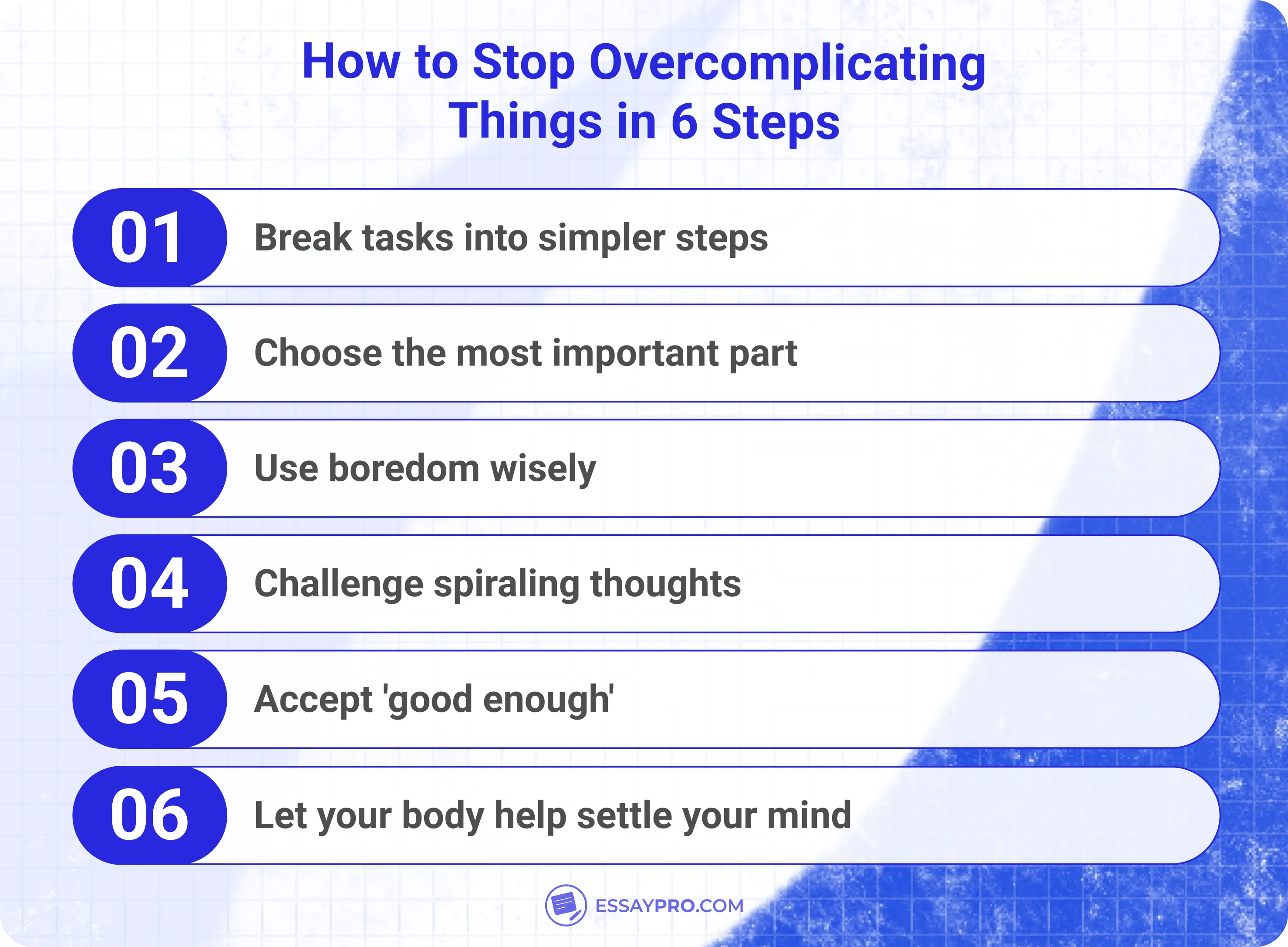
1. Break Tasks Into Simpler Steps
A complicated task becomes more manageable when you break it down into two or four steps. Cognitive science explains why exactly this works: the prefrontal cortex, the part of your brain that’s responsible for planning, weakens when it’s overwhelmed. A simple, pre-planned structure prevents this, making it easier for you to get through your responsibilities. People often assume that complexity signals intelligence, when in reality, it’s simplicity that proves focus. The moment you give your tasks a straightforward structure, the brain becomes all the more productive.
2. Choose The Most Important Part
A busy mind assigns equal importance to every detail, even when most of them serve no real purpose. We all know that mentally scrolling through endless options ultimately creates decision-making paralysis. Psychologists call this choice overload. Your brain regains clarity when your attention is fixed on the most important part of the task. Keeping things simple often solves more than expected because simplicity clears mental static.
3. Use Boredom Wisely
Boredom scares people because silence forces you to pay attention to what you would normally try to avoid. Yet what few people realize is how valuable boredom is. That’s why intentionally sitting with boredom has become popular among Gen Z, often described as ‘rawdogging boredom.’
Studies on meditation and mindfulness have shown that quiet moments decrease activity in the brain's Default Mode Network, which is the part that's responsible for self-reflection and rumination. When this network settles, the mind recalibrates. So, one of the most important pieces of advice we can give you is to sit with your boredom for a while.
Upgrade to Human-Written
If AI tools failed you, we won’t. EssayPro’s real writers support you from draft to final results.
4. Challenge Spiraling Thoughts
Sometimes, you overcomplicate things because of repetition. A thought loops because the brain mistakes frequency for truth. Cognitive behavioral therapy uses a simple technique called cognitive restructuring. Ask yourself: does this thought help me take the next action? If the answer is no, that thought is not worth obsessing over. The mind follows direct cues, so a single check-in stops the spiral and creates more space for action.
5. Accept ‘Good Enough’ As A Valid Finish Line
Perfection drains time. Accepting good enough allows you to build progress. Students who cling to perfect drafts often freeze, yet those who work with more acceptance gain more progress. Research from the Journal of Behavior Therapy shows that people who adopt a satisficer mindset complete tasks faster and report lower stress levels. But this doesn't mean that 'good enough' is the same as being careless. It just means that you can finish your tasks without looking for the absolute best option every time.
6. Let Your Body Help Settle the Mind
The body can pull you out of spiraling thoughts. Neuroscientists describe this as bottom-up regulation. A short walk, a change in posture, or a quick note in a journal activates sensory pathways that help your attention settle. Physical movement gives the mind something grounded to work with, and that shift often clears the mental fog. You create fewer unnecessary layers when your body brings you back into the moment.
6 Videos to Help You Stop Overcomplicating Things
The videos in this section offer simple ways to loosen the grip of overthinking. Each one comes from a different perspective, yet the main takeaway stays almost unchanged: a pause, a smaller step, or a moment of honest awareness can shift the entire mood of a day. These videos show real people catching themselves before the spiral builds and choosing something healthier instead.
6 Therapy Skills to Stop Overthinking Everything
The video walks through why the mind slips into overthinking and shows eight clear ways to break that habit.
- Noticing the moment rumination starts and naming it clearly.
- Scheduling a specific time for worry so it stops flooding the rest of the day.
- Shifting attention deliberately instead of following every thought.
- Returning to the present through sensory grounding.
- Turning vague “why” questions into concrete, doable “what can I do now?” steps.
- Re-centering on personal values to guide your focus.
- Using short-term distraction only as a brief reset.
- Seeking structured help through therapy.
How to Stop Overcomplicating Life - Practical Stoicism 101
The video explains how Stoic thinking can make life feel less chaotic. The creator talks about learning to control your inner reactions, keeping your thoughts simple, and stepping away from constant comparison. Your mindset shapes your experience, and you can train that mindset every day.
- Treat problems as neutral events and decide if they can be solved or not.
- Notice how stress grows when you compare yourself to others.
- Stop assuming you know what others think.
- Allow yourself to feel emotions fully instead of avoiding them.
- Learn to be comfortable alone so you can hear your own thoughts clearly.
- Keep pleasure and habits in balance so they don’t take over your life.
The most important takeaway from this video is simple: don't overcomplicate things. Take them as they are, not as they could be.
What You Try to Control, Controls You | The Paradox of Control
No matter how we try to control everything around us, there will always be things out of our reach. This video explains how overthinking things grows from constantly trying to be in charge. It encourages you to shift your attention back to what's actually in your power: your thoughts, choices, and responses. When we stop forcing everything to behave a certain way, we allow more peace in our lives.
How I Stopped Being an Overthinker | Tally Feingold
In this TED Talk, the speaker explains how the butterfly effect helped her stop getting stuck in overthinking. The simple idea that tiny actions can lead anywhere made her realize she can’t control every outcome, no matter how hard she tries. Accepting this lifted the pressure she put on her decisions and gave her a clearer inner voice to follow. Letting go of the need for perfect control made choices feel lighter and less overwhelming.
Jay Shetty: 2 Minute Trick To STOP Overthinking INSTANTLY!
The video shows how overthinking loosens its grip on your brain once you stop fighting your thoughts and start giving them a place to land. The speaker talks through a simple two-minute trick: write the looping thought on a small piece of paper, sit with it for a moment, and then physically destroy the page. The act signals release. Research backs this up, showing that discarding written thoughts helps the mind let them go.
Overthinking, Overanalyzing, Overcomplicating
The video explains that overthinking comes from a brain wired for fear and doubt. It shows how easily the cycle grows when we try to solve everything in our heads. The speaker encourages you to notice the mental drama, step away from it, and guide your mind with intention. She highlights the value of a calm morning routine: journaling, reflection, or generally anything that steadies your attention. The message is simple: awareness and small daily corrections create real calmness.
Final Thoughts
Overcomplication often begins with a brain that tries to predict danger too early. Stress heightens that instinct, and perfection raises the stakes even higher. Your mind becomes clearer when goals shrink into manageable steps. Mental spirals also lose power when thoughts are questioned instead of being accepted automatically. Simple habits, consistent grounding techniques, and honest awareness create the conditions for calm, focused action.
If deadlines are starting to feel overwhelming, you can always turn to EssayPro. Our platform offers help with writing tasks, but that's not all we provide. Our resources, which can be as specific as a citation generator IEEE, can give you a hand even with the smallest academic headaches.
Keep the Deadlines at Bay
Get help from EssayPro professionals and rest assured knowing you can take a break.
FAQ
Why Do I Keep Overcomplicating Things?
Is Overcomplicating Things ADHD?
How To Stop Overthinking And Overcomplicating So Much?
Is Overcomplication Connected To Perfectionism?
How Can I Hold On To A Simpler Way Of Thinking?

Sopho Miller
is an experienced content writer who specializes in digital marketing, business, and academic topics. With a Master’s degree in Digital Marketing, she combines her expertise with a practical approach to create clear, engaging, and educational content. She crafts detailed guides and resources that support students in their academic journey. Outside of work, Sopho stays current with the latest industry trends and regularly attends workshops to further sharpen her skills.