Key Takeaways
- Active recall sessions improve learning by training the brain to retrieve information, not recognize it.
- The method exposes gaps early, making studying more targeted and efficient.
- Repeated recall supports long-term memory and exam readiness.
- Active recall works across subjects when adapted properly.
- Short, effortful recall sessions outperform passive review over time.
The active recall study method is a focused way of learning that asks your brain to pull information from memory instead of simply rereading notes. By testing yourself with questions, recalling answers without looking, and checking what you missed, you strengthen memory and improve long-term retention. The process becomes even more effective with spaced, repeated practice.
When studying feels scattered or overwhelming, EssayPro helps students organize material, clarify ideas, and get support that makes learning strategies easier to apply in real coursework.

Writing Gets Easier With Real Support
EssayPro’s human guidance makes complex assignments clearer and less stressful.

What Is Active Recall Method?
The active recall method focuses on a single clear action: stop looking at the material and try to recall it. Rather than reviewing the same notes repeatedly, you test yourself by answering questions, explaining ideas in your own words, or writing out what you recall before checking the answer.
Active recall study method effectiveness is explained through the science behind how memory works. Memory strengthens through use. When the brain has to search for information, even if it feels uncomfortable, those memory links grow stronger. Over time, recall becomes quicker and more reliable, which is why this method supports long-term learning.
Passive studying feels easier, but does less. Reading notes or slides can make material look familiar, yet that familiarity often disappears during exams. Active recall strips away that false confidence and shows what you truly know.
For real data on how academic pressure affects students’ well-being, see these student stress statistics.
How Does Active Recall Actually Work?
Active recall works by forcing the brain to rebuild information instead of leaning on what’s already visible. When you try to remember something without notes, the brain has to trace the path to that idea on its own. That act of searching strengthens how the information is stored. It also separates what you truly understand from what only feels familiar, which passive review often hides.
Over time, repeated recall changes how knowledge is organized. Information becomes easier to access because the brain practices retrieving it across multiple sessions, not just recognizing it on a page. This is why recall holds up under pressure. The brain learns how to reach the answer, not just where it appeared in your notes.
If you’re gearing up for a major test, read this guide on how to prepare for university entrance exam.
Active Recall Studying Methods
Active recall doesn’t mean forcing yourself through one rigid technique. It’s more flexible than that. Some methods rely on quick prompts and repetition, like flashcards. Others ask you to apply knowledge through questions, explain ideas out loud, or rebuild material from memory on a blank page. Below are several active recall techniques that students commonly use.
Flashcards
Flashcards work best when they slow you down for a second. You see a prompt, pause, and wait for your brain to surface the answer before you check it. That pause is where much of the learning happens. The brain has to search, not skim. Over time, that repeated searching makes recall faster and more reliable. Keep cards short, focused on one idea, and revisit them over multiple days so memory has time to settle.
Practice Questions
Practice tests force your brain to retrieve information in context, rather than in isolation. Instead of remembering a definition, you’re asked to apply it. That shift trains the brain to recognize when and how knowledge should be used, which is exactly what exams demand. Writing your own questions can be especially effective because it makes you think like the test itself.
Teaching the Material (Feynman Technique)
Trying to teach something exposes understanding quickly. When you explain a concept to someone else, the brain has to organize ideas into a clear sequence. Confusion shows up immediately. If you get stuck mid-explanation, that’s useful feedback. It quickly reveals what hasn’t fully clicked, and you don’t need an audience because explaining ideas out loud to yourself can be just as effective.
Upgrade to Human-Written
Reliable, confidential, human-crafted papers — EssayPro has your back 24/7.
Summarizing in Your Own Words
Summarizing from memory forces you to decide what actually matters. The brain can’t rely on phrasing from notes, so it rebuilds the idea instead. That reconstruction strengthens understanding and reveals weak spots. The most effective summaries are written before you look back at the material, then corrected afterward.
Blurting
Blurting deliberately removes structure. You start with a blank page and write everything you remember, fast and imperfect. Seeing what comes out easily versus what’s missing shows how well information is stored. When you compare your attempt to the original material, the corrections stick because effort came first.
If you need to format sources correctly for papers that require the Chicago style, EssayPro’s Chicago style citation generator can help.
Combining Active Recall With Spaced Repetition
Active recall and spaced repetition work best when they’re treated as one process rather than two separate techniques. Start by using active recall first. For example, test yourself without notes, answer questions, or explain concepts from memory. That effort tells your brain what information matters. Then spacing comes in by deciding when you return to that material. Instead of reviewing the same topic the next day out of habit, you wait longer each time, revisiting it just before it starts to fade.
What makes this combination powerful is timing. Each recall attempt strengthens memory, and each gap between sessions forces the brain to rebuild the information again rather than coast on familiarity. Over time, recall becomes faster and more reliable, even under pressure.
To build a broader study routine that includes active recall along with other effective habits, check out this guide on how to study effectively.
How Active Recall Differs From Passive Study
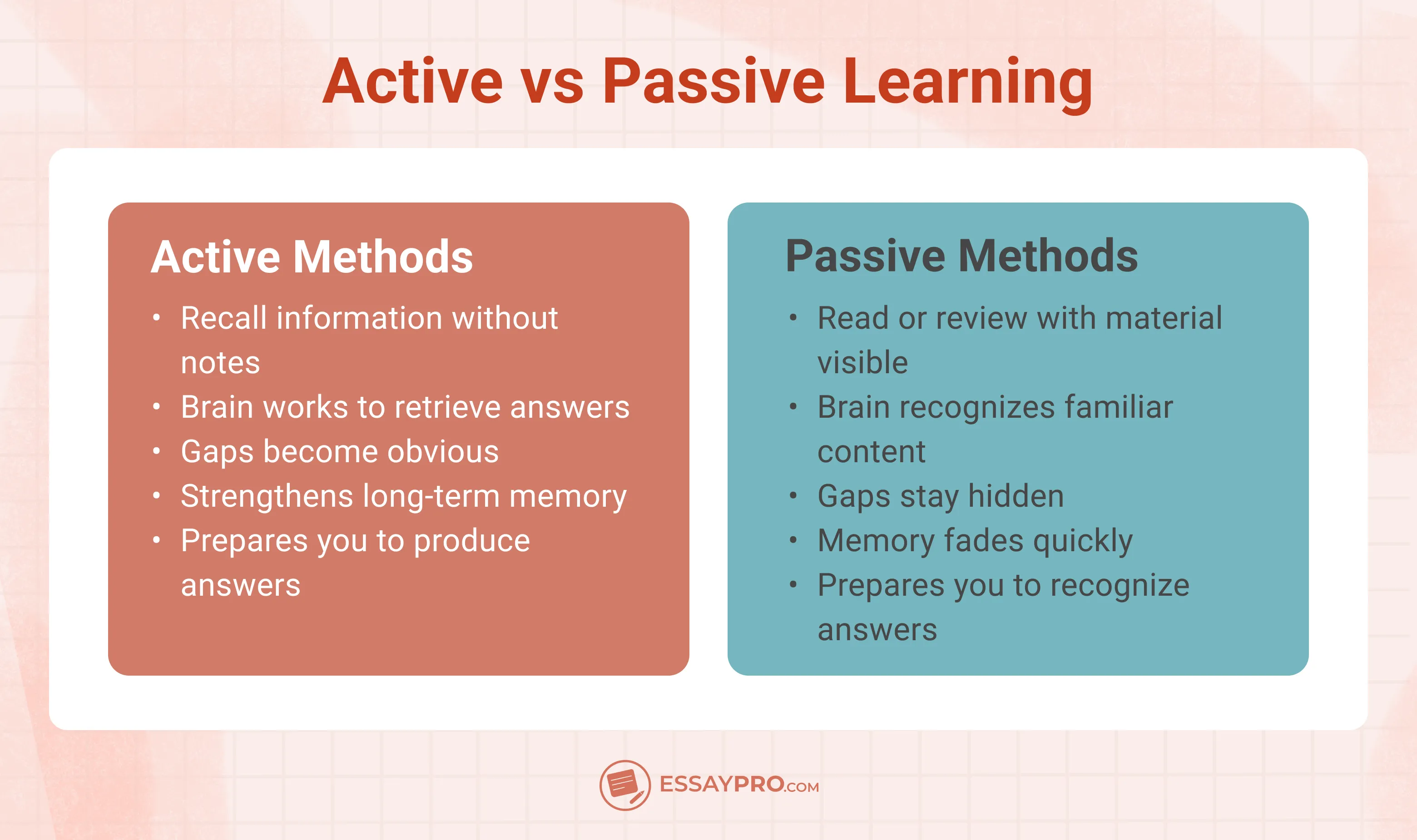
Active recall and passive studying differ in what they ask your brain to do.
Passive studying:
- Keeps information in front of you through notes, slides, or highlights
- Relies on familiarity and recognition
- Feels comfortable but hides gaps in understanding
- Understanding often fades once notes are removed
Active recall:
- Removes notes and forces memory retrieval
- Requires the brain to search for answers
- Makes gaps in knowledge obvious
- Strengthens recall through effort and repetition
- Prepares you to access information under exam conditions
One method builds recognition, while the other builds retrieval, which is what studying is ultimately meant to train.
To rephrase your ideas clearly, try a free paraphrasing tool that helps you express the same ideas in fresh language.
The Bottom Line
Active recall works because it changes the role of studying. Instead of reviewing information and hoping it sticks, you repeatedly ask your brain to retrieve what it has learned. That effort strengthens memory, exposes weak spots early, and makes knowledge easier to access when it actually matters, especially during exams. When combined with spacing and consistent practice, studying becomes more focused and far more efficient.
For students who want to apply active recall more effectively or need support organizing material, EssayPro offers help that aligns learning strategies with real coursework, helping ideas stick beyond the page.
When Grades Matter, Go with EssayPro
Get support from someone who understands academic standards.
FAQs
Is Active Recall the Best Study Method?
How to Use Active Recall Method?
Can Active Recall Work for All Subjects?
Why Is Active Recall Considered More Effective Than Rereading?
Is Active Recall Good for ADHD?

Mariam Navrozashvili
She has a Master’s degree in English Literature and brings a deep understanding of storytelling, critical analysis, and language structure to her work. On EssayPro Blog Mariam writes guides on literary analysis, essay composition and language studies to help students improve their writing skills. In her free time she likes to read classic novels and discuss literary theory.