
Key Takeaways
- About 76% of undergraduates reported feeling stressed in the past 30 days, with 21% in serious psychological distress.
- Among high schoolers, 40% felt sad or hopeless nearly daily for two weeks or more in 2023 (CDC), and girls (53%) report it at roughly twice the rate of boys (28%).
- Coursework is the main reason for prevalence of student stress 84.5% of college students who flagged academics called it a source of moderate or high distress.
- Support lags demand: only 37% of struggling students seek help.
The students’ tension can be felt on campus in September before the lectures even begin. The American College Health Association’s Fall 2025 survey found that about 76% of undergraduates reported moderate/high stress in the past 30 days. And academic stress isn’t something that simply causes anxiety and stops there. Poor psychological health affects everything that’s important in college, including, first of all, sleep, then, consequently, grades and mood. Even friendships suffer because of stress.
In this article, we’ll talk about the most recent student stress statistics and the specific factors that affect the anxiety levels in students, both in school and later in college.
Student Stress Statistics in 2026
Before we get into the specific pressures and exactly how stressed students are, here's the broader view:
- The CDC's Youth Risk Behavior Survey found that 28.5% of high school students said their mental health was not good most or all of the time in 2023.
- The Pew Research Center's April 2025 report found that 35% of teens describe themselves as extremely or very concerned about the state of teen mental health, while 55% of parents feel that worried.
- The American College Health Association's Fall 2025 survey found that anxiety is the most commonly diagnosed condition on campus, and that about 23% of undergraduates reported using cannabis in the past three months.
Two things jump out when you line these up. First, the concern is not evenly felt. Parents register the problem at a far higher rate than teens do, which tells me a lot of students have normalized a level of strain their parents still find alarming. Second, the college figures show what tends to happen when that strain goes unmanaged for years: diagnosable conditions and stress-driven coping habits are common well before graduation. My read is that schools which treat stress as routine and expected tend to catch students before the harder problems set in.
Some motivational songs for students can help you start the day on the right foot when the pressure of school gets too much.
Stress Prevalence in K-12
When you ask teenagers directly what's grinding them down, the classroom isn't the first thing out of their mouths. In the Pew Research Center's April 2025 report, of the teens who said they worry about their peers' mental health, 17% named bullying and 16% pointed to the sheer weight of expectation they're under. Social media threads through the rest. That same 2025 report clocked 45% of teens admitting they spend too much time on it, and the gap by gender was hard to miss, 25% of girls said it had hurt their mental health, against 14% of boys.

The CDC's 2023 Youth Risk Behavior Survey found girls reporting persistent sadness at nearly twice the rate of boys. If you work with this age group, my honest advice is to stop filing social pressure under "not academic," because for a 15-year-old, the two problems are running on the same track.
How Stressed Are College and University Students?
The campus stress figure in the snapshot looks steep until you read what's underneath it, and then it stops being surprising. Coursework does most of the damage. In the American College Health Association's Fall 2025 survey, 84.5% of the students identified academics as a problem over the past year, saying it had caused them moderate or high distress. That's not a fringe of overachievers. That's most of the ones who spoke up.
The same report has about 42% of undergraduates getting under seven hours of sleep on a normal weeknight, and 41% dealing with some degree of food insecurity. Loneliness rides right alongside, 48% screened positive on the survey's loneliness measure. So my recommendation to any campus actually reading its own numbers: quit treating money and sleep as background noise. A counseling center, on its own, won't undo what a functioning food pantry and a course load that lets students breathe could start to fix.
.webp)

Main Causes of Student Stress
Look across the data for long enough and a few pressures keep coming back. The main causes of stress for students are heavy academic demands, bullying on and off screens, separation from family, and issues regarding mental health. None works in isolation, either. Often, one makes another harder to manage.
Homework
Homework is still the pressure students mention most often, which is not especially surprising. eSchoolNews reported on a September 2024 survey of 1,500 U.S. students in which 72% of high schoolers said they felt stressed about returning to school. Homework led the list at 55.1%, ahead of studying for tests at 48.8% and writing papers at 44.1%. The part I find more revealing is the year-to-year shift (a jump would be a more appropriate word). 72.6% expected to worry about having too much homework, compared with 57% in 2023.
Academic stress, meaning pressure tied specifically to coursework, assignments, grading, and performance, is not confined to one bad evening. A missed deadline can make the next assignment harder to start, then sleep gets cut, then concentration drops. For students already overloaded, reducing duplicated work or spacing major deadlines apart can make a practical difference. That is worth considering when workloads are being planned.
Bullying
Bullying now reaches students in school and on their phones. The second can be harder to escape, obviously, because it continues after classes end and can easily reach students everywhere. According to the Cyberbullying Research Center, 26.5% of students said they had been cyberbullied during the previous 30 days in 2023, while about 55% had experienced it at some point in their lives.
The CDC's 2023 Youth Risk Behavior Survey found that 77% of high school students used social media several times a day, and the CDC associated that frequency with higher rates of bullying victimization. What concerns me here is how much of that can remain invisible to adults. Pew Research Center found that only 35% of students bullied on a single day told an adult; among those bullied on more than ten days, the figure rose to 60%. Regular check-ins help, but they need to be specific rather than a routine “everything okay?”
Distance from Family
College, for many students, means being away from their families and familiar conditions for the first time in their lives, which can, in itself, be a huge stress factor. Homesickness, meaning distress caused by separation from familiar people and places, affected a majority of college students during fall 2023, according to Inside Higher Ed's reporting on EdSights data. Rates were also higher than the previous year.
Male students reported the lowest levels, with 54% saying they were not homesick, while Asian students reported the highest levels of any group. What stands out to me is the connection with persistence, meaning a student's intention or ability to continue and return to college. Students with homesickness were less likely to plan on coming back. Early contact with family, campus groups, or counseling can help before that withdrawal becomes routine.
Mental Health Issues in Students
Some student stress can be tracked alongside diagnosed mental health conditions. Among undergraduates, about 20% reported an ADHD or ADD diagnosis, 18% reported PTSD or another trauma-related condition, and roughly 7% reported an eating disorder. Access to support looks limited by comparison: only 34.7% had received mental health services during the past year.
Transgender and gender-nonconforming students reported anxiety diagnoses at 62.8%, compared with 42.4% of cis women and 17.9% of cis men; their depression and PTSD rates were also two to three times higher. These students fall within the traditional college-age range, 18–24, when anxiety and depression often peak. For me, that makes early screening and accessible counseling practical priorities, not optional extras on many campuses.

Student Stress Levels by Country
Student stress looks different across countries, but the gap is larger than I expected. Cross River Therapy’s 2026 roundup places Japan at the top among the countries compared, while the United Kingdom records the lowest prevalence. The figures refer to the share of students experiencing stress, so they are easier to compare than surveys that use different frequency categories.
There is a 25-percentage-point difference between Japan and the UK, which suggests that student stress cannot be explained by academic workload alone. School expectations, entrance examinations, financial pressure, competition, family expectations, and access to mental health support can all change the experience substantially.
The U.S. is around the middle of this group at 67%, although Cross River Therapy separately describes it as having particularly stressed students and points to factors outside academics, including bullying and crime.
.webp)
I would avoid treating this table as a league table of “best” and “worst” education systems. Stress prevalence tells us how common the problem is; it does not, by itself, explain why students in one country report more of it than students elsewhere.
How Student Stress Impacts Long-Term Health
A few stressful days around finals are usually manageable. The bigger concern is stress that stays high for weeks or months, because the body has less time to recover between one pressure and the next. For stressed students, that can start affecting much more than grades. Sleep changes, concentration slips, mood becomes harder to regulate, and physical symptoms may show up, too. In practice, this is why I would pay more attention to duration than to one unusually bad week.
- Sleep and memory can suffer. Chronic stress often interferes with sleep, and once sleep gets worse, concentration and memory tend to follow. A student may spend longer studying but retain less, which can make the workload feel even heavier. Keeping a consistent sleep schedule is basic advice, but in this case, it is genuinely useful.
- Mental health can worsen. Long-term stress is associated with anxiety and depression, especially when several pressures are happening at once. Deadlines are one example, but money problems, family issues, and social conflict can be just as important. Existing symptoms may also become harder to control.
- Cardiovascular health can decline. Persistent stress can raise blood pressure and is linked with poorer cardiovascular health over time. A 2025 study found lower overall cardiovascular health scores among people reporting high chronic stress. That does not mean one difficult semester causes heart disease, but repeated stress over the years is worth taking seriously.
- Physical symptoms can build up. Headaches, muscle tension, stomach problems, fatigue, and appetite changes are all common with prolonged stress. These are easy to dismiss as random, especially during a busy term. If they keep returning, though, stress may be part of the reason.
- Immune function may weaken. Chronic stress can interfere with normal immune regulation, which may contribute to more frequent illness and longer-lasting inflammation. For students who seem to get sick every time deadlines pile up, that pattern is not necessarily a coincidence.
Get your statistics homework done with the help of EssayPro’s experts. When you’re short on time or energy, one of our professionals can instantly take over your assignments.
Why Don't Students Ask for Help?
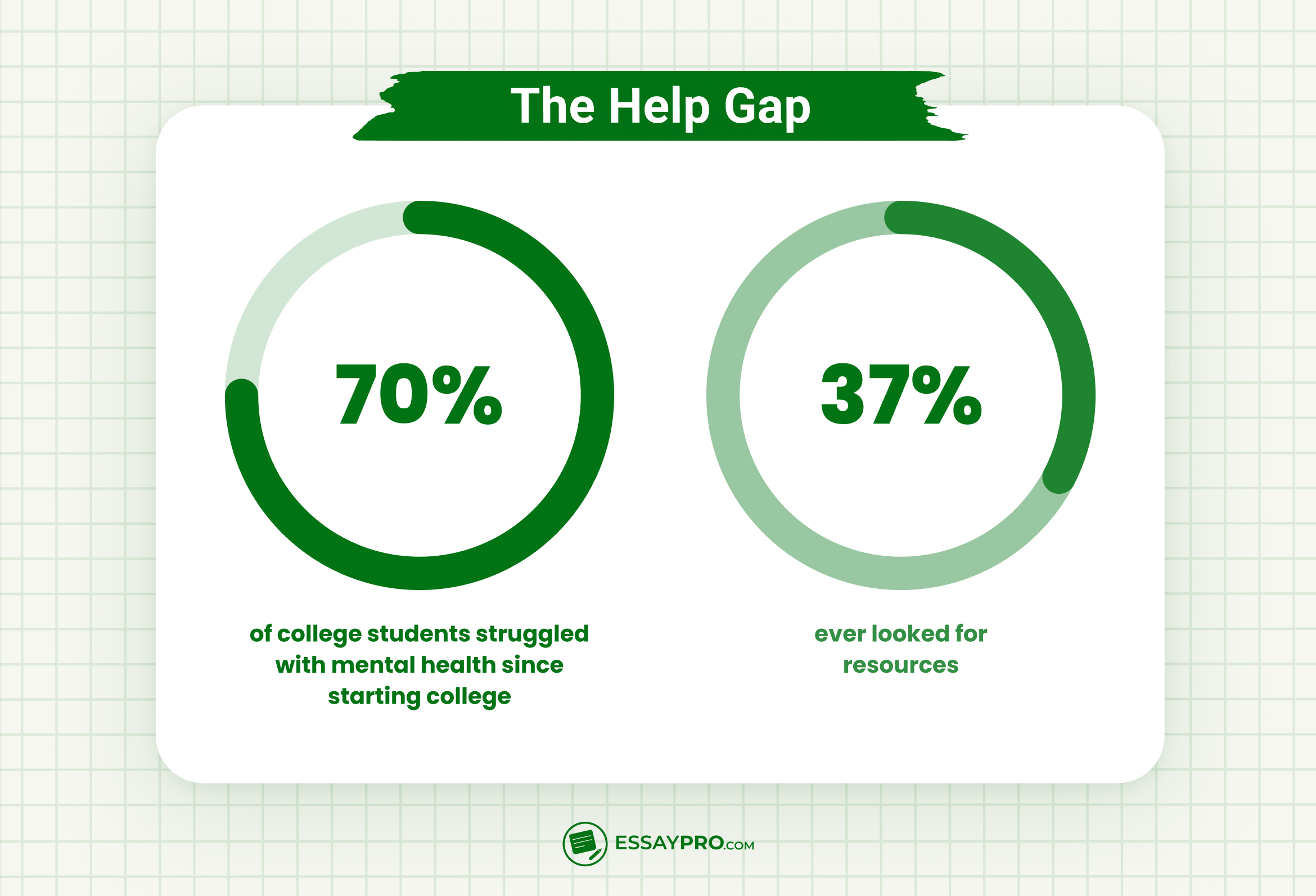
The gap between needing help and asking for it is wide, and it is measurable. In a March 2024 U.S. News/Generation Lab survey of 3,649 college students, 70% said they had struggled with mental health since starting college, yet only 37% ever looked for resources at their school. The reasons they gave were practical as much as emotional: cost, fear of stigma, past experiences that went badly, and plain uncertainty about how to connect with help. A 2024 peer-reviewed study reinforced the point, finding that fewer than 20% cited stigma, and that logistical barriers like access and time mattered more.
How Can Student Stress Be Addressed?
The useful approach, just like human mental well-being, is layered and simply cannot be fixed with one simple touch. The changes are structural, not flashy, and they work best in combination:
- Coordinate the workload. Schools that sync assignment and test calendars across departments cut the pileups that spike stress, and that coordination costs nothing but attention.
- Fix sleep and food first. A hungry, exhausted student cannot self-regulate, so campus food pantries and later assignment deadlines address the problem at its root.
- Lower the barrier to care. Same-day drop-in counseling, teletherapy, and clear signposting make help reachable, which matters given how few students seek it on their own.
- Build belonging. Advisors, peer groups, and small first-year cohorts give a student someone who notices when they slip.
- Ask directly. Parents and teachers should raise stress plainly and often, since the data shows kids seldom bring it up themselves.
And, by the way, if your major leans more toward the numbers, you can always get finance assignment help from our service.
Final Thoughts
The pattern across every dataset points in the same direction. Stress is now the baseline for most students, school-age through college, and it feeds on workload, bullying, distance from home, and untreated mental health conditions. The encouraging part is that the fixes are known, affordable, and mostly a matter of will.
FAQs
What Percent of Students Are Stressed by School?
How Prevalent Is Stress Among College Students?
What Mental-Health Support Is Available for Students?

Ana Ratishvili
Ana is a professional literary writer with a Master’s Degree in English literature. Through critical analysis and an understanding of storytelling techniques, she can craft insightful guides on how to write literary analysis essays and their structures so students can improve their writing skills.