
A definition essay focuses on explaining the meaning of a specific word or concept in depth. Instead of repeating a traditional or dictionary definition, this essay type explores how a term is understood, used, and interpreted in real contexts.
In this article, you’ll learn:
- What makes definition essays different from other academic essays
- How to choose a term that has enough depth to explain
- How to build a clear structure that supports your definition in your own words
- How to write an actual thesis statement for a definition paper
- How to explain a concept and create context using examples and analysis
- How to improve definition writing skills
If defining abstract or complex ideas feels overwhelming, you’re not alone. EssayPro offers professional support through its research paper writer service.
What is a Definition Essay?
A definition essay is an academic essay that explains the meaning of a specific word or concept in a clear, focused way. After establishing what the term means, the essay moves beyond surface explanation and examines how that meaning operates in real use, where it shifts, and why it can be interpreted differently. This type of academic writing is often used for words that seem familiar but reveal complexity once you try to define them precisely.
Note: A common mistake is assuming the reader shares your interpretation of a word. Many terms carry implied meaning alongside their literal definition. Ignoring those hidden layers can flatten your explanation and make the essay feel shallow rather than thoughtful.
Definition Essay Examples
Here are definition papers from our custom essay service. You can download each example of definition essay PDF for free to study its structure and format to guide your own work.
Writing a Definition Essay Step-by-Step
These steps walk you through the process of turning a familiar word into a clear, grounded definition that holds up under academic scrutiny.
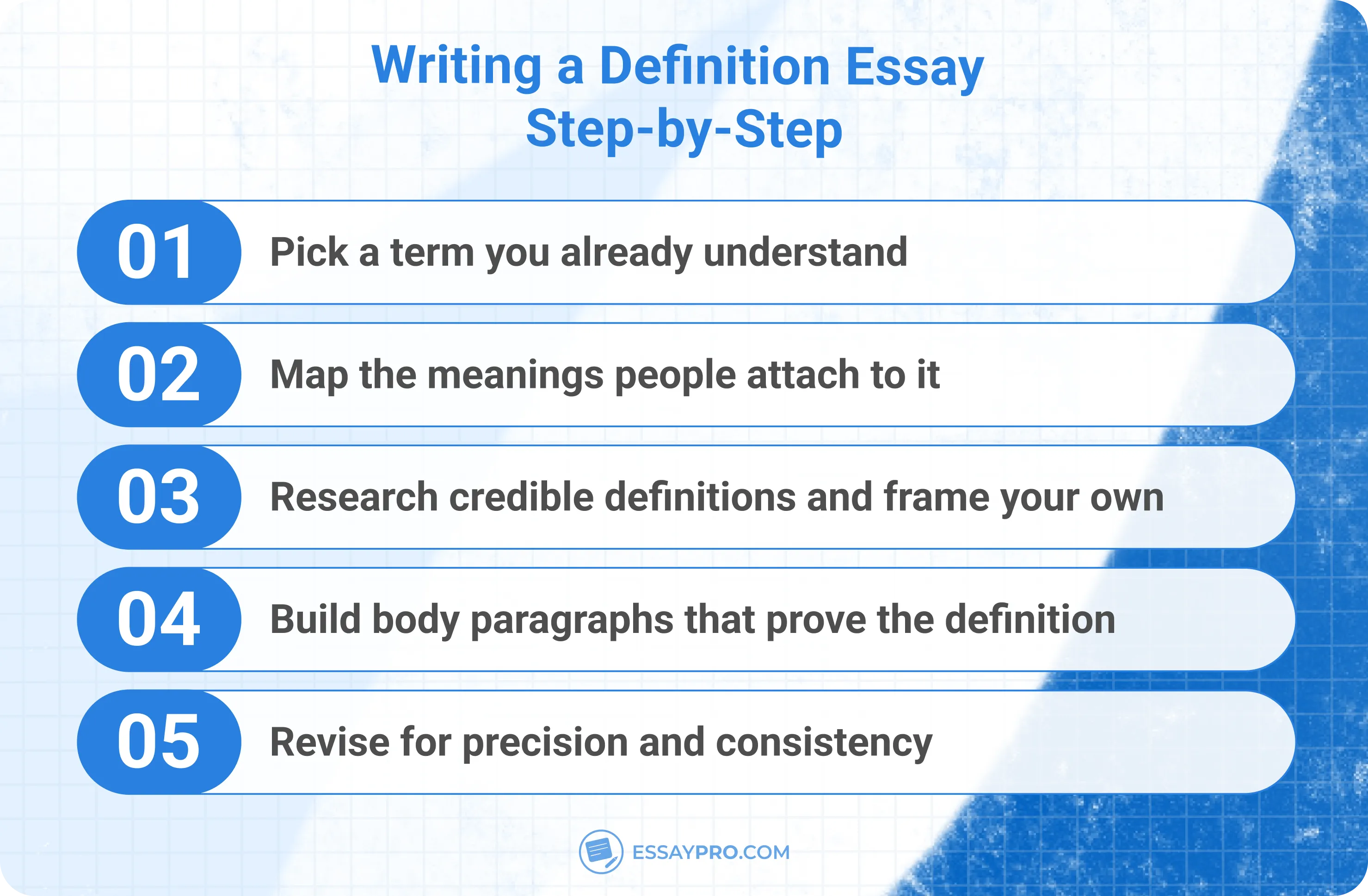
Step 1: Pick a Term You Already Understand
Choose a term you have encountered repeatedly in academic or everyday contexts. Prior familiarity helps you recognize how the word is commonly used and where confusion or disagreement appears. Start by listing situations where the term appeared with different meanings. These differences signal definitional depth.
If you choose freedom, note its use in political theory, personal choice, and legal rights. These contexts reveal distinct interpretations you can define and analyze in your essay.
Step 2: Map the Meanings People Attach to It
Watch how the word changes depending on who uses it and where it appears. A dictionary may offer a clean definition, but real usage often adds pressure, judgment, or permission. Notice tone shifts. Notice what the word allows someone to justify, explain away, or claim authority over. Meaning often reveals itself in those patterns rather than in formal wording alone.
For example, the term responsibility may mean legal obligation in law, personal accountability in psychology, and duty in social discussions.
Step 3: Research Credible Definitions and Frame Your Own
Collect definitions from academic sources such as textbooks, peer-reviewed articles, or subject-specific dictionaries. Compare how each source defines the term and note shared elements as well as gaps or limitations. Use this comparison to draft your own working definition that reflects both scholarly consensus and your focus.
When defining motivation, you may find repeated emphasis on internal drives, while fewer sources address environmental influence. Your definition can combine both to support a clear, focused thesis.
Step 4: Build Body Paragraphs That Prove the Definition
Write one body paragraph for each key aspect of your definition. Begin every paragraph with a clear claim about what the term includes or excludes. Support that claim using explanation, evidence, or a concrete situation.
If defining leadership, one paragraph may explain decision-making authority, supported by a workplace scenario.
Writer tip: After drafting a paragraph, underline the first sentence. If you cannot state in one line what new part of the definition that paragraph proves, the paragraph needs restructuring.
Step 5: Revise for Precision and Consistency
Read carefully for shifts in meaning. Watch for moments where the word starts doing something different than you intended. Examples should sharpen the definition, not blur it. The ending should echo the definition you built, leaving it settled rather than reopened.
If you’re short on time or need structured help at any stage, you can buy essay cheap through EssayPro.
How to Structure a Definition Essay Outline
A definition essay structure consists of an introduction, body paragraphs, and a conclusion. What makes it engaging is how you explore the term in the body paragraphs.
Introduction
The introductory paragraph opens the conversation around the term you plan to define. It should ease the reader in, not lecture them.
- Pull the reader in: Start with a moment, thought, or observation that naturally leads to the word you’re defining.
- Name the term: Make it clear what concept the essay focuses on and why people keep using it in different situations.
- Set your direction: Hint at how you understand the term and why its meaning deserves a closer look.
Definition essay introduction example: The word “home” is used casually, yet its meaning shifts depending on memory, comfort, and belonging, turning a simple term into something deeply personal and difficult to pin down.
If you’re still deciding what to write about, you can browse a wide range of definition essay topics for inspiration.
Body Paragraphs
Each paragraph should circle the term from a different angle, giving the reader a clearer sense of its shape.
- Etymology: Step back and trace where the word began. Its origin often explains why multiple meanings still cling to it, even after centuries of change.
- Boundaries: Clarify where the term stops. Naming common misuses or overextensions helps the reader understand what the word can reasonably claim.
- Examples: Bring the definition into focus using relatable yet academically appropriate situations. A short personal moment, a familiar situation, or a concrete case makes the idea tangible.
- Analysis: Linger on the implied meaning. Tone, emotional weight, and context often reveal more than the literal wording ever could.
- Compare and contrast: Set your understanding beside other interpretations. The friction between definitions adds depth and shows why the word’s meaning rarely sits still.
Advice from the Editor: If a paragraph feels like it could belong anywhere, it lacks purpose. Each one should earn its place by sharpening the definition in a distinct, memorable way.
Conclusion
The conclusion is where everything settles. Pull the thread back through the essay and remind the reader how the definition came together, without retracing every step. Rephrase your thesis so it sounds earned rather than announced, shaped by the examples and analysis you’ve already done.
Conclusion example: After examining how the term is used, interpreted, and experienced, its meaning becomes more precise. What first appeared simple now reveals depth shaped by context and our own perspective, showing why defining the term carefully is necessary rather than optional.
Common Types of Definition Essays
When choosing a term with a rich historical background, carefully determine the most effective approach. Here are some common types, as suggested by our dissertation writing help:
- Analysis: Break down the topic into its constituent parts and define each part separately.
- Classification: Determine the categories under which the topic can be classified.
- Comparison: Highlight the uniqueness of the topic by comparing and contrasting it with more common subjects.
- Details: Identify the key traits and distinctive qualities that best encapsulate the central idea of your essay.
- Negation: Clarify what your topic is, not to narrow down its definition.
- Origins and Causes: Explore the historical origins and background of the chosen concept, examining where it first appeared and any relevant traditional details.
- Results, Effects, and Uses: Discuss the consequences, effects, and practical applications of the subject matter.
Tips for Writing the Definition Essay
Here you'll find some great tips from our essay writer to transform your frown into a confident writer's grin:
- Avoid simple terms: Stay away from words that are universally understood and leave little room for interpretation. A traditional definition essay works best when the term invites discussion rather than agreement.
- Examples are king: Use real-life stories of successful people to illustrate your points. This makes your definition clear and relatable.
- Go beyond dictionary definitions: Explore the different ways your term is understood. A hug can show "love," but so can standing up for someone.
- Use contrasting examples: Don't just pile on positive examples. Show the complex meaning of your term by using contrasting situations (e.g., "Innovation can lead to lifesaving inventions, but also carries the risk of unintended consequences").
- Quote the experts: Don't be afraid to integrate short, relevant quotes from philosophers, authors, or historical figures to strengthen your argument.
- Demonstrate your own understanding of the chosen term: Show that you grasp the concept from multiple angles. Address complexity, limits, and variation to prove the definition is thoughtful and complete.
- Support your definition with evidence: Personal opinion alone is not enough. Use examples, observations, or credible sources to reinforce how and why your definition holds up.
Definition Essay Readiness Quiz
.webp)
.webp)
.webp)
.webp)
.webp)
.webp)
.webp)
.webp)
.webp)
.webp)
Final Words
- A strong definition essay explains a term in depth rather than repeating a dictionary line
- The best topics for definition essay involve words with layered, debated, or shifting meanings
- Each body paragraph should explore one clear aspect of the definition
- Examples and context give meaning and make abstract terms understandable
- Careful revision keeps the definition consistent and focused from start to finish
If you need extra support turning these ideas into a polished paper, EssayPro can help you order essay that follows academic standards while keeping your definition clear, original, and well-structured.
FAQ
How to Start a Definition Essay?
What is a Definition Essay Example?
What Is the Structure of a Definition Essay?
What Is the Purpose of a Definition Essay?
What Should I Write My Definition Essay About?
How Many Paragraphs Should a Definition Essay Be?

Daniel Parker
is a seasoned educational writer focusing on scholarship guidance, research papers, and various forms of academic essays including reflective and narrative essays. His expertise also extends to detailed case studies. A scholar with a background in English Literature and Education, Daniel’s work on EssayPro blog aims to support students in achieving academic excellence and securing scholarships. His hobbies include reading classic literature and participating in academic forums.
- Paradise Valley Community College. (2025). Definition essay. Paradise Valley LibGuides. Retrieved from https://paradisevalley.libguides.com/ENG102/definition_essay
- The University of Melbourne. (n.d.). Writing a great essay. Retrieved January 30, 2026, from https://students.unimelb.edu.au/academic-skills/resources/reading,-writing-and-referencing/essays/writing-a-great-essay
- Texas A&M University. (2024). Definition essay [Assignment/Rubric]. Strategies, Skills and Models for Student Success in Writing and Reading Comprehension. Retrieved January 30, 2026, from https://odp.library.tamu.edu/engl1301/chapter/the-definition-essay/


.webp)