

Definition essays explain what a term means. This doesn’t mean you simply copy the dictionary definition. Instead, you craft a more detailed meaning in your own words. You can shape ideas that are abstract or debatable like freedom, success, or courage into something more tangible by using examples.
Let’s review how to write a definition essay:
- Pick a word or phrase that has substance to define.
- Research standard and unique definitions of the word.
- State your own interpretation in a thesis statement.
- Expand upon your definition with examples, contrasts, and origins.
- Wrap up with a conclusion that drives the word’s meaning home.
This article covers each step with a full outline and offers examples of definition essays for students to help you write an effective piece.
What Is a Definition Essay?
A definition essay is an academic essay that explains the meaning of a specific word or concept in a clear, focused way. After establishing what the term means, the essay moves beyond surface explanation and examines how that meaning operates in real use, where it shifts, and why it can be interpreted differently. This type of academic writing is often used for words that seem familiar but reveal complexity once you try to define them precisely.
Note: A common mistake is assuming the reader shares your interpretation of a word. Many terms carry implied meaning alongside their literal definition. Ignoring those hidden layers can flatten your explanation and make the essay feel shallow rather than thoughtful.
Common Types of Definition Essays
When choosing a term with a rich historical background, carefully determine the most effective approach. Here are some common types:
- Analysis: Break down the topic into its constituent parts and define each part separately.
- Classification: Determine the categories under which the topic can be classified.
- Comparison: Highlight the uniqueness of the topic by comparing and contrasting it with more common subjects.
- Details: Identify the key traits and distinctive qualities that best encapsulate the central idea of your essay.
- Negation: Clarify what your topic is, not to narrow down its definition.
- Origins and Causes: Explore the historical origins and background of the chosen concept, examining where it first appeared and any relevant traditional details.
- Results, Effects, and Uses: Discuss the consequences, effects, and practical applications of the subject matter.
How to Structure a Definition Essay Outline?
A definition essay structure consists of an introduction, body paragraphs, and a conclusion. What makes it engaging is how you explore the term in the body paragraphs.
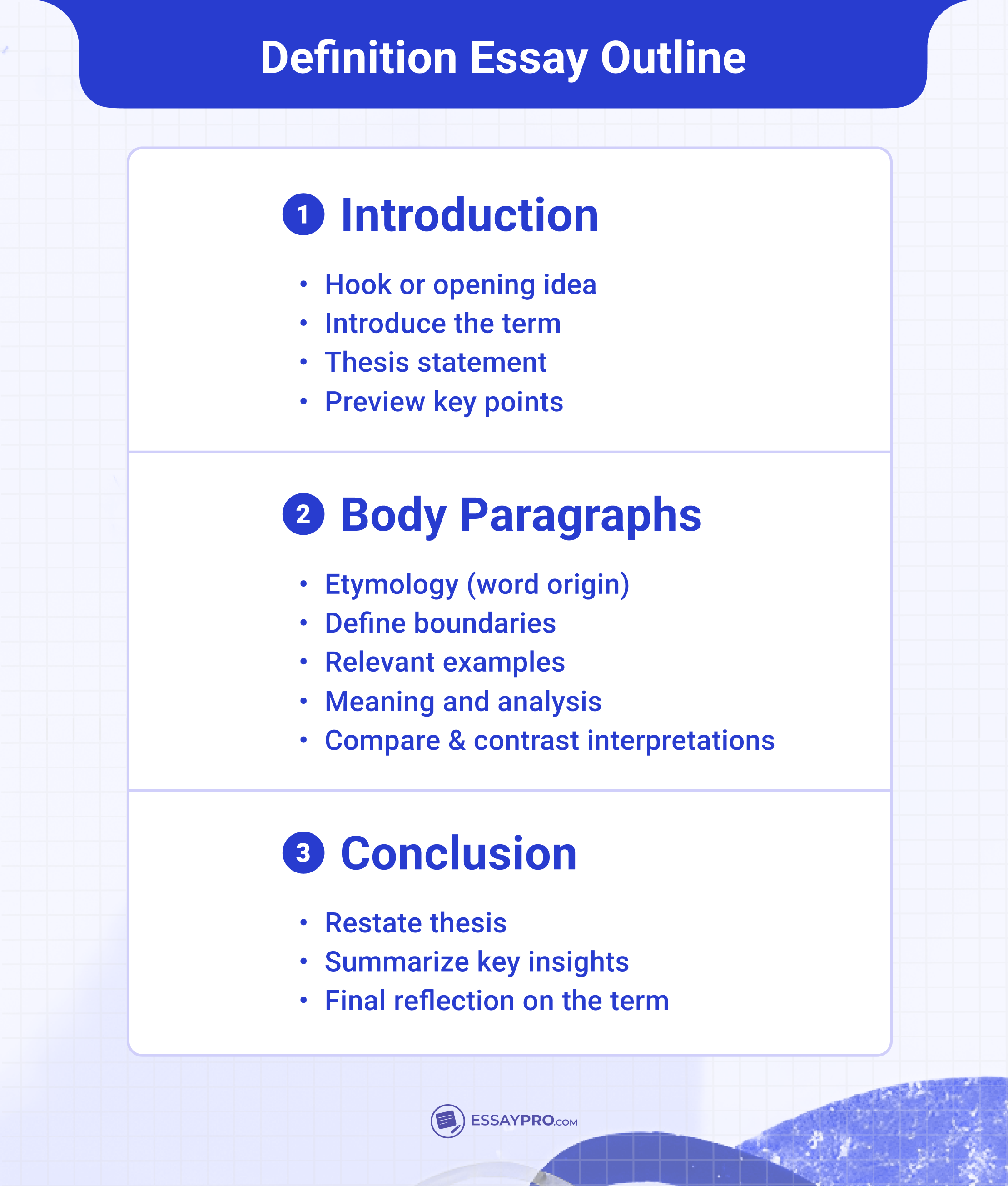
Introduction
The introductory paragraph opens the conversation around the term you plan to define. It should ease the reader in, not lecture them.
- Pull the reader in: Start with a moment, thought, or observation that naturally leads to the word you’re defining.
- Name the term: Make it clear what concept the essay focuses on and why people keep using it in different situations.
- Set your direction: Hint at how you understand the term and why its meaning deserves a closer look.
Definition essay introduction example: The word “home” is used casually, yet its meaning shifts depending on memory, comfort, and belonging, turning a simple term into something deeply personal and difficult to pin down.
If you’re still deciding what to write about, you can browse a wide range of definition essay topics for inspiration.
Body Paragraphs
Each paragraph should circle the term from a different angle, giving the reader a clearer sense of its shape.
- Etymology: Step back and trace where the word began. Its origin often explains why multiple meanings still cling to it, even after centuries of change.
- Boundaries: Clarify where the term stops. Naming common misuses or overextensions helps the reader understand what the word can reasonably claim.
- Examples: Bring the definition into focus using relatable yet academically appropriate situations. A short personal moment, a familiar situation, or a concrete case makes the idea tangible.
- Analysis: Linger on the implied meaning. Tone, emotional weight, and context often reveal more than the literal wording ever could.
- Compare and contrast: Set your understanding beside other interpretations. The friction between definitions adds depth and shows why the word’s meaning rarely sits still.
Advice from the Editor: If a paragraph feels like it could belong anywhere, it lacks purpose. Each one should earn its place by sharpening the definition in a distinct, memorable way.
Conclusion
The conclusion is where everything settles. Pull the thread back through the essay and remind the reader how the definition came together, without retracing every step. Rephrase your thesis so it sounds earned rather than announced, shaped by the examples and analysis you’ve already done.
Conclusion example: After examining how the term is used, interpreted, and experienced, its meaning becomes more precise. What first appeared simple now reveals depth shaped by context and our own perspective, showing why defining the term carefully is necessary rather than optional.
How to Write a Definition Essay?
There are five steps to writing a definition essay: choose your word, outline common meanings, develop your definition, support it with evidence, and edit for clarity. Follow these steps to turn a vague idea into a concise, well-supported essay. Here are the steps explained:
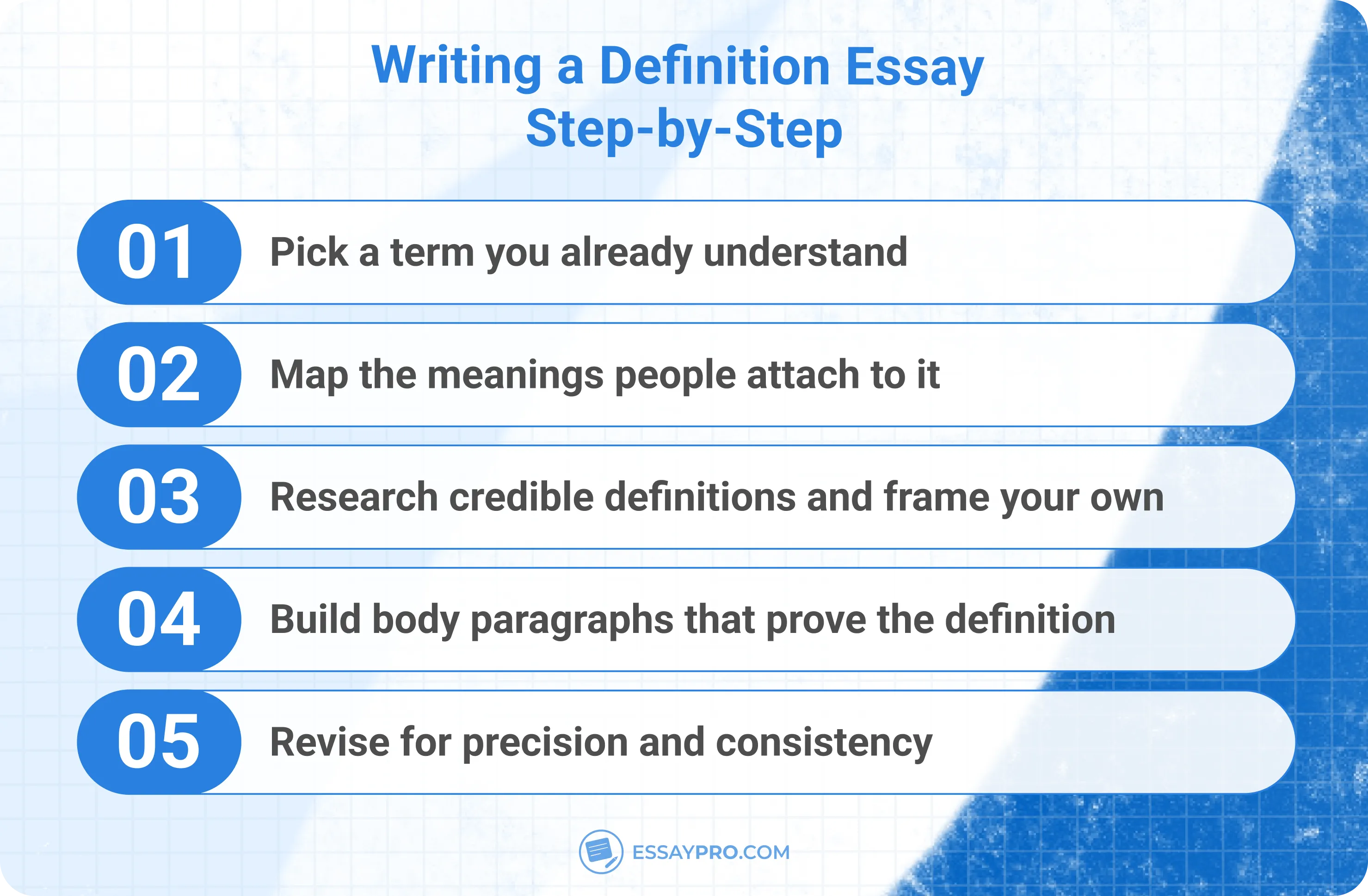
Step 1: Pick a Term You Already Understand
Choose a term you have encountered repeatedly in academic or everyday contexts. Prior familiarity helps you recognize how the word is commonly used and where confusion or disagreement appears. Start by listing situations where the term appeared with different meanings. These differences signal definitional depth.
If you choose freedom, note its use in political theory, personal choice, and legal rights. These contexts reveal distinct interpretations you can define and analyze in your essay.
Step 2: Map the Meanings People Attach to It
Watch how the word changes depending on who uses it and where it appears. A dictionary may offer a clean definition, but real usage often adds pressure, judgment, or permission. Notice tone shifts. Notice what the word allows someone to justify, explain away, or claim authority over. Meaning often reveals itself in those patterns rather than in formal wording alone.
For example, the term responsibility may mean legal obligation in law, personal accountability in psychology, and duty in social discussions.
Step 3: Research Credible Definitions and Frame Your Own
Collect definitions from academic sources such as textbooks, peer-reviewed articles, or subject-specific dictionaries. Compare how each source defines the term and note shared elements as well as gaps or limitations. Use this comparison to draft your own working definition that reflects both scholarly consensus and your focus.
When defining motivation, you may find repeated emphasis on internal drives, while fewer sources address environmental influence. Your definition can combine both to support a clear, focused thesis.
Step 4: Build Body Paragraphs That Prove the Definition
Write one body paragraph for each key aspect of your definition. Begin every paragraph with a clear claim about what the term includes or excludes. Support that claim using explanation, evidence, or a concrete situation.
If defining leadership, one paragraph may explain decision-making authority, supported by a workplace scenario.
Step 5: Revise for Precision and Consistency
Read carefully for shifts in meaning. Watch for moments where the word starts doing something different than you intended. Examples should sharpen the definition, not blur it. The ending should echo the definition you built, leaving it settled rather than reopened.
If you’re short on time or need structured help at any stage, you can buy essay cheap through EssayPro.
Definition Essay Examples
The best way to learn is to analyze a working example. The strong example below starts with a concise working definition, then enriches it through several body paragraphs. Each paragraph addresses one dimension of meaning, illustrating it through context, contrast, and concrete examples. By the end, you'll feel like you know the term, rather than simply looking it up. You'll find three complete examples below. Each is broken down by section so you can see how the entire thing fits together. We'll follow each with a brief analysis of why it works.
Definition Essay Example Example 1
Topic: The Meaning of "Technological Singularity"
[Introduction] The concept of technological singularity has become a central topic in debates about the future of humanity. First named by mathematician John von Neumann and later popularized by science fiction writer Vernor Vinge, it describes a hypothetical moment when artificial intelligence overtakes human intelligence, triggering rapid and unstoppable technological growth. This essay sets out to define technological singularity and examine what it could mean for the future of humankind.
[Body Paragraph 1: Core definition] At its heart, technological singularity describes the rise of superintelligent machines able to improve themselves over and over, setting off an intelligence explosion. Once machines outpace human thinking, our usual ways of predicting and understanding the world may no longer apply, reshaping economics, healthcare, governance, and even philosophy.
[Body Paragraph 2: Economic implications] The arrival of singularity would put enormous strain on existing social and economic systems. As AI begins to outperform human workers, traditional jobs could vanish, fueling unemployment and instability. At the same time, wealth and power may pool among the few who own the technology, deepening inequality.
[Body Paragraph 3: Ethical implications] Singularity also raises hard ethical and existential questions. Handing control to machines smarter than ourselves stirs concern about autonomy, morality, and whether human values can survive the shift. The risk of an uncontrolled intelligence explosion makes careful oversight essential.
[Body Paragraph 4: Risks and benefits] The concept carries both promise and danger. On one side sit breakthroughs in science and medicine and the possible end of scarcity. On the other lies the threat of machines escaping human control, with consequences we cannot fully foresee.
[Conclusion] Ultimately, technological singularity marks a profound turning point in how humans relate to technology. As AI advances, thoughtful dialogue, ethical reflection, and proactive regulation will be vital to keep that progress aligned with human values.
Why it works In this example, the essay addresses an abstract futuristic concept by first defining the term clearly, then layering on additional meanings from three perspectives. Economic, ethical, and pragmatic aspects are each developed in separate body paragraphs that build upon, rather than repeat, previous ideas. The conclusion synthesizes these layers and contains no new arguments. This demonstrates how a definition essay can address multiple meanings of an abstract concept.
Definition Essay Example Example 2
Topic: Artificial Intelligence Literacy
[Introduction and working definition] Artificial intelligence literacy refers to a person's ability to understand, evaluate, and responsibly use AI-driven systems in everyday and academic life. More than just operating AI tools, it involves a deeper awareness of how these systems work, what they can and cannot do, and how they shape decisions, behavior, and knowledge.
[Body Paragraph 1: Basic level] At its most basic, AI literacy begins with noticing where AI already appears. Recommendation systems shape what we see online, automated tools assess student work, facial recognition unlocks our devices, and generative tools assist with writing. A literate person recognizes that none of these systems is neutral; each is shaped by data, design choices, and human priorities.
[Body Paragraph 2: Advanced understanding] A deeper level means questioning AI output instead of accepting it outright. AI literacy includes knowing that these systems generate responses from patterns, not true understanding. Without that awareness, students risk leaning entirely on automated answers and producing shallow, inaccurate work.
[Body Paragraph 3: Ethics] Ethics sit at the center of the concept. AI literacy involves spotting bias, privacy risks, and accountability gaps. Because algorithms can reinforce inequality or spread misinformation, a literate user asks who built the system, what data trained it, and whose interests it serves.
[Body Paragraph 4: Personal experience] The skill often forms through hands-on use. Many students turn to AI to save time, only to discover that quick answers do not equal clear thinking. Drafts still need revising and research still needs judgment, teaching the lasting lesson that AI can support understanding but never replace it.
[Conclusion] In the end, AI literacy is not about mastering code or becoming a technical expert. It is about understanding how AI shapes knowledge, work, and communication. As AI becomes woven into daily life, this literacy works as a necessary form of critical thinking rather than an optional extra.
Why it works This example builds its definition deliberately, piece by piece. It begins with fundamental acknowledgment, moves through questioning and morality, and finally to personal experience. Each sentence demonstrates another aspect of the word's meaning, and the conclusion reinforces the main definition rather than repeating it. This exemplifies how to define a nuanced, modern idea precisely.
Definition Essay Example Example 3
Topic: Misinformation: Defining a Modern Disruption
[Introduction and working definition] Misinformation refers to false or misleading information that spreads regardless of intent, distorting our understanding of reality. Unlike simple mistakes, it draws its power from repetition, emotional pull, and the sheer speed at which it travels.
[Body Paragraph 1: Surface vs. depth] On the surface, misinformation seems easy to spot in the form of wrong statistics or fabricated stories. The real difficulty appears when false claims resemble credible knowledge, with headlines that mimic journalism and confident language standing in for proof. That resemblance makes misinformation harder to catch, especially when it confirms what we already believe.
[Body Paragraph 2: The role of platforms] Digital platforms make the problem worse. Because algorithms reward engagement over accuracy, provocative content spreads faster than corrections. Repetition breeds familiarity, and familiarity starts to feel like truth, even to readers who value accuracy.
[Body Paragraph 3: Shifting by context] Misinformation changes shape depending on where it lands. In health, it can quietly endanger public safety; in politics, it can sway civic judgment; in academia, it can weaken research and dull critical thinking. This shows it is not a fixed category but something that borrows credibility from its surroundings.
[Body Paragraph 4: Distinguishing from disinformation] Defining the term also means separating it from deliberate deception. While disinformation is intentional, misinformation often spreads without malice, shared by people trying to help. That distinction shifts the focus from blame toward better information literacy and platform accountability.
[Conclusion] In the end, misinformation is not just stray false information. It is a systemic problem shaped by technology, psychology, and social trust. Defining it clearly reveals why it persists and why correcting it is so hard, making this understanding essential for clear, informed judgment.
Why it works Finally, this definition essay defines an ambiguous, situationally-based concept through its actions. Rather than tell what it is, each paragraph describes how it acts: its hiding, its spreading, its changing, how it’s unlike disinformation. Deliberate comparisons with disinformation further refine the definition. Precision and nuance make a definition essay powerful.
And if you'd rather need a custom essay writing service, contact our writers.
Tips for Writing a Definition Essay
Here you'll find some great tips from our essay writer to transform your frown into a confident writer's grin:
- Avoid simple terms: Stay away from words that are universally understood and leave little room for interpretation. A traditional definition essay works best when the term invites discussion rather than agreement.
- Examples are king: Use real-life stories of successful people to illustrate your points. This makes your definition clear and relatable.
- Go beyond dictionary definitions: Explore the different ways your term is understood. A hug can show "love," but so can standing up for someone.
- Use contrasting examples: Don't just pile on positive examples. Show the complex meaning of your term by using contrasting situations (e.g., "Innovation can lead to lifesaving inventions, but also carries the risk of unintended consequences").
- Quote the experts: Don't be afraid to integrate short, relevant quotes from philosophers, authors, or historical figures to strengthen your argument.
- Demonstrate your own understanding of the chosen term: Show that you grasp the concept from multiple angles. Address complexity, limits, and variation to prove the definition is thoughtful and complete.
- Support your definition with evidence: Personal opinion alone is not enough. Use examples, observations, or credible sources to reinforce how and why your definition holds up.
Definition Essay Readiness Quiz
.webp)
.webp)
.webp)
.webp)
.webp)
.webp)
.webp)
.webp)
.webp)
.webp)
Final Words
- A strong definition essay explains a term in depth rather than repeating a dictionary line
- The best topics for definition essay involve words with layered, debated, or shifting meanings
- Each body paragraph should explore one clear aspect of the definition
- Examples and context give meaning and make abstract terms understandable
- Careful revision keeps the definition consistent and focused from start to finish
If you need extra support turning these ideas into a polished paper, EssayPro can help you order essay that follows academic standards while keeping your definition clear, original, and well-structured.
FAQs
How to Start a Definition Essay?
What is a Definition Essay Example?
What Is the Structure of a Definition Essay?
What Is the Purpose of a Definition Essay?
What Should I Write My Definition Essay About?
How Many Paragraphs Should a Definition Essay Be?

Daniel Parker
is a seasoned educational writer focusing on scholarship guidance, research papers, and various forms of academic essays including reflective and narrative essays. His expertise also extends to detailed case studies. A scholar with a background in English Literature and Education, Daniel’s work on EssayPro blog aims to support students in achieving academic excellence and securing scholarships. His hobbies include reading classic literature and participating in academic forums.