

The thesis statement is one sentence (sometimes two) that explains to the reader what your paper argues and why. It’s typically found at the end of your introduction, and all of your writing should connect back to it. Easy enough, right? Except most students write either thesis statements that are too broad, too obvious, or so vague you could read practically any meaning into them.
Your thesis matters more than you might think. Without a strong thesis statement, your paper will be more difficult to write since you won’t have a guide directing your writing. Below, we cover how to craft a thesis that works, along with effective thesis statement examples.
Tips for Writing a Thesis Statement
Remember that your thesis does not simply introduce your topic, but it makes a claim about your topic. The distinction between a weak and a strong one often lies in whether or not it is actually arguable.
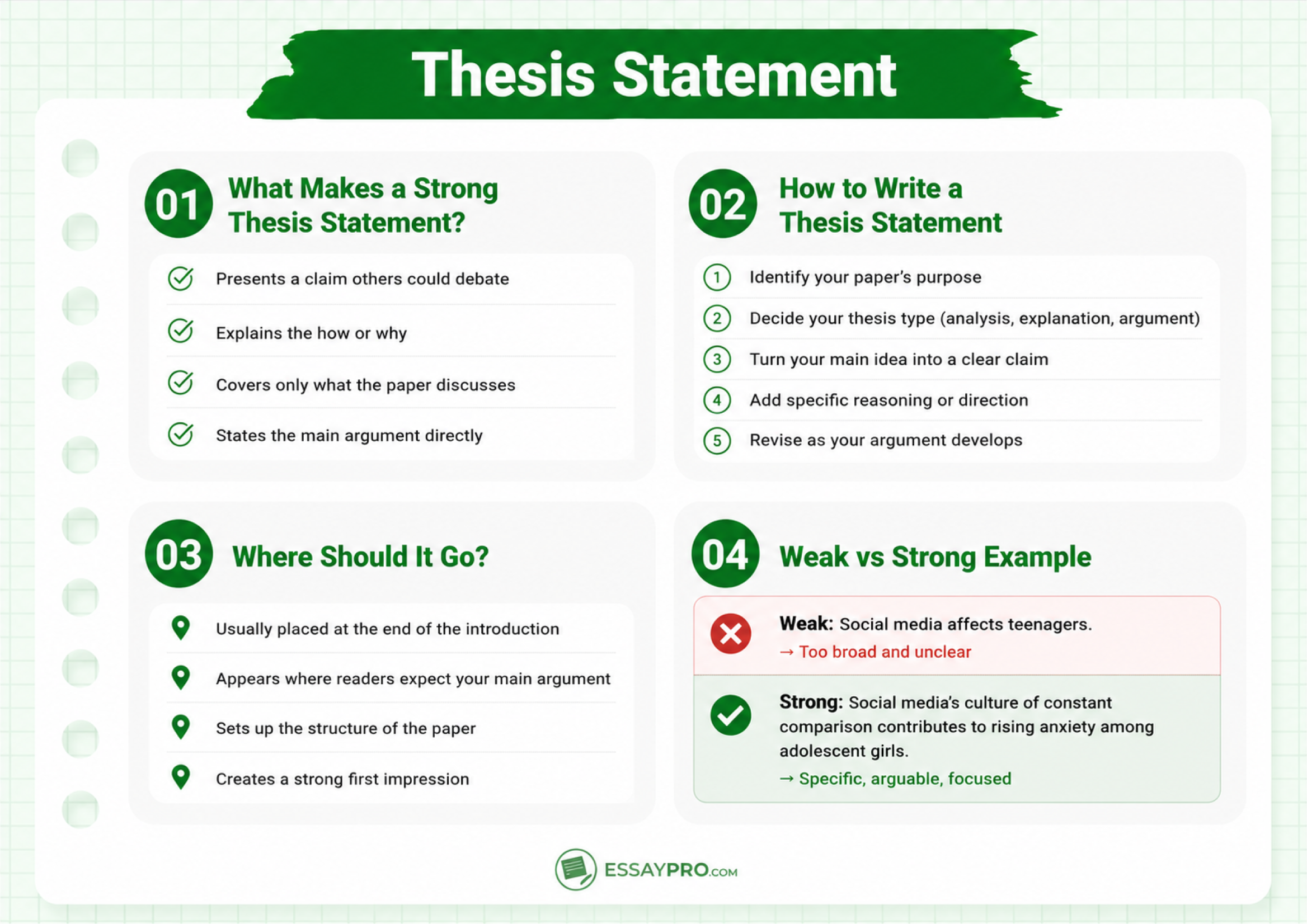
Here are some qualities that define a strong thesis statement:
- Arguable: It stakes out a position that someone could disagree with. Bad: Climate change is real. Good: Governments that prioritize economic growth over emissions policy are causing irreversible damage to the climate.
- Specific: It explains how or why, not just what. Bad: Social media affects teenagers. Good: Social media’s culture of constant comparison is directly contributing to anxiety rates in adolescent girls.
- Focused: It only addresses what you’ll cover in your paper.
Now that we’ve talked about the qualities, let’s see how to craft strong examples of a thesis statement.
- Determine the type of paper you’re writing. Are you analyzing something? If so, your thesis will likely contain words like “analyze.” Are you explaining something? Maybe your thesis will include “explain.” Or you may be arguing to convince your reader of something.
- Put it at the end of your introduction. Though sometimes you’ll see them in various places, thesis statements work best at the end of the introduction, because that’s where your reader expects to see them, and that’s where they will have the most impact.
- Leave it editable. As you write, you may find your thesis – and your argument – shifting. That’s ok! Revisit your thesis and edit it to fit what you’re actually arguing in your paper.
Is Your Thesis Statement Too Broad?
Get expert help building a focused argument that actually supports the rest of your paper.

Thesis Statement Examples for All Types of Writing
The style of your thesis will vary based on the type of paper you are writing. Argumentative means you are taking a stand, while in informative essays, you will be explaining something. An analytical thesis will break your subject down, and an expository one will give a straightforward explanation of why or how something works. We cover all of these below with good thesis statement examples for you to understand the difference.
Argumentative Thesis Statement Examples
An argumentative thesis makes a claim that someone could genuinely disagree with and signals that the paper will defend that position with evidence. Strong thesis statement examples here feel like the opening move in a debate, not a summary of a topic.
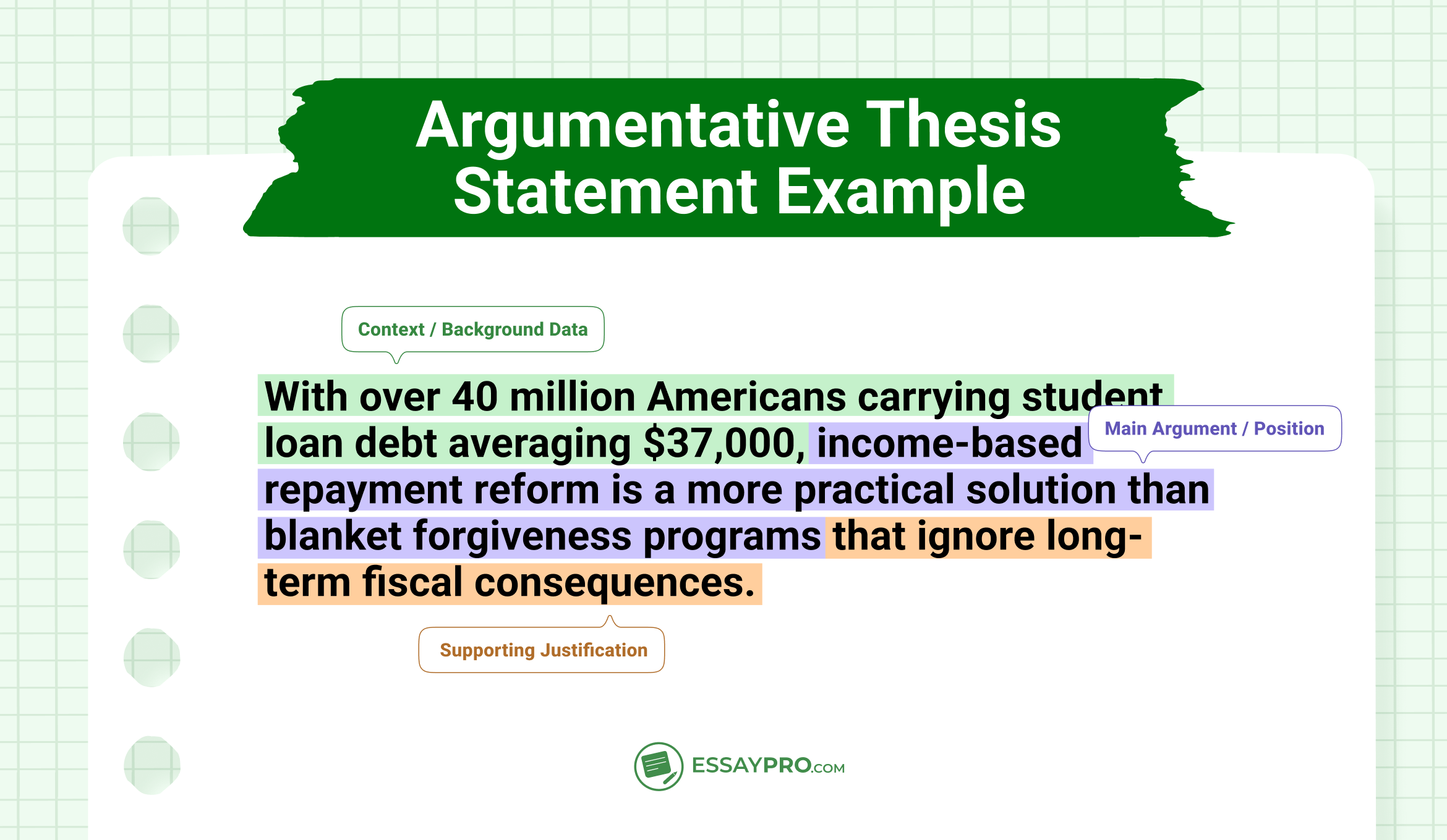
- With over 40 million Americans carrying student loan debt averaging $37,000, income-based repayment reform is a more practical solution than blanket forgiveness programs that ignore long-term fiscal consequences.
- Countries with nurse-to-patient ratios above 1:8 report significantly higher rates of preventable in-hospital deaths, making mandatory staffing legislation a patient safety issue rather than a workforce negotiation.
- Despite comprising 13% of the U.S. population, Black Americans account for 38% of the prison population, which indicates the criminal justice system requires structural reform rather than tougher sentencing.
- With screen time among children under 12 averaging over 4 hours daily, parental controls alone are insufficient and platform-level age restrictions need legal backing to be effective.
- Given that 70% of global greenhouse emissions come from just 100 companies, individual consumer behavior change campaigns distract from the corporate accountability measures that would actually move the needle.
Students working on large academic projects sometimes choose to buy thesis paper support for research and structure guidance.
Informative Thesis Statement Examples
An informative thesis does not argue a position. It tells the reader what the paper will cover and what they will understand by the end of it. The goal is clarity, not persuasion. A good informative thesis statement example maps the territory without taking sides.
- This paper examines how the United States opioid crisis developed between 1996 and 2010, tracing the role of pharmaceutical marketing, prescribing incentives, and delayed federal regulation in producing over 500,000 overdose deaths.
- The following paper outlines how three Nordic countries, Finland, Denmark, and Sweden, structured their early childhood education systems and what outcomes those models have produced in literacy, social development, and later academic performance.
- This paper explains how mRNA vaccine technology works, why it differs from traditional vaccine development, and how the platform was adapted for rapid COVID-19 deployment after over a decade of prior research.
- The essay below describes how gig economy classification disputes have played out in California, the UK, and the EU, and what each legal outcome has meant for worker protections in practice.
- This paper outlines the four stages of burnout as defined in occupational health research and how each stage presents differently across healthcare, education, and corporate work environments.
Analytical Thesis Statement Examples
An analytical thesis breaks a subject down and makes an interpretive claim about what those parts reveal. It goes beyond describing what something is and moves toward explaining what it means or how it functions.
- An analysis of sugar industry-funded research published between 1965 and 1980 shows a consistent pattern of downplaying cardiovascular risk while redirecting public health concern toward dietary fat, a shift that shaped nutritional policy for decades.
- Examining arrest data across U.S. cities with and without stop-and-frisk policies reveals that the practice produced no measurable reduction in violent crime while generating racially disproportionate contact with law enforcement.
- A review of WHO antibiotic consumption data shows that overprescription is concentrated in middle-income countries with limited pharmacy regulation, making global resistance a governance problem as much as a medical one.
- Analysis of maternal mortality statistics in the U.S. shows that Black women are three times more likely to die from pregnancy-related complications than white women, a gap that persists across income and education levels.
- Examining school funding structures in states where budgets are tied to local property tax revenue shows a direct correlation between neighborhood wealth and per-pupil spending that standardized testing cannot compensate for.
Expository Essay Thesis Examples
An expository thesis introduces a paper whose purpose is to explain something. It should be noted that this kind of thesis doesn't argue or evaluate. It simply informs. Furthermore, the thesis should tell the reader precisely what will be explained.
- Understanding how type 2 diabetes develops requires examining the relationship between insulin resistance, pancreatic function, and dietary patterns, three processes that interact over years before a clinical diagnosis is reached.
- This paper explains how solitary confinement affects brain function, drawing on neurological studies showing measurable changes in stress response, memory, and impulse control after as few as 15 days of isolation.
- Explaining the 2008 financial collapse requires looking at how mortgage-backed securities were rated, sold, and insured in ways that distributed risk invisibly across the global banking system until it failed simultaneously.
- This paper describes how the gut microbiome influences immune response, mood regulation, and inflammation, and why disruptions to its bacterial balance are now being studied as a factor in conditions ranging from depression to autoimmune disease.
- Understanding why 60% of small businesses fail within their first five years requires examining cash flow mismanagement, undercapitalization, and market timing as distinct but frequently overlapping causes.
Many students also ask how long a thesis statement should be when trying to keep their argument focused and specific.
Thesis Statement Examples for Research Papers
Thesis statements for research papers should be narrow and evidence-based from the outset. They indicate that you are taking a certain research path, rather than merely choosing a topic.
- Despite decades of investment in standardized testing reform, reading and math proficiency rates among U.S. fourth graders have remained largely flat since 2013, suggesting that assessment policy is being changed without addressing the instructional conditions that drive actual learning.
- Research on sleep deprivation in medical residents shows that shifts exceeding 24 hours are associated with a 300% increase in serious medical errors, yet hospital scheduling policies in many countries still permit them without restriction.
- Studies tracking antibiotic prescribing patterns across 30 countries between 2000 and 2015 found a 65% increase in total consumption, with the sharpest rises in low-regulation markets, pointing to a governance failure rather than a purely medical one.
- Longitudinal data from Finland's early childhood education program shows that delaying formal literacy instruction until age seven produces stronger long-term reading outcomes than early academic pressure, a finding that contradicts the direction most English-speaking countries are currently moving.
- Research consistently shows that housing-first interventions reduce chronic homelessness more cost-effectively than shelter-based models, yet shelter funding continues to dominate government spending in most major cities.
Literary Analysis Thesis Statement Examples
A literary analysis thesis is an argument about what a text means. The strongest are usually ones that are arguable, or that another reader could disagree with based on the same text.
- In The Great Gatsby, Fitzgerald uses Gatsby's inability to cross the green light's distance not as a symbol of hope but as a structural demonstration of how American upward mobility is designed to remain just out of reach.
- Toni Morrison's selective use of fragmented chronology in Beloved reflects how trauma resists linear narrative, forcing the reader to reconstruct events the way the characters themselves are forced to live with them.
- In 1984, Orwell's most precise political argument is not made through plot but through the grammar of Newspeak, which shows that removing vocabulary for resistance is more effective than punishing the act of resisting.
- Kafka's Gregor Samsa does not become monstrous when he transforms into an insect; the novella argues he was already treated as one, and the transformation simply makes the family's existing attitude visible.
- Shakespeare's Iago is not a villain motivated by jealousy, as the text states, but a figure whose actions expose how easily institutions built on honor and reputation can be dismantled by someone willing to say what others only think.
Rhetorical Analysis Thesis Statement Examples
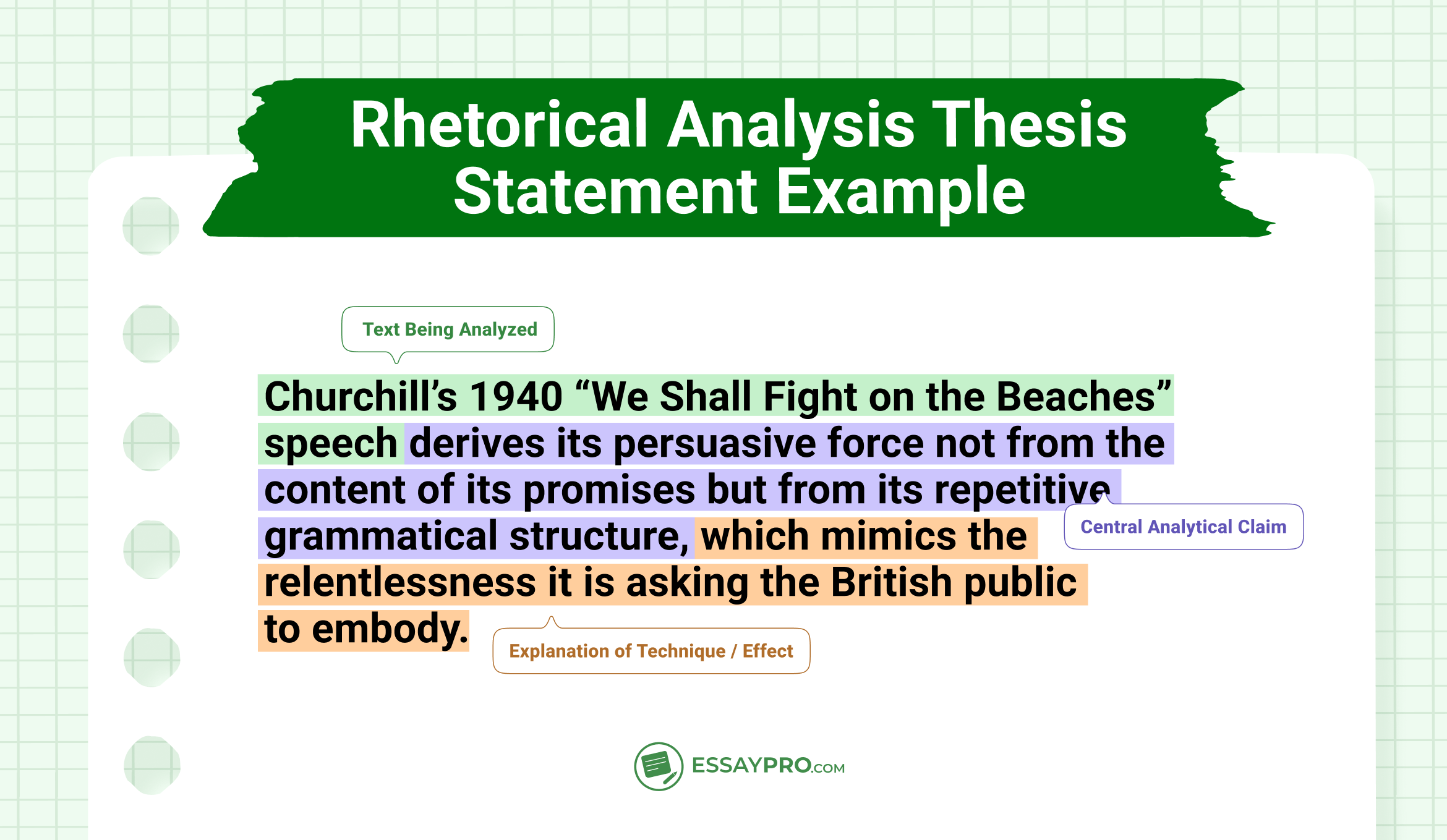
A rhetorical analysis thesis states which strategies a writer or speaker uses as well as how those strategies effectively persuade their specific audience. You want to name the technique used, the effect it has, and what that says about the argument.
- In her 2018 UN speech, Malala Yousafzai uses precise casualty statistics alongside personal narrative to shift her audience's emotional frame from sympathy to accountability, making inaction feel like a choice rather than an oversight.
- Churchill's 1940 "We Shall Fight on the Beaches" speech derives its persuasive force not from the content of its promises but from its repetitive grammatical structure, which mimics the relentlessness it is asking the British public to embody.
- In "Letter from Birmingham Jail," King's decision to address moderate white clergymen rather than segregationists reveals a rhetorical strategy of isolating the audience's moral inconsistency and making it harder for them to remain neutral.
- Apple's "Think Different" campaign persuaded consumers not by describing product features but by associating the brand with historical figures who defied institutions, a rhetorical move that reframed purchasing a computer as an act of identity rather than consumption.
- In her 2019 congressional testimony on climate, Greta Thunberg's deliberate use of scientific data delivered in a flat, emotionless tone created a more unsettling effect than emotional appeals would have, forcing the audience to sit with facts they could not redirect into sympathy.
Persuasive Thesis Statement Examples
A persuasive thesis clearly states its position and tells the reader that it will prove this position. It should be narrow enough to be argued, linked to evidence, and worded such that the reader knows exactly what claim you are making and why.
- Given that the U.S. spends more per capita on healthcare than any other developed nation while ranking 37th in overall health outcomes, the current insurance-based funding model is not a healthcare system but a cost-distribution system that benefits insurers more than patients.
- With 1 in 5 adults in the U.S. experiencing a mental health condition annually and only 43% receiving treatment, employers who exclude mental health coverage from workplace insurance are contributing to a productivity and absenteeism crisis they are simultaneously complaining about.
- The evidence from Portugal's 2001 drug decriminalization policy, which reduced overdose deaths by 80% over two decades, makes a stronger case for treating addiction as a public health issue than any punitive approach has managed to produce.
- Paid parental leave for both parents, not just mothers, reduces the long-term gender pay gap more effectively than workplace diversity programs because it distributes caregiving responsibility at the point where career penalties first appear.
- With 70% of food bank users in the UK reporting they are employed, food poverty is not a problem of individual financial mismanagement but a direct consequence of wage stagnation that charitable giving alone cannot fix.
Cause and Effect Thesis Statement Examples
A cause-and-effect thesis points out a linkage between two concepts. It asserts that one causes or contributes to the other in a specific way. The strong example of a thesis statement recognizes the relationship as specific rather than absolute.
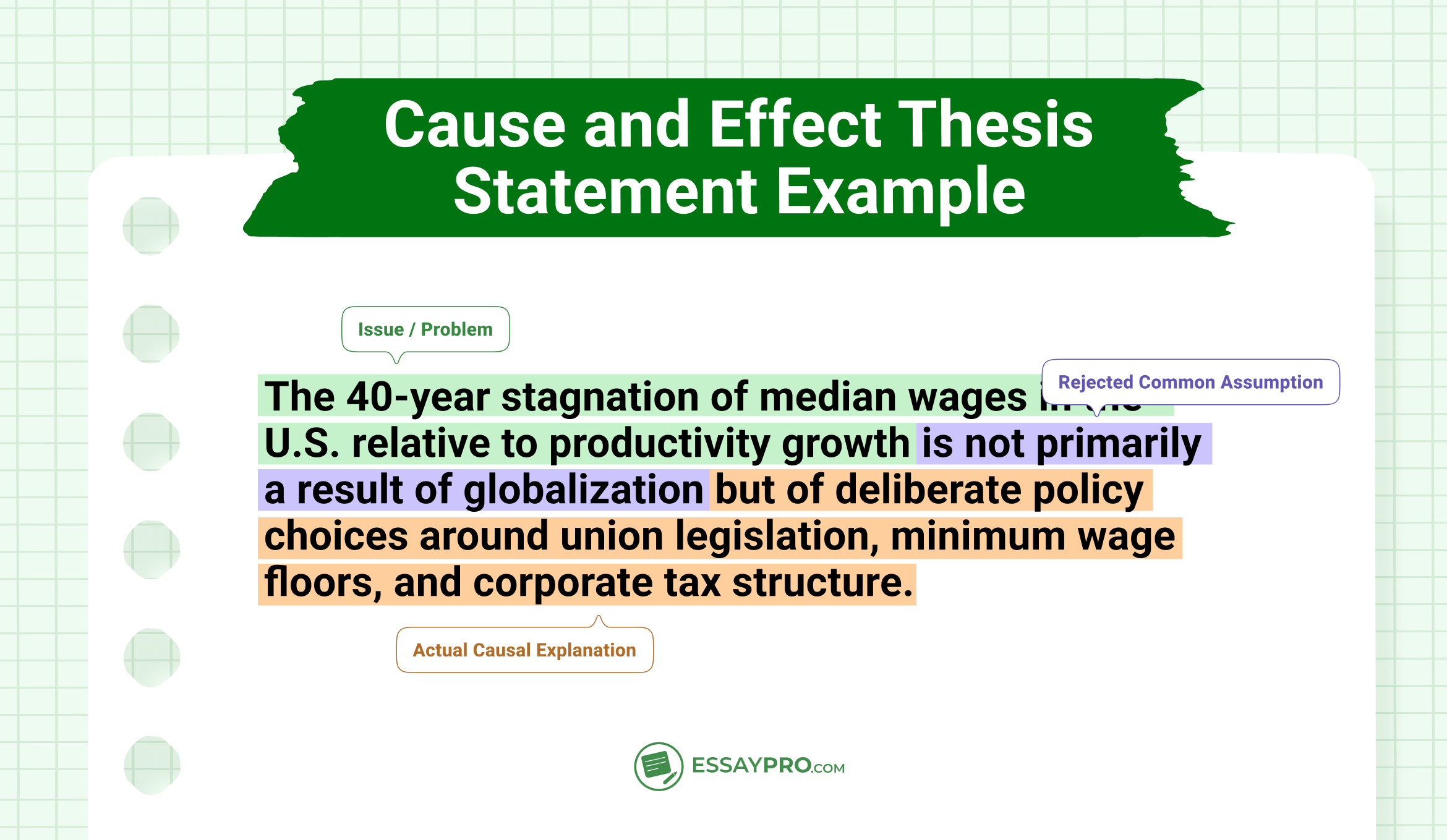
- The 40-year stagnation of median wages in the U.S. relative to productivity growth is not primarily a result of globalization but of deliberate policy choices around union legislation, minimum wage floors, and corporate tax structure.
- Rising rates of childhood myopia in East Asian urban populations correlate directly with reduced outdoor time rather than increased screen use, a distinction that changes what intervention actually needs to look like.
- The collapse of regional news outlets across the U.S. since 2008 has produced measurable increases in local government corruption, voter disengagement, and municipal bond costs in the communities that lost coverage.
- Decades of underfunding in preventative healthcare in low-income areas have produced emergency department overcrowding that costs the system significantly more than the primary care investment that was avoided.
- The introduction of performance-related pay in public school systems has consistently produced narrowed curricula and increased test prep time without improving the broader learning outcomes it was introduced to incentivize.
Analytical essays also depend on focused arguments. Learn how to write a rhetorical analysis with evidence and interpretation.
General Thesis Statement Examples
These work for all sorts of essays on a variety of topics. They're specific, clear, and grounded enough that you can apply the ideas to just about any thesis you're working on, no matter your topic or discipline.
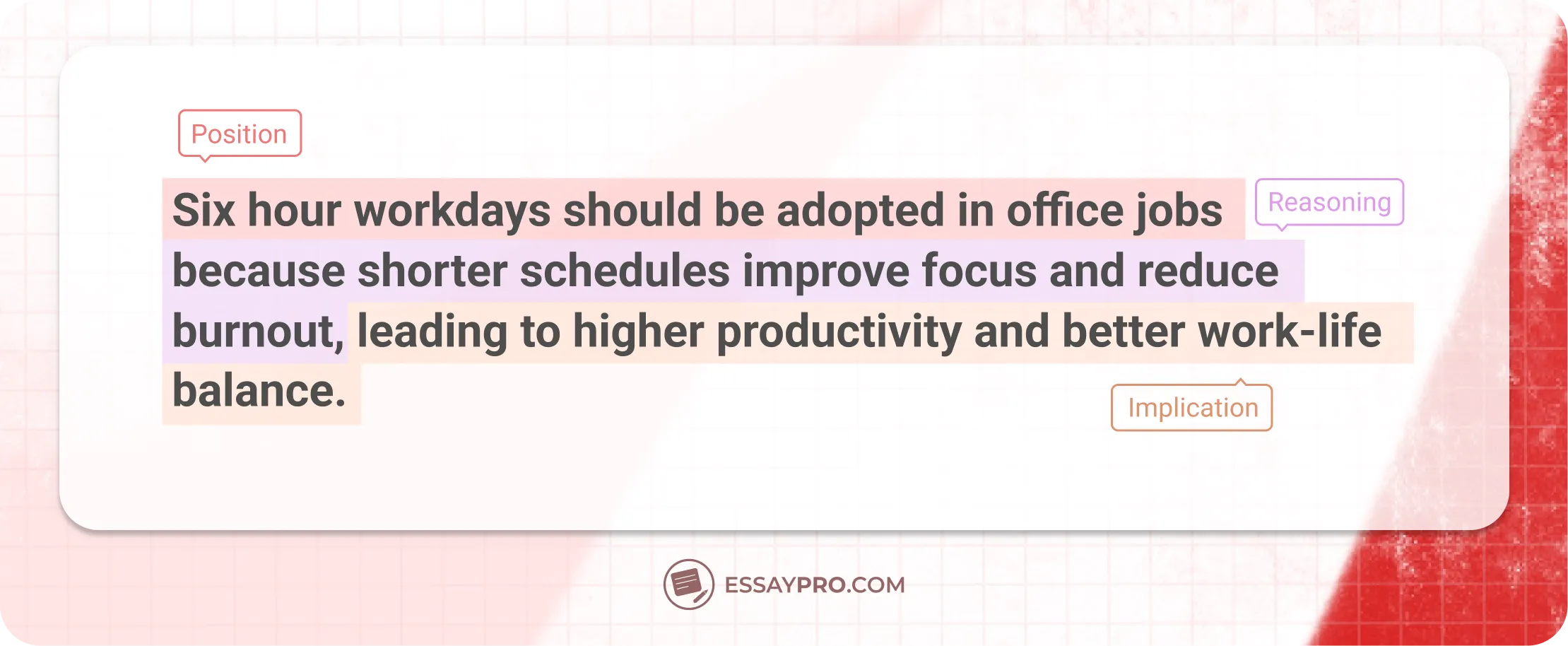
- With remote learning participation dropping by an average of 35% in low-income districts during the pandemic compared to 12% in high-income ones, school closures did not affect all students equally, and recovery policy needs to reflect that gap.
- The evidence consistently shows that countries with stronger tenancy protection laws have lower rates of housing instability, yet most housing policy debates focus on supply rather than the regulatory conditions that determine who benefits from it.
- The way social media algorithms prioritize emotionally provocative content has measurably shortened the news cycle, making it structurally harder for complex, slow-moving stories to receive sustained public attention regardless of their importance.
- Given that 90% of the world's data has been generated in the last two years alone, data literacy is no longer a specialist skill but a basic requirement for informed participation in civic and professional life.
- The research on restorative justice programs in secondary schools consistently shows reductions in suspension rates and improvements in school climate, yet adoption remains low because implementation requires a shift in institutional culture that policy mandates alone cannot produce.
Still Rewriting the Same Thesis?
Work with academic experts to strengthen your thesis and overall direction.
Final Thoughts
A good example of thesis statement does not magically appear fully-formed, and it should not have to. Start with a loose claim, see how it holds up against your evidence, and revise accordingly. You now have sufficient examples of what strong ones look like. Practice from there and you’ll ace it!
And if the workload becomes overwhelming, you may start wondering, "Who can help me write my thesis for me?" EssayPro can connect you with an expert who can support you through the process.
FAQs
What Makes a Good Thesis Statement Example?
What Is a Good Start for a Thesis Statement?
What Three Things Should a Thesis Statement Have?
How to Write Thesis Statement Examples?
What Are Some Thesis Statement Examples?

Mariam Navrozashvili
She has a Master’s degree in English Literature and brings a deep understanding of storytelling, critical analysis, and language structure to her work. On EssayPro Blog Mariam writes guides on literary analysis, essay composition and language studies to help students improve their writing skills. In her free time she likes to read classic novels and discuss literary theory.

.webp)