
Key Takeaways
- Finding your passion starts with repeated action, not sudden realization.
- Energy and sustained focus are often stronger indicators than raw talent or external praise.
- Fear and pressure often hide genuine interests.
- Strengths clarify direction when interests feel scattered.
- Commitment over time turns curiosity into purpose.
Finding your passion often begins with paying attention to what you enjoy doing, what you naturally care about, and what keeps you engaged. The Gallup Strengths Test (CliftonStrengths), taken by more than 30 million people worldwide, helps identify your natural talents and shows how they connect to work and study paths.
When high school or college students need help turning those insights into essays, EssayPro offers support that helps connect strengths, goals, and ideas on the page.

Human Thinking Beats Machine Guesswork
Structure your ideas and meet deadlines with EssayPro’s expert writers.

How to Find Your Passion as a Student?
Finding your passions in life usually comes down to a few grounded steps. Pay attention to what gives you energy, test interests through real action, and notice patterns that keep showing up over time, with tools like the Gallup Strengths Test helping you recognize those patterns more clearly. Here is how those ideas translate into clear, practical steps you can actually follow.
Track What Gives You Energy
Tracking what gives you energy means watching your reactions in real time instead of relying on titles, grades, or what sounds impressive. Some activities leave you mentally sharp even after hours. Others feel heavy after ten minutes.
This step works because energy is harder to fake than interest. You can force yourself through something you dislike, but you cannot fake sustained engagement. Over a week or two, patterns become obvious. What keeps pulling your attention back is worth taking seriously.
Try Before You Decide
The next step is to replace guesswork with experience. Thinking about an interest stays clean and safe; doing it introduces friction, boredom, effort, and surprise. That information matters more than any idea in your head.
Pick one passionate activity and make it concrete: write a page every day for a week, build a tiny project, teach a concept to someone else, or draw for thirty minutes after class.
Notice What You Avoid and Why
When you keep delaying a task or steering away from a topic, ask what is actually behind that reaction. It can be boredom, fear of looking bad, failing publicly, or stepping outside what feels familiar.
Watch your behavior over a week. Notice which things you avoid yet keep thinking about anyway. That tension often reveals interests shaped by self doubt, pressure from others, or ideas about what you are supposed to want rather than what you actually care about.
Take The Gallup Strengths Test
Taking the Gallup Strengths Test shows how you naturally think, solve problems, and interact with people. Many students feel stuck because their effort never seems to line up with results, and this test helps explain why.
You start to see why certain tasks feel natural while others drain you fast, even when you try hard. The results also prevent wasted time chasing interests that fight your instincts. Used well, the test points toward areas worth testing in real life.
Look for Repeating Patterns
Things you can be passionate about tend to resurface in different classes, hobbies, conversations, or side projects, even when circumstances change. Pay attention to what keeps returning.
Patterns also reveal what fades quickly. Short bursts of excitement that disappear under effort usually lack staying power. What remains steady, even when progress feels slow, deserves attention. Repetition is one of the clearest signs that an interest can grow into something deeper.
Commit for a Short Period
Choose a clear timeframe, like two weeks or a month, and show up consistently. During this window, notice how the activity fits into ordinary days. Pay attention to effort, frustration, and progress. Initial excitement often fades, so what matters is whether curiosity stays alive once the work feels routine.
Short commitment reduces pressure. You stop asking whether this must become your future and start observing how it feels to practice it regularly. That clarity makes the next decision easier and more honest.
Human-Written, Zero AI
Consistent quality. Human logic. Real academic expertise. Get reliable writing support from EssayPro.
What Is the Gallup Strengths Test (CliftonStrengths)?
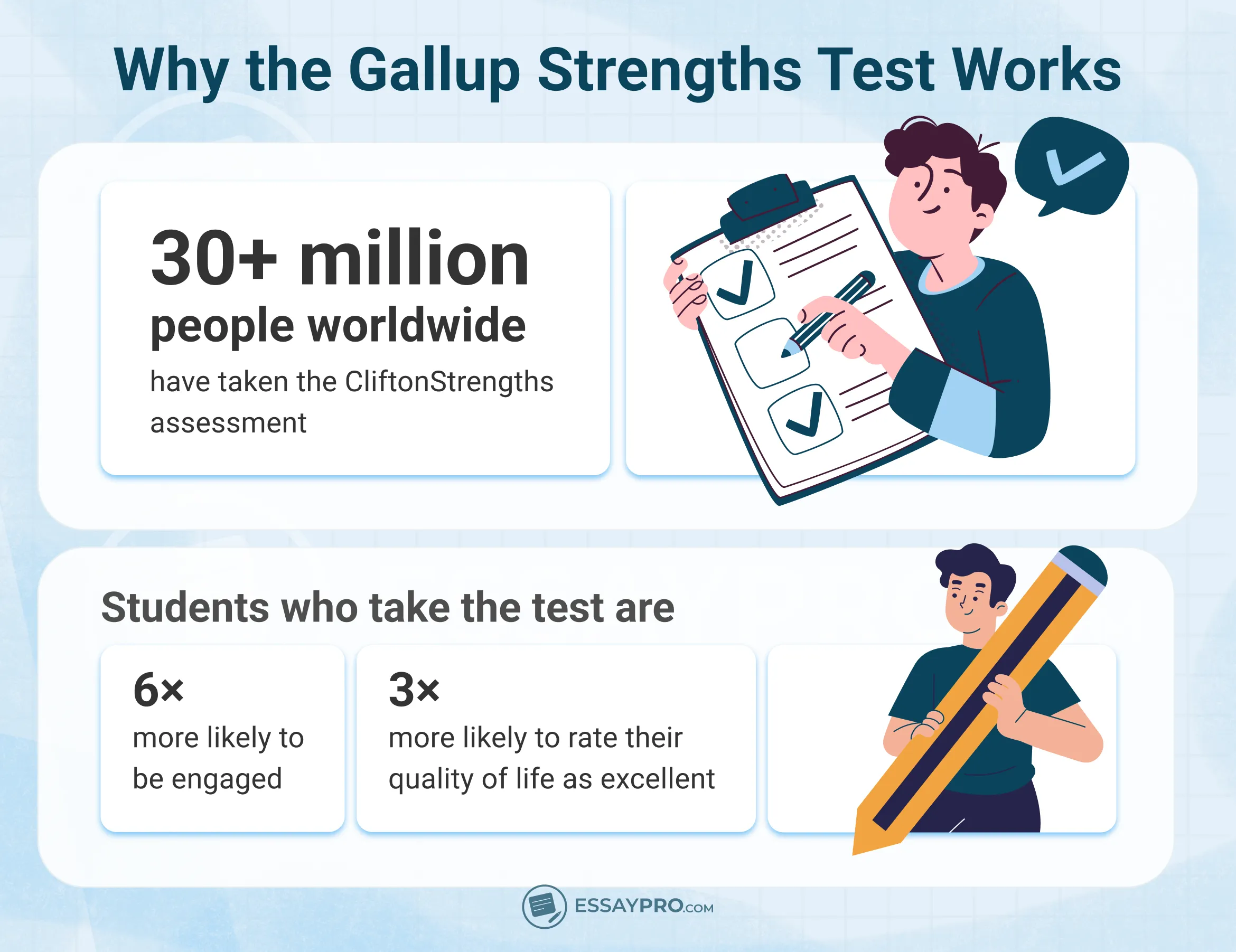
The Gallup Strengths Test, officially called CliftonStrengths, is an assessment designed to identify a student’s natural thinking patterns, behavioral tendencies, and ways of working that come most easily and consistently to them. Gallup reports that over 30 million people worldwide have taken the CliftonStrengths assessment, and students who learn and apply their strengths often report higher academic confidence and clearer goals.
How the test works and helps you to find your passion:
- Students answer a timed online questionnaire that measures instinctive reactions rather than learned responses
- The test analyzes patterns across paired statements to identify dominant talent themes
- Results rank a student’s top strengths from Gallup’s 34 defined talent themes
- Each strength comes with explanations and practical examples of how it shows up in learning, work, and decision-making
- The output focuses on recognition and application, helping students test interests and career paths more intentionally
For extra motivation while working through this process, you can also check out the best motivational songs for students.
How the CliftonStrengths Assessment Helps You Find Your Passion?
The Gallup Strengths Test (CliftonStrengths) helps you discover your passion by identifying your natural talent patterns and showing how you instinctively think, act, and engage with the world. Here’s what the test does:
- Identifies your dominant talent patterns: The test measures instinctive thinking, feeling, and behavior patterns, then ranks your strongest talents from Gallup’s 34 defined themes.
- Reveals where your energy naturally comes from: Results show which types of tasks, roles, and environments feel engaging for you.
- Explains how you learn and work best: The student report connects strengths to study habits, class participation, teamwork, and problem-solving styles.
- Improves engagement and motivation: Gallup’s student research shows that students who understand and use their strengths report higher engagement and confidence.
- Guides practical exploration of interests: Instead of guessing, students can test activities and career paths that align with their strongest talent themes.
- Supports long-term development, not quick labels: Gallup frames strengths as starting points for growth, helping talents develop into real skills over time through practice and application.
What to Do After You Get the Gallup Strengths Test Results?
Practical use comes from translating strengths into daily choices, testing them in real situations, and adjusting based on what actually works. Here’s what to do once you get your test results:
Step 1. Read each top strength with examples in mind
Start by highlighting lines that match your real behavior. Specific moments should come to mind, such as group projects you led, assignments you enjoyed, and problems you solved quickly. Patterns become clearer when tied to lived situations.
Step 2. Change how you study this week
Pick one strength and adjust your approach immediately. Notes can be reorganized, study sessions can be shortened, or material can be explained aloud to someone else.
Step 3. Test strengths in group settings
During team projects, take roles aligned with your strengths. Leadership, planning, idea generation, or execution should be chosen intentionally. Feedback is often received without asking.
Step 4. Track energy after each task
After the job is done, note how you feel. Focus, satisfaction, and steady progress signal alignment. Frustration or mental fatigue usually points elsewhere.
Step 5. Refine based on outcomes, not opinions
Some strengths will deliver results immediately, while others require adjustment. Use performance and energy as guides, not expectations from others.
For ideas that help you practice communication and confidence, you can also review motivational speaking topics.
The Bottom Line
Finding your passion rarely happens in one clear moment. It develops through paying attention to energy, testing interests in real situations, and using tools like the Gallup Strengths Test to recognize patterns faster. Small commitments and honest reflection turn vague ideas into direction.
And if you need help refining your writing along the way, the essay shortener tool is available. EssayPro supports students by helping them organize thoughts, clarify goals, and move forward with confidence.
Trust Human Writers, Not Algorithms
EssayPro connects you with experts who organize research and meet academic standards.
FAQs
How to Find a Passion?
Why Is Finding Your Passion so Hard?
What Causes Lack of Passion?
How to Become More Passionate?
How to Identify Passions and Strengths?

Sopho Miller
is an experienced content writer who specializes in digital marketing, business, and academic topics. With a Master’s degree in Digital Marketing, she combines her expertise with a practical approach to create clear, engaging, and educational content. She crafts detailed guides and resources that support students in their academic journey. Outside of work, Sopho stays current with the latest industry trends and regularly attends workshops to further sharpen her skills.
- University of South Florida Admissions. (n.d.). How to find your passion and a career you love. https://admissions.usf.edu/blog/how-to-find-your-passion-and-a-career-you-love
- New Brighton Christian School. (n.d.). How to become passionate about learning. https://www.nbcs.nsw.edu.au/how-to-become-passionate-about-learning/
- North Carolina State University, Division of Academic and Student Affairs. (n.d.). Gallup CliftonStrengths. https://sle.dasa.ncsu.edu/leadership/gallup-cliftonstrengths/