Key Takeaways
- Titles for essays identify the paper’s subject, scope, and central claim.
- Writing strategies include drafting the title after the essay, reusing thesis terms, and limiting scope.
- Common title structures are two-part titles, descriptive phrases, and question-based titles.
- Good titles are specific and aligned with the argument; bad titles remain broad or non-directional.
An academic title is the first and main thing readers will experience about your paper. An essay title is the short line at the top of a paper that signals the subject, focus, and direction of the argument before the reader reaches the first paragraph. It also should tell as much as possible about your paper’s central claim and its significance. Good titles often include:
- a hook
- a set of key terms
- a source
When coursework piles up and deadlines overlap, EssayPro supports students who choose to buy essay online as part of managing heavy workloads.
What Makes a Good Title
Now, here are five principles that make a title work in the real world:
- Predictive power: When someone reads the title, they should already have a decent sense of what conclusion the paper is heading toward.
- Placement: Put the title on its own line at the top of the first page, exactly where the style guide expects it. These placement and formatting rules apply to all pages, including the title page and subsequent pages.
- Tone: The title should speak in the same voice as the essay itself; if the writing allows some edge, the title can carry it too.
- Keyword density: The key terms should show up in the title so instructors know exactly what this is about.
- Scope limitation: Titles become more precise when they signal the scope of the source material rather than the entire field.
If your essay references books or longer works, read our blog on how to write a book title in an essay.

Strategic Methods to Build a Strong Essay Title
These sections break the process of writing good titles for essays into concrete steps. Think in terms of the three pillars of a professional title: Hook, Keyword, Context. Miss one, and the title either sounds empty, invisible, or misleading.
Build the Title From the Finished Argument
To write essay title, build it only after the argument is locked in. Open your finished draft and find the single sentence where you take a clear position, usually the thesis or the final paragraph. Write that claim in plain language, without academic padding. Then list the two or three terms you relied on to prove it, the words that keep showing up in your analysis, evidence, and section headings. Combine the claim and those terms into one line. If the line explains what the paper concludes and what it focuses on, you’re close. Cut anything that sounds like an assignment label. What remains should read like the paper distilled, not a label stuck on top.
Adjust the Title to the Course and Instructor
Start by identifying where the paper will be read and how it will be graded. Look at the course syllabus, recent assignment sheets, and the way your instructor titles their own materials. Some courses reward precise, technical language. Others tolerate a bit of edge or abstraction. That context should shape every word in the title.
For example, imagine the same paper on decision-making under pressure:
In a psychology course, a title like 'Time Pressure and Risk Assessment in Clinical Decision-Making' fits expectations. It signals the method and subject clearly.
In a philosophy or ethics course, the same argument could appear as 'Choosing Under Pressure: Moral Risk and Human Judgment.'
Select Keywords From the Thesis and Evidence
Open your paper and locate the thesis sentence. Copy it onto a blank line. Then scan the body paragraphs and note which terms appear again and again in topic sentences, evidence discussion, and section transitions. Ignore general words like 'impact' or 'analysis.' Keep the terms that name what the paper is actually about.
Take a paper that argues early exposure to bilingual education improves long-term reading comprehension.
Start with the thesis sentence. Bilingual education, early exposure, and reading comprehension appear in the evidence, data discussion, and conclusion.
A weak title would be 'Bilingual Education in Schools.' It names the topic but ignores the argument.
A stronger title would be 'Early Exposure to Bilingual Education and Reading Comprehension Outcomes.'
If you mention films in your writing, refer to our article on how to write a movie title in an essay.
Open with a Hook
Start with a title that states the topic and claims clearly. This is your baseline. Once that line works on its own, look back at the argument and identify what makes it interesting: a tension, a consequence, or a surprising outcome that the paper explains. Turn that element into a short catchy phrase, then follow it with a precise explanation of what the paper covers.
Remove Extra Words From the Title
Write the title in its complete form first. Then remove any words or phrases that do not change the meaning of the title. Expressions such as 'an analysis of' or 'a study on' can be deleted because they add no informational value. Next, check for repeated ideas and keep the most precise wording. Read the revised title once. If it still communicates the topic and the central claim without explanation, it is concise enough.
Make the Title Match the Thesis Statement
Begin with the thesis sentence and reduce it to its essential claim. Remove qualifiers, background framing, and methodological language. What remains should answer one question: what does this paper ultimately argue? Translate that claim into title form using the same subject terms and the same directional logic.
For example, if the thesis concludes that remote proctoring increases test anxiety and correlates with lower exam performance among first-year students, the title must reflect both the cause and the outcome.
'Remote Proctoring in Online Exams' leaves the conclusion invisible.
'Remote Proctoring, Test Anxiety, and Declining Exam Performance in First-Year Students' mirrors the thesis directly.
If you need comprehensive dissertation help that aligns with your academic goals, EssayPro provides assistance every step of the way.
Choose a Title Structure
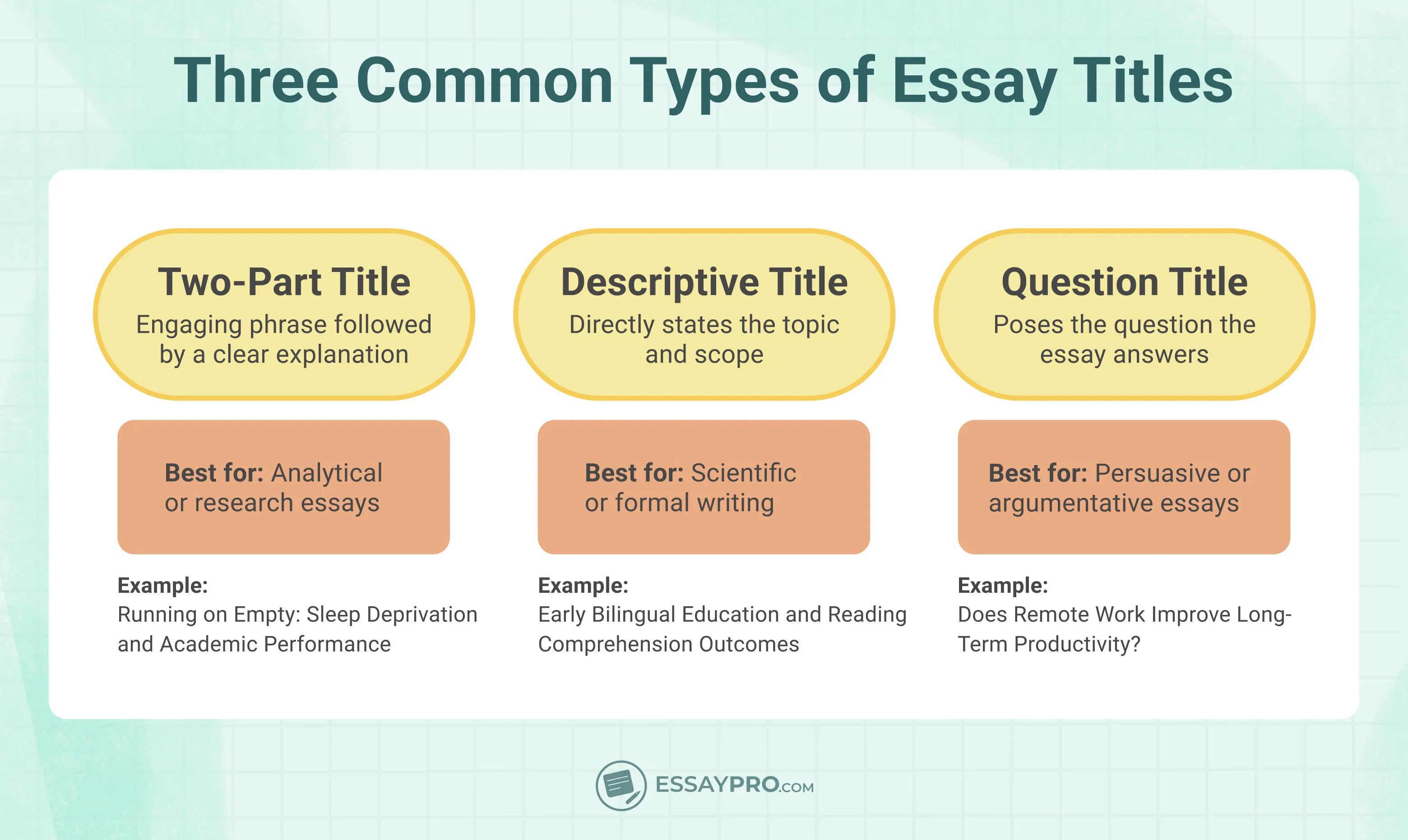
Most essay titles fall into three common structures: two-part titles, descriptive phrases, and question titles.
Two-Part Title
This structure uses a short lead phrase followed by a clarifying subtitle as a title for an essay.
Examples:
- Echoes of Silence: Political Censorship in Postwar Eastern Europe
- Running on Empty: Sleep Deprivation and Academic Performance in College Students
- Lines of Control: Border Policy and Migration Patterns in the EU
Descriptive Phrase
A descriptive title states the topic directly, without stylistic framing.
Examples:
- The Effects of Early Bilingual Education on Reading Comprehension
- Risk Assessment Strategies in Emergency Medical Decision-Making
- Social Media Use and Attention Span Decline Among Adolescents
Question Title
A question title presents the issue the essay answers.
Examples:
- Does Remote Work Improve Long-Term Employee Productivity?
- Should Standardized Testing Determine College Admissions?
- Can Early Intervention Reduce Literacy Gaps in Primary Education?
Keep in mind that this structure fits persuasive writing, where the paper leads the reader toward a conclusion. In a formal research paper, it’s usually better to state the answer instead of posing the question. Additionally, in longer academic projects, the main title frames the entire work, while each chapter title narrows the focus of its section.
How to Format the Title
A solid essay title format looks correct on the page, and it doesn’t draw attention to itself for the wrong reasons. Here are the basic essay title format rules:
- Capitalization: Use title case. Capitalize major words and keep short articles and prepositions lowercase.
- Placement: Put the title on its own line at the top of the first page, exactly where the style guide expects it.
- Emphasis: Skip bold, italics, underlining, and quotation marks unless your instructor explicitly asks for them.
- Length: One clean line is ideal. Longer usually means the title needs shortening.
Style basics
- MLA format: Title case, centered, plain text.
- APA: Title case, centered, bold on the title page.
- Chicago: Title case, centered, styling depends on the document type.
APA requires a title page. For student papers, include the title, author, school, course number and name, instructor, and due date, formatted according to the Publication Manual. Before your own research paper is submitted, ensure all required information is present and formatted according to the Publication Manual guidelines.
One last note: the colon is the gold standard of academic titles. It lets you open with interest, then clarify the focus without forcing cleverness. Used well, it balances creativity with information.
If you’re looking for an essay for sale that matches your topic, deadline, and guidelines, EssayPro provides custom academic support.
Staring at the Header with No Inspiration?
We provide more than a title — we write the entire winning paper.
Creating Strong Essay Titles
Bad titles stay broad, repeat the assignment topic, or hide the paper’s direction. Good titles narrow the focus, signal the argument, and sound intentional. To make an essay title truly strong, the writer has to understand what the paper actually proves.
Below, each example shows how a title improves as clarity, structure, and purpose increase.
Two-Part Titles
Descriptive Titles
Question Titles
Final Thoughts
A strong essay title comes from understanding the argument, choosing language that reflects it accurately, and formatting it correctly on the page. When the title matches the thesis, fits the course expectations, and avoids filler, it does its job before the reader reaches the introduction.
For those typing ‘write my essay for me’ into search bars, EssayPro offers reliable guidance that helps strengthen academic focus and meet course expectations.
FAQs
What Is an Essay Title?
What Is a Good Title for an Essay?
How to Write a Title in an Essay?
Should I Capitalize Words Like 'the' or 'of' in My Title?
Should My Essay Title Be in Quotation Marks or Bold?

Daniel Parker
is a seasoned educational writer focusing on scholarship guidance, research papers, and various forms of academic essays including reflective and narrative essays. His expertise also extends to detailed case studies. A scholar with a background in English Literature and Education, Daniel’s work on EssayPro blog aims to support students in achieving academic excellence and securing scholarships. His hobbies include reading classic literature and participating in academic forums.
- Hull University Library. (n.d.). Essay formatting. Retrieved from https://libguides.hull.ac.uk/essays/format
- Illinois Valley Community College. (n.d.). Essay title formatting guidelines. Retrieved from https://www.ivcc.edu/stylesite/Essay_Title.pdf
- Royal Roads University Library. (n.d.). Developing effective essay titles. Retrieved from https://libguides.royalroads.ca/developing_essay/titles