

A descriptive essay is a form of writing that presents a single subject through sensory details, precise language, and focused observation so the reader can clearly experience what is being described. It relies on structure and detail selection rather than explanation or argument to create a vivid overall impression. The most common categories used for such writing are:
- People and presence: physical detail, habits, and small behaviors that reveal character
- Places and environments: spatial layout, texture, sound, and atmosphere rendered through observation
- Moments and experiences: one contained event described with emotional clarity and restraint
If you already have some idea about what is a descriptive essay, the 10 examples below will help you find inspiration.
Turn Simple Ideas Into Vivid Writing
EssayPro writers support you in building expressive and detailed essays.

Main Parts of a Descriptive Essay
A well written descriptive essay is organized around sensory details that anchor the description, precision in word choice, focus on a single subject, and a clear structure that controls order. Let's look at each part in detail and discuss the weak and strong examples.
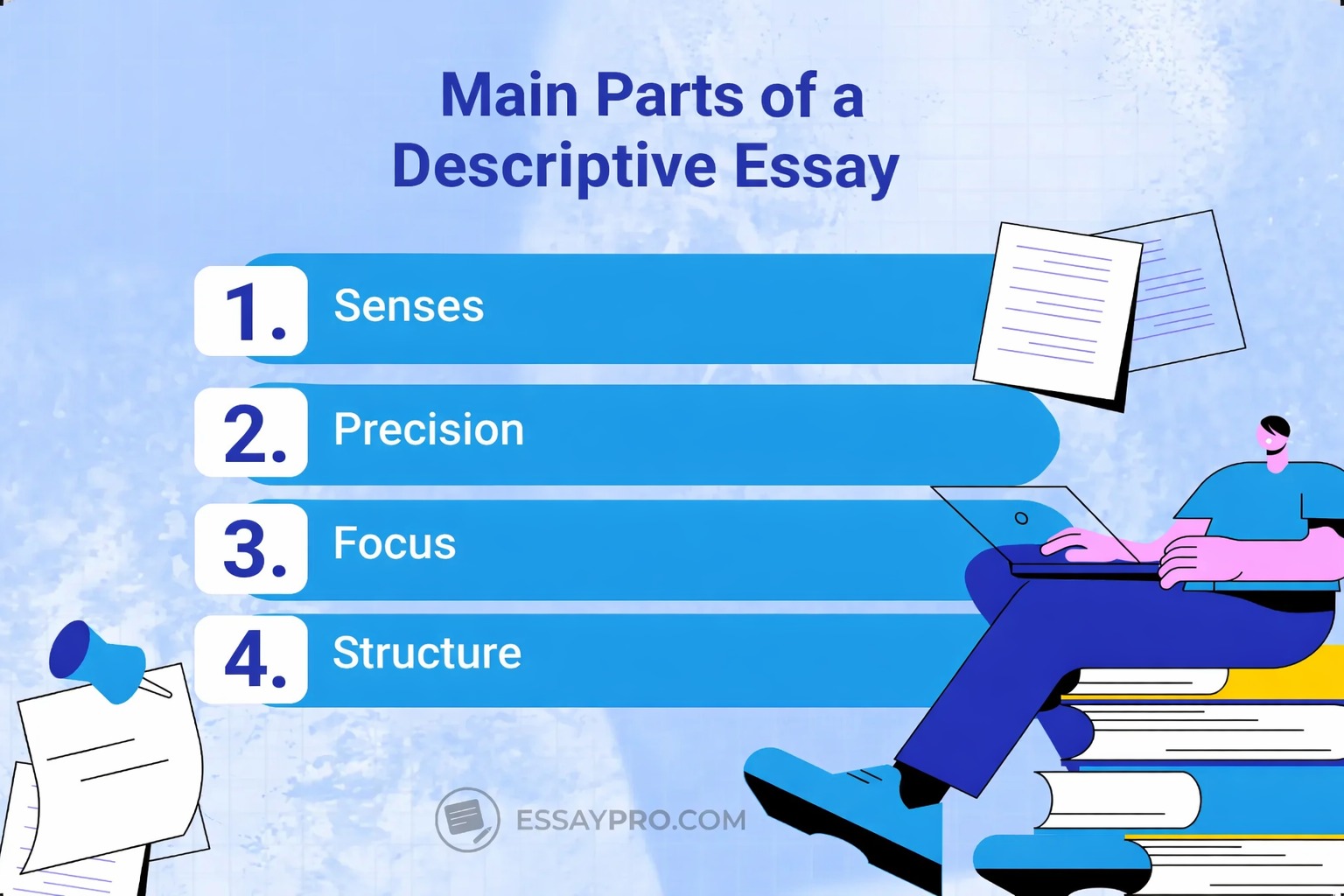
- Senses: covers sensory details that connect the five senses to the description. Sensory details work best when they serve the subject and support the essay’s tone.
Weak sentence: The beach was nice and relaxing.
Strong sentence: Salt hung in the air, a sweet scent mixed with sunscreen, and gentle lapping kept time against the rocks.
- Precision: covers the word choice and the specific details that turn a general idea into a vivid picture. Strong descriptive writing uses concrete nouns, exact verbs, and adjectives intentionally.
Weak sentence: He had some stuff on the table.
Strong sentence: The table held a cracked phone case, a damp receipt, and a pencil ground flat from pressure.
- Focus: controls the reader's attention. Each paragraph commits to one angle of the subject, so the person reading never has to guess what matters at that moment.
Weak sentence: The city had a lot going on everywhere.
Strong sentence: My focus stayed on one street vendor, his hands moving fast as steam rose from the cart.
- Structure: controls the order of description: an introductory paragraph, body paragraphs that develop the description, and a closing that leaves an impression. A thesis statement can guide the paragraph order even when the essay stays image-driven.
Weak sentence: The market was loud, busy, and confusing.
Strong sentence: Voices rose first from the fruit stalls, then my attention settled on one vendor slicing oranges behind a chipped wooden counter.
Find Inspiration for a Descriptive Essay
An effective descriptive essay starts with the right prompt. The categories in this section provide that starting point by narrowing your attention to subjects that naturally support descriptive writing and hold detail without drifting.
Each category trains a different skill that matters in descriptive writing. If you're ready to start writing, check out the examples of hooks for essays so you can figure out how to start your paper.
Transitional Spaces People Ignore
A short descriptive essay works well here because the subject stays contained, and your description can stay specific without wandering across the whole world.
- Waiting beside an elevator panel while the numbers change and the air turns stale
- Standing in a stairwell where dust coats the rail, and footsteps echo twice
- Sitting in a parked car as rainy days blur streetlights into watery streaks
Objects With Personal History
This category forces strong word choice and careful detail selection, since one object must carry the entire description through the paragraph.
- A chipped mug with a faded logo and a faint coffee ring baked into the bottom
- A notebook with torn edges and ink smudges that suggest rushed class notes
- A key worn smooth, warm at the tip, and slightly bent near the groove
Sounds That Define a Place
Sound-based prompts widen descriptive writing past visuals and push sensory details into the foreground, which helps the reader stay engaged.
- The steady hum of a refrigerator in a kitchen after midnight
- Sneakers squeaking on a hallway floor where every step announces itself
- Wind striking loose signage, then stopping, then hitting again with force
Physical Work and Repetition
Repetitive tasks help you control pacing and keep body paragraphs tight, which supports a good descriptive essay with a clear structure.
- Folding towels at the same table each morning, corners never lining up
- Scrubbing a countertop until the skin on your knuckles turns raw
- Changing a lightbulb in a narrow space where elbows keep bumping walls
Weather at Close Range
Weather directly alters the immediate surroundings rather than the landscape as a whole. The description can capture physical contact, showing how conditions force small behavioral adjustments within a single moment.
- Fog sticking to eyelashes during a first visit to a new neighborhood
- Heat clinging to skin long after sunset, fabric turning heavy
- Cold metal biting through thin gloves as fingers lose feeling
Rooms With Unspoken Rules
These prompts focus on behavior changes without anyone stating instructions. The rule is never announced, but it influences how the space is used and experienced.
- A library table marked by carved initials and dried glue residue
- A clinic waiting room with identical chairs and fluorescent lights that never rest
- A classroom after the bell, paper scraps under desks, and silence in the corners
Food as Sensory Memory
Food prompts work well for descriptive essay examples because the five senses show up naturally, and figurative language can appear without forcing it.
- The bitter edge of over-steeped tea that dries the tongue
- Bread cooling on a counter, crust crackling as the kitchen settles
- Citrus oil on fingertips, sharp scent lingering after peeling fruit
Moments of Stillness
Stillness helps you focus on description. The subject stays stable, and your sentences can build a vivid picture with controlled adjectives.
- Sitting alone before anyone wakes, light thin and gray through the blinds
- Watching dust drift in a sunbeam, slow motion in plain sight
- Standing still while traffic fades, then returns in waves
Familiar Routes
Repetition reveals new details even in the most familiar places. An essay can even use this as a grounded opening scene.
- Walking the same street during different seasons, noticing new stains on the sidewalk
- Riding the same bus seat each weekday, the vinyl cracked along one seam
- Passing a closed storefront each morning, gate half-lowered and crooked
First Encounters With Rules
These prompts focus on the first time a rule is noticed or broken. The description should be grounded in a single moment where behavior changes due to a rule.
- Touching an object marked off-limits, then pulling your hand back too late
- Hearing adults lower their voices as you step into the room
- Learning to stay silent in a place where speaking feels forbidden
10 Descriptive Essay Examples
The examples below show how a description is actually built across a full essay, from opening image to final impression. Hopefully, after reading through these samples, you can see how vivid language and structure can work together.
Descriptive Essay Example 1: The First Hour of the Day
The kitchen is already awake when I step into it, even though no one else is. Morning light slides through the narrow window above the sink and lands unevenly across the counter, stopping short of the stove. The air feels cool at first, then slowly adjusts as the room settles around me. Cabinets lean slightly, their doors never quite lining up, paint rubbed thin where hands have reached for the same handles year after year. The table sits too close to the wall, forcing one chair to angle outward. The room does not look arranged. It looks used.
The sink draws attention without asking for it. A faint curve runs along its edge where something heavy struck long ago. Water marks cling to the porcelain in pale streaks, layered and permanent. A sponge rests near the drain, collapsed into itself, still damp. When I turn the tap, the sound fills the room at once, sharper than expected, then steady. Steam lifts and softens the window until the outside disappears. Soap cuts through the cool air, clean and slightly bitter. My hands carry the scent even after I dry them.
The table feels different. Its surface holds small records of daily life. Scratches cross one another in no clear pattern, some shallow, others deep enough to trace slowly with a fingertip. A dark ring stains one corner, pressed into the wood beyond repair. Chairs press close, their backs smoothed by years of contact. Sitting there never feels accidental. The table seems to expect attention. Cups leave pale circles behind. A spoon strikes the side of a mug once, then rests. Sound dulls here, absorbed by wood and fabric, as if the room prefers restraint.
Everything in the kitchen moves according to habit. The refrigerator opens with a practiced pull and releases a rush of cold air that settles near the floor. Inside, jars stand in neat lines, labels facing outward, contents visible without effort. The door closes and hums softly, then fades. Across the room, the stove waits. Heat has dulled its surface, leaving faint marks that blend together. The knob resists slightly before turning. A click cuts through the stillness. The burner answers with a steady hiss. The kitchen shifts, almost imperceptibly, into motion.
Smell settles into the space and stays. Bread warms unevenly in the toaster, its edges darkening faster than the center. Butter melts and spreads, leaving a thin sheen behind. Coffee sharpens as it sits, its scent growing heavier with each passing minute. The smell clings to towels and curtains, staying long after the dishes are cleared. Outside noise slips in through the open window, distant and softened, never fully entering. The room keeps its own boundary, shaped by routine rather than walls.
Time behaves differently here. It stretches and contracts around small actions. A cup fills, empties, and fills again. A towel ends up draped over a chair and remains there. Light shifts slowly across the counter, leaving one surface and settling on another. Nothing urgent happens. Nothing needs to. The kitchen holds together through familiarity, through the quiet order of repeated use.
When voices finally enter the room, the kitchen has already established itself. Its surfaces, sounds, and rhythms leave a clear impression without explanation. The space does not demand attention, yet careful notice reveals its shape and steadiness. Long after the morning passes, the memory remains intact, built from touch, sound, and the simple certainty of a room that knows its purpose.
Descriptive Essay Example 2: The Laundromat at 11:47 p.m.
The laundromat smells like heat and old detergent the moment the door swings shut behind me. Not the sharp, clean kind, but something heavier that settles in the back of the throat. Fluorescent lights buzz overhead, too bright for the hour, casting a pale shine over rows of machines that never seem to rest. The floor is damp near the entrance, tiles darkened where water has splashed and never fully dried. Outside, the street has gone quiet. Inside, everything hums.
The washers move first. Their steady rotation sets the pace of the room, metal drums turning behind scratched glass. Clothes press outward, then slide back down, trapped in a slow, endless loop. A sock sticks to the window of one machine, stretching and folding again with each spin. The sound is constant. A low churn layered with a rhythmic thud, like something breathing in its sleep. Every few seconds, a machine shudders slightly, as if reminding the room that it is still working.
Dryers answer with a different rhythm. They roar, then pause, then roar again, heat rolling out each time a door cracks open. Warm air spills onto my legs as I load my clothes, heavy and faintly sweet. The metal of the drum is hot against my fingers. I pull my hand back too quickly and shake it once, more out of habit than pain. Lint coats the rim, gray and soft, collecting no matter how often it’s cleared away. The dryer door shuts with a hollow clang that echoes longer than expected.
People drift in and out without much ceremony. No one greets anyone else. A man in a paint-stained jacket folds clothes with quick, practiced movements, stacking them neatly before sliding them into a bag. A woman sits against the wall, scrolling on her phone, foot tapping against the base of her chair. Someone coughs from the back corner. A machine beeps, sharp and impatient, then falls silent when no one responds. Everyone seems absorbed in their own small task, sharing the space without acknowledging it.
The chairs along the wall feel temporary. Plastic seats, slightly warped, lined up beneath a bulletin board layered with torn flyers. Half the notices advertise services that no longer exist. The rest promise quick fixes to long-standing problems. I sit anyway. The chair creaks under my weight, then settles. The floor vibrates faintly through the soles of my shoes. It feels like the room never fully stops moving, even when nothing appears to change.
Time stretches strangely here. Minutes blur together, measured by cycles and soft alarms rather than clocks. I watch my dryer through the scratched window, waiting for the clothes to fall in the right way. They never do. The light inside flickers, then steadies. Heat fogs the glass for a moment before clearing again. Outside, a car passes, its headlights sweeping briefly across the window before disappearing. The laundromat stays the same.
When the machine finally stops, the silence feels louder than the noise did. I open the door and reach inside. The clothes are hot and dry, edges stiff with warmth. Fabric slides against fabric as I pull everything out, the pile awkward in my arms. Folding feels slower now. Each movement requires attention. Sleeves twist. Corners refuse to line up. I smooth them anyway.
As I leave, the machines resume their rhythm behind me. The door swings closed. The smell lingers on my jacket. The street feels colder than before. I walk away knowing the room will keep going without me, lights buzzing, drums turning, waiting for the next person to step inside and pick up where it never stopped.
Descriptive Essay Example 3: The Last Bus Stop on River Road
The bus stop sits at the edge of River Road like it forgot to leave when everything else moved on. A metal bench leans toward the ditch, one bolt missing, the seat dipping slightly in the middle. The shelter’s plastic wall has turned cloudy over time, its surface scratched with names that no longer mean much to anyone. Cars pass without slowing. Most of them do not even signal anymore. The stop exists anyway.
I come here in the late afternoon, when the light starts losing its edge. Sun hits the road at an angle that makes the asphalt look thin, almost brittle. Heat rises in soft waves, warping the white line near the curb. A paper cup rolls a few feet, then settles again. The air smells faintly of dust and cut grass from a field down the road. Nothing announces itself. The place waits.
The bench feels colder than expected. Metal presses through denim and stays there. The sound of traffic comes in short bursts, engines flaring, then fading. Between those bursts, the road empties. In that space, smaller sounds surface. Wind drags dry leaves across the concrete. A bird lands on the shelter roof, shifts once, then takes off again. The plastic wall creaks as it expands under the sun.
The bus stop was not built for lingering. Schedules are posted, though no one checks them anymore. The print has faded enough to blur the times together. Once, people stood here every evening. Shoes lined up along the curb. Conversations filled the space, then cut off as the bus arrived. That rhythm no longer exists, but traces remain. A worn patch on the ground marks where feet used to wait. A dent in the shelter frame shows where someone leaned too hard.
I watch the road instead. Cars pass close enough to stir the air. Tires hiss against the pavement. One truck rattles loose gravel into the ditch. Another driver slows, glances over, then speeds up again. The bus never appears, yet the habit of waiting stays intact. Time stretches here, measured in passing vehicles rather than minutes.
Light shifts again. Shadows from the shelter lengthen and cross the bench. The plastic wall catches the sun and turns milky white, then dull. The smell of grass fades, replaced by warm asphalt. A breeze cuts through, brief and sharp, then disappears. The road hums quietly, like it always does.
Standing up feels louder than it should. The bench scrapes once as I step away. For a moment, the stop looks occupied again. Then it returns to itself. The road keeps moving. The shelter holds its place. The bus stop stays behind, waiting without expectation, fixed in a routine that no longer needs an ending.
Descriptive Essay Example 4: Under the Stadium Lights
By the time the last car pulls out of the parking lot, the stadium feels too large for itself. Rows of empty seats rise in long, identical lines, their colors dulled now that no one occupies them. Paper cups collect along the aisles, caught against concrete steps. A banner hangs loose near the entrance, one corner flapping weakly in the night air. The game ended an hour ago, yet the place has not fully let go of it.
The field sits at the center, stretched wide and unnaturally bright. Stadium lights pour down without restraint, bleaching the grass into something almost artificial. White lines cut sharply across the surface, crisp and untouched again after hours of cleats and sliding feet. The goalposts stand rigid, casting narrow shadows that fall and overlap. Without movement, the field looks paused, like a photograph taken too late.
Sound behaves differently once the crowd disappears. The echo of cheering lingers only as a memory. In its place, smaller noises rise. A loose sign rattles against a railing. Somewhere high in the stands, metal taps lightly against metal as it cools. Footsteps from a lone worker drift across the concrete, then vanish. The space amplifies every minor sound, stretching it farther than expected before letting it fade.
I walk along the edge of the field where the grass meets the track. The surface underfoot changes from soft to firm in a single step. The smell of turf mixes with sweat and spilled soda, a blend that feels heavy and familiar. Near the bench area, water bottles lie on their sides, caps missing, labels peeling away. A towel remains draped over a seat, forgotten or abandoned without ceremony. The bench itself shows signs of use, scuffed and darkened where hands once pressed for balance.
The scoreboard looms above it all, frozen on the final numbers. No one looks up anymore, but it stays lit anyway. Time, score, and period remain locked in place, refusing to move forward. The brightness feels unnecessary now, yet turning it off would seem final. The lights continue their vigil, holding the space open just a little longer.
Walking through the stands reveals a different layer of the evening. Seats fold up neatly, waiting to be used again. A program lies face-down beneath one row, edges bent and damp. Crushed popcorn clings to the concrete floor, ground in by hundreds of shoes. The air smells faintly of sugar and grease. It settles into clothing and lingers long after the noise has gone. From the highest row, the field looks smaller, contained by the glow rather than defined by it.
The stadium feels less like a place built for spectacle and more like a structure built for repetition. Each game follows the same pattern. People arrive early, claim seats, raise their voices, then leave in waves. The building absorbs all of it without reaction. It waits through wins and losses with the same stillness. The marks left behind change slightly, but the rhythm stays the same.
Eventually, the lights begin to dim. One section darkens, then another. Shadows stretch across the field, softening the sharp lines. The scoreboard blinks once before going black. Without the artificial brightness, the grass fades into the surrounding night. The stadium recedes, losing its edges. What remains feels quieter, heavier, as if the space can finally rest.
Leaving the field, I pass through the tunnel that once funneled players toward the noise. Now it holds only the echo of footsteps and the faint smell of rubber mats. The exit opens onto an empty lot, the asphalt cooling quickly. Behind me, the stadium settles into darkness, no longer performing. It stands ready for the next crowd, but for now, it belongs to the silence.
Descriptive Essay Example 5: What the Green Line Never Tells You
I always notice the smell first. It’s a mix of warm rubber, metal dust, and something faintly sweet that I can never quite place. The train doors slide open with a tired sigh, and the platform releases a small crowd into the car. Shoes scrape. Someone bumps a shoulder and mutters an apology that lands nowhere. The doors close again, and the train pulls forward with a low groan that feels older than the city itself.
Inside, everything is slightly off. Seats tilt at angles that make you sit straighter than you want to. Advertisements peel at the corners, promising better skin, better sleep, better decisions. The windows reflect faces more clearly than they show the tunnels outside. Most riders avoid eye contact, choosing instead to stare at their phones or at nothing in particular. A man grips the overhead bar too tightly. A woman rests her forehead against the glass, eyes closed, lips moving as if rehearsing something important.
The train lurches between stations, never smoothly, always with intention. Each stop resets the scene. New passengers step in. Others leave without looking back. The car exhales, then fills again. Sound travels strangely here. A cough feels loud. Laughter cuts through everything else. Somewhere near the back, headphones leak a beat that refuses to stay private. The conductor’s voice crackles over the speaker, flattened and distant, announcing stops everyone already knows.
I stand near the door, pressed close to a map that shows the city reduced to colored lines and dots. It makes everything seem manageable. Clean. Predictable. The reality feels different. The train jerks forward, and my balance shifts. I adjust without thinking. Everyone does. There’s an unspoken agreement about space, about movement, about not asking questions. No one explains the rules. You learn them by getting it wrong once.
As the ride stretches on, details surface. The floor bears dark marks that never fade, no matter how often it’s cleaned. A sticker near the seat has been scratched beyond recognition. A coffee cup rolls slightly with each turn, then settles again. The air grows warmer, heavier. Jackets come off. Sleeves push up. A child swings their legs in a rhythm that doesn’t match the train’s movement.
Time behaves oddly underground. Minutes feel compressed, then suddenly long. Stations blur together until one finally matters. I watch the digital sign count down, number by number, as if it’s doing me a favor. When my stop approaches, my body reacts before my mind does. I shift my weight. I edge closer to the door. The train slows, metal screaming briefly against metal, and then we’re there.
Stepping onto the platform feels like surfacing from water. The air changes instantly. Sounds spread out instead of bouncing back. People fan out in different directions, their urgency returning all at once. I pause for a moment, letting others pass, watching the train close its doors again. It doesn’t wait. It never does. The car disappears into the tunnel, carrying its small, unfinished stories with it.
Walking up the stairs, I feel lighter, though nothing about me has changed. The city waits above, loud and unfiltered. Traffic hums. A siren cuts across the street. Somewhere, someone shouts into a phone. The ride already feels distant, reduced to fragments. Yet I know I’ll step back into that same car tomorrow, breathing in that same smell, adjusting to the same uneven floor. The train won’t explain itself. It never has. It just keeps moving, and somehow, we move with it.
Descriptive Essay Example 6: Between the Last Call and the First Light
The bar closes at one, but no one leaves right away. Chairs stay where they are, turned at odd angles, as if conversation might restart at any second. The music cuts out abruptly, leaving behind a silence that feels too exposed. Glasses line the counter in uneven rows, their rims dulled by fingerprints. The air carries the mixed scent of citrus, alcohol, and something metallic that clings to the back of the throat. This is the hour that doesn’t belong to anyone.
Behind the bar, routines take over. Bottles return to their shelves without ceremony. A rag moves in slow circles across the counter, smearing moisture before gathering it again. Ice melts quietly in forgotten glasses, the sound almost polite. The bartender does not rush. There is no reason to. Time has loosened its grip, stretching thin and elastic, shaped by habit rather than urgency.
Near the door, a man searches his pockets for a lighter that never appears. He checks the same jacket twice, then shrugs and tucks his hands into his sleeves. A couple stands close together without touching, words already spent. Their coats hang open, forgotten. Someone laughs too loudly, then stops, surprised by the sound of their own voice. The room absorbs it all without judgment.
Light behaves differently at this hour. Neon from outside spills through the window, staining the floor in faint reds and blues. The overhead bulbs feel harsher now, revealing scuffed wood, small cracks in the walls, dust caught along the baseboards. During the evening, none of this mattered. Now it all feels visible. Honest. The bar looks less like a place designed for enjoyment and more like a space built to be used and worn down.
Cleanup continues in stages. Trash bags fill slowly, bottles clinking against one another with each drop. A mop leans against the wall, waiting its turn. The floor sticks slightly underfoot, resisting each step. Every sound carries farther than expected. A drawer slides open. A register clicks shut. Somewhere in the back, water runs, then stops. The building seems to listen to itself.
Outside, the street has changed. Traffic thins. Headlights pass without lingering. A bus roars by, empty enough to echo. The night feels less crowded now, less interested in performance. People drift out one by one, offering quick nods instead of goodbyes. No one asks where anyone else is going. The assumption is simple. Everyone is heading toward something quieter.
When the door finally locks, the bar feels smaller. The absence of people leaves behind impressions rather than emptiness. Warmth fades slowly. The bartender counts the register twice, careful and methodical, then slips the bills into a drawer that sticks halfway closed. A jacket is pulled on. Keys jingle once. The lights dim in sections, shadows stretching and folding into corners.
For a moment, there is stillness. Not the kind that demands attention, but the kind that settles naturally once effort stops. The bar holds onto its shape without trying to impress anyone. Tables wait. Glasses dry. The floor cools. Outside, the sky begins to thin, dark blue shifting toward something lighter.
Walking away, the building recedes into the block, indistinguishable from the others. Soon, it will reopen. Music will return. Glasses will fill again. The hour between will disappear without record. Yet it lingers in small ways, in the ache of feet, in the faint smell that stays on clothing, in the sense that something passed quietly, without announcement, and did not need to be seen to matter.
Descriptive Essay Example 7: Where the Chalk Dust Settles
By the time the classroom empties, the noise leaves first. Desks stop scraping. Bags stop dropping. The door clicks shut with a thin, final sound that seems too small for the sudden quiet. What remains is a room that looks familiar but feels altered, like a face without expression. The board still carries the day’s writing, half-erased, chalk smudged into pale clouds that hover around unfinished equations. The air feels dry. Dust hangs in it longer than expected.
The room reveals itself slowly. Sunlight slants through the tall windows and lands across the floor in long rectangles, stopping just short of the back wall. Chairs sit unevenly, some tucked in, others angled outward, as if the students stood up too quickly to care. A notebook lies open on one desk, pages creased where someone pressed down too hard. The clock above the board ticks louder now, each second spaced out, insisting on being noticed.
The teacher’s desk anchors the front of the room. Papers stack themselves into careful disorder, corners misaligned, margins crowded with handwritten notes. A red pen rests near the edge, cap off, ink drying at the tip. A coffee mug sits beside it, ringed inside with a dark stain that never quite washes away. The smell of chalk mixes with stale coffee and old paper, a combination that signals work rather than comfort. This is not a room meant to relax in. It is meant to be used.
The board holds the most evidence of the day. Lines overlap where corrections were made too late. A sentence trails off mid-thought, its ending abandoned when time ran out. Eraser marks blur parts of the surface into a dull gray, while other sections remain sharp and white. Running a hand across the board leaves a fine residue on the skin. Chalk dust settles everywhere. On sleeves. On shoes. On the ledge beneath the board where broken pieces collect like fragments of something once whole.
Desks tell their own stories. One has initials carved into the corner, letters deep enough to last longer than anyone in the room. Another wobbles slightly, forcing its occupant to balance carefully all period. Pencil shavings scatter beneath a chair, thin curls catching the light. A ruler lies abandoned on the floor, kicked aside without thought. These small disruptions remain after the people who caused them are gone.
Sound behaves strangely here. The building hums faintly, air moving through vents overhead. Somewhere down the hall, a door closes. Footsteps echo once, then fade. The silence feels structured, not empty. It presses in gently, encouraging stillness. Even the clock seems to slow, its ticking stretching into the space between breaths.
As the light shifts, the room changes again. Shadows climb the walls. The board darkens where the sun no longer reaches it. The day’s work begins to lose its clarity, details softening as attention moves elsewhere. Soon, someone will come through to straighten chairs, erase the board, reset the room. Evidence of effort will disappear in minutes.
For now, the classroom holds its shape. It keeps the weight of the day without comment. Lessons delivered. Questions asked and left hanging. Moments of confusion, understanding, impatience. All of it lingers in faint marks and uneven arrangements. When the lights finally shut off, the room will wait, unchanged in purpose, ready to be filled again. The chalk dust will settle where it always does, quiet and persistent, marking the space long after the voices have gone.
Descriptive Essay Example 8: Notes Left on the Workbench
The shed sits behind the house like it never quite decided what it was supposed to be. One wall leans a little more than it should. The door sticks unless you lift it just right. Sunlight filters in through a single window clouded with age, cutting the interior into uneven sections of light and shadow. The space smells of oil, sawdust, and metal warmed by years of friction. This is not a place meant for visitors. It exists for work and for the quiet thinking that comes with it.
The workbench runs the length of the back wall. Its surface carries the marks of repeated use, deep cuts layered over shallow scratches, stains darkened by time rather than neglect. Tools rest where they were last placed, not arranged, but not scattered either. A hammer lies handle-first toward the edge, ready without intention. Screwdrivers gather near a coffee can filled with bent nails and stripped screws. Wood shavings collect in the corners, curling in on themselves like they gave up halfway through becoming something else.
Nothing here feels temporary. Even the dust seems settled, as if it knows it belongs. When I run my fingers across the bench, grit presses into my skin. The texture is familiar. Comforting, in a way that does not ask for explanation. The surface carries weight. It holds projects that were finished years ago and others that never made it past the planning stage.
The center of the bench holds a notebook. Its cover is warped, pages swollen from humidity and use. Pencil marks crowd the paper, some dark and decisive, others faint where pressure eased. Measurements repeat with small adjustments. Arrows point to notes written sideways in the margins. A few pages are torn out, edges rough, removed without ceremony. This is where ideas were tested before they ever reached wood or metal.
Sound behaves differently here. Outside, the world moves on at its usual pace. Cars pass. Birds call out from the fence line. Inside the shed, everything feels muted. The walls absorb noise, keeping it close. When a tool shifts, the sound stays contained, dull and brief. Silence fills the rest, heavy but not uncomfortable. It invites attention.
The light shifts as the afternoon wears on. Dust becomes visible only when it drifts through the beam from the window. Shadows stretch across the bench, softening sharp edges. The space changes without asking permission, marking time through subtle movement rather than clocks. There is no rush here. There never was.
I notice small signs of the person who worked here long before I did. A notch carved into the bench, shallow but deliberate. A ruler with one end broken off, still used anyway. A drawer that sticks, pulled open too many times to bother fixing. These details form a kind of record, more honest than anything written down. They show preference, habit, patience, frustration. They show effort repeated often enough to leave a trace.
The shed was never meant to preserve anything. It was built to support motion, to handle mistakes, to be altered as needed. Yet it holds memory all the same. Each tool carries the shape of the hand that used it most. Each mark on the bench points back to a decision, a pause, a moment when something almost worked.
As evening settles, the light fades entirely. The window turns dark. The shed closes in on itself, quiet and contained. Tools return to stillness. The notebook stays open where it was left, pencil resting across the page. Nothing here feels finished, but nothing feels abandoned either.
Leaving the shed, I pull the door closed with the familiar lift that keeps it from catching. The sound echoes once, then disappears. The space behind me remains unchanged, waiting without expectation. The notes on the workbench stay where they are, holding thought, effort, and time in a form that does not need to be explained to matter.
Descriptive Essay Example 9: A Few Degrees Off True North
The map insists the trail is simple. A thin line cuts through the forest, bends once near the creek, then straightens again toward the ridge. On paper, it looks obedient. In real life, the path disagrees. It begins clearly enough, packed dirt bordered by stones, then loosens into something less certain. Pine needles soften the ground. Roots interrupt the rhythm of walking. The forest does not announce where you should go. It offers suggestions and waits to see what you do with them.
I notice the air before anything else. It smells damp, layered with earth and old leaves. The temperature drops slightly once the trees thicken, just enough to register on bare skin. Light filters through uneven branches and lands in broken patches, never staying long in one place. The trail narrows without warning. My pace slows, not from effort, but from attention. Every step starts to feel chosen.
The soundscape shifts as I move deeper. Gravel crunch gives way to muted thuds. Somewhere above, branches creak and settle. Birds move in short bursts of noise, then vanish again. My own breathing becomes louder than expected, steady and close. There is no silence here, only sounds that don’t ask to be noticed. The forest keeps going regardless of whether anyone listens.
The trail marker appears late. A faded strip of paint on a tree trunk, barely visible unless you’re looking for it. I stop longer than necessary, studying it as if it might explain something. It doesn’t. It only confirms that someone else passed through once and thought this was worth noting. I move on, adjusting my direction slightly, trusting instinct more than instruction. The map stays folded in my pocket.
Walking becomes less about distance and more about balance. Rocks shift underfoot. The ground slopes in subtle ways that pull attention sideways. A fallen log blocks part of the path, forcing a decision. I step over it, then backtrack a few paces to check my footing. There is no urgency. The forest does not reward speed. It rewards patience and the willingness to correct course without frustration.
Time stretches here, not because it slows, but because it fills. Each moment carries weight. A spider web catches the light between two branches. A patch of moss spreads thick and bright over a stone, cool to the touch. Water runs nearby, unseen but present, its sound guiding me more than any signpost. The trail curves again, then opens briefly into a clearing where the trees pull back just enough to let the sky through.
I stop there. The ridge lies somewhere ahead, though I can’t see it yet. Sweat cools against my skin. My legs feel worked but steady. Standing still feels earned. The forest breathes around me, unchanged by my presence. For a moment, direction doesn’t matter. There is no need to measure progress. Being here is enough.
Eventually, I move again. The path grows firmer as elevation changes. Stones appear more frequently, embedded deep, offering reliable footing. The trees thin. Wind moves more freely, carrying sharper scents. The ridge reveals itself not through a grand view, but through subtle shifts. The ground levels. The light brightens. The air feels clearer, lighter.
When I reach the top, the view arrives quietly. No sudden reveal. Just space opening outward, layers of trees stretching into distance, muted blues and greens fading into one another. The trail ends without ceremony. There is no marker here, no sign claiming completion. I stand, adjust my pack, and breathe.
On the way back, the path looks different. Familiar, yet altered. I recognize certain rocks, certain bends, but they no longer ask the same questions. Direction feels easier now, not because the trail changed, but because I did. The map remains folded. I don’t need it anymore. I follow the ground, the light, the small cues that guide without insisting.
Leaving the forest, the world sharpens again. Roads straighten. Sounds stack on top of one another. The trail fades behind me, indifferent to my departure. It keeps its shape, slightly off true north, waiting for the next person to notice that the line on the map was never the whole story.
Descriptive Essay Example 10: How the House Learns Your Name
The house did not feel like mine at first. It creaked at the wrong times. Doors resisted my hands. Light pooled in places I did not expect and avoided others entirely. I moved through the rooms carefully, as if the space might correct me if I stepped too confidently. Everything inside still belonged to someone else, even though their furniture was gone.
The first week passed in fragments. Boxes stayed unopened longer than they should have. I learned which floorboard complained near the hallway and which window refused to stay open unless propped. At night, the house made its own decisions. Pipes knocked once, then again, louder this time. The refrigerator hummed with a persistence that felt almost conversational. I lay awake, cataloging sounds, trying to decide which ones mattered.
Mornings felt easier. Sunlight entered the kitchen at a sharp angle, landing directly on the counter and nowhere else. Dust appeared instantly, visible and unapologetic. I wiped it away, only to watch it return the next day. The sink drained slowly, demanding patience. Coffee tasted different here. The air carried a faint scent of paint and something older beneath it, something the walls kept to themselves.
Furniture arrived slowly, one piece at a time. A table came first, its legs uneven on the tile. I folded paper beneath one corner and left it there. The couch followed, too large for the living room but comfortable enough to justify its presence. Each addition shifted the balance of the space. The house adjusted. Sounds softened. Corners felt less sharp.
I began to move without thinking. Keys landed on the same shelf each evening. Shoes lined up near the door, then drifted out of alignment as days passed. I stopped checking light switches and learned which ones controlled which rooms. The house responded in small ways. Doors opened more easily. The floorboards complained less often. Or maybe I stopped noticing.
One afternoon, rain arrived without warning. Water struck the roof in uneven bursts, louder in some rooms than others. I followed the sound from window to window, listening to how the house carried it. One room amplified the rain until it felt overwhelming. Another softened it into something almost rhythmic. I stood in the hallway, letting the noise pass over me, realizing the house was offering options.
By the third week, silence returned. Not the uneasy kind from the beginning, but something settled. I could sit in a room without filling it. The walls no longer felt like boundaries. They felt like agreement. I worked at the table, aware of the clock only when it chimed. I cooked without rushing, letting dishes pile up until I dealt with them on my own schedule. The house waited.
Details surfaced once urgency faded. A faint mark on the wall near the stairs where something heavy had been dragged. A drawer that never closed all the way, no matter how firmly it was pushed. A patch of floor near the window that stayed colder than the rest. These flaws did not demand fixing. They felt like introductions.
Guests noticed different things. One commented on the light. Another mentioned how quiet it felt. I listened without correcting them. Their impressions belonged to them. Mine had already taken root. I knew which room to sit in when I needed to think and which one felt wrong at certain hours. I knew how long the shower took to heat and when the hot water would give out. The house and I had started speaking the same language.
Months later, I realized I no longer described the house to myself. I referred to it the way you refer to a person you know well. Imprecisely. Confidently. It did not feel necessary to explain why certain rooms felt better than others. The logic lived in my body now, not in words.
The house did not change much after that. It simply held me. It kept my routines intact and absorbed my absences without complaint. When I left for days at a time, it waited. When I returned, it responded immediately, familiar and exact. The creaks returned, but they sounded expected now. The light fell where I remembered it would.
At some point, without asking permission, the house learned my name.
Bringing Everything Together
Descriptive essay writing works best when sensory detail, precise word choice, sustained focus, and clear structure support one another throughout the piece. The writer guides the reader carefully, allowing each detail to appear in the right place so the impression can be unified.
A descriptive essay writing service can give you an extra hand whenever you're struggling to get started.

Ana Ratishvili
Ana is a professional literary writer with a Master’s Degree in English literature. Through critical analysis and an understanding of storytelling techniques, she can craft insightful guides on how to write literary analysis essays and their structures so students can improve their writing skills.

.webp)