
Bluebook citation is the standardized system for citing legal authorities in U.S. legal writing. The 22nd edition of The Bluebook was released in mid-2025 and serves as the authoritative citation guide as of January 2026.The new edition introduces important updates, especially for online sources, emerging technologies, and the proper citation of Tribal Nation materials.
This guide introduces citation examples used in modern legal writing. For additional support, EssayPro’s writer helps students work through Bluebook rules with confidence, offering structured guidance when navigating complex standards and formatting details.
What Is Bluebook Citation?
Bluebook citation is the dominant system for citing legal authorities in the United States. Created to help readers quickly locate cited sources, it standardizes how cases, statutes, supreme court and state court documents, law reviews, and other legal documents are referenced. First published in 1925, it has evolved into a comprehensive style manual used across law schools, courts, and legal practice. As of 2026, Bluebook citation bridges legal formalism and the digital age, functioning as a code of conduct for presenting legal sources clearly and verifiably. Cross-referenced rules and a clear layout make navigation easy, with front-cover guidance setting context from the start.
If you want to explore opportunities at the nation’s top programs, our separate guide focuses on T14 law schools.
Bluebook Citations Done Right
EssayPro supports legal writing that meets academic and professional standards.

What Changed in the Bluebook Citation 22nd Edition
The 22nd edition makes Bluebook citation noticeably more digital-friendly by adjusting long-standing rules to match how legal research now happens.
- One visible shift appears in the treatment of signals and the Bluepages. Rule 1.2 introduces the new contrast signal. New Bluepages sections B22 and B23 tighten guidance for student work, especially in documents built for electronic submission.
- The biggest overhaul sits in Rule 18, which now directly addresses AI-generated content and online sources. Internet citations must include stable, archived links such as Perma.cc.
- Tribal law receives formal recognition through Rule 22 and a new online-only Table T1. Constitutions, codes, and Tribal court decisions now have structured citation rules.
- Digital access also shapes archival sources under Rule 23, while quotations gain flexibility with the allowance of “(citation modified)” in B5.3. Court filings now follow modern docket conventions by replacing “ECF” with “Dkt.” Non-Roman scripts are clarified under Rule 7, reflecting global, online research realities.
For advanced research projects, EssayPro’s custom dissertation writing service supports analysis and citation accuracy.
Where Bluebook Citation Is Used: Common Applications
The Bluebook is split into two systems that serve different audiences: Bluepages and Whitepages.
- The Bluepages are written for practitioners. Judges, attorneys, and legal professionals use them for court filings, legal memoranda, and litigation documents. The rules are streamlined and focused on efficiency because the goal is fast reference inside the legal system.
- The Whitepages are for scholars. Law students writing for professors, law reviews, and academic papers must follow the Whitepages, even though the Bluepages appear at the front of the book. This catches students every year. Academic work requires fuller citations, stricter formatting, and appropriate rule coverage.
If you are writing for a class, dissertation, or law journals, default to the Whitepages. Using the Bluepages in academic work signals the wrong citation system and standards, no matter how convenient they look.
When working with other documents, the Bluebook makes it easier to find rules by relying on full tables and a built-in quick reference system that directs writers to the appropriate citation format without unnecessary searching.
What Elements Make Up the Legal Bluebook?
The Bluebook, A Uniform System of Citation, is organized around several core components that work together to standardize how legal sources are cited. These elements guide citing cases, statutes, books, court documents, and digital materials while maintaining consistency across academic and professional legal writing. The 22nd edition updates these parts to reflect modern research practices.
Key elements of the legal bluebook include:
- Bluepages: Front-of-book rules for practitioners drafting court filings, legal memoranda, and litigation documents. The 22nd edition adds Bluepages B22 and B23 for clearer student and practice-focused guidance.
- Whitepages: Detailed citation rules for academic writing, law reviews, and student papers. These rules apply when writing for professors or journals.
- Tables: Jurisdiction-specific abbreviations and authorities. The 22nd edition introduces an online-only Table T1 covering Tribal Nations.
- Signals and order of authorities: Rules for signals and source ordering, including the new contrast signal in Rule 1.2.
- Source-specific rules: Updated guidance for online and AI sources, Tribal law, archival materials, quotations, and modern docket citations.
For application-related writing guidance, EssayPro’s admission essay writer can help refine structure and organization.
Bluebook Citation Format
Bluebook citation formatting is governed by local rules for order, abbreviations, typeface, and signals, all designed to present legal authorities clearly, prioritize retrievability, and ensure citations function as precise references.
Core formatting elements include:
- Order of components: Sample citations follow a fixed sequence that begins with the authority name and moves through the source, court, and date.
- Abbreviations: Courts, reporters, institutions, and commonly used legal terms rely on standardized abbreviations found in the Tables.
- Typeface rules: Case names and certain publication titles appear in italics or small caps to visually distinguish legal authorities within a citation.
- Signals: Introductory signals clarify how a cited authority relates to the text, indicating support, comparison, or analytical contrast.
- Parentheticals: Short explanatory notes provide context, describe procedural posture, or note citation modifications.
- Pinpoint citations: Specific page numbers, sections, or paragraphs direct readers to the exact location of the referenced material.
- Digital source formatting: Online materials require stable, reliable links, often with archived versions.
Footnotes and Bibliography in Bluebook Citation Style
In Bluebook citation style, footnotes and a bibliography serve different but complementary purposes. Footnotes provide immediate source references tied to specific claims. A bibliography, when required, offers a consolidated list of all sources consulted, helping readers see the full research scope.
Footnotes (The Practitioner’s Standard)
Practitioners use Bluebook footnotes to anchor each claim to a source without breaking the rhythm of the argument. You’ll see them in briefs, motions, and court filings, sitting at the bottom of the page and pointing the reader straight to the controlling authority.
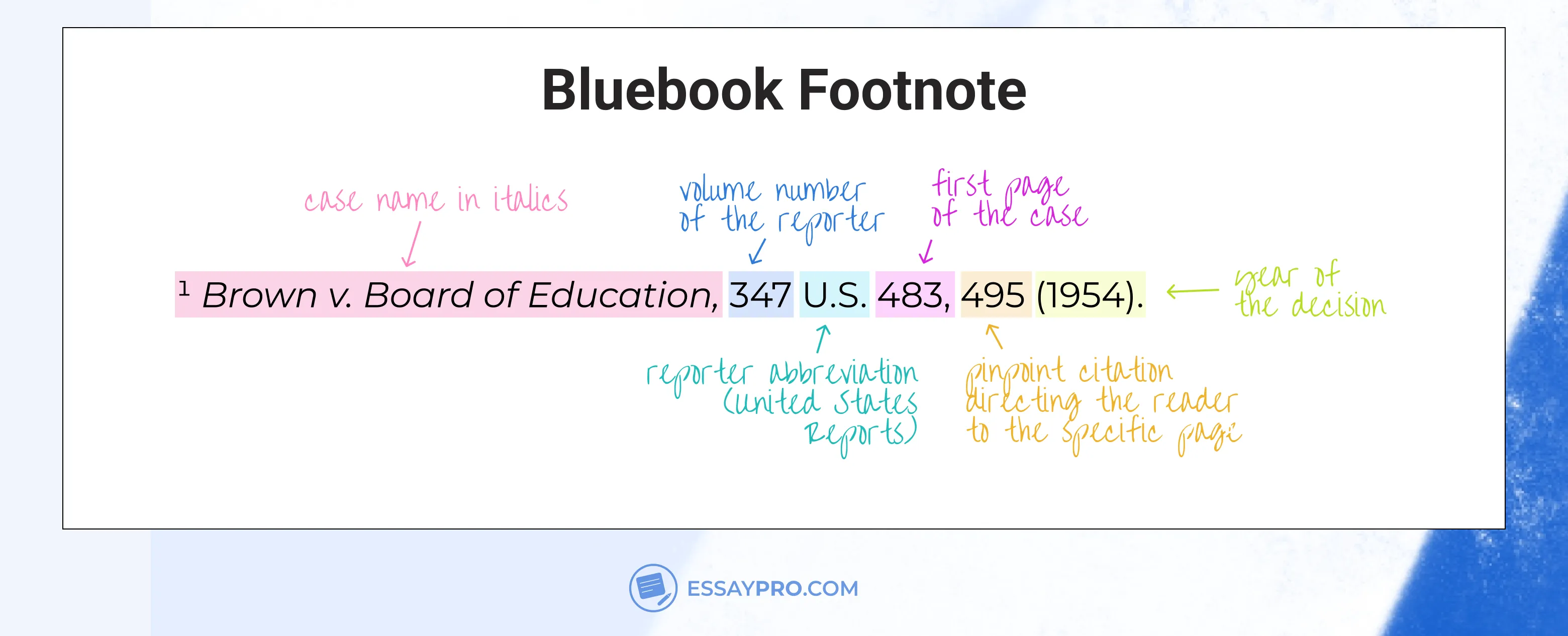
A footnote citation follows a strict structure:
- The name of the cited case or authority
- The reporter or source
- A pinpoint reference
- The court and year
A case citation might appear as Smith v. Jones, 123 F.3d 456, 459 (9th Cir. 2025). Introductory signals often lead the citation, explaining whether the source supports, contrasts with, or merely relates to the text above.
The 22nd edition does not overhaul Bluebook footnote formatting itself. Instead, it refines how footnotes communicate meaning, most notably through the addition of the contrast signal in Rule 1.2.
Bibliographies (The Academic Specialty)
A Bluebook bibliography serves a different purpose than footnotes. Instead of anchoring individual claims, they map the full scope of research behind an academic piece. You’ll see bibliographies in law review articles, student notes, and scholarly papers, usually placed at the end to show what sources shaped the analysis as a whole.
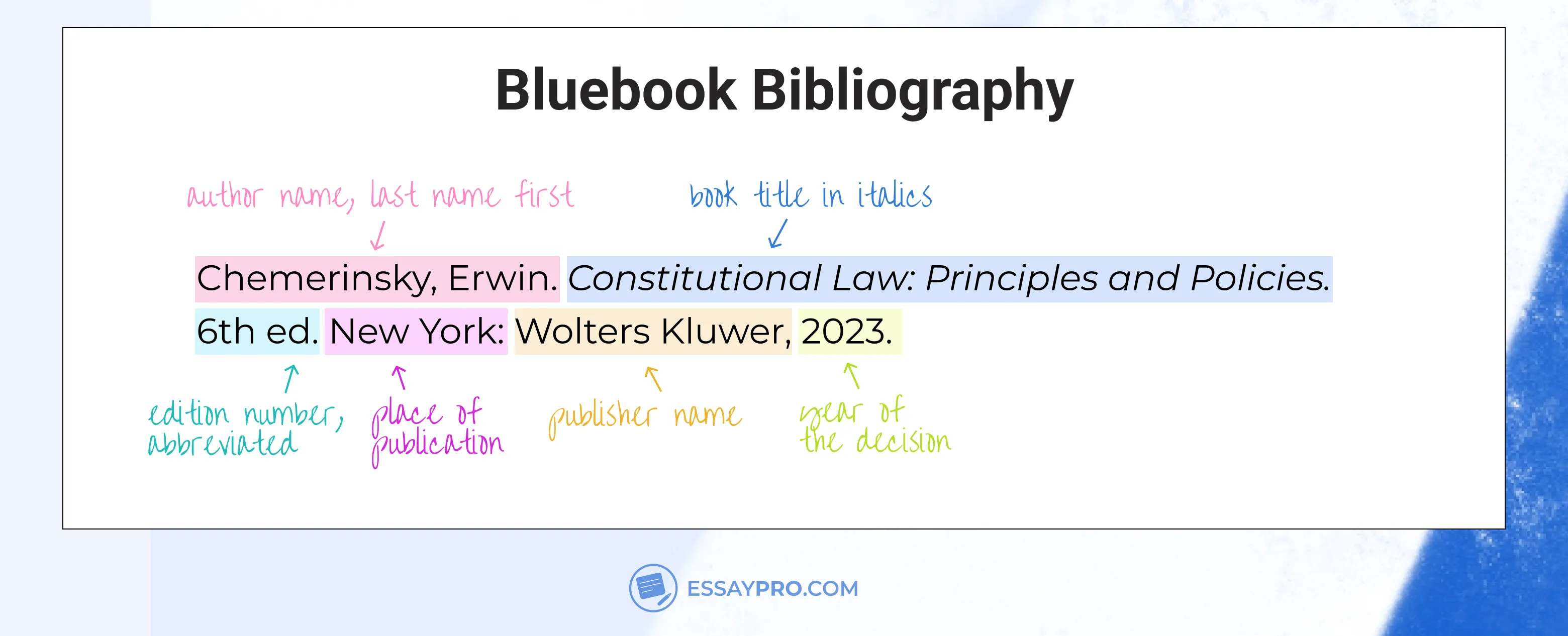
A Bluebook bibliography format follows a structured style that varies from common citation types, but it typically includes:
- The author’s name
- The title of the work
- Publication details
- The year of publication
A book entry might appear as John Q. Public, Legal Theory in Practice 123 (2d ed. 2024). Journal articles list the author, article title, volume number, journal name, and page range. Bibliographies do not replace footnotes. They complement them by showing the full range of authorities consulted and signaling depth of research and academic credibility. The Bluebook also includes a quick reference inside cover, giving writers immediate access to common citation formats.
Write with Confidence and Cite with Authority
EssayPro supports legal writing that meets Bluebook standards, so your focus stays on argument and analysis.
Bluebook Citation Examples
Bluebook citations follow a consistent formula that moves from identification to location. Most relevant examples begin by naming the legal authority, then supply the source where it appears, add a pinpoint reference when needed, and end with court or publication details and the year.
The Bluebook citation examples below show how this formula adapts across cases, statutes, books, and online sources.
The Bottom Line
Bluebook legal citation structure follows a clear logic built around precision, consistency, and source traceability. Once you understand how the rules work together, from footnotes and bibliographies to source-specific formats, citing legal authorities becomes a methodical process rather than guesswork.
Meanwhile, if you need structured help, buy essay paper online on EssayPro to keep citations accurate and compliant!
FAQs
What Is Bluebook Citation Format?
How to Do Bluebook Citation?
What Is a Bluebook Citation Example?
How to Cite a Website in Bluebook Style?
Does the Bluebook Cover International Law or Just U.S. Law?

Daniel Parker
is a seasoned educational writer focusing on scholarship guidance, research papers, and various forms of academic essays including reflective and narrative essays. His expertise also extends to detailed case studies. A scholar with a background in English Literature and Education, Daniel’s work on EssayPro blog aims to support students in achieving academic excellence and securing scholarships. His hobbies include reading classic literature and participating in academic forums.
- University of Washington Law Library. (2025, October 31). Bluebook 101. University of Washington. https://lib.law.uw.edu/bluebook101
- The Bluebook Online. (n.d.). Quick style guide. https://www.legalbluebook.com/bluebook/v21/quick-style-guide
- Georgetown Law Library. (2025, March 10). Bluebook guide. Georgetown University Law Center. https://guides.ll.georgetown.edu/bluebook?