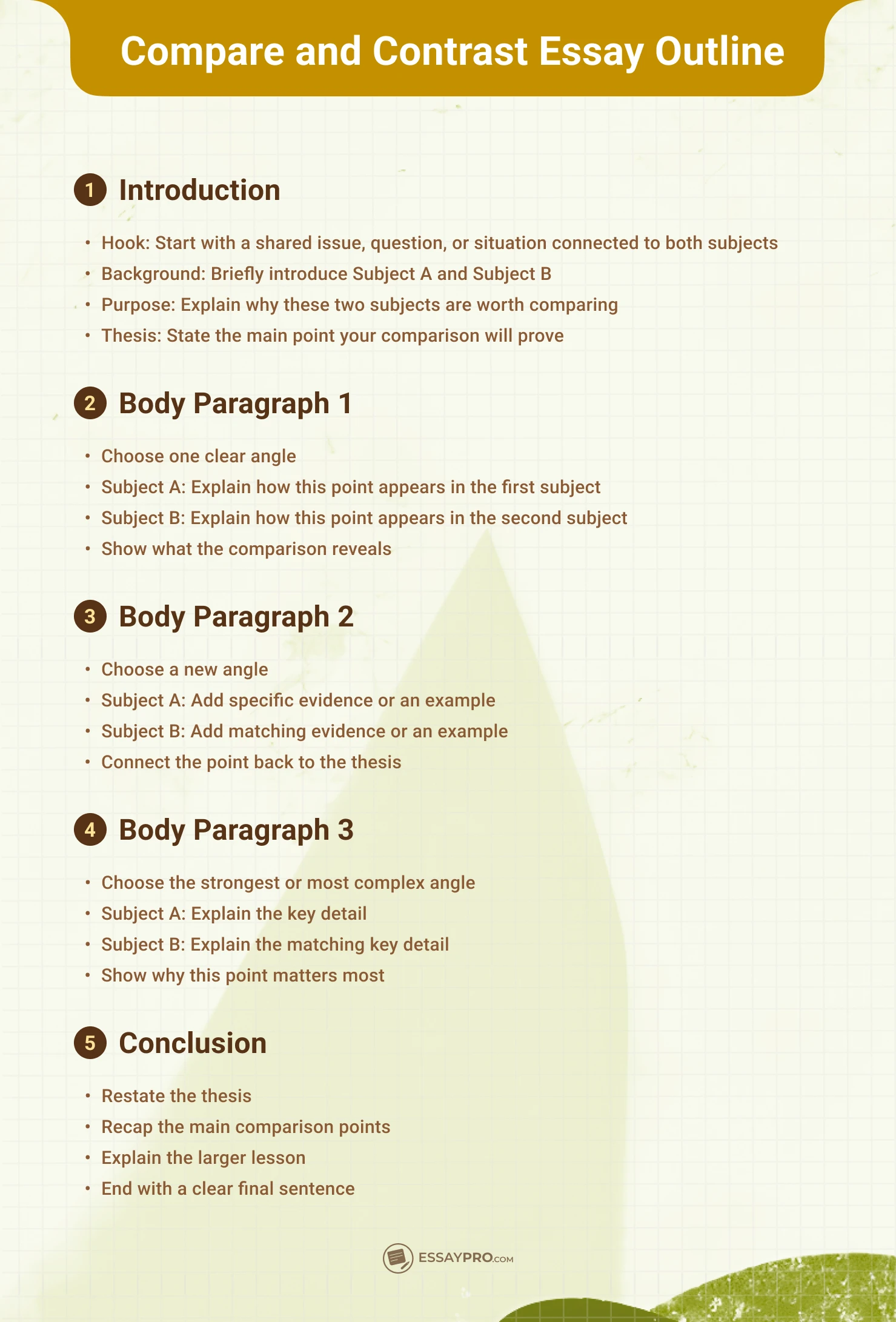
Below are five full examples of compare and contrast essay, tailored to middle school, high school, and university assignments. These examples cover specific pairings in literature, historical events, scientific concepts, and modern social issues.
Each example shows how to frame a precise thesis, choose comparable criteria, apply point-by-point or block organization, support claims with concrete evidence, and end with a clear analytical takeaway rather than a simple list of similarities and differences.
In this article, our service will share some meaningful topics and give you tips for improving your writing skills.
Expert Tip
Write your thesis as a sentence that explains why the two subjects are being compared. If you can swap in different subjects without changing the thesis, it’s too vague.
Compare and Contrast Essay Not Coming Together?
We will help you choose the right structure, tighten your thesis, and organize comparisons so your essay reads clearly.
5 Complete Compare and Contrast Essay Examples
These examples of compare and contrast essay show how effective comparison writing adapts to different academic levels.
Example 1: Sports Comparison (Middle School Level)
Subjects: Team Sports vs. Individual Sports
Organization: Point-by-point method
Length: 308 words
Grade Level: 6th–8th grade
Team Sports vs. Individual Sports: How Each Builds Skills and Responsibility
Many middle school students play sports, but not all sports feel the same. Some students enjoy being part of a team, while others prefer competing on their own. Team sports and individual sports both help students grow, but they teach responsibility and skills in different ways. The kind of sport a student plays can shape how they learn to work, practice, and improve.
Team sports focus on shared effort. In games such as soccer or basketball, players rely on each other to succeed. Each person has a specific role, and one mistake can impact everyone. Responsibility means being present at practice, staying focused, and putting in effort for the benefit of the group. Team sports also require constant communication. Players need to speak clearly, listen carefully, and work together, even during disagreements. This process can be difficult, but it helps students develop patience and learn how to support others.
Individual sports place responsibility in a different place. In activities like swimming or tennis, the outcome depends on one person. There are no teammates to rely on during competition. Students must push themselves to practice and improve. When something goes wrong, they must learn from it instead of blaming others. This helps students become more self-aware and disciplined. Progress feels personal because effort leads directly to results.
Both types of sports help students develop useful skills. Team sports improve cooperation and social skills, which are helpful in school and friendships. Individual sports strengthen focus and self-motivation, which can help with homework and personal goals. Each sport teaches students how to handle challenges and keep going.
In the end, both team sports and individual sports offer important lessons. Team sports help students learn how to cooperate and share responsibility, while individual sports encourage independence and self-discipline. Each approach builds responsibility in its own way and prepares students for different challenges.
Why This Works
- Uses familiar subjects, allowing students to focus on comparison rather than background explanation.
- Applies clear comparison criteria such as responsibility, teamwork, and personal effort throughout the essay.
- Maintains balanced coverage so neither subject dominates the analysis.
- Uses concrete, age-appropriate examples that connect directly to student experience.
- Concludes by reinforcing the comparison instead of repeating earlier points or summarizing mechanically.
Example 2: Social Comparison (High School Level)
Subjects: Social Media Friendships vs. Face-to-Face Friendships
Organization: Point-by-point method
Length: 444 words
Grade Level: 11th–12th grade
Social Media Friendships vs. Face-to-Face Friendships: What Changes When the Screen Gets Involved
Friendship does not disappear when the setting changes, but it does change shape. Talking to someone through a screen feels different from sitting across from them, even when the words are similar. Social media friendships and face-to-face friendships both exist in the same lives, often overlapping, yet they grow in very different ways. The medium affects how people communicate, how much they trust each other, and how real the connection feels.
Social media friendships grow through constant access. Messages can be sent at any hour. Photos, posts, and stories fill in the gaps between conversations. This creates a sense of closeness, even when people live far apart. Students can stay connected to friends they rarely see and maintain relationships that might otherwise fade. Online spaces also give people time to think before responding, which can make communication feel safer, especially for those who struggle to speak openly in person.
At the same time, that distance creates limits. A screen filters emotion. Tone, facial expression, and silence often disappear or get misunderstood. A short message can sound cold when it was not meant that way. Support can feel less powerful when it arrives as text among dozens of other notifications. Many online friendships rely more on shared content than shared experiences. People know what others post, but not always what they are carrying.
Face-to-face friendships develop through presence. Sitting in the same room creates moments that cannot be edited or delayed. Reactions happen instantly. Laughter, frustration, and awkward pauses all become part of the relationship. Trust builds through shared experiences, not curated images. When someone shows up on a bad day, the friendship deepens. There is no option to log out.
These friendships require more effort because schedules often conflict, distance affects how often people meet, and disagreements carry more weight when they have to be handled directly rather than avoided. Learning how to listen, respond, and stay present during uncomfortable moments builds emotional maturity. Face-to-face friendships expose flaws, and that exposure creates honesty.
Another difference appears in how people present themselves. Social media encourages selection. People choose what others see and what remains hidden. Friendships formed in that space can feel polished. In person, there is less control. People see stress, boredom, and uncertainty. That lack of control makes the connection feel more human.
Both forms of friendship matter. Social media friendships expand access and keep people connected across distances. Face-to-face friendships offer depth and emotional clarity. One provides reach. The other provides weight.
In the end, friendship depends on more than location. Still, how people connect shapes what the connection becomes. Screens make friendship easier to maintain. Presence makes it harder to replace.
Why This Works
- Focuses on a comparison that students actively experience, which strengthens engagement and authenticity.
- Uses clear comparison criteria such as communication, trust, emotional depth, and effort across both subjects.
- Balances analysis by acknowledging the strengths and limitations of each type of friendship.
- Moves beyond surface differences to examine how the medium shapes behavior and identity.
- Ends with a reflective conclusion that synthesizes insight rather than restating similarities and differences.
If you’re in the middle of writing a dissertation paper, whether it has compare and contrast elements or something else, try our dissertation writing services.
Example 3: Cultural Comparison (College Level)
Subjects: Consumer Culture in the 1990s vs. the 2020s
Organization: Block method (period by period)
Length: 631 words
Grade Level: College (100–200 level)
Consumer Culture in the 1990s vs. the 2020s: Shifts in Values and Behavior
Consumer culture says a great deal about what people value, even when they do not mean it to. The way people buy things reflects how they understand success, security, and identity. The consumer culture of the 1990s grew in a world that moved more slowly and felt more predictable. The consumer culture of the 2020s exists in a climate of speed, exposure, and uncertainty. Comparing these two periods shows how buying has shifted from a private, long-term decision into a constant, visible activity shaped by pressure and immediacy.
In the 1990s, consumption was tied closely to ownership. Buying something meant keeping it. Music collections filled shelves with CDs. Movies were rewound and watched again. Clothing styles changed, but trends did not disappear overnight. Advertising reflected this rhythm. Brands promised reliability and lasting value. A purchase felt like a choice that carried weight. People saved for items, compared options, and expected them to last.
Shopping also had boundaries. It happened in stores, during specific hours, and often required physical effort. Information was limited. Reviews came from magazines or conversations with friends. This lack of constant input slowed decision-making. Buying something required intention. Consumption fit into daily life rather than competing for attention every moment.
Consumer culture in the 2020s follows a different pattern. Access often matters more than ownership, with streaming services replacing physical media and subscriptions turning products into temporary use rather than long-term possessions. Trends move quickly, especially in fashion, where items can feel outdated before they wear out. Buying no longer happens at clear moments. It slips into everyday scrolling, making consumption feel constant and often unplanned rather than deliberate.
Technology drives this shift. Smartphones place shopping, advertising, and comparison tools in the same space where people relax, socialize, and study. Algorithms predict interests and present products before desire fully forms. Advertising no longer interrupts content. It becomes the content. Buying feels effortless, almost passive, even when it shapes finances and identity.
Values around identity also change. In the 1990s, brands suggested membership in broad cultural groups. Owning certain products communicated taste and status, but mostly within local communities. In the 2020s, consumption becomes a public performance. Social media encourages people to display purchases, routines, and lifestyles. Products gain meaning through visibility. Value shifts toward how something appears rather than how long it lasts.
Economic conditions deepen this divide. The 1990s carried a sense of upward mobility for many consumers. Long-term purchases felt reasonable because stability seemed achievable. The 2020s feel less secure. Rising costs and unstable work environments push consumers toward flexibility. Renting, subscribing, and reselling feel safer than committing to permanence. Consumption adapts to uncertainty.
Modern consumers talk more openly about ethics than in the past. Sustainability and labor conditions come up in everyday conversations, and awareness is clearly there. Yet that awareness often stops short of changing behavior. Fast fashion still moves quickly, upgrades happen constantly, and convenience usually wins out. This gap between what people say they value and how they actually consume has become one of the defining tensions of contemporary consumer culture.
The emotional side of consumption shifts as well. In the 1990s, waiting played a role in making purchases feel special. Anticipation added meaning to the experience. In the 2020s, instant access compresses that feeling. Satisfaction comes quickly, but it disappears just as fast, turning buying into something frequent and fleeting rather than memorable.
The contrast between the 1990s and the 2020s highlights a fundamental change in how people engage with consumption. What once involved deliberate, bounded choices has shifted toward constant and highly visible activity. Consumer culture now plays an active role in shaping desire as it unfolds, rather than merely responding to it. Recognizing this shift helps explain why contemporary consumption often feels effortless in practice yet draining in experience.
Why This Works
- Compares two clearly defined time periods, which keeps the analysis focused and historically grounded.
- Uses specific cultural markers such as media formats, shopping habits, and advertising styles to support claims.
- Maintains balance by examining both the benefits and drawbacks of each era without oversimplifying either one.
- Moves beyond description to explain how consumption shapes identity, emotion, and everyday experience.
For an accessible breakdown of core research strategies that will complement your Bluebook work, see our guide on doing a research.
Example 4: Ethical and Economic Comparison (College Level)
Subjects: Surveillance Capitalism vs. Consumer Privacy
Organization: Point-by-point method
Length: 972 words
Grade Level: College (200–300 level)
Surveillance Capitalism vs. Consumer Privacy: Trading Convenience for Control
Modern consumer life runs on a quiet trade. People receive speed, personalization, and ease. In return, they give away information. This exchange rarely feels dramatic because it happens gradually, hidden inside everyday habits. Ordering food, scrolling through social media, or using navigation apps all seem harmless in isolation. Yet together, these actions feed a system often described as surveillance capitalism. Comparing this system with the idea of consumer privacy reveals a growing tension between convenience and control, one that shapes how people behave, decide, and even understand autonomy.
Surveillance capitalism depends on data extraction. Companies collect information not only about what people buy, but also how they move and pause. Recommendations appear useful, advertisements seem well matched, and interfaces adjust seamlessly. From the consumer’s perspective, the system presents itself as efficient and user-friendly, reducing friction and making decisions feel easier and more streamlined.
Privacy, in contrast, relies on limits. It assumes that some information should remain unknown, even if knowing it would improve efficiency. Privacy creates distance between personal life and commercial systems. It protects uncertainty and imperfection. In earlier consumer models, this distance existed naturally. Businesses knew what customers purchased, but not how long they looked at a shelf or what they searched for afterward. The boundary was structural.
In today’s system, that boundary gradually wears away. Personal data is treated as something to be extracted and used, not something people naturally own. Privacy shifts into an individual responsibility, leaving consumers to protect themselves instead of relying on shared safeguards. Users are asked to read long policies, change settings, and make careful choices, even though the systems around them are built to confuse rather than clarify. Agreement turns into a box to check, not a decision that carries real understanding.
One reason this exchange feels easy to accept is convenience. Surveillance systems remove small obstacles from everyday life. Navigation apps adjust routes instantly, streaming platforms suggest what to watch next, and online stores remember preferences and payment details. These features save time and reduce friction. Over time, they also reset expectations. Systems that do not anticipate needs start to feel inefficient or outdated, and privacy gradually comes to seem less like a right and more like an inconvenience.
Behavior changes quietly under these conditions. Knowing that activity is being tracked leads people to adjust how they search, speak, and present themselves, often without fully realizing it. Curiosity becomes more cautious, and expression more restrained. This awareness does not need to feel threatening to be effective. Surveillance capitalism works precisely because it fades into the background, normalizing observation until being watched feels like part of the environment rather than something to question.
Privacy concerns often get explained through worst-case scenarios. Stories about data leaks, stolen identities, or online manipulation dominate the conversation. Those dangers are real, but they miss the larger change taking place. The deeper issue is about who holds influence. Companies gain the ability to steer behavior across millions of people at once. Consumers still make choices, but those choices are nudged, filtered, and shaped long before they feel personal.
This influence does not feel coercive. It feels personalized. Algorithms present options that appear aligned with preference, masking the fact that alternatives exist. Surveillance capitalism thrives on predictability because prediction generates profit.
Economic pressure further complicates this conflict. Many consumers feel they have little real ability to opt out, since essential services increasingly depend on data collection. Employment, education, and healthcare increasingly operate through digital platforms. Refusing participation can lead to exclusion. Privacy becomes a luxury rather than a standard.
You can see this shift most clearly across generations. Younger consumers usually know their data is being collected, but that awareness rarely turns into pushback. There is more acceptance than outrage. Being tracked feels built into daily life, not something that can be refused. As a result, the focus shifts away from stopping surveillance and toward managing how visible one is within it. Privacy stops feeling like a guaranteed right and starts looking more like a personal workaround.
At the same time, public concern continues to grow. Data scandals trigger short bursts of outrage, and new regulations attempt to restore balance. Yet the underlying incentives remain largely untouched. Surveillance capitalism rewards expansion, where more data leads to stronger prediction and stronger prediction leads to higher profit. Privacy, by its nature, places limits on that growth, which makes it difficult to sustain within the same economic logic.
The tension between these systems reveals a deeper question about consumer culture. Is convenience worth long-term loss of control? Does personalization justify constant observation? These questions do not produce simple answers because benefits and costs are unevenly distributed.
The issue is not nostalgia for a less connected past. Digital tools provide real value. The problem lies in asymmetry. Surveillance capitalism concentrates knowledge and influence in ways consumers cannot easily see or challenge. Privacy weakens when transparency disappears.
Comparing surveillance capitalism and consumer privacy shows that the conflict is not about technology alone. It is about values. One system prioritizes efficiency, prediction, and growth. The other prioritizes autonomy, uncertainty, and restraint. As consumer life becomes increasingly data-driven, this conflict moves from the background into daily experience.
The future of consumer culture will be shaped by how this exchange is handled. Convenience will continue to attract, while privacy will continue to demand protection. Recognizing what is gained and what is surrendered is the first step toward making conscious choices instead of slipping quietly into permanent visibility.
Why This Works
- Tackles an abstract concept by grounding it in everyday consumer behavior, which keeps the analysis accessible.
- Clearly defines both subjects before comparing them, preventing conceptual overlap or confusion.
- Uses concrete examples such as apps, algorithms, and digital services to support theoretical claims.
- Moves beyond surface risks to examine power, influence, and long-term behavioral effects.
- Sustains a balanced, analytical tone while advancing a clear central insight about control and convenience.
Example 5: Cognitive and Cultural Comparison (College Level)
Subjects: The Attention Economy vs. Deep Focus
Organization: Point-by-point method
Length: 842 words
Grade Level: College (200–300 level)
The Attention Economy vs. Deep Focus: How Constant Stimulation Reshapes Thinking
Modern life is filled with signals asking for attention. Notifications vibrate, headlines scroll, and platforms compete to keep eyes moving. This environment has given rise to what is often called the attention economy, a system built around capturing and holding focus for profit. In contrast, deep focus depends on sustained concentration, silence, and time. Comparing the attention economy with deep focus reveals a fundamental shift in how people think, learn, and experience meaning.
The attention economy treats attention as a scarce resource. Platforms are designed to maximize engagement by keeping users alert, curious, or emotionally triggered. Short videos, endless feeds, and algorithmic recommendations create constant novelty. Each moment invites another click. Attention becomes fragmented by design. The goal is not completion, but continuation.
This structure changes how people interact with information. Content is consumed quickly, often without context. As information becomes fragmented, arguments give way to headlines, and reflection is replaced by quick visual signals. Ideas arrive in partial form rather than as complete narratives, which slowly reshape how attention is trained. Depth starts to feel effortful, silence becomes uneasy, and focus no longer comes naturally. Instead, concentration turns into something that must be actively defended against constant interruption.
Deep focus operates on a different rhythm. It requires uninterrupted time and mental patience. Reading a long text, solving a complex problem, or developing an idea demands sustained attention without immediate reward. Progress unfolds slowly, which makes distraction feel costly rather than tempting. This mode of focus allows understanding to deepen, since connections emerge across ideas over time instead of forming in brief, isolated moments.
The contrast between these modes is not simply about preference. It is structural. The attention economy rewards speed, reaction, and emotional intensity. Deep focus rewards persistence, ambiguity, and delayed satisfaction. One system thrives on interruption. The other collapses under it.
Learning makes this tension especially clear. In attention-driven environments, knowledge becomes easy to skim but difficult to absorb. Students often collect information quickly, yet struggle to connect ideas in meaningful ways. Concepts remain shallow, and memory turns short-term. Deep focus, by contrast, gives ideas time to settle. It allows room for confusion, revision, and eventual insight, showing that real understanding grows through friction rather than effortless flow.
The attention economy also reshapes emotional experience. Constant stimulation keeps the mind alert, yet rarely at ease, as there is always something else waiting to be seen. Satisfaction arrives briefly and fades just as quickly. Deep focus produces a different emotional state. Time seems to stretch, awareness narrows, and the mind settles into a quieter rhythm, where meaning grows out of continuity rather than constant novelty.
Economic incentives push this divide even further. Platforms make money by keeping people engaged for as long as possible, not by helping them understand anything deeply. Success gets counted in clicks, views, and minutes watched, not insight gained. Deep focus does not fit that model. It produces no fast metrics and no easy data trail. Because it does not generate quick returns, spaces that support sustained concentration slowly disappear while attention-hungry environments keep multiplying.
This shift shapes identity as well. In attention-based systems, people begin to define themselves through responsiveness, where being informed means staying constantly updated and being present means reacting quickly. Value becomes tied to visibility and immediacy. Deep focus operates differently, placing importance on withdrawal and sustained engagement. Stepping away from constant exchange can look unproductive or even antisocial in attention-driven cultures, even though it is often necessary for deeper thinking and self-understanding.
Technology on its own is not the problem. The same tools can either protect concentration or constantly break it. The real issue is how digital systems are designed. When platforms benefit from interruption, distraction starts to feel normal. Over time, deep focus seems unusual, even though it matches how complex thought has always taken shape.
The loss of deep focus carries costs that go well beyond productivity. It weakens creativity, judgment, and self-understanding, all of which depend on time and mental space to develop. Creative thinking needs periods of incubation, ethical reasoning unfolds through patience, and self-reflection depends on quiet attention. When focus never fully settles, these processes struggle to take hold, and the mind shifts toward constant reaction instead of sustained reflection.
At the same time, rejecting the attention economy entirely is unrealistic. Modern life depends on rapid information exchange. The challenge lies in balance. Without intentional boundaries, attention becomes externally managed. Deep focus must be protected rather than assumed.
Comparing the attention economy with deep focus reveals a conflict between speed and depth, stimulation and meaning. One system keeps people engaged. The other helps them understand. As attention continues to be monetized, the ability to focus deeply becomes less common and more valuable.
The future of thinking depends on how this tension is addressed. Attention will always be pulled outward by competing demands, which makes focus something that has to be drawn inward deliberately. Choosing depth requires resisting systems designed for distraction. Without that resistance, thinking becomes fragmented, learning becomes shallow, and meaning becomes harder to reach.
Why This Works
- Compares two opposing cognitive environments rather than concrete objects, which raises the analytical difficulty.
- Traces cause-and-effect relationships between systems, habits, and thinking patterns instead of listing differences.
- Integrates learning, emotion, identity, and economics into a single comparison without losing clarity.
- Treats distraction as a designed condition, not a personal failure, strengthening the critical perspective.
- Positions deep focus as a cultural skill that must be protected, giving the essay relevance beyond academia.
Using These Examples but Still Stuck?
We help you adapt the structure and logic from these examples to your own assignment.
Compare and Contrast Essay Examples PDF
Five compare and contrast essay examples are available for download in PDF format. Each example shows a complete paper created by our writer and structured according to academic standards.
Compare and Contrast Essay Techniques
Compare and contrast essay techniques focus on selecting subjects that share a clear basis for comparison, identifying meaningful similarities and differences, and shaping those observations into a focused thesis.

Writers usually organize ideas using either the Block Method, which examines one subject fully before moving to the next, or the Point-by-Point Method, which compares specific aspects across both subjects. Strong transitions and specific evidence help connect ideas and move the essay beyond simple listing into clear analysis.
Final Words
By walking through full essays at different levels and explaining why each one holds together, this guide gives a clearer sense of how topics are framed, how comparisons stay balanced, and how conclusions land with real insight.
If your draft still feels hard to organize, you can always get research paper help from EssayPro’s experienced professionals.
FAQs
What Is a Compare and Contrast Essay Example?
A compare and contrast essay example is a complete sample paper that shows how two subjects are analyzed side by side. It demonstrates thesis development, organization, balanced comparison, and clear conclusions.
What Are the Methods of Comparison and Contrast?
The two main methods are the block method, which discusses one subject fully before moving to the other, and the point-by-point method, which compares shared aspects across both subjects throughout the essay.
How to Use These Compare and Contrast Essay Examples?
Use these examples as reference models rather than copy sources. Pay attention to structure, transitions, and evidence use, then apply the same approach to your own topic and assignment guidelines.

Daniel Parker
is a seasoned educational writer focusing on scholarship guidance, research papers, and various forms of academic essays including reflective and narrative essays. His expertise also extends to detailed case studies. A scholar with a background in English Literature and Education, Daniel’s work on EssayPro blog aims to support students in achieving academic excellence and securing scholarships. His hobbies include reading classic literature and participating in academic forums.
- Queen’s University. (n.d.). Compare and contrast essays. Student Academic Success Services. https://sass.queensu.ca/resources/online/compare-contrast?
- University of Toronto. (n.d.). The comparative essay. Writing Advice. https://advice.writing.utoronto.ca/types-of-writing/comparative-essay/?
- The University of Nottingham. (2022). Compare/contrast essay handout [PDF]. https://xerte.nottingham.ac.uk/USER-FILES/50964-zalzps-site/media/Writing/Compare_and_Contrast/compare-contrast-essay-handout-2022.pdf?