The critical thinking definition is the ability to look at the information (be it hard facts, raw data, firsthand observations, research) objectively and, with your own reasoning, reach a specific judgment about it. Good critical thinkers have the ability to sort through a messy pile of information and arrive at meaningful conclusions on their own.
The good thing is that this skill is completely learnable, which this article aims to do. We will break down real examples of critical thinking for students, which specific skills are the most valuable to employers in the workplace, and how you can develop your abilities.
Why Are Critical Thinking Skills Important for Employers?
Ask a manager what they really want in a new hire, and the honest answer usually circles back to whether this person can handle a complicated situation without someone constantly hovering nearby. The reason why almost all hiring managers want this very skill in potential employees is that companies usually run into problems that have no one clean solution, so they need people who can weigh the confusing parts and reason through the logic without micromanagement. Every field needs that, so it lifts any job application.
Examples of Critical Thinking Across Different Roles
Most critical thinking examples look pretty ordinary from the outside, with someone just catching a detail that does not fit and following it. Here are five examples of specific jobs and how employees in the respective industries can implement their critical thinking skills:
How to Promote Your Skills Throughout the Job Search?
So you have the skill. The job search is where you have to make it show. Critical thinking skills tend to vanish in the applications unless you tie them to concrete solutions that you actually pulled off. Each strategies below ask for slightly different moves, but done right, they almost guarantee that you can translate your skills to the application.
Get the Right Keywords on Your Resume
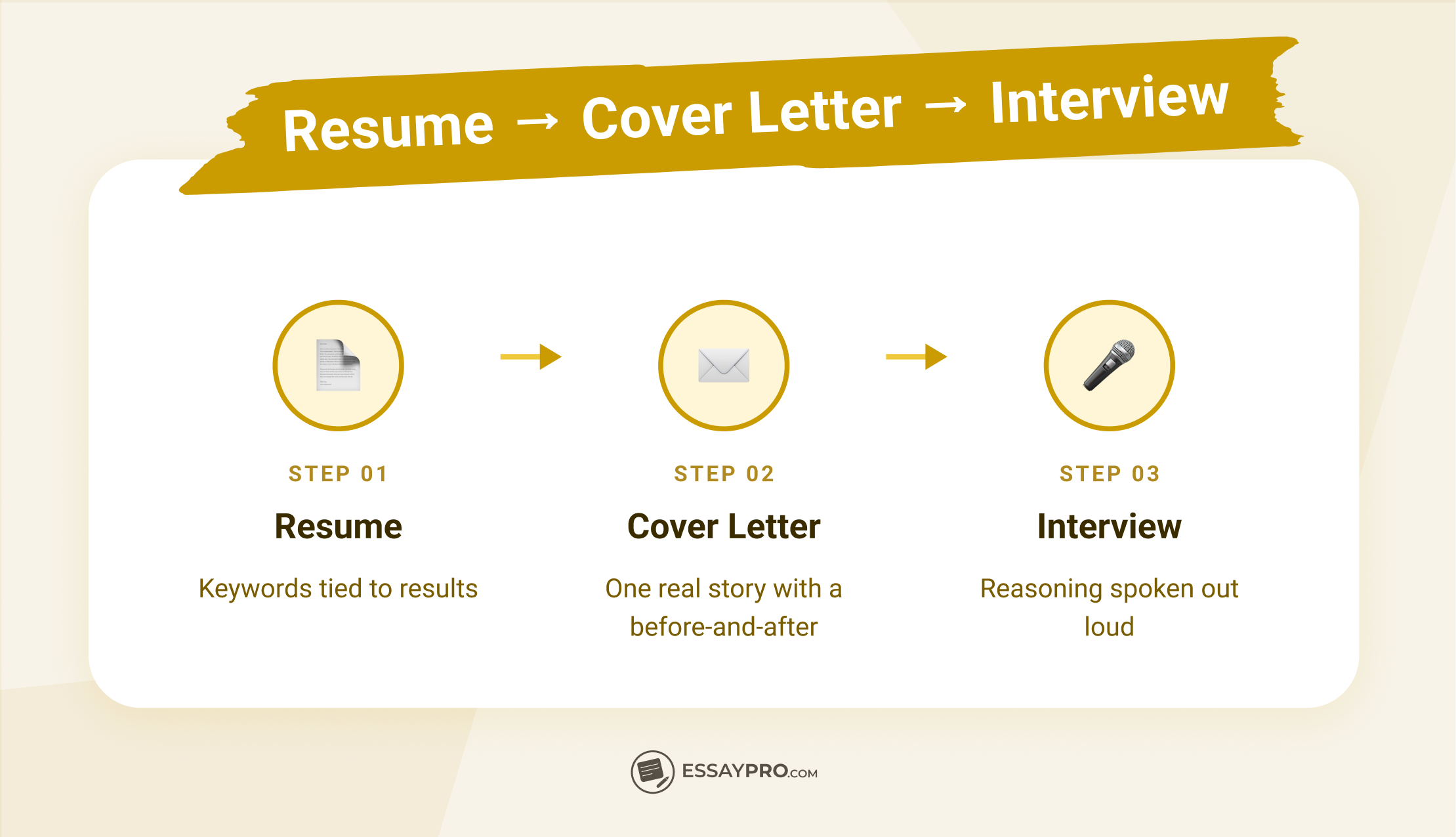
Before a human being gives you a call, your resume is read twice, first by the ranking software, then by a manager. Want to increase your chances of getting a call? Feed both. Drop these into your job history where each one describes a real result:
- evaluation
- diagnosis
- research
- interpretation
Then write a single summary line where the reasoning shows through on its own. For example: "Operations coordinator who cut a three-week onboarding backlog in half after auditing where new hires kept stalling."
Use Your Cover Letter to Describe Skills
You have a very limited space in a cover letter, so you need to pick a story that will show everything you want the employer to know about you. Critical thinking skills in your cover letter only mean something when they describe a scenario that really happened, with a clear before and after. Think of a mess you “inherited,” then lay it out in three beats:
- What exactly was wrong when you arrived?
- The techniques you used to figure out the cause
- What was changed after you implemented the fix
Prove Your Skills in the Interview
You can list every skill you come up with, but none of them will impress the employer unless you showcase them in the interview. If you’ve gotten through enough interviews, I’m sure you will agree that at least one question is always asked about a real problem you once handled. The way you answer tells the interviewer everything from how easily you can notice issues to the steps you go through to reach the decision.
The hypotheticals are a bit harder to prep for. The interviewer sets an imaginary problem in front of you and watches you think in real time. Here, your most valuable technique is to say everything out loud as you think. They mostly care about how you reason your way to the solution.
Core Critical Thinking Skills in the Workplace
Recruiters bundle everything under critical thinking skills, but the label covers different abilities, and they do not develop the same way. Here is the full breakdown of the critical thinking in the workplace, plus the words worth knowing before an interview.

Analysis
Everything that requires you to examine something requires analysis. This is the skill that allows you to figure out what something means. Good analysts obsess not over what is included in a spreadsheet (or any document, for that matter), but rather the gap, a detail that no one bothered to include. Analysis calls for:
- Data breakdown
- Evidence evaluation
- Pattern detection
- Assumption testing
- Inference
Communication
A conclusion that never leaves your head is worthless to the team. This skill translates your reasoning to other people in a form they can use, and plenty of the real work gets done in a room full of colleagues arguing toward one answer. State the finding simply, then back it with the proof.
- Clear explanation
- Precise writing
- Presentation
- Active listening
- Consensus-building
Creativity
Creativity catches the pattern the whole team missed. It also produces the option the last three people never raised, which drags analysis past the first answer that looked good enough. The reframers get remembered at review time. They ask a sharper question while everyone else fights the one already on the table.
- Problem reframing
- Idea synthesis
- Lateral connections
- Original thinking
- Foresight
Open-Mindedness
Drop the assumptions. Open-mindedness asks you to judge information on its own terms, and objectivity only holds when you can admit a confident first read was wrong. Humility matters most here. Teams that run on it make fewer bad calls, since the weak guesses get caught before they reach anyone important.
- Bias awareness
- Fairness
- Humility
- Careful observation
- Self-review
Problem Solving
Problem-solving gathers the other four and puts them to work. You define the actual trouble, build a fix, launch it, then check honestly if it changed anything. Employers want the whole loop, including the dull stretch where you measure the results and own whatever fell short.
- Issue diagnosis
- Option generation
- Decision-making
- Outcome evaluation
- Iteration
Final Thoughts
Critical thinking comes down to reading information honestly and acting on it with nerve. Employers chase it because it signals someone who decides well without a babysitter. Students can grow the five core skills, then prove each one across a resume, a cover letter, and a live interview. Practice handles the rest.
FAQs

How Can I Show Critical Thinking on My Resume Without Technical Data Experience?
How Do Interviewers Assess Critical Thinking Skills?
What Are the 5 Core Critical Thinking Skills?

Adam Jason
is an expert in nursing and healthcare, with a strong background in history, law, and literature. Holding advanced degrees in nursing and public health, his analytical approach and comprehensive knowledge help students navigate complex topics. On EssayPro blog, Adam provides insightful articles on everything from historical analysis to the intricacies of healthcare policies. In his downtime, he enjoys historical documentaries and volunteering at local clinics.