A common question from students is should it be masters degree or master’s degree? The word should be spelled with an apostrophe to show possession of the degree by the master. However, if you’re writing the full degree name, you shouldn’t use an apostrophe. Master of Science or Master of Arts both start with a capital M and have no apostrophe. Neither do common abbreviations like MA, MSc or MBA.
We cover every rule, common misspellings and real examples in this article, so you will never confuse them again.
Master’s or Masters Degree? A Grammar Guide
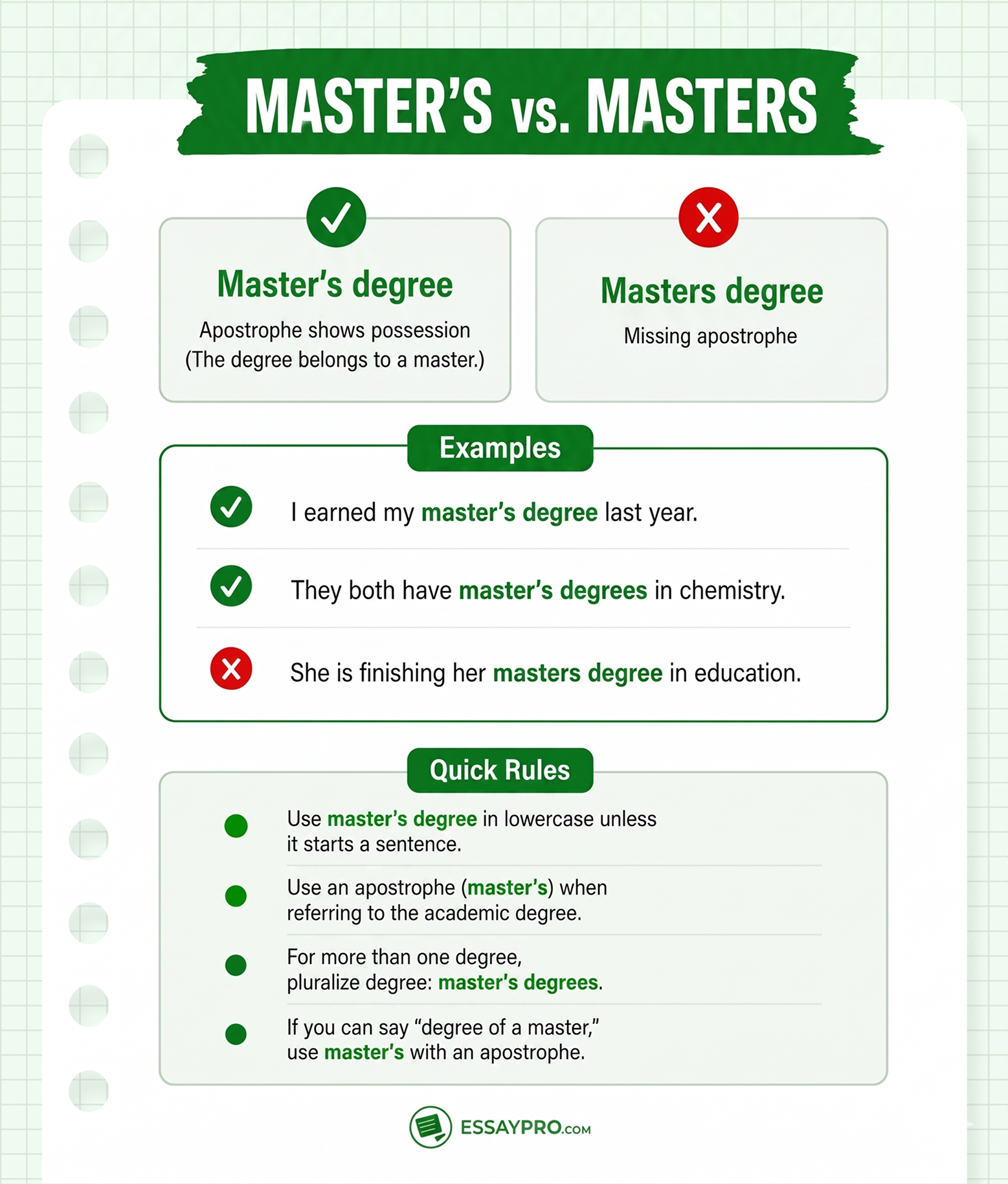
When it comes to ‘masters or master's?, the apostrophe shows possession. It is the degree of a master, or someone who has mastered something. If you take away the apostrophe, you take away the possession.
Plurals go on degrees, not master's. So if there are two or more people graduating, they have earned master's degrees, not masters degrees, nor masters' degrees.
- Correct: I completed my master's degree last spring.
- Correct: They both have master's degrees in chemistry.
- Incorrect: John is working on his masters degree in philosophy.
When to Capitalize 'Master’s Degree'?
Whether to capitalize masters or master's degree depends on how you are referring to the degree in the sentence.
Capitalize when writing the full official title of a specific degree. These are proper nouns and need capitals.
- Correct: She holds a Master of Business Administration.
- Correct: He graduated with a Master of Science in Chemistry.
Use lowercase when referring to the degree in general terms, not as an official title.
- Correct: She is completing her master's degree this spring.
- Correct: He has a master's degree in psychology.
Need Help Finishing the Final Draft?
Get expert help with grammar, wording, formatting, and overall writing before submission.

Bachelor’s Degree Explained
A bachelor's degree follows the same logic as a master's degree. The apostrophe is possessive. The degree belongs to a bachelor (meaning a graduate who has completed undergraduate study).
Outside of writing the actual title, it always carries an apostrophe. When used in formal titles the apostrophe drops and the first letter takes capitalization. "Bachelor of Arts" and "Bachelor of Science" are both correct.
- Correct: She received her bachelor's degree in three years.
- Correct: He holds a Bachelor of Science in chemistry.
- Incorrect: They both graduated with bachelors degree last spring.
Using appropriate synonyms can help improve clarity and reduce repetition in academic writing.
Using Degree Names Correctly in Academic and Professional Writing
It's as important to know where you should write your degree as it is how to write it. Formatting changes based on the situation, and using the wrong version in a professional document will stand out more than most people realize.
Professional Settings: Resume, CV, LinkedIn, etc.
Write out the full formal title, capitalized, without an apostrophe. It's the name of your degree award, treat it like one.
- Example: Bachelor of Arts in English Literature, University of Edinburgh, 2022
- Example: Master of Science in Data Analytics, 2024
Academic Writing: Essays, Papers, Projects, etc.
Using the lowercase possessive form is preferred unless you are using the name of a department or specific program in its official full title.
- Example: She earned her master's degree prior to working on the research.
- Example: Candidates should have at least a bachelor's degree in a relevant subject.
Swapping between the two means you aren't being inconsistent. You are just using the proper version for the situation, and that shows you know the difference.
Correct capitalization also applies to a college assignment heading, where formatting and grammar conventions matter.
A Guide to Academic Degree Types
Higher education is structured in clear tiers, and each level comes with its own naming conventions, formatting rules, and expectations. Knowing where each degree sits and how to write it correctly matters whether you are filling out an application, updating a CV, or writing an academic paper.
Associate Degree
An associate degree is a two-year undergraduate qualification, typically offered by community colleges and vocational institutions. It is one of the few degree types that does not use an apostrophe in standard usage. "Associate degree" is the accepted form, not "associate's degree," though you will occasionally see both.
- Associate of Arts (AA) in Communications
- Associate of Science (AS) in Nursing
- Associate of Applied Science (AAS) in Information Technology
Bachelor's Degree
A bachelor's degree is the standard undergraduate qualification, typically completed over three to four years. In general writing it takes an apostrophe. In formal titles it drops the apostrophe and capitalizes.
- Bachelor of Arts (BA) in English Literature
- Bachelor of Science (BSc) in Computer Science
- Bachelor of Business Administration (BBA)
- Bachelor of Education (BEd)
Master's Degree
A master's degree is a postgraduate qualification completed after a bachelor's degree, usually taking one to two years. The apostrophe is required in general use. In formal titles, capitalize and drop the apostrophe.
- Master of Arts (MA) in History
- Master of Science (MSc) in Data Science
- Master of Business Administration (MBA)
- Master of Public Health (MPH)
Before submission, use a self editing checklist to catch grammar, punctuation, and formatting mistakes.
Doctoral Degree
A doctoral degree is the highest academic qualification available and typically takes three to seven years to complete, depending on the field and country. The word "doctoral" is an adjective here, so no apostrophe applies.
- Doctor of Philosophy (PhD) in Sociology
- Doctor of Medicine (MD)
- Doctor of Education (EdD)
- Doctor of Psychology (PsyD)
Professional Degree
Professional degrees prepare graduates for licensed or regulated careers in specific fields. They sit alongside or above master's level, depending on the discipline and are always written as formal titles without an apostrophe.
- Juris Doctor (JD) in Law
- Doctor of Dental Surgery (DDS)
- Doctor of Pharmacy (PharmD)
- Bachelor of Architecture (BArch)
Degree Levels, Abbreviations, and What They Mean
Degree abbreviations vary internationally, by institution and by discipline. One degree may be represented by different letters depending on the granting institution. The following is a general reference guide for abbreviations of the most common degrees and what each degree represents.
Frequent Degree-Related Writing Errors
Degree titles are one of those weird gray areas that never seems to escape tiny formatting errors. They appear in essays, resumes, and academic papers all the time. And the majority of them are caused by the same few habits. Let’s see what to look for when still wondering whether it’s master's degree or masters degree.
- Leaving off the apostrophe in general writing. Using masters degree or bachelors degree is incorrect in normal writing. The degree you are talking about always belongs to someone.
- Using an apostrophe in a formal title. Master’s of Science has an apostrophe where it shouldn’t. Formal titles don’t require an apostrophe, but they do use capital letters.
- Capitalizing incorrectly. Saying ‘She earned a Master’s Degree’ forces unnecessary capitalization. The rule of lowercase only applies to the exception of the full title.
- Making plurals with improper apostrophes. Masters’ degrees has the apostrophe after the ‘s’ when it should be before. It should be ‘master’s degrees.’
- Abbreviating incorrectly. If you use both MSc and M. Sc. in the same paper, you are not being consistent. Choose one format, and stick with it.
If you are studying writing techniques, these figurative language examples explain common literary devices and their uses.
Want a Second Set of Eyes on Your Paper?
Work with academic experts to catch mistakes and improve clarity throughout your assignment.
The Bottom Line
Correct use of degree titles can seem like a minor detail when crafting professional or academic documents. Once you learn the reasoning behind the punctuation usage, however, it's simple to remember. If the title is being used generally, add an apostrophe. If you are using the formal title of the degree, leave it off. You now have everything you need to get it right every time.
FAQs
Is It Masters or Master's Degree?
Is Master's Degree Capitalized?
How to Shorten "Master's Degree"?
How Do You Write Degrees in a List?

Adam Jason
is an expert in nursing and healthcare, with a strong background in history, law, and literature. Holding advanced degrees in nursing and public health, his analytical approach and comprehensive knowledge help students navigate complex topics. On EssayPro blog, Adam provides insightful articles on everything from historical analysis to the intricacies of healthcare policies. In his downtime, he enjoys historical documentaries and volunteering at local clinics.
.webp)