

You complete your essay and pat yourself on the back, only to look down at the word count and realize you are short 300 words. Welcome to every writer’s nightmare. However, the solution is never to make your spaces larger than college margins allow, unnecessarily elaborate on your points, or simply repeat yourself. Teachers can see right through that. What you really need to do is identify where your thinking was lacking and expand on your ideas.
Here’s how to make your essay longer:
- Expand on existing points by adding more evidence and explanation.
- Include new ideas, examples, or counterpoints.
- Develop under fleshed-out sections you may have rushed.
In this article, we provide legitimate, quality-improving tips and ways to make an essay longer that will help you effortlessly.
Still Short on Words?
Get expert help expanding your essay with stronger analysis and well-developed ideas.

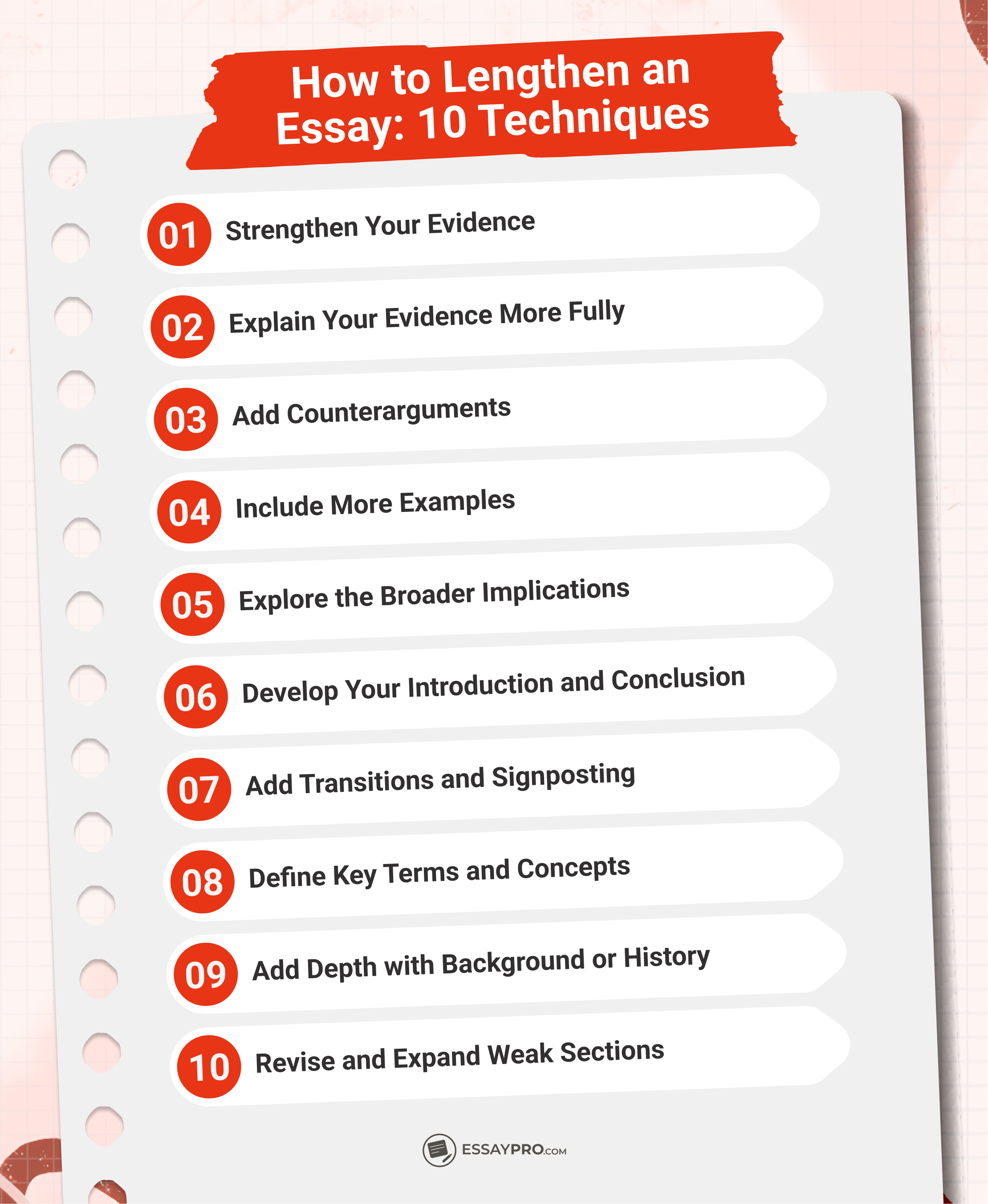
How to Lengthen an Essay: 10 Techniques
The easiest method to lengthen an essay is to improve it. Instead of resorting to shortcuts, refine your points, develop further, and elaborate on those areas you may have initially overlooked. Below are 10 best ways to make essay longer that will improve the quality of your writing simultaneously. After implementing these, you'll find yourself writing plenty.
1. Strengthen Your Evidence
The easiest way to add length to your essay is to support your points with more evidence. Found yourself making a claim with few or no support? Add more information. Whether it be data, quotes, examples, or research. Stuffing your paper with information doesn't hurt anybody, and it certainly makes your argument much more persuasive.
Quick check: For every main point, ask yourself: Have I proven this, or just stated it?
Planning your structure becomes easier once you know how many paragraphs is 1000 words for your writing style.
2. Explain Your Evidence More Fully
Adding evidence is only half the job. Many students drop a quote or fact and move on without explaining its significance. Take the time to analyze each piece of evidence, showing how it connects to your argument.
A strong evidence-based paragraph usually includes:
- The claim you are making
- The evidence that supports it
- An explanation of how the evidence proves your point
- A link back to your thesis
Example: After quoting a study, spend two or three sentences unpacking what it means, why it matters, and how it strengthens your overall argument.
3. Add Counterarguments
Acknowledging the opposing view is a powerful way to add both length and depth. Presenting a counterargument and then responding to it shows critical thinking and makes your essay more balanced and persuasive.
Example: If you argue that homework should be reduced, add a paragraph addressing why some believe homework is essential, then explain why your position still holds. This easily adds 100 or more meaningful words.
Tip: Use phrases like "Some may argue..." or "Critics of this view suggest..." to introduce counterarguments smoothly.
4. Include More Examples
Examples make abstract ideas concrete, and adding more of them naturally lengthens your essay while improving clarity. Real-world examples, case studies, or hypothetical scenarios all work well.
Example: If you are writing about effective leadership, do not stop at one example. Add a second or third, perhaps a historical figure, a business leader, and a personal experience, to illustrate your point from multiple angles.
5. Explore the Broader Implications
Push your analysis further by exploring what your argument means in a wider context. Ask the "so what?" question. Why does your point matter? What are its consequences or future implications?
Example: After arguing that AI will change education, expand by discussing what this means for teachers, students, and society over the next decade. This adds depth and demonstrates sophisticated thinking.
6. Develop Your Introduction and Conclusion
Rushed introductions and conclusions are common, and they are easy places to add meaningful length. Your introduction can provide more context or background, while your conclusion can reflect more fully on the significance of your argument.
A fuller introduction might include:
- An engaging hook
- Relevant background or context
- A clear, well-developed thesis
Tip: In your conclusion, go beyond summarizing. End with a broader insight, a call to action, or a thought-provoking final point.
7. Add Transitions and Signposting
Smooth transitions between paragraphs improve flow and add a modest number of words. Signposting, briefly telling the reader what is coming next or recapping what you have covered, also strengthens structure.
Example: Instead of jumping straight to a new point, add a sentence like "Having examined the economic effects, it is equally important to consider the social consequences." This guides the reader and adds substance.
8. Define Key Terms and Concepts
If your essay uses important terms, take a moment to define and explain them. This is especially useful for complex or specialized topics, and it ensures your reader fully understands your argument.
Example: In an essay on "sustainability," briefly explain what the term means in your context, since different fields define it differently. A clear definition adds words and prevents confusion.
9. Add Depth with Background or History
Providing relevant background or historical context can enrich your essay and add length, as long as it stays connected to your argument. This helps the reader understand why your topic matters.
Example: In an essay about modern privacy laws, a short paragraph on how privacy concerns evolved with technology gives valuable context and naturally extends your essay.
Tip: Keep background relevant. Only include history that supports or illuminates your main argument.
10. Revise and Expand Weak Sections
Finally, reread your essay and look for sections that feel thin or rushed. These are prime opportunities for expansion. Often, a single underdeveloped paragraph can be doubled in length by adding evidence, explanation, or examples.
Use this quick diagnostic to find weak spots:
Example: If a body paragraph is only two sentences long, it almost certainly needs more support. Add evidence and explanation until the idea is fully developed.
The strategies in this guide are especially useful when working on a 3000 word essay with a challenging word count.
Mistakes to Avoid While Making an Essay Longer
Word counts force you to sometimes rush your essay. When rushing, it’s easy to make mistakes. Here are some things you should avoid while trying to lengthen your essay.
- Stuffing with “filler” phrases. Words such as “due to the fact that” or “in today’s modern society” don’t add any real content to your essay. Readers are likely to notice this approach.
- Restating. It can feel helpful to restate an idea with different words to extend your essay. However, this may come across as repetitive.
- Digressing from the topic. Including extra information that’s not directly related to your topic can add to your word count but may make your essay feel less focused.
- Padding with quotes. Long quotes take up a lot of space, but your analysis is what the grader is looking for. Use those quotes wisely.
- Changing the format to make it look longer. Bigger font, bigger margins, more space between lines…if you need to do these things, you’re not adding valuable content to your essay.
- Being needlessly wordy. Turning clear sentences into bloated ones makes your writing harder to read, not better.
Understanding how many words are in a 5 paragraph essay can help you distribute your ideas more effectively.
Need a Paper That Meets Every Requirement?
Work with professional writers to create a complete, polished essay on time.
Putting It All Together
Bottom line: Make your essay longer by making it stronger. Each of the tips above lengthens your essay not by mindlessly fluffing it up, but by reinforcing your arguments, making your writing clearer, and demonstrating higher-level thinking. As a final tip, review this checklist before you hand in your essay:
- Did I back up all of my statements?
- Did I explain why my evidence is important?
- Did I address counterarguments?
- Did I use sufficient examples?
- Did I discuss why my argument or position is significant?
- Did I adequately develop my introduction and conclusion?
If you answered yes to these questions, you’ve earned that word count. Your essay will read long, will read like you put thought into it and covered all your bases, and will really feel like it has a strong argument. That’s the type of length that should merit a higher grade.
FAQs
How to Easily Make an Essay Longer?
Will Adjusting the Font or Margins to Hit the Word Count Backfire?
What Can I Do If My Opening and Closing Feel Too Brief?

Daniel Parker
is a seasoned educational writer focusing on scholarship guidance, research papers, and various forms of academic essays including reflective and narrative essays. His expertise also extends to detailed case studies. A scholar with a background in English Literature and Education, Daniel’s work on EssayPro blog aims to support students in achieving academic excellence and securing scholarships. His hobbies include reading classic literature and participating in academic forums.