
An Oxford comma is the comma placed before the final conjunction (and or or) in a list of three or more items, as in “pens, pencils, and erasers.” Also called the serial comma, the Oxford comma marks where the second-to-last item ends and the last one begins. The mark appears only in lists of three or more, never in a list of two. When to use the Oxford comma depends on the style guide: APA, MLA, Chicago, AMA, and IEEE require it in every list, while the Associated Press and most British newspapers drop it unless a sentence would be unclear without it.
What is an Oxford comma?
An Oxford comma, also called the serial comma or Harvard comma, is the comma placed after the second-to-last item in a series, directly before the conjunction. The name traces to Oxford University Press, where the comma has been house style since Horace Hart printed the press’s rules for compositors in 1905. Harvard University Press uses the same mark, which is where the alternative name comes from.
The two versions below show one sentence with the mark and without it.
- With the Oxford comma: She packed socks, shoes, and a coat.
- Without the Oxford comma: She packed socks, shoes and a coat.
If you’re looking for a solid idea for your academic paper, browse our communication research topics.
When should you use an Oxford comma?
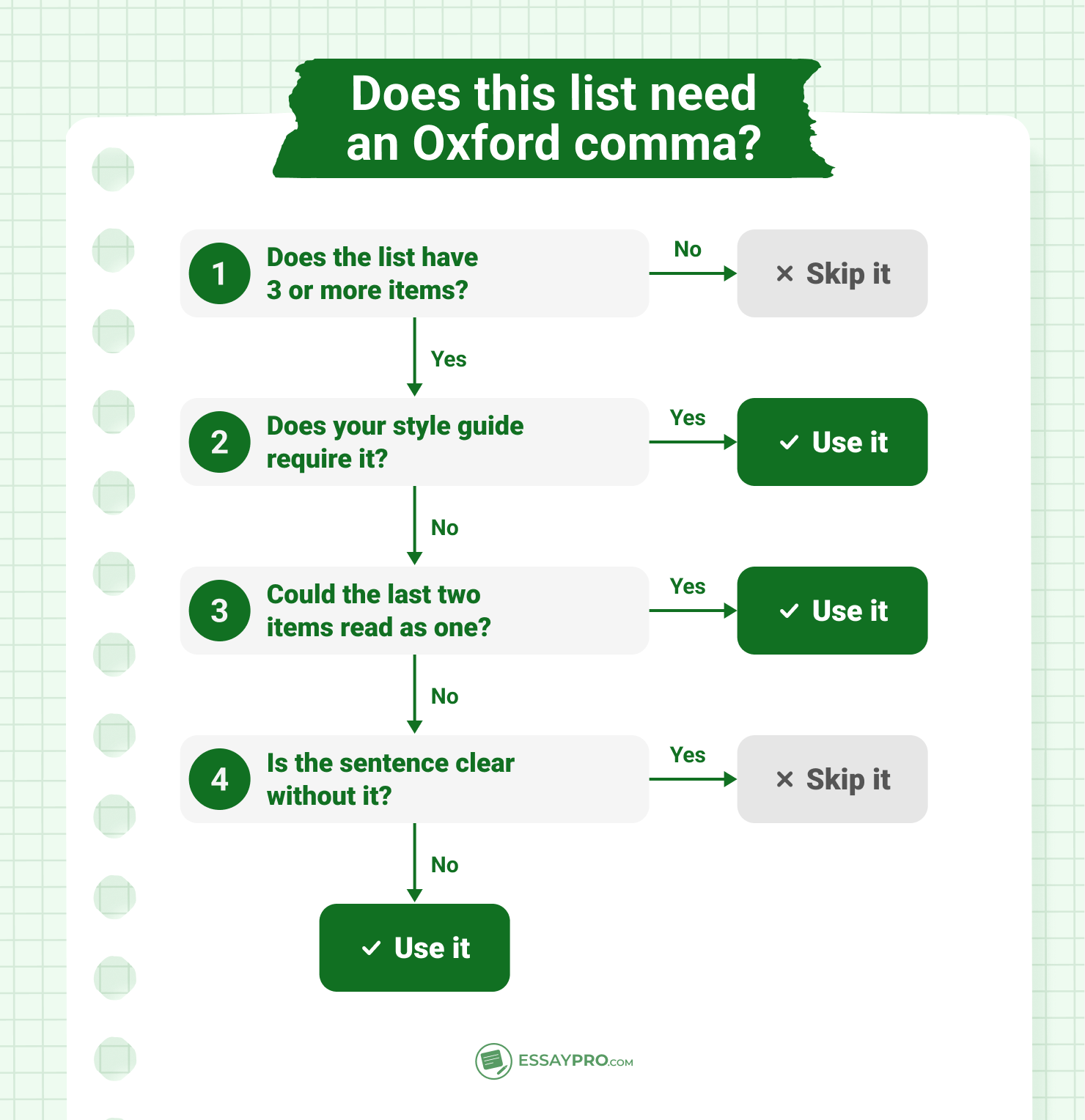
Use the Oxford comma whenever the style guide you follow requires it, and whenever leaving it out would let readers group the items the wrong way. Academic, medical, and technical guides require it in every list of three or more. Journalists add it only when a sentence needs the extra comma for clarity. Four situations call for the Oxford comma most often:
- When the last two items could read as one. “She thanked her sisters, Oprah, and Beyoncé” keeps the sisters separate from the two singers.
- When list items already contain and. “Breakfast options are bacon and eggs, toast and jam, and coffee” keeps each option distinct.
- In long or multi-part series. “The report covered staffing levels, budget shortfalls, equipment failures, and safety concerns” gives readers a clean break before the final item.
- When a style guide mandates it. An APA, MLA, Chicago, AMA, or IEEE document uses the comma in every list, as in “accuracy, speed, and recall.”
You should also learn the rules on using the comma before or after but.

Catch It Before They Do
Typos, weak arguments, missing sources, all gone before your professor opens it.
Which style guides require the Oxford comma?
Five major style guides require the Oxford comma in every series: APA, MLA, Chicago, AMA, and IEEE. The Associated Press and most British newspapers omit it except where a sentence would be unclear. British academic publishing is split: Oxford University Press keeps the comma, while Cambridge University Press drops it. The table compares each guide’s rule, current edition, and primary source.
Does the Oxford comma actually prevent ambiguity?
The Oxford comma prevents ambiguity whenever, in the essay examples, the last two items in a list could otherwise read as a description of the item before them. The comma keeps the final item separate from the one it might be mistaken for. In simple lists where no such confusion is possible, the comma changes nothing. The Oxford comma examples below show both outcomes.
What is the difference between an Oxford comma and a serial comma?
There is no difference: the Oxford comma and the serial comma are two names for the same mark, the comma before the final conjunction in a list of three or more items. The same comma also answers to series comma and Harvard comma. The name serial comma describes its job, marking each item in a series. The name Oxford comma credits Oxford University Press, which has kept the mark in its house style since Horace Hart printed the press’s rules in 1905. The name Harvard comma credits Harvard University Press. Series comma is the plainest label. All four names point to one comma, placed before and or or.
Does the Oxford comma apply to lists of two items?
No. The Oxford comma applies only to lists of three or more items, never to a list of two. A two-item list takes no comma before and or or. “She ordered soup and salad” is correct; “She ordered soup, and salad” is an error.
The Oxford comma rules govern the last item in a series, so a list needs three items or more before the comma has any place. With two items, the conjunction alone joins them, and a comma splits the pair for no reason. This rule holds in every style guide, whether it uses the Oxford comma or omits it. “Tea or coffee” needs no comma; “tea, coffee, or water” does.
What mistakes do people make with the Oxford comma?
Six mistakes account for most Oxford comma errors: using it in two-item lists, mixing two styles in one document, creating a false appositive, placing the comma on the wrong side of the conjunction, using it where semicolons belong, and assuming AP style requires it. Each one is avoidable.
- Adding a comma to a two-item list. The Oxford comma belongs only in a series of three or more. A list of two items, such as “bread and butter,” takes no comma before the conjunction.
- Switching between styles in one document. Consistency matters more than the choice itself. A document that adds the comma in one list and omits it in the next reads as careless editing.
- Letting the comma create a false appositive. Sometimes the comma makes the last two items read as a description of the first. “My heroes, a nurse, and a teacher” can misread. Reorder the list.
- Placing the comma after the conjunction. The Oxford comma goes before and or or, never after it. “Red, white and, blue” is wrong. The correct position is “red, white, and blue.”
- Using a comma where semicolons belong. List items that contain their own commas take semicolons, not an Oxford comma. “Paris, France; Rome, Italy; and Bern, Switzerland” keeps each place clear.
- Assuming AP style requires it. AP style omits the Oxford comma in simple series and adds it only for clarity. Writers trained in academic style often insert it in news copy against AP rules.
When should you use active and passive voice in academic writing? While we’re on the subject of grammar, you should check out our separate guide as well.
Should you use the Oxford comma in academic writing?
Yes, usually: APA, MLA, Chicago, AMA, and IEEE all require the Oxford comma, and these guides cover most student and scholarly writing. When to use the Oxford comma in a specific paper follows a precedence order, where each level overrides the ones below it. Check these sources in order:
- The assignment brief or the target journal’s author guidelines. This is the most specific instruction and overrides everything below it.
- The style guide the course or department requires. APA, MLA, Chicago, AMA, and IEEE all mandate the comma.
- The institution’s house style, which applies where the course names no guide.
- Consistency within the document, which applies where no guide addresses the comma at all.
One rule outranks the choice itself: pick one approach and hold it from the first list to the last.
Don’t lose your points over the most trivial part of the language; learn the rules of using the article ‘the’ in English.
Beat the Blank Page
Give us a loose topic and get a well-structured, cited draft out by morning.
Interesting fact: has a missing Oxford comma ever cost money?
A missing Oxford comma cost Oakhurst Dairy $5 million. Five delivery drivers in Maine sued for years of unpaid overtime, and the case hinged on one absent comma in the state’s overtime law. A federal appeals court sided with the drivers in 2017, and the dairy settled in February 2018.
Maine’s overtime law named the jobs that earned no overtime pay, ending with employees who handled the “packing for shipment or distribution of” perishable foods. No comma followed “shipment,” and the gap left room for two readings. One side read the clause as a single job, packing, done either for shipment or for distribution. The other read it as two jobs, “packing for shipment” and “distribution,” with distribution standing on its own. Oakhurst’s drivers delivered dairy and packed nothing, so everything came down to which reading a court would accept. A comma after “shipment” would have removed the doubt.
The case ran over four years:
- 2014: 5 Oakhurst delivery drivers filed suit in federal court, arguing the dairy owed them years of unpaid overtime for their delivery work.
- First ruling: A federal district court sided with Oakhurst, treating distribution as its own exempt activity and dismissing the drivers’ claim.
- March 13, 2017: The First Circuit reversed, calling the statute ambiguous. Because Maine’s overtime law must be read in favor of workers, the court ruled for the drivers. Judge David Barron opened with a line that spread far past law reviews: “For want of a comma, we have this case.”
- February 2018: Oakhurst agreed to a $5 million settlement covering about 127 drivers, with $50,000 each to the five named plaintiffs and claims for the rest.
- Aftermath: Maine’s Legislative Drafting Manual still tells lawmakers to leave the serial comma out. Rather than adopt the Oxford comma, the legislature rewrote the overtime list with semicolons, separating each item so no two could blur together again.
If you’d prefer for a professional to handle the grammar, you can always rely on our essay writing service for expert help.
Final thoughts
The Oxford comma is the comma before the final and or or in a list of three or more items. Academic style guides, among them APA, MLA, Chicago, AMA, and IEEE, require it, while AP style and most British newspapers omit it unless a sentence would be unclear. The comma earns its place when the last two items could otherwise read as a description of the item before them. It never belongs in a list of two. Across every guide, one rule outranks the choice itself: use the comma or drop it, but do so consistently from the first list to the last.
FAQ
What is an Oxford comma?
When should you use an Oxford comma?
Is the Oxford comma required in APA?
Does AP style use the Oxford comma?
Is the Oxford comma the same as the serial comma?
Is the Oxford comma grammatically necessary?
Do you use an Oxford comma with two items?
Why is it called the Oxford comma?

Ana Ratishvili
Ana is a professional literary writer with a Master’s Degree in English literature. Through critical analysis and an understanding of storytelling techniques, she can craft insightful guides on how to write literary analysis essays and their structures so students can improve their writing skills.