
.webp)
A little English grammar quiz for you: Which of these two sentences is grammatically correct: “I saw an unicorn” or “I saw a unicorn”? If you hesitated, join the crowd. When it comes to the use of "the" and "a/an" in English, articles can be tricky for many confident writers because they sound correct, but the rules are based on pronunciation rather than spelling, and usage depends more on context than hard rules.
Pay attention to how naturally your mind chooses the right article in these sentences:
He is an engineer.
She purchased a laptop.
Did you watch the movie last night?
Cats are good pets.
Notice there wasn’t an article in the fourth sentence. That’s also correct. In this article, we’ll provide rules for articles in English grammar, precisely when to use a, an, the, or no article at all. Once you learn these tricks, it’ll become second nature.
What is an article
Articles belong in the adjective family. All adjectives modify nouns, but articles specifically tell the listener or reader whether the noun being mentioned is specific or not.
Definite (specific) or indefinite (general).
We have two articles in English. They are “the” and “a/an.”
“The” = Definite Article “A/An” = Indefinite Article
“The” is used when talking about something specific. “A/An” is used when talking about something non-specific.
Example: “Can you pass me a chair?” Here, any chair will do. “Can you pass me the chair?” There is a specific chair that both the speaker and listener know about. You can see how using the article changes the sentence. This is why the correct use of the article is important.
If grammar rules are slowing you down, you can request ‘write my college paper’ with expert support for editing and formatting.

Better Drafts Start Here
Turn rough notes into a focused, well-organized paper with help from real writers!

Definite and indefinite articles
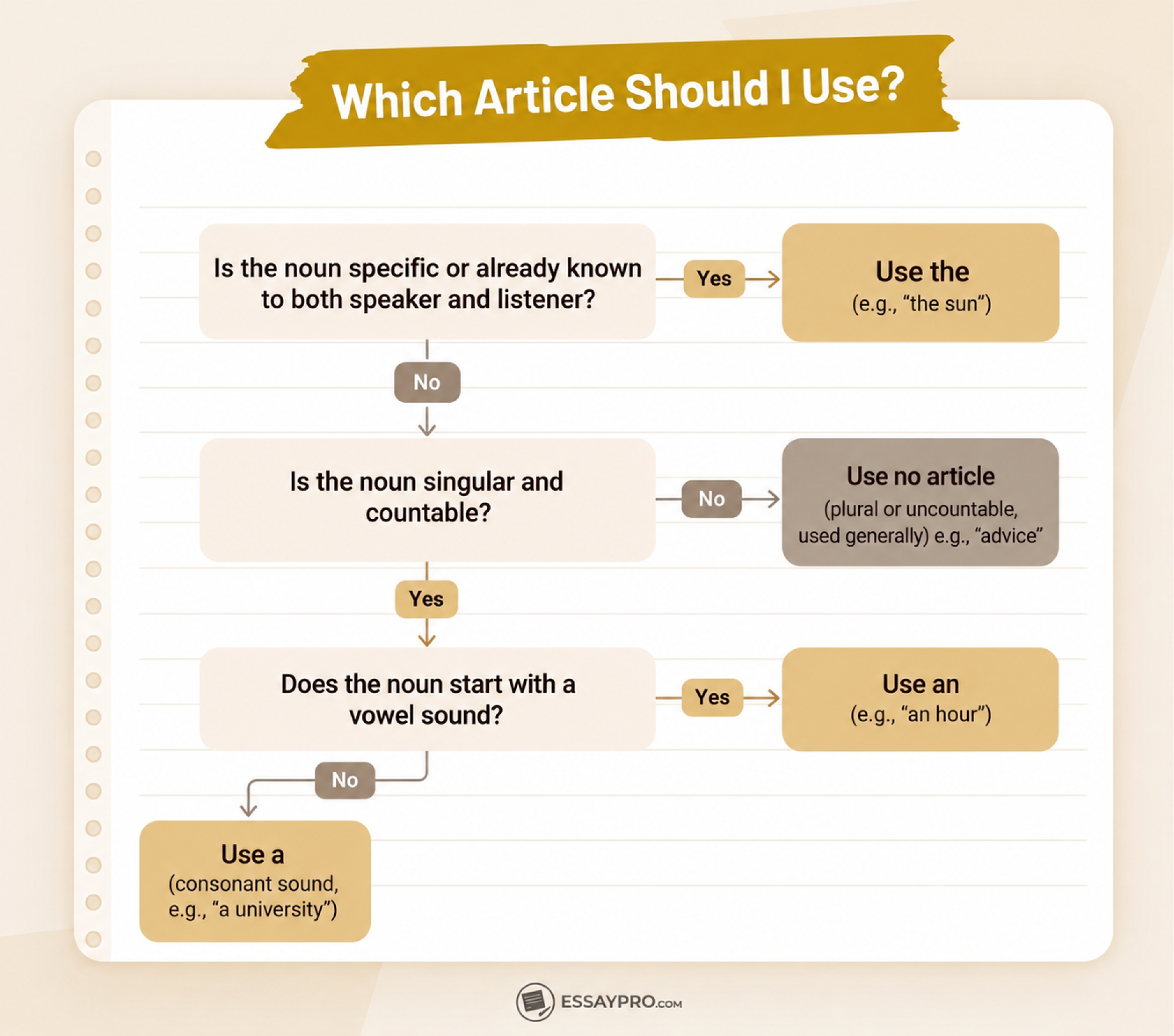
Once you know the difference between "the" and "a/an" in theory, it helps to see how each one behaves in practice, since the choice depends entirely on whether the noun is specific or general.
What is a definite article?
The is the definite article, and it points to something specific that both the speaker and listener already understand. It's used when the noun has already been mentioned, is unique, or is clear from context.
- I finally finished the report you asked for.
- The sun rises in the east.
- Can you close the door behind you?
In each case, there's no ambiguity about which report, which sun, or which door is meant.
What is an indefinite article?
A and an are indefinite articles, used when the noun isn't specific, when it's being introduced for the first time, or when any example of that noun would work. A comes before consonant sounds, while an comes before vowel sounds.
- She adopted a puppy last weekend.
- He's looking for an apartment near downtown.
- I need a pen to sign this.
None of these points refers to one particular puppy, apartment, or pen. They simply introduce a noun without narrowing it down to something specific.
Students facing tight deadlines sometimes choose to buy college papers that meet their academic requirements.
Why articles are important in English
Here's an experiment: read a sentence but omit the articles. You'll quickly find English becomes ambiguous, clunky, or just plain ungrammatical. Articles convey useful information: they let the listener know whether you are referring to something specific or something general; whether you've mentioned it before; sometimes even how many there are.
Consider these two sentences:
I discovered a telephone on the bench. (some telephone, one we haven't named yet)
I discovered the telephone on the bench. (the one you were looking for)
Same words but completely different meanings. The only difference is the article. Articles force you to make distinctions like this. Comfort with making such distinctions is the difference between grammatical English and effective English.
Using a/an
A and an are indefinite articles, used before singular, countable nouns when you're not referring to anything specific. They introduce a noun for the first time or refer to any one example of a category.
Main rules:
- Use a/an before singular countable nouns only, never plural or uncountable nouns.
- Use it when the noun hasn't been mentioned before, or when it doesn't matter which specific one you mean.
- Use it to describe someone's profession, role, or category.
Examples:
- She's reading a novel.
- He ordered a coffee.
- They're looking for a mechanic.
- I have an idea.
Once you've mastered articles, review comma before or after but to improve sentence clarity and punctuation.
A vs. an
The choice between a and an depends on sound, not spelling. Use a before words that begin with a consonant sound, and an before words that begin with a vowel sound.
Main rules:
- Use a before consonant sounds: a dog, a university, a European trip. (Note: "university" and "European" start with a vowel letter but a consonant sound, "yoo-.")
- Use an before vowel sounds: an apple, an hour, an honest answer. (Note: "hour" and "honest" start with consonant letters, but the h is silent, so the sound begins with a vowel.)
Examples:
- She bought a used car.
- He waited an hour for the bus.
- It was a one-time offer. (sounds like "wun," a consonant sound)
- They hired an MBA graduate. ("MBA" is pronounced "em-bee-ay," starting with a vowel sound)
Not using a/an
A/an is left out in several common situations, mainly involving plural nouns, uncountable nouns, and certain fixed expressions.
Main rules:
- Don't use a/an before plural nouns.
- Don't use a/an before uncountable nouns (like information, water, or advice).
- Don't use a/an before most proper nouns.
Examples:
- Dogs make loyal companions. (not "a dogs")
- She gave me advice I'll never forget. (not "an advice")
- I love Paris in the spring. (no article before the city name)
Using the
The is the definite article, used when both the speaker and listener know exactly which noun is being referred to. It works with singular, plural, countable, and uncountable nouns alike.
Main rules:
- Use the when the noun has already been mentioned.
- Use the when there's only one of something (the sun, the internet, the president).
- Use the when context makes the specific item obvious.
- Use the with certain geographical names: oceans, seas, rivers, mountain ranges, and countries with plural or collective names (the Pacific Ocean, the Alps, the Netherlands, the United States).
Examples:
- I bought a laptop, but the laptop broke within a week.
- The moon looked especially bright last night.
- Have you crossed the Mississippi River before?
- They're planning a trip to the Philippines.
Using articles correctly goes hand in hand with understanding punctuation marks and other essential grammar rules.
Exception for plurals
The can be used with plural nouns when referring to a specific, identifiable group rather than a general category.
Main rules:
- Use the with plural nouns when the group is known or has already been introduced.
- Skip the when speaking about plural nouns in general.
Examples:
- The students in my class are preparing for finals. (a specific group)
- Students often struggle with time management. (students in general, no article)
- The books on that shelf belong to my sister. (specific books)
After polishing your grammar, make sure you understand MLA vs APA format before submitting your paper.
Not using the
The is omitted in several standard situations, particularly with general statements, most proper nouns, and certain fixed phrases.
Main rules:
- Don't use the when speaking generally about plural or uncountable nouns.
- Don't use the before most country, city, or street names.
- Don't use the before meals, languages, or academic subjects in general references.
Examples:
- Music brings people together. (not "the music," speaking generally)
- She lives in Canada. (no article before the country name)
- We're learning Spanish this semester. (no article before the language)
Don't forget to learn how to make a cover page that matches your instructor's formatting requirements.
Better Drafts Start Here
Turn rough notes into a focused, well-organized paper with help from real writers!
Summary
Contrary to what you might think, given their apparent simplicity, the articles a, an and the actually do have meaning. Remember that a/an means "any," and is used with singular nouns when the noun is nonspecific, while the is used with both singular and plural nouns when the noun is specific or already known to the listener. Whether you use a or an depends on sound, not necessarily spelling.
Articles are also omitted with plurals and uncountable nouns when used in the general sense. When these rules start to sink in, you'll find that deciding which article to use won't feel arbitrary.
FAQs
What is an article in grammar?
What are examples of articles in grammar?
When should you not use an article?

Daniel Parker
is a seasoned educational writer focusing on scholarship guidance, research papers, and various forms of academic essays including reflective and narrative essays. His expertise also extends to detailed case studies. A scholar with a background in English Literature and Education, Daniel’s work on EssayPro blog aims to support students in achieving academic excellence and securing scholarships. His hobbies include reading classic literature and participating in academic forums.