

Is and are are present-tense forms of the verb to be. In simple terms, use is when the subject means one person, place, thing, or idea. Use are when the subject means more than one. This rule is called subject-verb agreement because the verb has to match the subject in number. The is vs are choice becomes easier once you find the real subject of the sentence. That sounds basic, I know, but many mistakes happen because another noun appears nearby and distracts the writer. This guide explains is vs are subject verb agreement in a clear way.

Difference Between Is and Are
The difference between is and are depends on the subject. Is belongs with singular third-person subjects, such as he, she, it, or one noun. Are belongs with plural subjects, as well as you, we, and they. The use of “is vs. are” can feel less obvious in longer sentences because the subject may have extra details attached to it.
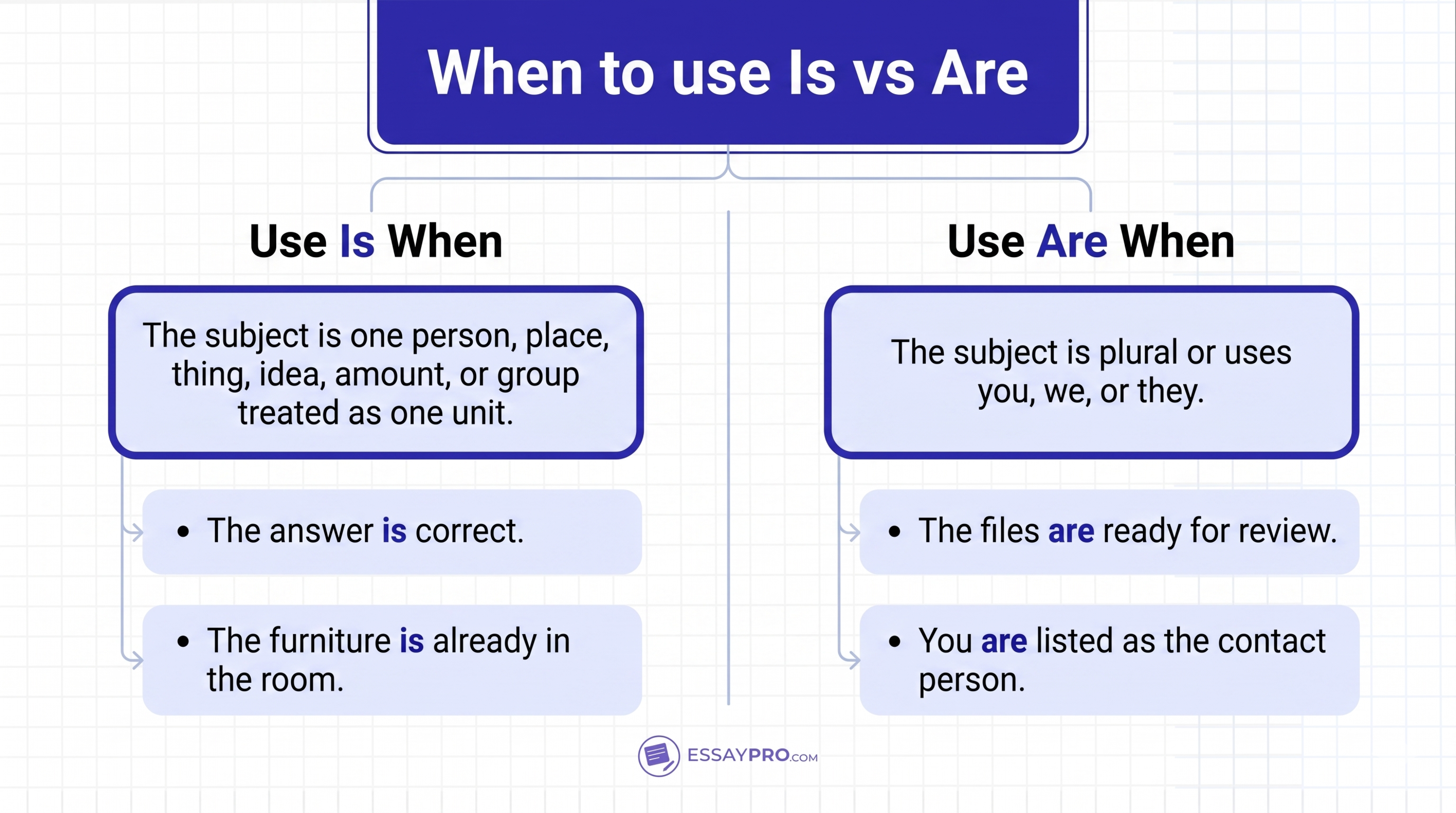
For example, in “The folder with old receipts is missing,” the subject is folder. Receipts is plural, but it only adds detail. The verb still agrees with folder. That small distinction matters a lot.
So, with is vs are, the subject controls the verb.
When to Use “Is”?
Use is when the subject names one person, one object, one place, one idea, or one unit. This rule looks simple in short sentences, but longer writing can make it awkward. A phrase may come after the subject, and the noun within that phrase may look plural. Still, the verb has to agree with the main subject.
Take this sentence: “The report with several charts is ready.” Several charts may catch your eye, yet report is the subject. Since report is singular, is fits the sentence. One of the most useful habits in is vs are subject verb agreement is to find the subject first, then choose the verb accordingly.
Examples:
- The laptop is charging near the window.
- My appointment is scheduled for Thursday afternoon.
- The final paragraph is too long for the assignment.
- Her explanation is clear enough for the class discussion.
- The package near the front desk is fragile.
By the way, if you’ve been assigned a paper that asks you to put two concepts/things side by side and examine their relationship closely, compare and contrast essay topics will help you get started.
When Dealing With Mass Nouns
Mass nouns name things that are usually treated as one whole amount. You may divide them into smaller parts in real life, but the noun itself still behaves as singular in grammar. This is why mass nouns usually take is.
This can confuse writers because some mass nouns contain many separate items. Information may include ten facts. Furniture may include a bed, a table, and two chairs. Equipment may include several devices. Even so, the main noun stays singular, so the verb should be is.
Examples:
- The water in the bottle is cold.
- The sand on the floor is hard to clean.
- The information in the chart is accurate.
- The furniture in the waiting room is new.
- The advice in the comment is useful.
When a Collective Noun Is Treated as a Single Entity
A collective noun names a group. Words like board, panel, crew, department, and choir can all refer to more than one person, but they often act as one unit in a sentence. In American English, collective nouns usually take is when the group is presented as a single body.
The point is how the sentence treats the group. If the group makes one decision, gives one answer, or performs one shared action, is sounds natural and grammatically correct. I’d pay attention to meaning here, because grammar depends on what the group is doing in the sentence.
Examples:
- The board is reviewing the policy this week.
- The panel is ready for the interview.
- The crew is fixing the elevator.
- The department is moving into a larger office.
- The choir is preparing for the winter concert.
Reciting all the grammar rules even in your sleep can’t help you sometimes, when you have a full paper to write and it’s already 2 a.m. In moments like this, you can order analytical essay (or 500 word essay, or any other kind of essay, really) from our service.

Better Drafts Start Here
Turn rough notes into a focused, well-organized paper with help from real writers!
When to Use “Are”?
Use are when the subject is plural, meaning the sentence names more than one person, place, thing, action, or idea. Are also belongs with you, we, and they. The pronoun you is the part that sometimes feels a little odd, because it can point to one person, yet it still takes are in standard English.
In the is vs are rule, are usually appears when the subject has more than one part. Two singular nouns joined by and also create a plural subject in most cases. So, if the sentence talks about a planner and a notebook together, the verb should be are. This is one of the easier rules, honestly, once the subject is clear.
Examples:
- The schedules are printed for tomorrow’s meeting.
- You are listed as the main contact.
- We are close to the final draft.
- The charger and adapter are inside the drawer.
- Several comments are still unresolved.
When Dealing With Nouns in Plural
Plural nouns take are because they name more than one item, person, place, action, condition, or idea. The basic are vs is plural rule is that a singular subject takes is, and a plural subject takes are. The difficult part is usually not the rule itself. The difficult part is finding the actual subject when the sentence has extra details around it.
A plural subject can appear at the beginning of a sentence, after a question word, within a longer noun phrase, or with another noun joined by and. Extra phrases should not change the verb. If the main subject is plural, are remains the correct choice.
Examples:
- The notes on the second page are incomplete.
- These guidelines are stricter than the older version.
- The windows near the entrance are locked.
- The calendar alerts and reminders are active.
- Both explanations are acceptable in this context.
When a Collective Noun Is Treated as Individual Members
A collective noun names a group, such as staff, cast, faculty, council, audience, or crew. In many sentences, that group acts as one unit and takes is. Sometimes, though, the sentence clearly points to the individual members within the group. In that case, are can be used, especially in British English.
This rule needs a careful eye. American English usually treats collective nouns as singular, so writers in the U.S. often use is. Still, when the meaning focuses on separate actions, separate opinions, separate locations, or separate responsibilities, are may fit better. That is part of learning when to use is and are correctly, because grammar follows the subject’s role in the sentence.
Examples:
- The staff are choosing their own training dates.
- The cast are checking their costumes in separate rooms.
- The faculty are updating their profiles at different times.
- The council are returning to their districts after the vote.
- The audience are taking their seats section by section.
A completely free plagiarism checker from EssayPro can help you clean up your final draft after correcting all grammar errors.
Common Tricky Scenarios
The basic rule sounds simple enough: one subject takes is, and more than one subject takes are. The trouble begins when the subject gets buried within a longer sentence. A phrase can sit beside it. A plural noun can appear nearby. A word can look plural and still act singular. That is why learning when to use is vs are means learning how to find the real subject first.
Here are the ten scenarios that cause the most mistakes.
A useful habit is to shorten the sentence in your head. “The binder with meeting notes is on the chair” becomes “The binder is on the chair.” Once the extra phrase disappears for a second, the correct verb becomes easier to hear and easier to explain.
If small grammar choices tend to trip you up, punctuation rules can feel just as confusing. For example, knowing whether to place a comma before or after but can make your sentences clearer and easier to read.
Is vs Are Usage Examples
Is vs are usage depends on the subject of the sentence. Use is with a singular noun, a singular pronoun, an uncountable noun, a collective noun treated as one unit, or a total amount. Use are with plural nouns, plural pronouns, and compound subjects that name more than one person or thing.
This sounds mechanical at first, and yes, grammar sometimes is. Still, the rule becomes more practical once you test it within normal sentences. The question should stay the same each time: what is the sentence really talking about?
Final Thoughts
Subject-verb agreement is the main rule behind is and are: the verb must match the real subject. Singular subjects, mass nouns, single amounts, and one-unit groups take is. Plural subjects, compound subjects, and separate group members take are. Use is when speaking about one person, place, thing, or idea, and are when referring to more than one. Understanding this basic rule helps you form grammatically correct sentences.
FAQs
When Should I Use Is vs Are?
What Are Common Mistakes with Is and Are?
What Is the Difference Between Using "Is" and "Are" in a Sentence?
.webp)