LRO Observes Apollo Landing Sites: A Scientific Perspective
In 2009, NASA's Lunar Reconnaissance Orbiter (LRO) captured its first images of the Apollo landing sites — offering both a historic confirmation and a step forward for modern lunar research. For the first time in decades, human-made artifacts left on the Moon during the Apollo missions became visible through high-resolution imaging technology.
These observations serve not only as visual proof of past exploration but also as a scientific milestone that reinforces the role of remote sensing in space research and future mission planning.
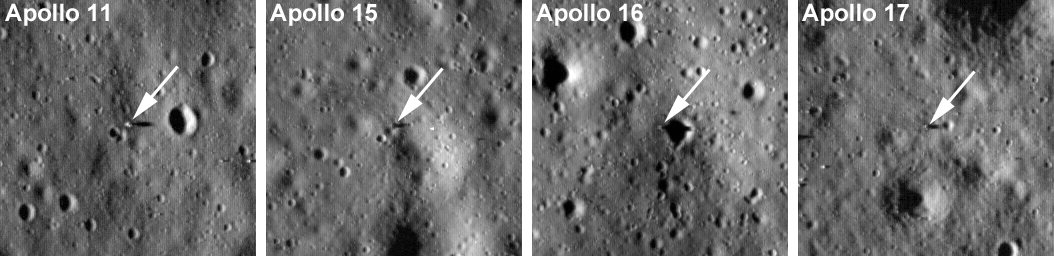
Image above:
- Apollo 11 lunar module, Eagle. Displayed image width: 282 meters (about 925 ft.)
- Apollo 15 lunar module, Falcon. Displayed image width: 384 meters (about 1,260 ft.)
- Apollo 16 lunar module, Orion. Displayed image width: 256 meters (about 840 ft.)
- Apollo 17 lunar module, Challenger. Displayed image width: 359 meters (about 1,178 ft.)
What Is LRO and Why Does It Matter?
Launched on June 18, 2009, LRO is a NASA spacecraft designed to map the lunar surface in unprecedented detail. Its primary objective is to identify safe landing sites, locate potential resources, and gather crucial environmental data to support upcoming missions.
Equipped with seven scientific instruments, LRO is a mobile lunar laboratory. Its imaging system, the Lunar Reconnaissance Orbiter Camera (LROC), consists of:
- Two high-resolution Narrow Angle Cameras
- One Wide Angle Camera for broad surface scans
Together, these tools are advancing lunar science by capturing surface features with extraordinary clarity.
Apollo Sites Captured by LROC
Between July 11 and July 15, LROC successfully imaged five of the six Apollo landing sites, with Apollo 12 scheduled to be captured later. These images were taken even before LRO reached its final mapping orbit, showcasing the spacecraft’s early capability.
Technical Details:
- Resolution: Approximately 4 feet per pixel
- Descent stage size: Around 12 feet in diameter, appearing as ~9 pixels
- Shadows: With the Sun low on the lunar horizon, even relatively small objects cast elongated shadows across the surface — making the Apollo modules easier to detect
One of the standout images was from the Apollo 14 site, where favorable lighting allowed visibility of the Apollo Lunar Surface Experiment Package (ALSEP). Even more impressively, astronaut footpaths between the lander and equipment were faintly visible — an exciting discovery for both historians and planetary scientists.
Why These Images Matter for Science and Education
These early LRO images are not just symbolic. They represent:
- Proof of concept: Remote sensing can reliably detect and document human artifacts on another celestial body.
- Baseline data: The images help calibrate instruments and refine imaging techniques.
- Educational opportunity: Students and researchers can study real-life evidence of space missions using current technology.
They also pave the way for site selection for future lunar landings, both robotic and crewed, by identifying terrain types, potential hazards, and resource locations.
What’s Next for LRO?
LRO was expected to enter its primary mission orbit — a nearly circular path about 31 miles (50 km) above the Moon’s surface — by August 2009. From that vantage point, future images will achieve two to three times greater resolution, offering deeper insight into the lunar environment.
As the mission continues, the data collected by LRO will support:
- Geological studies
- Impact crater analysis
- Thermal and radiation mapping
- Landing site safety assessments
A Continuing Legacy of Exploration
According to LRO project scientist Richard Vondrak, the images are a testament to two things: the enduring significance of the Apollo program and the momentum of modern lunar science.
These visuals remind us that space exploration is ongoing, and tools like LRO play a crucial role in building the knowledge base for humanity’s next steps on the Moon — and beyond.
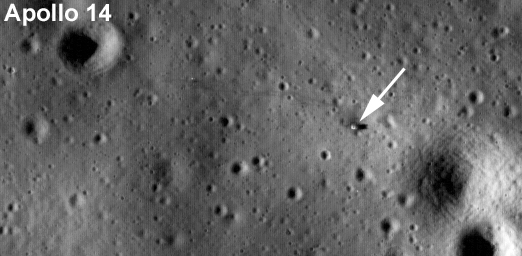

Apollo 14 lunar module, Antares. Displayed image width: 538 meters (about 1,765 ft.)
Supplemental Material
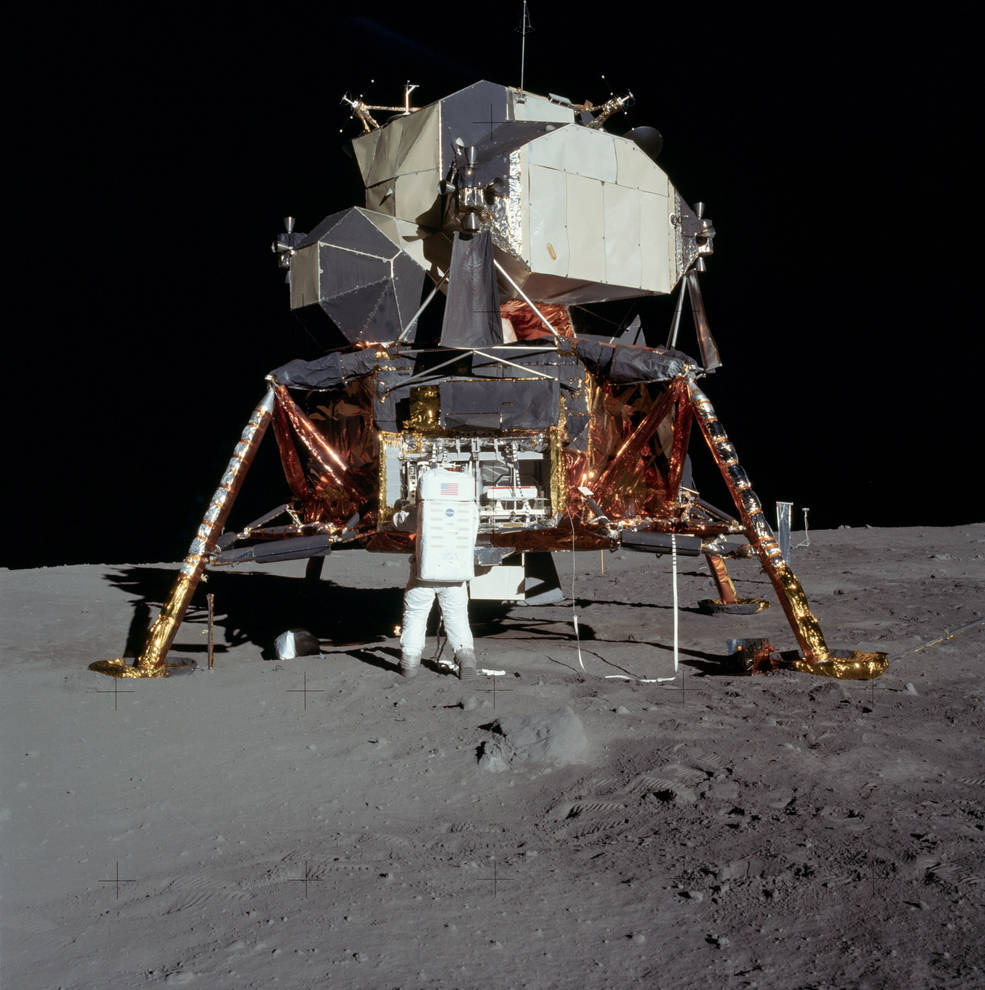
This photograph shows Apollo 11 astronaut Buzz Aldrin in front of the lunar module. The photo helps provide a scale to the LROC images shown above.
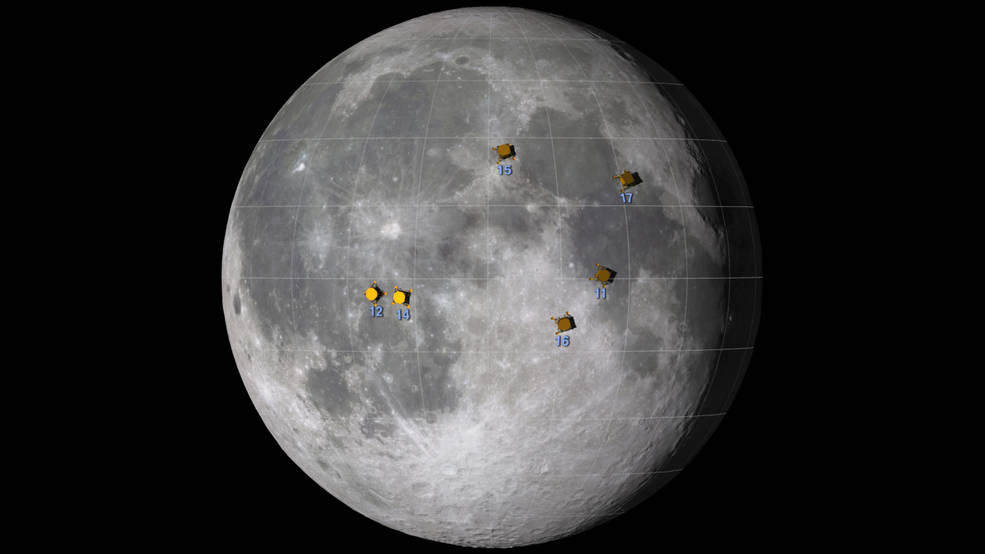
This graphic shows the approximate locations of the Apollo moon landing sites.