

A medical narrative report is a written summary that explains a patient’s condition, medical history, symptoms, injuries, and treatment in a clear narrative format. Healthcare professionals prepare this document to describe clinical findings and support medical evaluation.
In this article, you'll learn how to create a medical narrative report, what information belongs there, and how exactly a patient care report records objective findings. We'll also show you a downloadable fill-in-the-blanks template along with two real examples of a narrative report.
What Is a Medical Narrative Report?
A medical narrative report is a structured written explanation of a patient’s medical condition. The narrative describes symptoms, injuries, medical history, and treatment using clear clinical language. Such reports are often prepared to support documentation requirements for CMS 1500 billing forms and workers' compensation claims.
Healthcare professionals use the report to document objective findings obtained during medical evaluation. The document may appear in a patient care report, insurance documentation, disability assessments, or legal case files. The narrative records clinical observations such as vitals, body temperature, pain description, and other signs that explain the patient’s condition.
If you ever need help correctly structuring your patient's medical narrative, you can rely on our professional report writing services for guidance.

Key Parts of a Medical Narrative Report
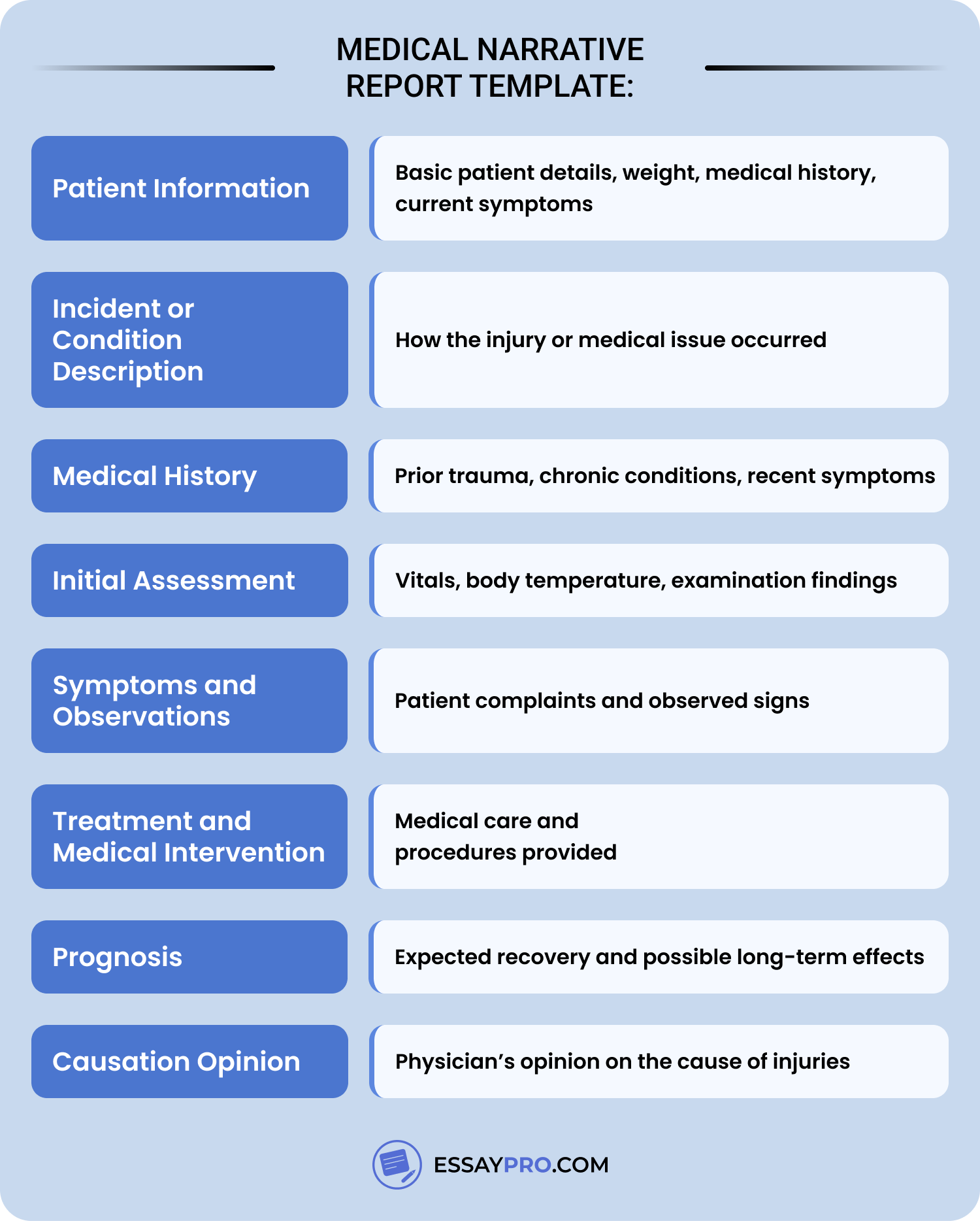
A medical narrative report follows a structured format that organizes clinical information clearly and helps medical professionals evaluate the patient’s condition.
- Patient Information - Identifies the patient and records key details such as weight, medical history, and current symptoms.
- Incident or Condition Description - Explains how the injuries or symptoms occurred and notes relevant circumstances.
- Medical History - Documents previous trauma, chronic conditions, or symptoms reported in recent weeks.
- Initial Assessment - Records findings, including vitals, body temperature, and examination results.
- Symptoms and Observations - Lists patient-reported symptoms and signs observed during evaluation.
- Treatment and Medical Intervention - Describes medical care provided.
- Prognosis - Explains expected recovery and possible long-term effects.
- Causation Opinion - Provides the physician’s opinion about the cause of the injuries based on clinical evaluation.
Pro tip Document negative findings when clinically relevant. Recording absent symptoms (e.g., no neurological deficit, no wheezing, no loss of consciousness) strengthens the assessment and clarifies the patient’s condition during evaluation.
While gathering the necessary information about the patient and deciding the appropriate treatment, PICOT questions examples can help you form a clearly defined research direction.
Medical Narrative Report Example
The following medical narrative report sample shows how key clinical information appears in a clear and structured report. A concise narrative helps document the patient’s condition, injuries, assessment findings, treatment plan, and prognosis using precise medical language.
- Patient: Michael Carter
- Date of Evaluation: February 10, 2026
- Incident Description: Patient reports involvement in a motor vehicle accident on February 8, 2026. The patient was seated in the driver's seat of a vehicle struck at an intersection.
- Medical History: Patient denies previous head trauma or similar symptoms before the incident.
- Assessment: Patient presents complaining of neck pain and mild headache. Vitals obtained. Body temperature within normal range. Examination noted limited head movement and tenderness.
- Symptoms and Observations: Patient reports stiffness and localized pain when turning the head.
- Treatment: Anti-inflammatory medication prescribed. Physical therapy initiated.
- Prognosis: Recovery expected within eight to ten weeks with continued treatment.
- Causation Opinion: Based on the history, assessment findings, and presence of symptoms after the incident, the injuries described in this report are consistent with trauma sustained in the motor vehicle accident.
Take a look at two of the more detailed medical narrative reports in PDF files below:

Medical Narrative Report Template
A medical narrative report follows a consistent structure that allows clinicians to document the patient’s condition, assessment findings, and treatment clearly. The template below shows how information is usually organized in a patient care report narrative.
- Patient Information: [Name, date of birth, date of evaluation, and date of injury or onset of symptoms]
- History of Present Illness: [Description of the event or medical issue that led to the injury or symptoms, including when it occurred and how the patient reports it happened]
- Subjective Complaints: [Patient-reported symptoms, location of pain, severity, duration, and any functional limitations described during the medical evaluation]
- Objective Findings: [Clinical observations and examination results, including vitals, body temperature, physical examination findings, and results of diagnostic testing if available]
- Diagnosis: [Medical diagnosis established after evaluation based on clinical findings and diagnostic evidence]
- Treatment Provided: [Medical care delivered during the visit and any recommended treatment plan, such as medication, therapy, or follow-up care]
- Work Status: [Current functional capacity, ability to perform occupational duties, and any temporary activity restrictions]
- Medical Opinion: [Physician’s professional opinion regarding the cause of the injury and the expected prognosis]
Download a free medical narrative report PDF with a fill-in-the-blanks template you can adapt to any of your cases:
Check out several real nursing case study examples to learn how to describe a patient care report.
Tips for Writing a Medical Narrative Report
A medical narrative report should communicate clinical findings clearly and accurately. The narrative must explain the patient’s condition, symptoms, injuries, and treatment in a way that another clinician can understand without additional clarification.
- Document events in chronological order - Record the patient’s presentation first, then describe the assessment, findings, treatment, and prognosis in the sequence they occurred during evaluation.
- Use objective clinical language - Describe observable findings such as vitals, body temperature, gait stability, and examination results rather than general or subjective descriptions.
- Specify the exact anatomical location of injuries - Identify where symptoms occur by naming the body region involved, such as the cervical spine, thoracic area, or left arm.
- Separate patient complaints from examination findings - Place patient-reported symptoms in the subjective section and document measurable clinical findings in the findings portion of the report.
- Include measurable clinical data - Record numerical information such as pain scale ratings, vital sign measurements, and temperature readings to strengthen accuracy and support medical evaluation.
Pro tip: Use standard medical abbreviations only when universally recognized. Terms such as BP, HR, and ROM improve efficiency in documentation. Avoid uncommon abbreviations that may create ambiguity during legal or insurance review.
Medical assignment writing help from professionals can give you an extra hand whenever you feel overwhelmed with clinical details.
The Bottom Line
A strong medical narrative report example for students demonstrates how a clinical report organizes essential medical information. The narrative records the patient’s condition, symptoms, injuries, assessment findings, treatment, and prognosis in a structured format. It also includes patient information, medical history, findings, and the physician’s medical opinion. A report can support clinical learning tools, such as a nursing concept map, that help organize relationships between symptoms, diagnosis, and care decisions. Clear organization and precise documentation ensure the report remains accurate and reliable during clinical or legal review.
FAQs
How to Use Medical Narrative Report Example?
What Is an Example of a Doctor's Medical Report?
How to Write a Medical Narrative Report?
Where to Find Medical Narrative Report Example?
How Long Should a Medical Narrative Report Be?
Can I Use a Medical Narrative Report Example as a Template?

Ana Ratishvili
Ana is a professional literary writer with a Master’s Degree in English literature. Through critical analysis and an understanding of storytelling techniques, she can craft insightful guides on how to write literary analysis essays and their structures so students can improve their writing skills.
.webp)
.webp)