
A nursing concept map is a visual diagram connecting a patient’s assessment findings, health problems, nursing interventions, and expected outcomes. It shows why a finding matters to a care decision, rather than copying the patient chart into boxes.
The challenge is deciding what belongs together: a pain score, a medication order, and a note about difficulty walking may describe one connected problem.
This guide follows those connections from assessment through evaluation, with an example and free PDF templates.
What is a nursing concept map?
A nursing concept map makes the reasoning between findings and actions visible. An arrow labeled “limits” between pain and mobility says more than two adjacent boxes.
Choose a format according to the relationships you need to show:
- Spider map: Places the patient or main concern in the center, with branches for findings, medications, diagnoses, interventions, and outcomes. Use it for a one-page overview.
- Hierarchical map: Places broad concepts above supporting details, making priority problems and their evidence easier to distinguish.
- Flow map: Shows assessments, decisions, and actions in sequence, especially when a later action depends on an earlier finding.
- System map: Shows interactions among body systems and other influences, such as pain, impaired mobility, and recovery.
Consider a practice case involving incisional pain. A spider map can collect pain, movement, and treatment information, but it cannot clearly show a decision sequence by branching alone. If the assignment asks what happens before an assisted transfer, use a flow map: assess pain and dizziness, review the planned interventions, reassess, then determine the assistance needed.
A concept map can help you develop a nursing care plan by making the relationships behind each care decision visible.
A medical diagnosis names a disease, such as heart failure. A nursing diagnosis describes a patient’s response, such as impaired gas exchange. Label them distinctly.

Need a full care plan?
Get a care plan or concept map written to your instructor’s requirements.

Key elements of nursing concept maps
In the practice case, the chart contains “pain,” a treatment order, and a mobility note. These entries need connections before they can explain care:
- Central concept: Incisional pain affecting movement anchors this focused map.
- Assessment findings: “Patient reports incisional pain of 7/10 when coughing” supplies evidence; “pain” alone does not.
- Related concepts: Relevant history, risk factors, medications, and nursing diagnoses help explain the concern.
- Connecting lines and linking phrases: Pain limits movement; that relationship connects two otherwise separate chart entries.
- Expected outcomes: A measurable result and timeframe establish what improvement will look like.
- Nursing interventions and rationales: Each action needs a reason tied to the findings, not just a place on the map.
- Evaluation: Reassessment shows whether the intended change occurred and what needs revision.
Use your instructor’s required format and assigned reference for standardized nursing diagnoses. A diagnosis label cannot substitute for supporting findings.
Why we use concept maps in nursing school
Mapping exposes mistakes that a tidy list can hide. Consider the example of shortness of breath, crackles, and increased work of breathing. A student might place these cues under “assessment,” add unrelated routine interventions, and assume the care plan is complete. Nothing yet explains how care addresses the respiratory concern.
The correction is to connect the cues to respiratory status, then link monitoring, interventions, and reassessment to that concern. An unsupported arrow reveals where more assessment or explanation is needed.
Concept maps support:
- Studying: Connect pathophysiology with symptoms, diagnostic findings, and treatments.
- Clinical preparation: Bring relevant patient information to an instructor discussion.
- Care planning: Explain why an intervention fits an identified problem.
- Case discussions: Identify missing information and compare explanations.
- Evaluation: Trace the patient’s response back to the intervention.
For a separate writing assignment, our list of definition essay topics offers starting points for explaining a concept clearly.
How to create a nursing concept map: a step-by-step guide
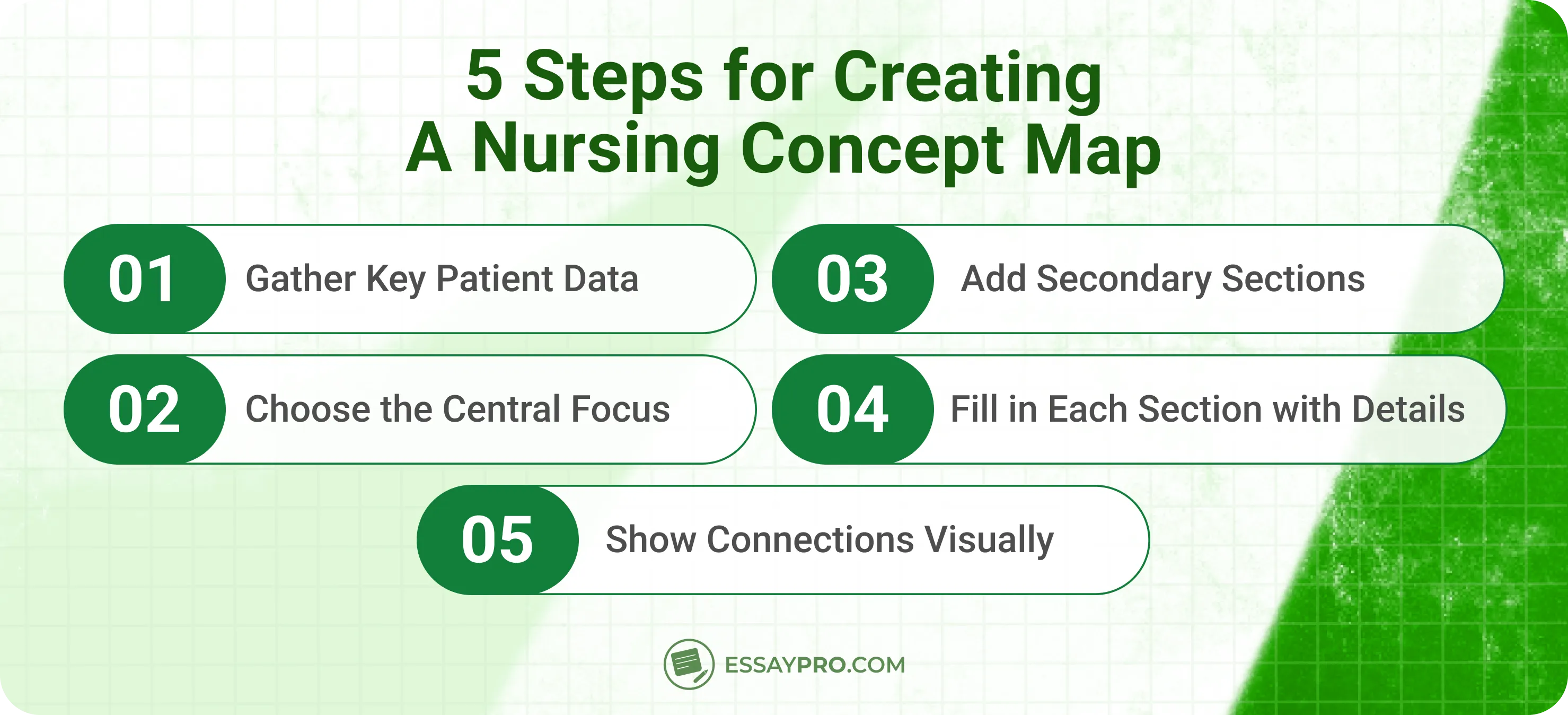
Use the incisional-pain practice case to build one chain: findings, priority, action, and response. Check the assignment requirements before choosing the layout. Consider the below nursing concept map examples to inspire your writing.
Step 1. Collect important information about the patient
Gather permitted information from assessment, the health record, and handoff. Review these categories, selecting what affects the case:
- Chief concern and symptoms, including the patient’s words.
- Vital signs, pain assessment, and focused examination findings.
- Relevant medical and surgical history.
- Current medications, allergies, and prescribed treatments.
- Laboratory results and diagnostic findings.
- Mobility, nutrition, elimination, and skin assessment.
- Psychosocial needs, support systems, and learning needs.
For this practice map, start with the reported incisional pain of 7/10 when coughing, movement difficulties, and verified treatment orders. Record assessment times so reassessment has a meaningful comparison. A blood glucose value likewise needs its unit, timing, and relationship to meals or treatment.
Keep identifying information off coursework unless required within an approved system. Mark missing assessments as questions, not findings.
Step 2. Choose the central focus
For a whole-patient assignment, “Adult patient hospitalized with heart failure” is a de-identified central label. For this focused practice case, use incisional pain affecting mobility. Do not let a medical diagnosis automatically determine the priority; immediate threats to breathing, circulation, or safety need prompt attention.
Possible central topics include:
- Priority nursing diagnosis: A patient response supported by findings.
- Significant health concern: Here, pain interfering with movement.
- SBAR communication issue: Situation, Background, Assessment, and Recommendation organize a focused concern.
- Core nursing responsibility: A task such as fall prevention or discharge teaching.
Choose one center. Several competing centers make the priority difficult to follow.
Step 3. Add secondary sections
Build branches that give the central concern enough context:
- Assessment findings.
- Relevant pathophysiology and risk factors.
- Priority nursing problems.
- Medications and treatments.
- Nursing interventions and rationales.
- Expected outcomes and evaluation.
In the pain example, place the coughing-related pain report under assessment, verified orders under treatments, and the planned assisted transfer under outcomes. Leave room beside each intervention for its rationale and reassessment. A branch earns its space by explaining a decision.
Step 4. Fill in each section with details
Turn categories into patient-specific entries. “Pain” is a heading; “patient reports incisional pain of 7/10 when coughing” is usable evidence.
For each priority problem, specify:
- Supporting cues: Findings that establish the concern.
- A measurable outcome: The intended change and deadline.
- Interventions: Actions addressing that concern.
- Rationales: Why those actions fit the findings.
- Evaluation findings: What you will reassess.
For this example: “Within one hour of the planned interventions, the patient will report pain at or below their agreed goal and transfer to a chair with the prescribed assistance.” That outcome requires both a pain reassessment and observation of the transfer.
Separate independent nursing actions from ordered treatments. Verify medication names, doses, routes, and schedules against the current order before including them.
Step 5. Show connections visually
Read each arrow as a sentence:
- Pain limits mobility.
- Reduced mobility increases pressure-injury risk.
- Repositioning reduces sustained pressure.
- Skin reassessment evaluates the response to preventive care.
Add cross-links where needed: dizziness can connect to medication assessment, mobility, and fall precautions. Use color consistently without making color necessary to understand the relationships.
Check the finished map:
- Every priority problem has supporting findings.
- Every intervention connects to a problem or outcome.
- Outcomes have measurable targets and timeframes.
- Evaluation records the response after care.
- Abbreviations, units, and relationship labels are clear.
If reassessment changes the priority, change the map - not just the date.
Use concept maps to coordinate patient care
A map can focus a multidisciplinary handover on a connection that needs clarification. Consider this imagined exchange about dizziness and difficulty walking safely:
Nurse: “Dizziness is linked to difficulty walking on this map. Can we clarify medication contributors and the assistance needed?”
Pharmacist: “Which medications and administration times have you verified? Put those beside the dizziness findings for review.”
Physical therapist: “What happened during the attempted movement? Add that observation, and I’ll assess mobility and assistance needs.”
Nurse: “I’ll add both reviews to the relevant branches and make the reassessment responsibility and update time explicit.”
The exchange produces specific follow-up rather than a vague instruction to “coordinate care.” Use terms colleagues outside nursing understand. Share through approved channels, and document assessments, care, and follow-up in the required clinical record; the map supports that discussion.
Concept map nursing example
The spider map below centers on type 2 diabetes mellitus. It supplies a layout; the patient’s findings must supply the content.
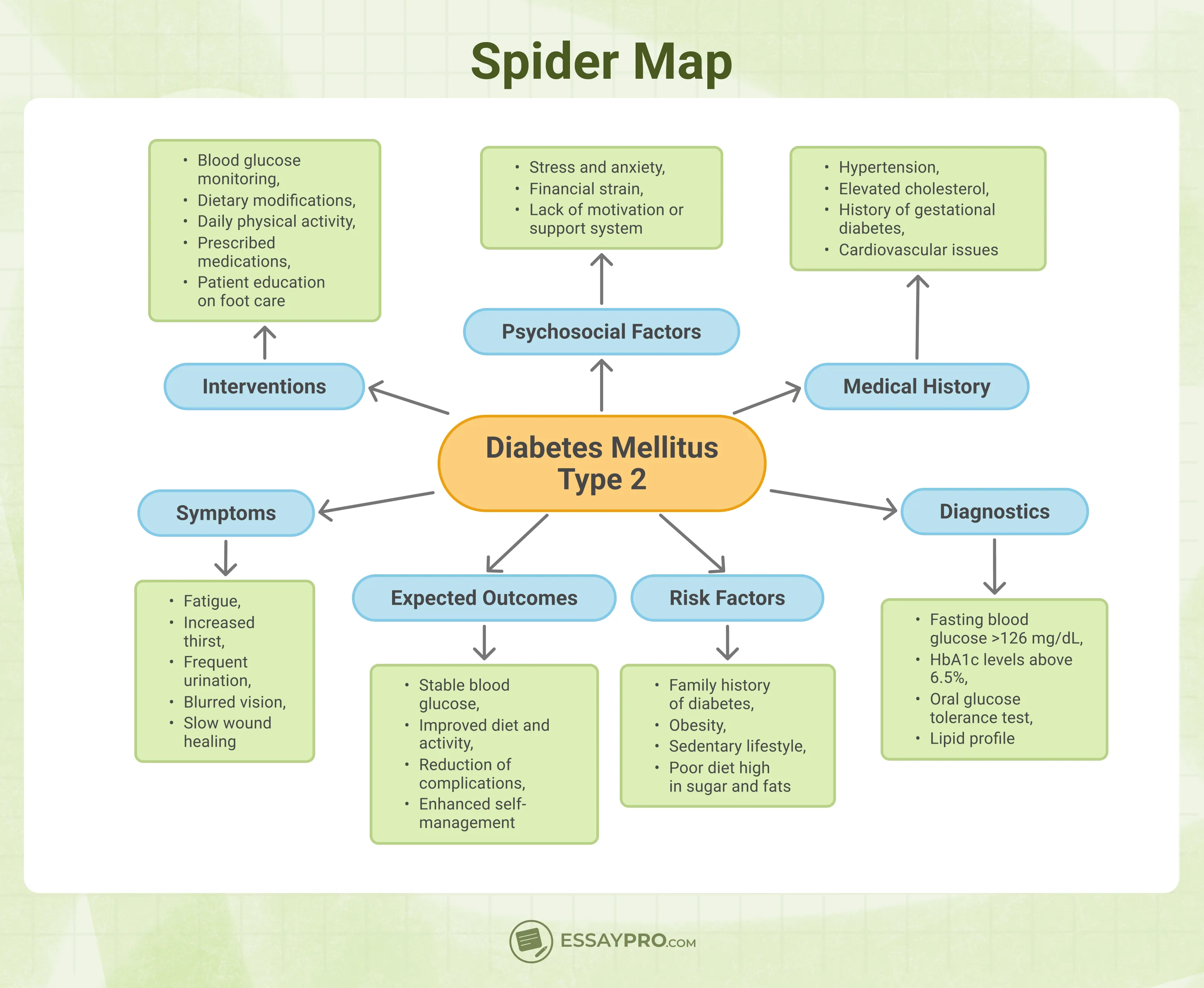
Medical diagnosis spider nursing concept map: Type 2 diabetes mellitus.
This separate practice example focuses on learning to use an insulin pen:
Now imagine the patient says, “I’m afraid I’ll choose the wrong dose,” and stops during practice. Add that stated concern to assessment rather than labeling the patient unwilling to learn. Record which steps were completed and where practice stopped; repeat teaching for the missed steps.
The findings identify the learning need; demonstration and practice address it; return demonstration evaluates the skill. Add neuropathy, a foot wound, or medication-management difficulties only when the case supports them.
Stuck on your concept map?
GOur writers can help you link problems, evidence, and interventions into a rubric-ready map.
Free nursing concept map templates
Copy this text template into a document and fill in each bracket. Replace every bracket and delete any section your rubric doesn’t ask for.
PATIENT INFORMATION
- Age and sex: [ ]
- Reason for care: [ ]
- Relevant history: [ ]
- Allergies: [ ]
- Current medications: [ ]
CENTRAL FOCUS (priority problem or diagnosis)
- Problem or diagnosis: [ ]
- Related to (cause): [ ]
- Supporting evidence: [ ]
ASSESSMENT DATA
- Subjective (what the patient reports): [ ]
- Objective (vital signs, exam findings): [ ]
- Lab and diagnostic results: [ ]
CONTRIBUTING FACTORS
- Pathophysiology or risk factors: [ ]
MEDICATIONS AND TREATMENTS
- Medication or treatment: [ ]
Purpose: [ ]
Nursing considerations: [ ]
NURSING INTERVENTIONS
- Intervention 1: [ ]
Rationale: [ ]
- Intervention 2: [ ]
Rationale: [ ]
- Intervention 3: [ ]
Rationale: [ ]
PATIENT EDUCATION
- Key teaching points: [ ]
DESIRED OUTCOMES (measurable, with a time frame)
- Outcome 1: [ ]
- Outcome 2: [ ]
EVALUATION
- Result: [met / partly met / not met]
- Next steps: [ ]
CONNECTIONS (show how the sections link)
- [Item A] → [Item B]. Why they are linked: [ ]
- [Item B] → [Item C]. Why they are linked: [ ]
Below you'll find nursing concept map templates you can use to create exclusive ones of your own:
Final thoughts
Before finishing, read the map as an explanation of care:
- Does it describe this patient rather than a generic disease?
- Does each arrow express a relationship?
- Do findings support the priorities?
- Are outcomes measurable and time-bound?
- Does evaluation identify what to continue or change?
For organizing a written assignment, our writers at EssayPro can help with structure and clarity. If you are preparing a final project, explore our nursing capstone project ideas for potential topics.
Clinical reasoning is the connection you can defend: this finding supports this concern, this action addresses it, and this reassessment tells you what to do next.
FAQs
How to fill out a nursing concept map?
How to do a concept map for nursing?
What is the main purpose of a concept map?
Can ChatGPT create a concept map?
Can you give me some examples of nursing concepts?
What is the difference between a concept map and a care plan?

Adam Jason
is an expert in nursing and healthcare, with a strong background in history, law, and literature. Holding advanced degrees in nursing and public health, his analytical approach and comprehensive knowledge help students navigate complex topics. On EssayPro blog, Adam provides insightful articles on everything from historical analysis to the intricacies of healthcare policies. In his downtime, he enjoys historical documentaries and volunteering at local clinics.


