
Key Takeaways
- Keep your introduction to about 10% of the paper, so a 3,000-word paper gets roughly a 300-word opening.
- Build it on Swales' 3 moves: establish the territory, establish the niche, then occupy the niche.
- Cover 4 parts in that space: hook, background, gap, and your thesis or research question.
- Write the introduction last, after your results exist, so it matches your actual findings.
- Limit yourself to 1 clear research question in a short paper instead of stacking 3 that go unanswered.
To write a research paper introduction name your theme broadly at first, then narrow it down to specific research question using a funnel approach. In this section, you also expose the gap in existing knowledge and justify paper’s reason for existing. The opening must be kept concise, only about 1-3 pages long. Another practical note is to write this section last. Even though it’s the very first block that anyone reads, most weak introductions come from the very students who draft it first before they know what their own work will conclude.
This guide covers everything there is to know about how to write an introduction for a research paper. Including how long it should run for different assignments and the concrete examples you can use to adapt to your own writing.
What is a research paper introduction?
A research paper introduction is the opening section of a paper. It states what you investigated, why the question deserved attention in the first place, and what you set out to establish.
An introduction for an essay and for the research paper are different, and are meant to do different things. An essay introduction gives the reader a reason to keep reading the work, while a research paper introduction justifies your study and the reason you spent so much time figuring out why and how to research the topic.
Even in a short student paper, your introduction has to review prior work well enough that the gap you address looks legitimate to a skeptical reader. Your professor wants a specific reason your paper adds something the field did not already have.
How long should a research paper introduction be?
Research paper introduction should be around 10% of your total word count. A 3,000-word paper points you toward a 300-word introduction, and the ratio scales predictably.
One warning, and I can’t say this enough, your introduction probably needs to be shorter than what you write at first. Resist the urge to empty the entire literature review in there, or to discuss the results and describe the sampling methods in research. If your introduction reports findings or explains your method, move those parts out. They belong in later sections.
Something outranks every figure you’ll ever see, and that is the assignment brief, or your target journal’s submission guidelines. If you're submitting to a journal, check its author guidelines first, since editors screen for length. With no rule in front of you, the 10% figure is a safe default.
What to include in a research paper introduction
So what actually goes into an introduction paragraph for a research paper? In 1990, the linguist John Swales gave us the framework that writing centers still teach. He called it the CARS model, short for Create a Research Space, and it works through three moves.
If you've read other guides, you've seen these parts under different labels. The overlap:
- The Hook opens Move 1, or establishing the territory.
- Context and literature review finish Move 1.
- The Gap is Move 2, establishing the niche.
- Your Purpose (thesis plus roadmap) is Move 3, occupying the niche.
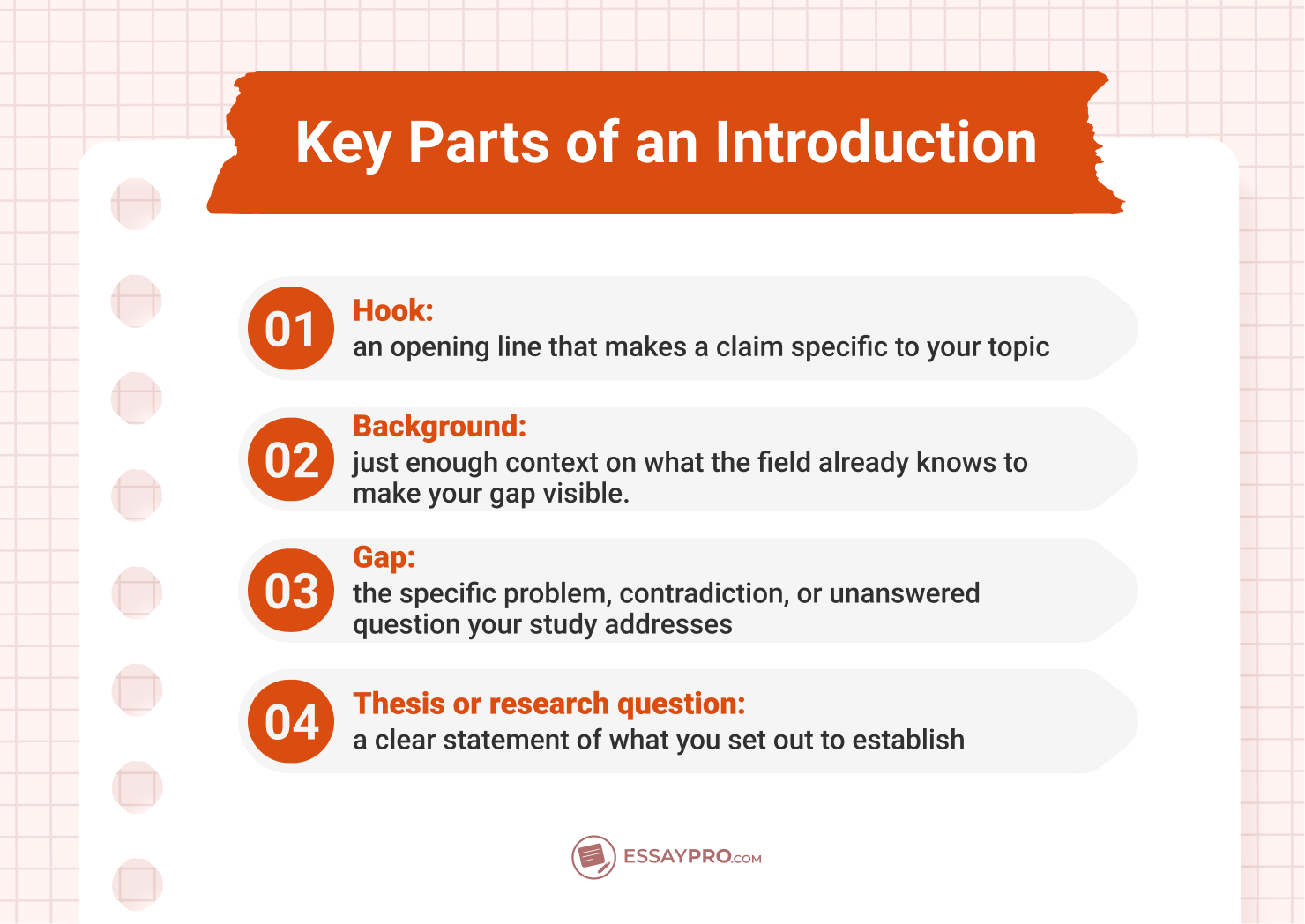
Background usually takes up the most words, while the gap often gets one sentence. Although that is the very sentence that your reader is looking for, so it needs to be as specific as possible. "Little research exists on remote work," is next to meaningless. "Remote-work studies focus on office employees, so we surveyed warehouse staff," names the exact gap you fill.

Research Paper Due Soon?
Hand the hard part to expert sand get back a polished, ready-to-submit paper on time!

How to write a research paper introduction step by step
To write a good research paper introduction work through these six steps in order, and each one hands you a piece you can drop straight into the draft.
Step 1: Establish the territory in two or three sentences
Move 1, according to Swales, or establishing the territory. You need two or three sentences, maybe three (and never more than that), that tell the reader about the area you’re working in, plus where the specialists in the field haven’t looked yet. This could be broad, but only in the very beginning, then a quick narrowing toward your own corner.
Pro tip: Check where your first citation is. Sentence one means you've opened too narrowly; no citations at all in the territory section means you're making claims a reviewer will want backed.
Step 2: Scan existing research
Once your own analysis is done, read the recent, big-name work in your corner, enough to sense what everyone treats as obvious and where people still disagree. Start with one recent review article or meta-analysis before you touch individual studies, because they will already have the territory mapped for you and often name the open questions outright, so you can easily find the gap.
Pro tip: Jump to the last paragraph of a few recent introductions before you read anything else in those papers. That's where authors admit what's still missing and point to what future work should tackle.
Step 3: Identify the gap
Move 2, the one you look for the gap, and the step people get wrong most often. Since the gap is the thing that justifies your paper existing at all, it needs wording that actually signals some kind of disagreement. Swales laid out four framings that reliably do the work:
- Absence: "No study has examined X in this population."
- Conflict: "Findings on X remain contradictory."
- Unanswered question: "It stays unclear why X occurs."
- Extension: "Prior work on X has not been applied to Y."
Pro tip: Run your gap through Google Scholar and see how many sources come up. If you see a dozen recent studies that do the exact thing you say no one has done, better you find that out soon.
Step 4: State research question, hypothesis, or objective
Right after the gap, the reader is primed for your response, so give them one clean statement of it. The form depends on your design, but keep it to a sentence or two, and make it map onto the gap you just named. The error I flag more than any other: a hypothesis that answers a different gap than the one stated two lines above it.
Pro tip: Got more than one research question? Number them (RQ1, RQ2), then carry those exact labels through your methods section of research paper example, results, and discussion.
And while you’re at it, learn how to write a research question in the first place.
Step 5: Add scope and a roadmap if the paper is long
Anything under roughly 3,000 words, skip this entirely, because a short paper doesn't need signposting cluttering it. Longer work is a different case. There, the scope spells out what you deliberately did not include ("This study looks at public universities, not private ones"), which instantly disarms the skeptical reviewer who’d otherwise accuse you of ignoring something. The roadmap previews your section order in a line.
Pro tip: That word-count threshold is really about section count. Five or more distinct sections and readers want the map, whatever the length; three sections and they almost never do.
If you want to let a professional handle all these steps instead of spending hours at the screen, you can always buy research paper from us.
Research paper introduction examples
Below are three complete introductions, each one a research paper introduction example built from scratch, with the Swales moves marked so you can watch the machinery work. If you want to read full samples, introduction, conclusion, and everything in the middle, read our research paper examples.
Example 1: Empirical STEM
[Move 1: Establish the territory] Lead contamination in drinking water is a stubborn public-health problem, and it hits low-income communities hardest, where aging pipes rarely get replaced (Author, Year). Existing removal methods work, but most are expensive or energy-hungry, which puts them out of reach for the systems that need them most. [Move 2: Establish the niche] Recent work on biochar filters shows real promise for capturing heavy metals at low cost (Author, Year). What nobody has pinned down is how these filters behave over months of continuous use, since almost every published test runs for days. Long-term performance, the one thing a water utility has to know, has gone essentially unmeasured. [Move 3: Occupy the niche] This study tracks a rice-husk biochar filter across a 12-week trial and measures lead-removal efficiency at weekly intervals under realistic flow. We test if performance stays above the EPA action level over time, and we pinpoint when the filter needs replacing. If it holds, the design offers an affordable option for small and rural water systems.
Notice how fast this one moves. The STEM introduction burns no words on grand framing; by the third sentence you're already staring at the gap. It leans on prior studies as data points, not as ideas to argue with, and narrows toward a single testable, measurable question. Compare that to the humanities example, which opens slowly and treats its sources as positions to push against. The social science version falls between the two: more conceptual setup than this piece, but still aimed at a defined empirical question. If the STEM intro has one obsession, it's precision.
Example 2: Argumentative Humanities
[Move 1: Establish the territory] For two centuries, readers have treated Mary Shelley's Frankenstein as a cautionary tale about science reaching past its limits (Author, Year). The creature is the warning; Victor is the sin. That reading has hardened into the default lens in classrooms and popular culture alike. [Move 2: Establish the niche] Something in it stays unexamined, though. If the novel condemns Victor for creating life, why does it hand the creature the most eloquent, morally serious voice in the whole book? Critics fixed on the science hurry past the creature's own account of his abandonment. They read his suffering as a plot mechanism. It may be the ethical center of the book. [Move 3: Occupy the niche] This essay argues that the true subject of Frankenstein is care, or the absence of it. Set the creature's central chapters beside Victor's evasions and a different novel comes into view. Victor's crime arrives after the creation, in the long stretch when he abandons the being he made. Shelley's terror is a terror of neglect.
This is the slow one, on purpose. Where the STEM intro raced to its question, the humanities version lingers on the existing conversation, because the argument only lands against what readers already assume. Its sources aren't data; they're positions to push against. And there's no method section on the way, so the introduction itself has to hold the interpretive stance. The thesis is arguable by design, which the STEM example would never tolerate. Set beside the social science intro, this one is far more at ease with the first person and with a voice of its own.
Example 3: Social Science
[Move 1: Establish the territory] Remote work became the default for millions of office employees after 2020, and researchers raced to measure its effects on productivity and well-being (Author, Year). Most of that work paints a reassuring picture: output holds up, and plenty of workers prefer the flexibility. [Move 2: Establish the niche] The debate has centered on people already established in their careers, though. Early-career employees are a different case. Mentorship, the informal kind that happens through overheard conversations and hallway questions, is exactly what a distributed office strips away, and we have almost no evidence on what its loss does to junior staff. A few studies gesture at the problem (Author, Year), but none follows one cohort over time. [Move 3: Occupy the niche] This study draws on a two-year survey of 480 employees in their first three years at three consulting firms, and it asks how remote and hybrid arrangements affect access to mentorship and, in turn, promotion. We compare fully remote, hybrid, and in-office cohorts. Our aim is to establish if flexibility carries a hidden cost for those earliest in their careers.
The social science intro is the hybrid of the bunch, and you can feel it. It opens with real-world context like the STEM piece, then spends a moment on concepts (what even counts as mentorship?) the way the humanities essay dwells on ideas. Its endpoint, though, is pure empiricism: a defined sample, named variables, a measurable question. It argues for a gap through prior studies, the STEM habit, yet it also has to justify why that gap matters socially, which the STEM intro takes for granted. It runs longer than the STEM piece and stays more empirical than the humanities one.
Weak vs. strong introduction
The weak version:
Work has always been a central part of human life. Over the years, the way we work has changed in many ways. In today's fast-paced world, companies are constantly searching for ways to boost productivity. The five-day work week has been the standard for over a century. Recently, some organizations have started experimenting with a four-day work week instead. Many people believe this change could benefit both employers and employees. A four-day work week means staff work fewer days for the same pay. This is an interesting topic that affects millions of workers worldwide, and there are many different opinions about it. This paper will discuss the four-day work week and its effect on employee productivity.
The strong version:
The four-day work week has become a serious policy question, tested in national trials and large employer pilots. A 2022 UK pilot of 61 companies and roughly 2,900 employees kept full pay for an 80% schedule, and most firms reported productivity held steady or improved (World Economic Forum). Almost all of that evidence comes from office-based knowledge workers, where tasks are flexible and largely self-paced. What happens in shift-based roles like manufacturing, where output is tied directly to hours on the floor, has barely been tested. This study surveys 320 factory employees across four plants that adopted a compressed schedule in 2024, and it compares output per shift before and after the switch. If productivity holds where hours and output are tightly linked, the case for a four-day week reaches well beyond the desk.
What changed, move by move:
- Move 1, the opening (territory). Opening with a claim true to all of human history does nothing that an introduction should do. The rewrite opens on a specific development and allows the reader to lean on a dated and sourced statistic.
- Move 1, the background. The weak version stacks facts no one disputes. The strong version narrows the background to one pointed observation that the evidence base is almost entirely office workers. It’s what makes room for a gap.
- Move 2, the gap (niche). The weak intro has no gap at all, which is its fatal flaw. The strong intro names one precisely: shift-based, hours-linked work is untested. A reader can now restate the gap in a sentence.
- Move 3, the purpose (occupy). The weak intro ends by announcing a topic ("This paper will discuss..."). The strong intro ends with a concrete study design and a stake: it says what was done and why the answer matters.
How introductions differ by discipline
How you write an introduction for a research paper depends heavily on your discipline, and the differences are bigger than most guides let on.
- Sciences. In the natural sciences, the introduction is short, and it does not dawdle. Established knowledge, narrow to the specific problem within a paragraph or two, and, finally, a hypothesis. That’s all you need for the opening. The heavy literature review? Skip it until its dedicated section. And because Swales developed the CARS model by studying science articles in the first place, the three moves fit this format more snugly than any other.
- Engineering. Just like the field itself, engineering introductions are built around a problem and a solution. In the introduction, you state a technical challenge along with where the existing methods fall short, then present how your approach will be the fix for the said challenge. The gap here is usually a performance limitation. Introductions often close with an explicit, numbered list of contributions, so reviewers can see exactly what the paper claims to add.
- Medicine and health. Open a medical paper and the numbers hit you almost at once. The author wants you to feel the weight of the problem first, so out come the figures of how many people have the condition, how many die, what it costs the system, each dragging a citation behind it. Reporting standards keep these introductions lean, landing on one sharp objective or a PICO question.
- Social sciences. Theory pulls a lot of the weight in social sciences, which is partly why these introductions sprawl. Before your reader can judge your gap, you have to place the work among competing frameworks and pin down your terms. Study trust, and you owe me a definition, because there are several. On the other hand,y economics research paper tends to open on an empirical puzzle, then state its contribution outright.
- Humanities. The humanities throw out the template entirely. There's no IMRaD, no methods section to come, and the introduction can read like the opening of an argument, because that's what it is. You might begin with a text, an image, or a provocative question, then build toward your interpretive claim. The "gap" becomes a conversation you're entering: what have critics missed or gotten wrong, and what does your reading reveal? Voice and style matter here as much as the argument itself.
Introduction vs. abstract vs. literature review
Three sections, the abstract, the research paper introduction, and the literature review, all touch on prior work and purpose, so it's easy to blur them. Here's how they actually differ.
The overlap that causes the most trouble is the abstract and the introduction. Students write a strong abstract, then paste half of it into the opening paragraph. What this causes is that the reader goes through the same sentences twice. For example, the abstract gives away your results, which the intro should not do. The literature review is a whole other thing: the abstract and introduction mention prior work in passing, while the review is where you actually interrogate it, study by study.
Writing the very last paper of the course? Ask one of us, ‘Write my term paper,’ and we’ll get right on it.
Common mistakes in research paper introductions
Knowing how to start a research paper is partly about knowing what to delete. These are the seven introduction mistakes I flag most often, and every one is fixable in a single pass.
- Repeat of the abstract. Your reader finished the abstract seconds ago. If you want to burn their patience, you can echo it sentence for sentence in the opening paragraph again, but why? Plus, with that, you just unknowingly told them the two sections were never planned apart. Give them something the abstract didn't.
- A universal opening claim. "Since the dawn of time." "In today's society." Neither one says a thing about your actual topic. A sentence true of everything teaches the reader nothing at all. Your real opener is the line that could only belong to your paper.
- Too much background. Background has one job, which is to make your gap visible. Beyond that, it's padding. Spend three pages on history before the question arrives and you've lost the reader well before the point. Keep only the context your study genuinely needs. An online research paper writing service can help you find the perfect spot.
- A novelty claim with no literature search. "No one has studied this" is a reckless line if you never checked. Your reviewers have followed the field for years. One paper you missed, and the whole premise gives way. Search first. Claim second.
- Over-claimed importance. Your study of one town's recycling habits will not "revolutionize environmental policy," and saying so reads as naive. Inflated stakes make seasoned readers wary. Size your significance to what the evidence supports, then trust the reader to see the value.
- No stated gap. Of all of them, this is the one I see most. A tidy summary of the field, then your purpose, and nothing named in between: the reader gets no reason your paper had to exist. Name the hole.
- Three aims where one would do. New researchers set ambitious objectives. Cram three research questions into a short paper, though, and usually none of them gets answered well. Pick the one that matters, then hand the whole paper to it.
Stuck with an Introduction for a Research Paper?
Hand the hard part to expert sand get back a polished, ready-to-submit paper on time!
Final thoughts
A research paper introduction comes down to one job: proving your study needed to exist. Establish the territory, name the gap, then state your purpose. Keep it near 10% of the paper, write it after your results are in, and cut the universal opener. Do that and the section works.
FAQ
How do you start a research paper introduction?
How long should a research paper introduction be?
What are the parts of a research paper introduction?
Should the introduction include a thesis statement?
What's the difference between an introduction and an abstract?
Do you write the introduction first or last?
Should you cite sources in the introduction?
How is a research paper introduction different from an essay Introduction?

Ana Ratishvili
Ana is a professional literary writer with a Master’s Degree in English literature. Through critical analysis and an understanding of storytelling techniques, she can craft insightful guides on how to write literary analysis essays and their structures so students can improve their writing skills.