
A dissertation proposal is something you will write prior to beginning your dissertation. It can be referred to as your prospectus. Your research question will be presented along with a literature review and your methodology for your committee to review. Usually, this is done after you complete your coursework and pass your qual exams. According to the University of North Texas Libraries, the dissertation proposal will be submitted to your committee to review and defend.
The following sections will walk you through how to write a dissertation proposal and what it should look like in practice with an example.


What is a dissertation proposal?
A dissertation proposal is the formal plan your committee must approve before you begin your research. Some programs call it a prospectus. It explains what you will study, how you will study it, why it matters, and, in many programs, when you will do the work, according to Penn State’s Graduate Writing Center.
Its purpose is to convince your committee that you are ready to start. At a proposal defense, you present the plan, and the committee asks questions. The University of North Texas Libraries says the committee wants to know whether your research questions have academic merit and whether you have chosen the right methods to answer them.
Most proposals contain the same core sections:
UNT Libraries lists these sections and notes that an outline and timeline may be added. Requirements differ by department, so confirm yours with your advisor.
A proposal is a plan, not a lock. Penn State’s guide says it is not meant to limit your ideas. Still, major changes need approval. One UMass department’s guidelines call it a “handshake” agreement between student and committee. They say significant departures from the approved plan should be discussed with and approved by the committee, because unapproved changes can slow graduation.
Why is a dissertation proposal important?
A proposal allows you to (1) create a plan, (2) save time, and (3) gain approval.
- By writing out a proposal, you will have answered your question: how you will go about it, and when you plan to finish. So when you begin collecting data, you know your goal.
- If there are flaws in your question or how you plan to answer it, your committee can inform you before you collect your data. It can also be used to help you write your dissertation because most of what you write for your proposal will be transferred into your dissertation (UNT Libraries).
- Some schools will require you to gain approval from your committee before you can proceed with your study. According to one school at the University of Minnesota, you may not file your IRB application or begin your study until each member of your committee has approved your proposal.
Dissertation proposal structure
Most proposals follow the same order: introduction, research questions, literature review, methodology, significance, and a timeline. This standard dissertation proposal format comes from the University of North Texas Libraries, and departments adjust it, so confirm yours with your advisor.
How long is a dissertation proposal?
Dissertation proposal length depends on your program. Master’s proposals usually run about 5 to 20 pages, and PhD proposals about 10 to 40, with a few programs requiring the first three chapters of the dissertation.
Follow your department’s limit, and treat these as examples, not rules.
How to write a dissertation proposal in 7 steps
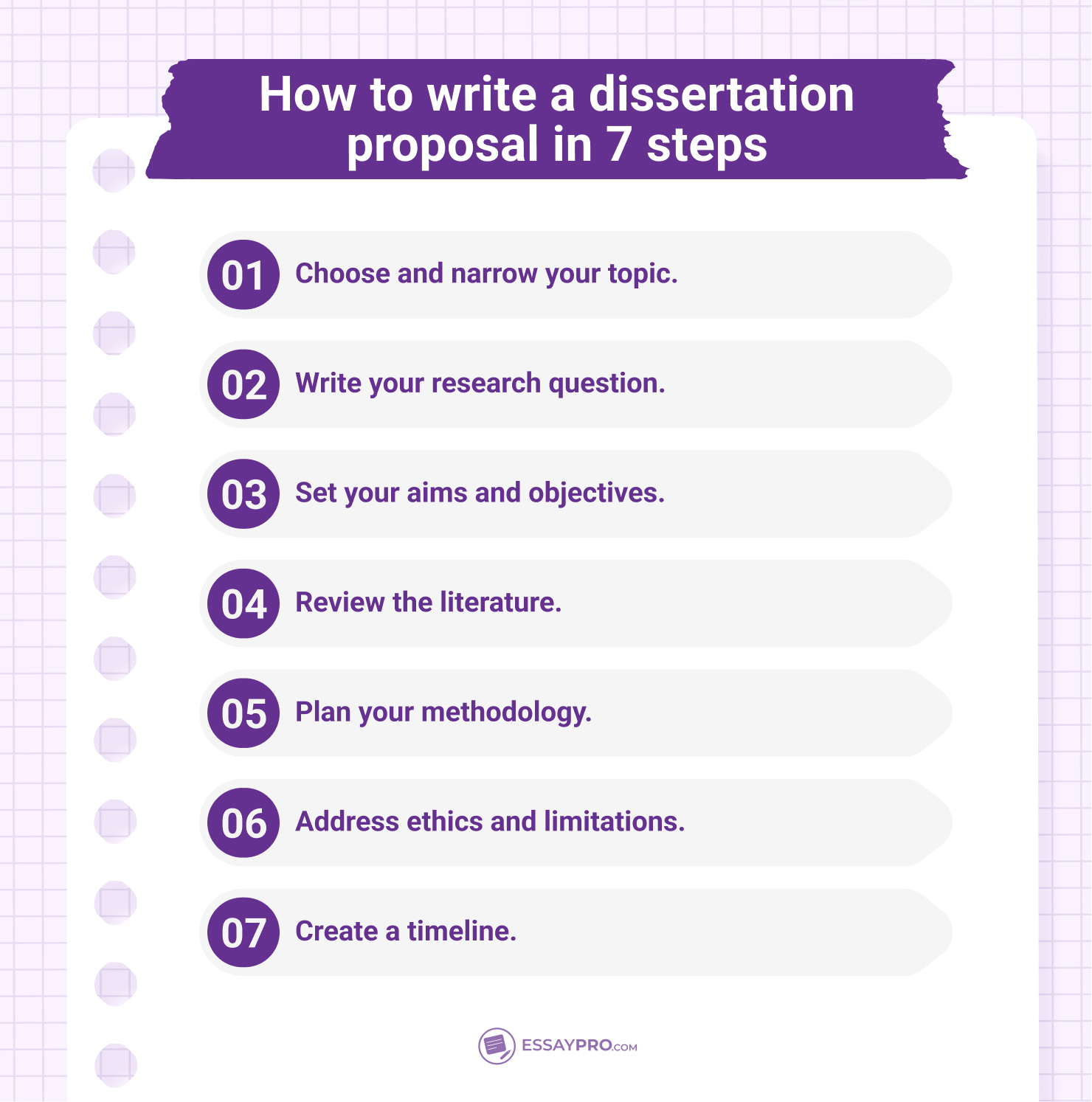
To understand how to write a dissertation proposal, first narrow your topic, ask a precise question, set aims and objectives, review the literature, plan your method, address ethics, and build a timeline. Follow these seven steps in order, and check each one against your department’s guidelines.
- Choose and narrow your topic.
- Write your research question.
- Set your aims and objectives.
- Review the literature.
- Plan your methodology.
- Address ethics and limitations.
- Create a timeline.
The examples below follow one sample project, using wording drawn from the education research topics guide: one-to-one tablets and reading comprehension.
Step 1: Choose and narrow your topic
These dissertation proposal steps start with narrowing, because every later section depends on it. Pick a problem you can study with the time, data, and access you have. Then narrow it by population, setting, and outcome. Brown’s political science department says a prospectus should pose a precise question, set the topic in a theoretical context, and describe the proposed methods. Check feasibility early. Ask whether the data exists and whether you will need approval.
Example: Education technology, then one-to-one device programs, then reading comprehension in Grades 3 to 5.
Studying business? Browse business management dissertation topics for ideas you can narrow.
Step 2: Write your research question
University of North Texas Libraries says the committee wants to know whether your questions have academic merit. Write one main question, with a population, a time window, and an outcome you can measure.
- Weak: Do tablets help students read?
- Strong: How did reading comprehension scores change in Grades 3 to 5 in districts that adopted one-to-one tablet programs between 2020 and 2024?
Step 3: Set your aims and objectives
The aim is one broad statement of what the study will achieve. Objectives are the specific steps that deliver it, written as a short numbered list that starts with a verb, such as “to compare.” Keep to three to five, and make each one answer a research question and a method.
Example:
- Aim: To examine whether one-to-one tablet adoption is associated with changes in reading comprehension in Grades 3 to 5.
- Objectives: (1) To collect district-level reading scores for 2020 to 2024. (2) To compare score changes in adopting and non-adopting districts. (3) To identify differences by district poverty level.
For more on wording, see our guide on how to write research objectives.
Step 4: Review the literature
Summarize the key theoretical and empirical work, organized by theme, as the University of Western Ontario’s sociology department advises. UConn’s educational psychology department suggests allocating about 20-25% of the proposal. Your job is to show the gap, not to retell everything.
The University of Michigan Library suggests tracking each source in a literature matrix:
Example row: [Author, year] | tablet programs and reading | district test data | small gains | no comparison group | useful for design.
If sources pile up faster than you can organize them, our research paper writing service can help structure your review.
Step 5: Plan your methodology
UNT Libraries says the committee judges whether you chose the right methods. Describe your design, your participants or data source, your measures, and your analysis plan, and justify each choice.
Example: Use public, district-level state assessment scores. Compare change from 2020 to 2024 in adopting and non-adopting districts, since a claim about effects needs a comparison group.
Step 6: Address ethics and limitations
Find out when approval is required. One University of Minnesota program states that students may not submit an IRB application or begin research until all committee members approve the proposal. At UConn, IRB approval is required before the proposal goes to the Graduate School. Federal regulations at 45 CFR 46 require IRB review and informed consent for covered human subjects research unless an exemption or waiver applies.
State your limits honestly.
Example: Public, aggregate scores usually need little or no review, but confirm with your IRB. Limitation: district averages cannot show how individual students were affected.
Step 7: Create a timeline
Work backward from your deadlines, and leave time for committee review. Harvard’s psychology program asks for the proposal two weeks before the meeting. A UMass department wants the defense at least seven months before the dissertation defense.
Dissertation proposal template
A dissertation proposal template is a fill-in outline of the standard sections: introduction, research questions, literature review, methodology, significance, and timeline, the structure the University of North Texas Libraries describes. Copy it, replace each bracket, and check it against your department’s requirements.
TITLE
[Topic] and [outcome] among [population] in [setting]
1. INTRODUCTION
Problem: [What is the problem?]
Context: [Where and when does it occur?]
Importance: [Who is affected, and why does it matter?]
2. RESEARCH QUESTION(S)
Main question: [How / Does ... among ... between [years]?]
Sub-question (optional): [...]
3. AIM AND OBJECTIVES
Aim: To [verb] [what] among [who].
Objectives: (1) To [verb] ... (2) To [verb] ... (3) To [verb] ...
4. LITERATURE REVIEW
Theme 1: [key studies and findings]
Theme 2: [key studies and findings]
Gap: [what is missing that your study addresses]
5. METHODOLOGY
Design: [quantitative / qualitative / mixed]
Participants or data: [who or what, how many, how chosen]
Measures: [instruments or variables]
Analysis: [how you will analyze the evidence]
Justification: [why this method fits the question]
6. ETHICS AND LIMITATIONS
Approval needed: [IRB / data-use agreement / none]
Limitations: [what the study cannot show]
7. SIGNIFICANCE
[What the study adds to the field and to practice]
8. TIMELINE
[Month: task]
REFERENCES
[Only the sources cited in the proposal]
Want feedback on your draft? Our paper writing assistance can check it against your department’s guidelines.
Dissertation proposal example
A strong dissertation proposal sample identifies a specific problem, poses a precise question, and matches the method to the problem. This short hypothetical sample, built on the tablet-and-reading example from earlier, shows each of those moves.
Title: One-to-One Tablet Programs and Reading Comprehension in Grades 3 to 5: A District-Level Comparison
Introduction: District leaders must decide whether to fund one-to-one tablet programs, and they need evidence on early reading. This study examines whether adoption between 2020 and 2024 is associated with changes in reading comprehension.
Research question: How did reading comprehension scores change in Grades 3 to 5 in districts that adopted one-to-one tablet programs between 2020 and 2024, compared with similar districts that did not?
Aim: To examine whether tablet adoption is associated with changes in reading scores.
Method: Using public district-level state assessment scores from 2019 to 2024, I will match adopting and non-adopting districts on poverty rate and enrollment, then compare changes in average scores.
Limitations and approval: District averages cannot show effects on individual students, and adoption was not random. The data are public and aggregate, so I will confirm with the IRB whether review is needed.
Why it works:
- A narrow focus. One program, one grade band, and one time window make the study feasible to complete.
- One answerable question. It names the population, the period, and a comparison.
- Aligned parts. The aim, method, and data all match the question.
- A comparison group. Matching similar districts guards against overclaiming.
- Honest limits. It says what the data cannot show.
- Approval addressed. It names the review question before the committee asks.
Dissertation proposal vs. research proposal
A dissertation proposal is the plan your committee approves after you enroll. A research proposal is usually the shorter document you submit to apply for a PhD, though some programs use the terms loosely.
Common mistakes to avoid in a dissertation proposal
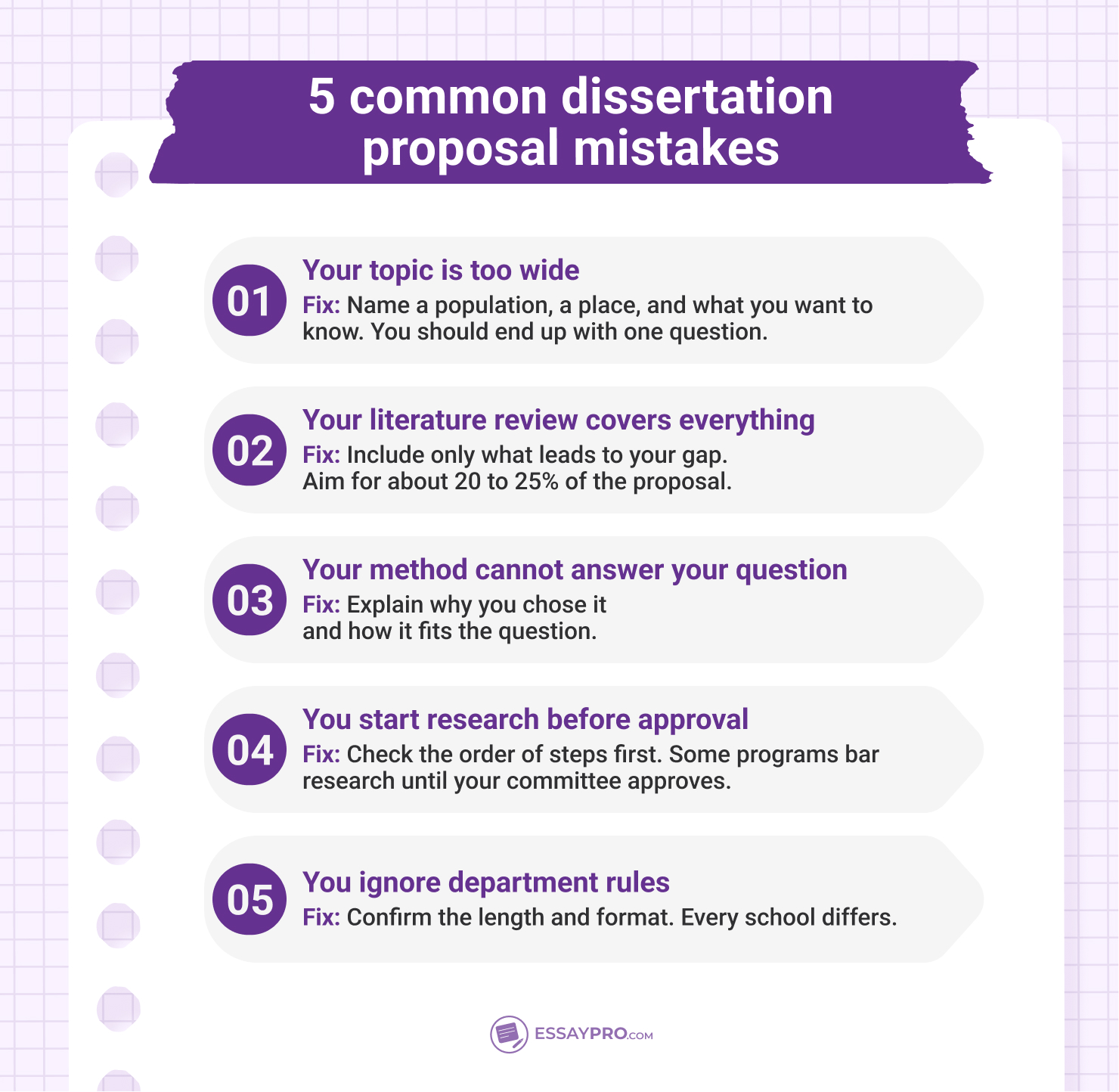
Here are five common dissertation proposal mistakes people make while writing:
- Your topic is too wide. Correct this by specifying a population, location and what you want to know more about. Once you have that down, you should have one question left.
- Writing your literature review about everything. Only write about the things that will lead into your gap in the literature. You should use around 20-25% of your references for your gap. (This is from UConn Educational Psychology)
- Using a method that will not answer your question. Explain why you chose that method and how it relates to your question.
- Jumping into your research without permission. Know what steps you need to take first. Some will not let you begin research until you have a committee.
- Not following your department's guidelines. Make sure you know how long your proposal should be and what format to use. Every school can be different.
For support from proposal to final chapters, see our dissertation help.
Last words
A dissertation proposal is the plan your committee approves before you start your research. Write it in seven steps: narrow your topic, ask a precise question, set aims and objectives, review the literature, plan your method, address ethics, and build a timeline. Use the template to organize it, keep to your department’s length, and avoid broad topics, long literature reviews, and starting before approval.
FAQs
What is a dissertation proposal?
How to structure a dissertation proposal?
How many pages is a dissertation proposal?

Adam Jason
is an expert in nursing and healthcare, with a strong background in history, law, and literature. Holding advanced degrees in nursing and public health, his analytical approach and comprehensive knowledge help students navigate complex topics. On EssayPro blog, Adam provides insightful articles on everything from historical analysis to the intricacies of healthcare policies. In his downtime, he enjoys historical documentaries and volunteering at local clinics.