
A cover page is a standalone sheet that identifies an essay’s title, its author, and the class or instructor it belongs to. I understand why a student might be compelled to treat it as an afterthought; after all, it’s just a few lines of text that don’t contain any argument. But missing a course number or misplacing a title can cost you points that have nothing to do with the argument or your writing in general.
In this article, we’ll spend some time talking about what a cover page is and why it’s required in the first place. I also decided on creating a cover page example for each major format, so you have no spacing and placement questions for any kind of assignment.
What Is a Cover Page for an Essay?
A cover page, sometimes called a title page, is a separate sheet at the front of an essay. It identifies the paper (who wrote it, what it's called, which course it belongs to) without crowding that information into the actual introduction. The exact elements shift depending on the school or the style guide, but there's a fairly predictable list that repeats across fields and subjects:
- Essay title
- Author's full name
- Course name or number
- Instructor's name
- Institution name
- Submission date
- Word count, if the assignment asks for it

Better Drafts Start Here
Turn rough notes into a focused, well-organized paper with help from real writers!

Why Is a Title Page Important?
The title page is important because it’s the first thing the reader sees. When an instructor is grading thirty essays on the same prompt, that page becomes the quickest way to tell one submission from another. Leave off a name, or skip the course number, and you've handed someone an extra problem to solve. And trust me, no professor enjoys solving someone else’s mistakes. I've seen students lose points for exactly this reason, and the writing itself had nothing to do with it. Besides, a student who has learned how to make a title page correctly tends to come across to an instructor as someone who handles formatting with some care across the board.
When Is an Essay Cover Page Required?
Not every essay needs a cover page. Figuring out which situation you're in can save you a step you didn't need to take (or spare you an awkward gap where a title page should've been). My advice, before anything else, is to check the assignment sheet or the syllabus, because instructor preference tends to override the general convention tied to a citation style. Once that's settled, go through this quick list. A cover page tends to be required when:
- The paper is being formatted in APA
- You're submitting a formal research paper, a thesis, or a dissertation
- The rubric or syllabus specifically lists a title page
- The essay is headed toward a journal or some other formal publication
A cover page is usually optional, or skipped outright, when:
- MLA is the required format, since a heading replaces it
- The assignment is short, informal, or written in class
- Your professor has said, plainly, that no title page is needed
If none of that settles it, a two-line email to your instructor will, faster than any guesswork on your part.
Does an Essay Cover Page Vary between Paper Types?
A cover page does vary between assignment types. Citation styles, like professors, have their own separate expectations, and I've seen more than one paper lose polish because an MLA essay showed up in APA writing style (or vice versa, it happens both ways). Below is a quick reference for what each style actually asks for.
General Guidelines on How to Make a Cover Page
A few rules about how to make a cover page for an essay hold true no matter which style an assignment demands, and it's worth nailing these down before you touch the specifics of the Chicago style format or APA or whatever your professor assigned.
- Confirm the required style before anything else. Guessing wrong means redoing the whole cover page later, and that's a wasted step nobody has time for.
- Match your font choices to the body of the essay. Times New Roman at 12pt remains the safest default across most formats, and switching fonts between the cover page and the essay itself just looks sloppy, frankly.
- Stick to one-inch margins on all sides. This works across nearly every style guide, so unless a specific format says otherwise, leave that setting alone.
- Center your titles, names, and course details. This rule is close to universal, both vertically and horizontally, though exactly where things land shifts depending on which style you're following.
- Pay close attention to spelling when you create a cover page. An instructor's name spelled wrong, or a course number that's off by one digit, is such an easy fix, yet it happens constantly. It's the kind of small error that jumps out immediately to anyone grading the paper.
- Save formatting for last, if you can manage it. Write the essay first, confirm your word count, and build the cover page once the rest of the draft is settled. That order avoids the annoying situation where your page count shifts and the cover page no longer matches what you actually submitted.
Essay Cover Page Style Guides Section by Section
Five formats appear consistently in coursework: APA, MLA, Chicago, ASA, and Harvard. Each one treats the first page differently enough that mixing up their rules is an easy mistake, so here's a breakdown of what belongs where.
APA Cover Page Format (7th Edition)
Psychology, education, and nursing courses use APA constantly, largely because the citation style itself has become a gold standard in those fields. An APA cover page, under the current 7th edition rules, follows a fairly rigid structure, and professors who grade formatting separately from content will dock points for deviating from it. Core elements of an APA format cover page:
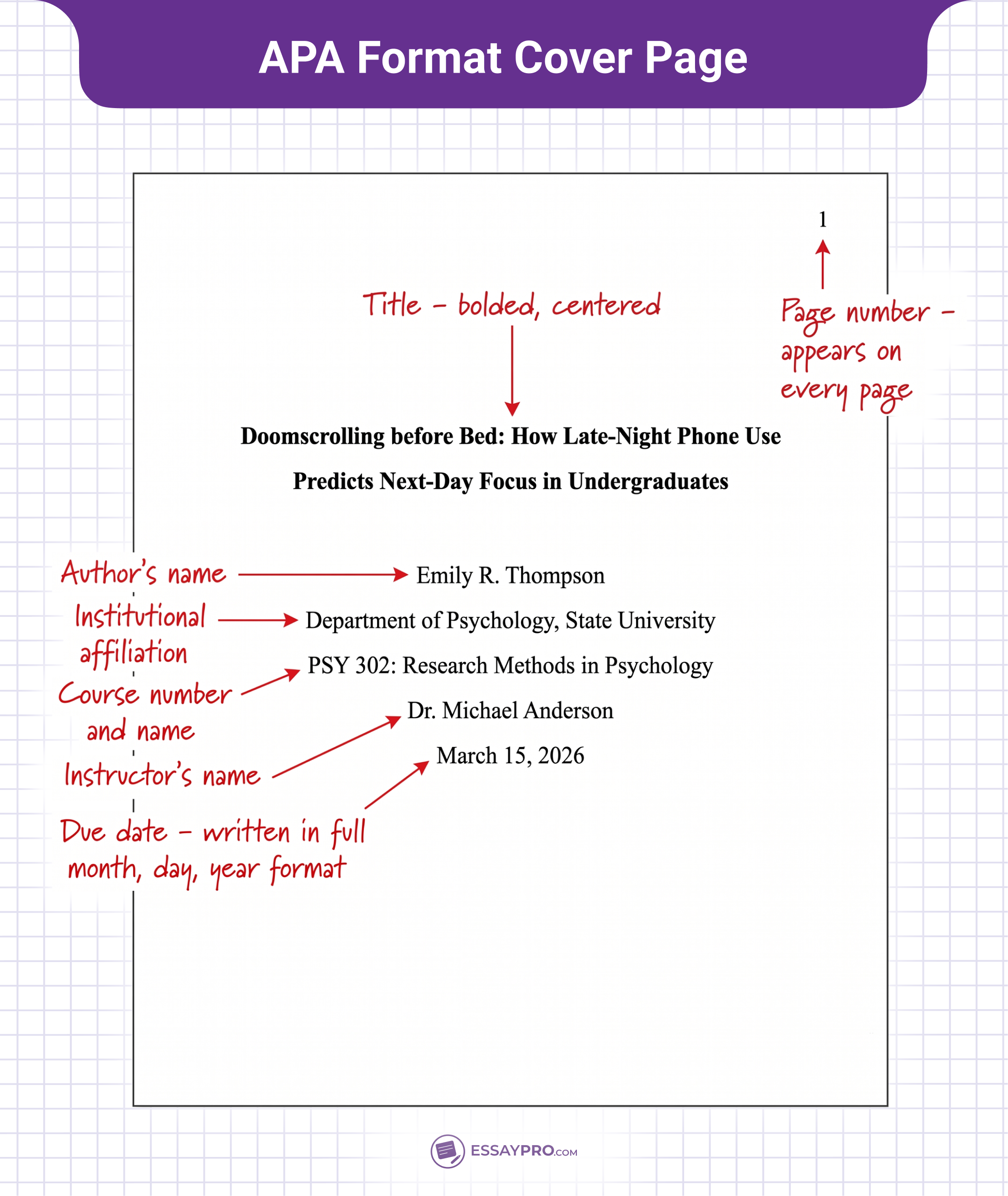
- Title of the paper, bolded, sitting in the upper half of the page
- Author's full name, below the title
- Institutional affiliation, meaning your school or department
- Course number and name
- Instructor's name
- Due date
- Page number, top right corner
- Running head, required for professional papers, optional for most student papers under current guidance
Everything gets centered and double-spaced, and honestly, keep the title itself under two lines if you can manage it. Psychology professors especially tend to enforce this format down to the letter, so pull an actual current manual rather than trusting some template you saved from last semester. Our APA paper writing services can help you with both the essay’s contents and formatting if you’re too tired to handle them.
MLA Cover Page Format (9th Edition)
Literature, humanities, and composition courses claim MLA as their home turf. Although the MLA format doesn’t technically require a standalone cover page, most of the time. A heading goes directly on the essay's first page instead. Some instructors ask for a separate MLA cover page regardless, which means the smart move is to ask rather than assume either way. When a standalone page gets requested, an example of the essay cover page in MLA style usually includes:
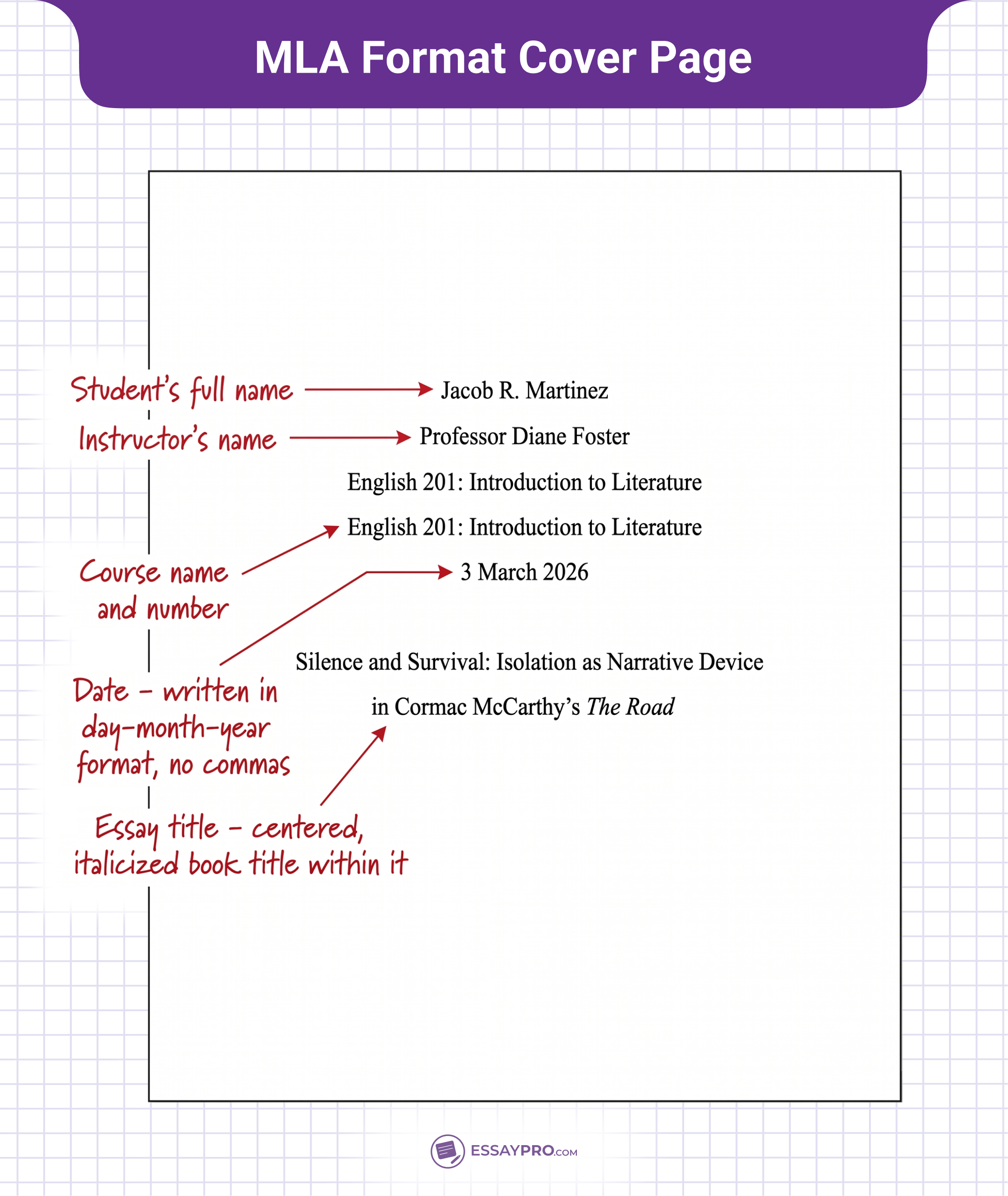
- Student's full name
- Instructor's name
- Course name and number
- Date, written day-month-year
- Essay title, centered around a third of the way down the page
Without a separate page requirement, that same information (minus the title, generally) becomes a four-line heading in the upper left corner, with a centered title just above the body text. An MLA-format cover page example for an essay is really just a formality wrapped around information that would otherwise be placed in the heading anyway, so check your syllabus before assuming you need the extra sheet.
Chicago Cover Page Format
History courses use Chicago constantly, and it turns up occasionally in social science or business classes that favor its footnote system over parenthetical citations. A cover page for an essay in Chicago style tends to look sparse next to APA's denser layout, though it follows its own strict rules for the first page. Typical elements:
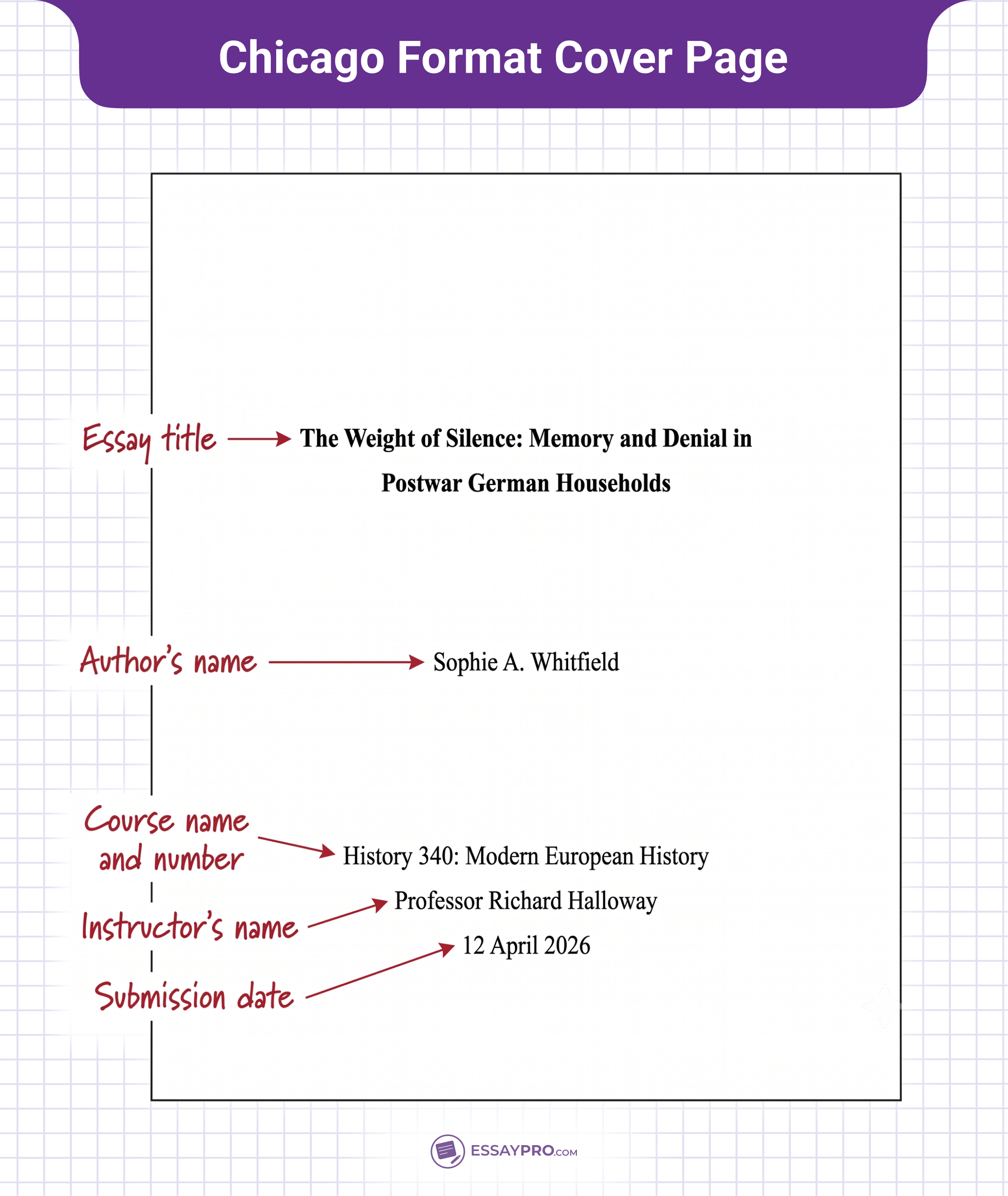
- Full title, centered, roughly a third of the way down the page
- Author's name, centered below the title
- Course name, instructor's name, and date, stacked near the bottom third
Chicago style skips the running head and page number on the cover page itself, unlike APA, though page numbering typically starts on the page right after. Font and spacing match whatever's used in the rest of the paper, so there's no special formatting beyond centering these three blocks of text. Something I've noticed also is that Chicago's cover page has more white space than APA's, which can feel oddly empty if APA's denser layout is what you're used to.
ASA Cover Page Format
Sociology courses claim the ASA format specifically, and it borrows a handful of conventions from APA while still diverging in its own ways. An ASA title page demands more information than some other formats, and students transferring over from psychology or education classes, expecting something APA-like, usually get surprised by the extra requirements. Core elements of an ASA title page:
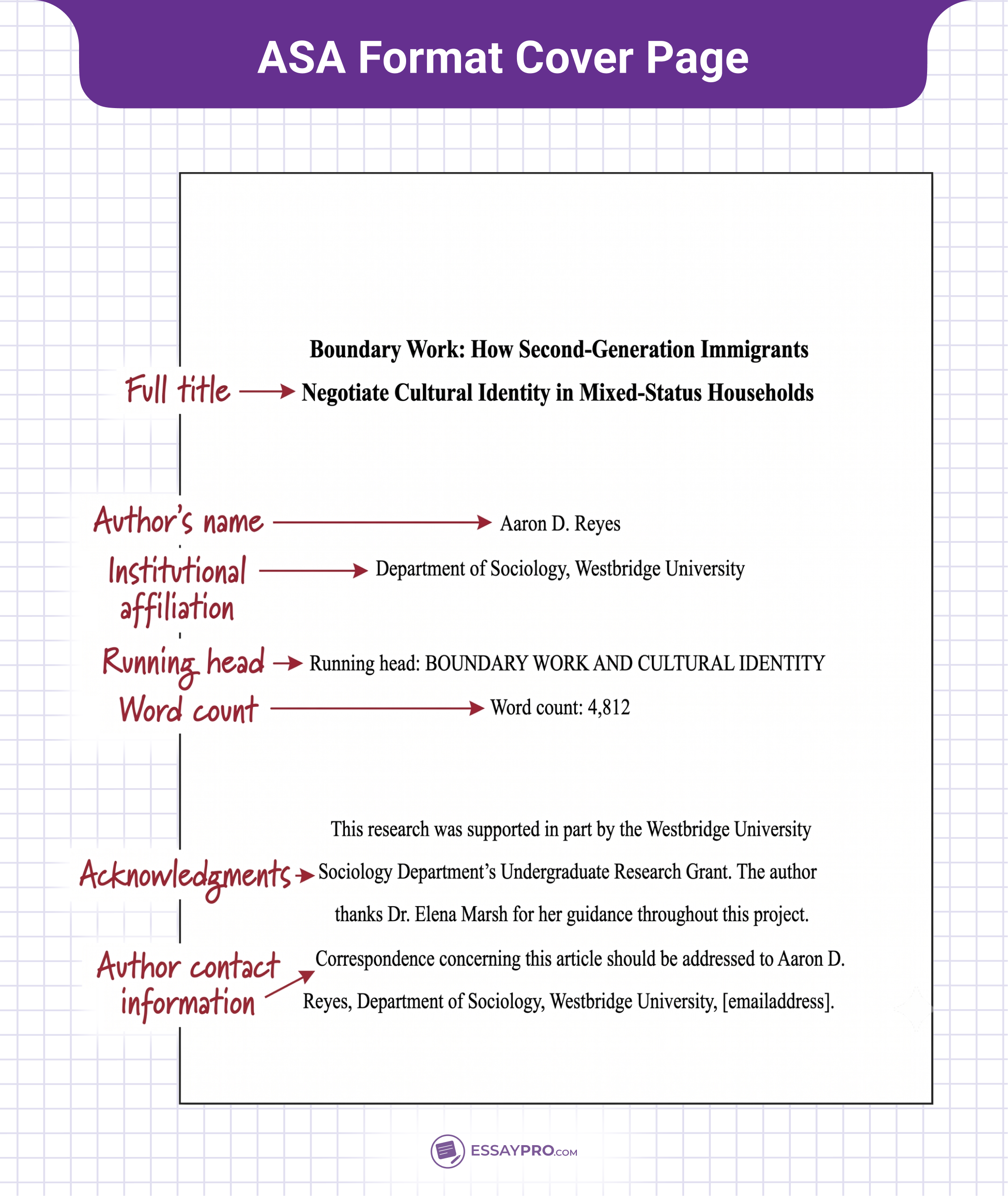
- Full title of the paper
- Author's name and institutional affiliation
- Word count of the entire essay, including footnotes and references, in most cases
- A running head, shorter than the full title
- Acknowledgments or grant information, where applicable
- Author contact information, for some formal submissions
The word count requirement catches more students off guard than anything else on this list, mainly because neither APA nor MLA typically asks for it. Check your actual rubric, though, since some instructors waive that requirement for regular coursework even when the general ASA guide includes it.
Harvard Cover Page Format
A wide range of disciplines use the Harvard style, particularly at UK institutions, and its exact rules shift more by university than by subject area. A Harvard-style cover page example will look a little different depending on which department wrote the actual guide, which means checking your specific institution's handbook matters here more than it does for most other formats. Common elements tend to include:
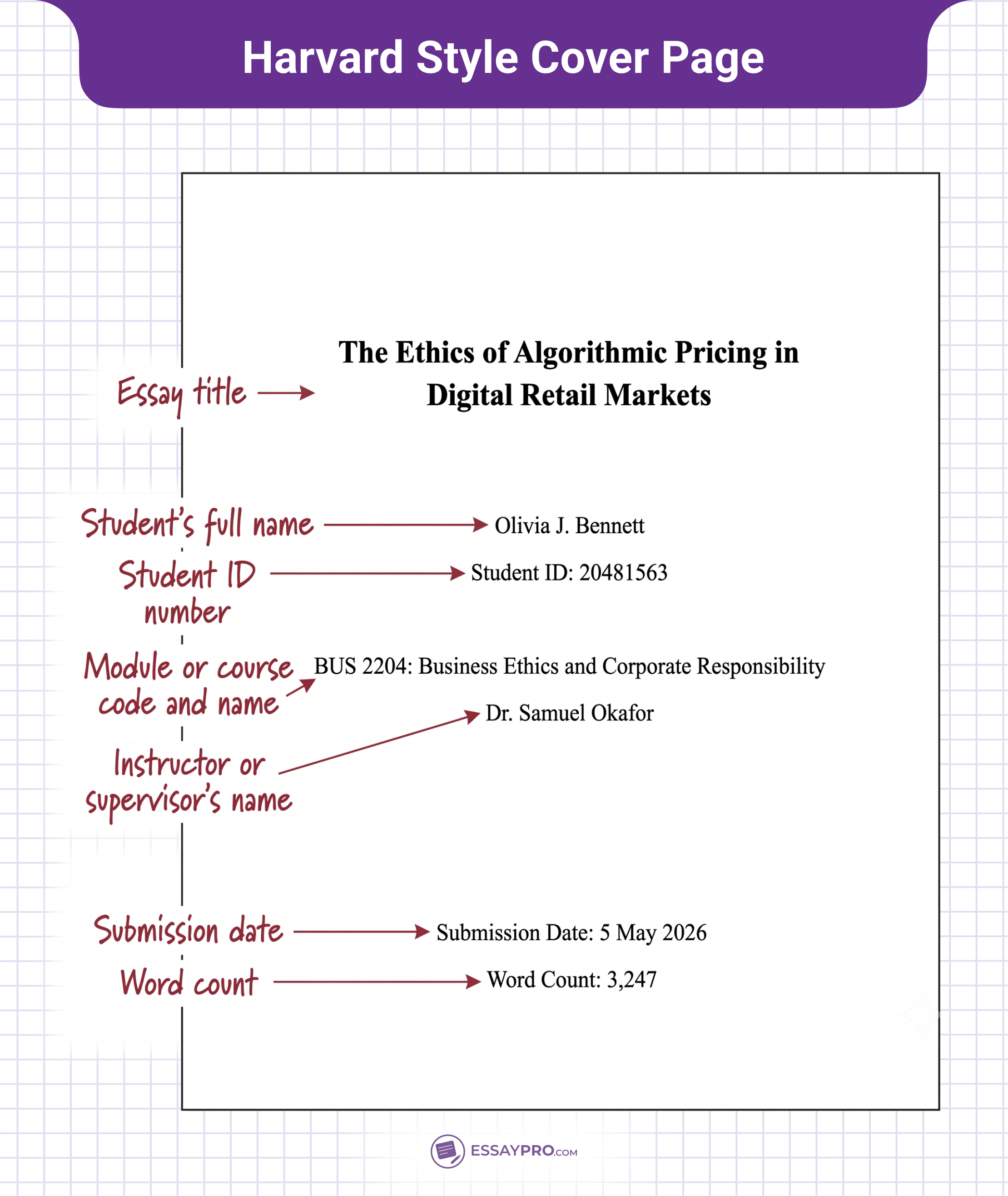
- Essay title
- Student's full name and ID number
- Module or course code and name
- Instructor or supervisor's name
- Submission date
- Word count
Some Harvard guides also ask for a table of contents on its own page, right after the cover sheet, especially for longer research papers. Given how much this varies between institutions, treat any generic Harvard template as a rough starting point rather than a final answer, and check the details against your own department's paperwork before you submit anything.
It gets tough to memorize all these rules for all the different assignment types. Send a quick 'Finish my assignment' request through our platform so your formatting details can be handled by the professionals.
Better Drafts Start Here
Turn rough notes into a focused, well-organized paper with help from real writers!
Final Thoughts
A cover page identifies an essay before the reader reaches its argument, and the details it carries (title, author, course, instructor) matter more than students often assume. Requirements shift by style and by assignment, so confirming the correct format first saves a rewrite later, and keeps the actual grade tied to your writing.
FAQs
What Is a Title Page?
What Does a Cover Page Look Like?
How to Make a Title Page in APA Format?
What Is the Format for a Cover Page?

Ana Ratishvili
Ana is a professional literary writer with a Master’s Degree in English literature. Through critical analysis and an understanding of storytelling techniques, she can craft insightful guides on how to write literary analysis essays and their structures so students can improve their writing skills.

.webp)