Academic probation is a formal warning a college issues once a student’s GPA falls under the school’s minimum, usually 2.0. To get off academic probation, the student has to lift that GPA back above the cutoff within a limited number of terms and re-enter good academic standing.
The number of terms, and which GPA the school actually counts, changes depending on the institution. Those specifics live in the academic catalog or the student handbook. Read them closely before you make another move, because the wrong deadline wrecks the whole recovery plan. This guide covers the definition, the common reasons for probation, the steps that clear it, and what happens to students who stay below the line.

Stay on top of deadlines
Your academic record matters, but so does your rest. Our writers help you submit strong work on time.

What is academic probation?
Academic probation is the standing a college assigns when a student’s performance drops below the minimum required for continued enrollment, most often a 2.0 cumulative GPA. It operates as a warning and a recovery window. A single weak term almost never ends in dismissal, and the student gets a defined period to pull the numbers back up.
Most campuses treat it as a built-in second chance. North Carolina Central University, for one, calls probation a chance for a student to return to good academic standing before suspension becomes the next step. What actually puts someone there depends on the campus. A few colleges watch the cumulative GPA alone. Plenty of others factor in the term GPA, earned credits, or the satisfactory-academic-progress standards that financial aid is tied to. The 2.0 benchmark shows up the most. Lindenwood and Stephen F. Austin State universities both set that exact cutoff for good standing, though graduate programs and MBA colleges commonly draw the line higher, at 3.0.
Why do students get placed on academic probation?
Students get placed on academic probation when the GPA the school tracks falls below its minimum for good standing, usually after one or two terms under 2.0. The academic probation GPA threshold is set campus by campus, and dropping beneath it is the single most common reason for the notice.
Common triggers include:
- Cumulative GPA under the school’s minimum, usually 2.0
- A single term GPA below 2.0, even with a decent cumulative GPA
- Several failed or repeated courses in one term
- Too many withdrawals, which shrink the earned-credit count
- A gap in the satisfactory-academic-progress standards financial aid requires
- A program-specific minimum missed in a major like nursing or engineering
The numbers leave out why they happened. Plenty of students take a near-full course load on top of a 25-hour-a-week job, and something eventually gives, usually the coursework. A single rough stretch at home, an illness, a family emergency, can wipe out a month of lectures and leave a transcript that no longer matches what the student knows. First-year students especially tend to underestimate the jump in workload, so a schedule that looked manageable in August turns overwhelming by October. A requirement that belonged to the wrong major, or an 8 a.m. section the student kept skipping, can pull a GPA down for a full semester.
What happens when you’re on academic probation?
Probation does not pull a student out of school. Enrollment continues, but the registrar attaches a set of conditions for the coming term, and those conditions are the part most students underestimate. Nearly all of them reduce to three demands: a lighter course load, required check-ins with an advisor, and a term GPA floor, usually 2.0, that leaves no room to coast. The grades that triggered probation stay on the record and still count toward the degree.
Typical conditions include:
- A credit-hour cap, often 12 to 15 credits, so the term stays manageable
- Required meetings with an academic advisor or a success coach
- A minimum term GPA, usually 2.0, every semester until the cumulative GPA recovers
- A hold on certain activities, such as athletics, student government, or study abroad
- Loss or review of financial aid when satisfactory academic progress is not met
- A signed academic plan that lists the term’s courses and the support attached to them
Of those, the advising requirement is the one students treat as skippable, and that is usually a mistake. The advisor is the person who can drop a failing course before the deadline or catch a financial-aid problem while there is still time to act on it.
How long does academic probation last?
Academic probation usually runs for one term. The school reviews the record at the end of the semester, and how long it lasts depends entirely on the math, when the cumulative GPA climbs back to the school’s minimum. One strong semester can end it. A large gap, consequently, takes longer. Lindenwood University keeps a student on probation semester after semester, for as long as each individual term GPA stays at 2.0 or higher, until the cumulative average finally reaches 2.0.
Does academic probation show on your transcript?
Academic probation shows on the official transcript at some schools and stays in internal records at others. The grades that put a student there appear regardless, because those are a permanent part of the record. The University of Oregon prints an “Academic Probation” line directly on the official transcript. Case Western Reserve University moved it off the official version, on the reasoning that the triggering grades already appear there.
Academic warning vs. probation vs. suspension vs. dismissal
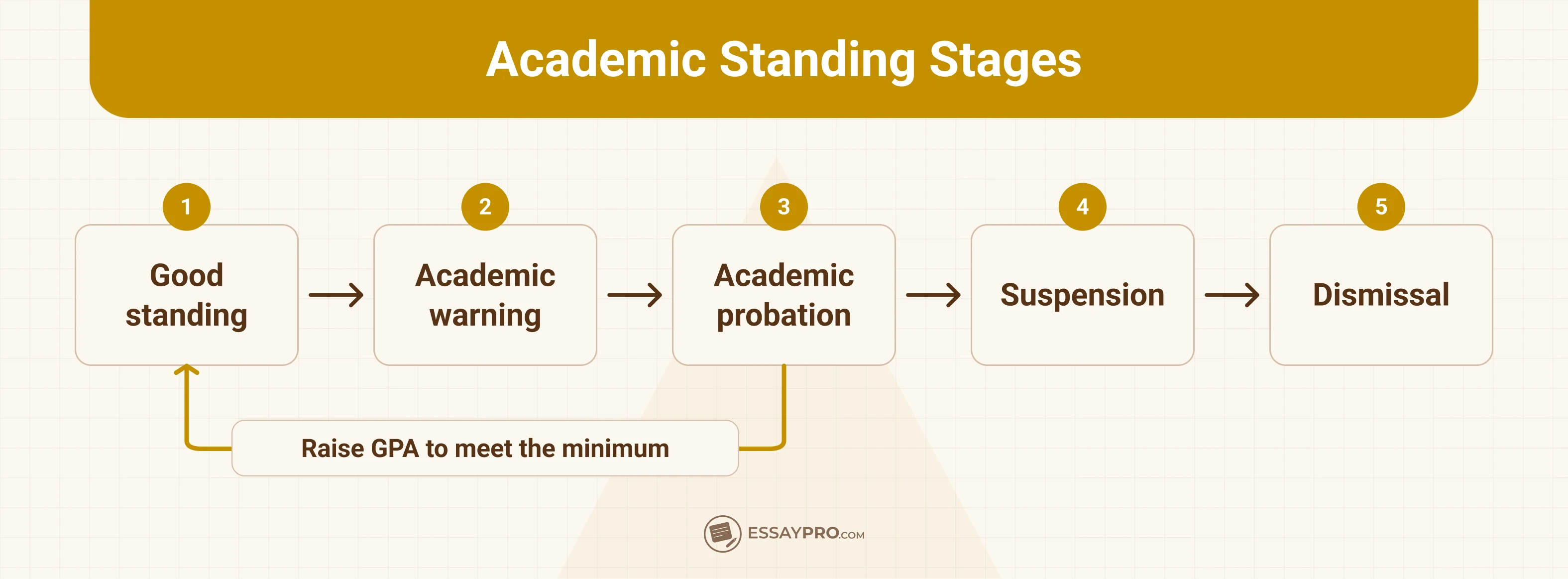
These four labels, academic warning, probation, suspension, and dismissal, describe an escalation, each stage more serious than the one before it. The academic probation vs suspension distinction is the one worth learning first, because that is where a student’s enrollment actually stops. Probation keeps someone in class under a set of conditions. Suspension ends that enrollment for a fixed period. Academic dismissal is the final stage for most students, a long-term or permanent separation from the institution.
The labels in that table are not standardized, and the exact sequence changes between catalogs. Plenty of schools skip the warning stage and start a struggling student straight on probation. North Carolina Central University, for instance, adds a middle step and runs a separate monitoring status between probation and suspension, which gives a student one more checkpoint before enrollment is at risk.
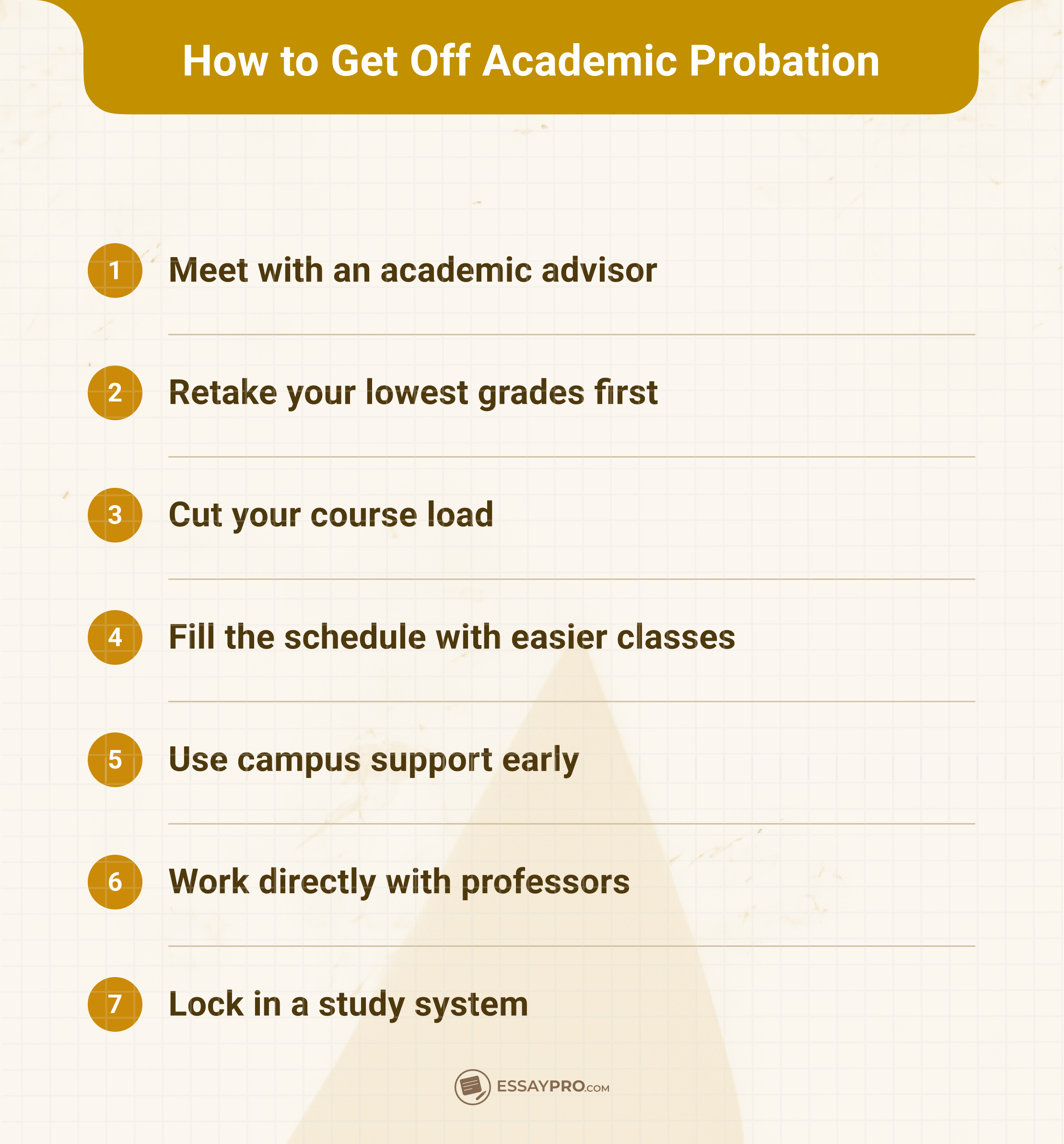
How to get off academic probation: 7 steps
To get off academic probation, a student raises the cumulative GPA back to the school’s minimum, usually 2.0, within the number of terms the policy allows. Three moves do most of the work: retaking failed courses, cutting the load, and using campus support. The steps run in the order that returns the most grade points for the least risk.
1. Meet with an academic advisor
Book this meeting in the first week, before you register for a single class. The advisor has the one thing a recovery plan runs on, which is the exact math.
- The school’s academic probation guidelines spell out the term GPA you owe, the deadline to clear it, and any cap on credits. Read them together, line by line.
- Two numbers matter above the rest: the cumulative GPA that ends probation, and how many terms are left to reach it.
- If the standing itself looks wrong, say a miscalculated GPA or a grade change that never posted, ask about the academic probation appeal process and its filing window that same day.
2. Retake your lowest grades first
Repeat the D and F courses before you touch anything else. Grade replacement pulls the old failing grade out of the GPA calculation, so the cumulative average moves the moment the retake posts, and at most schools that recalculation happens automatically. The one complication is that the rules differ by campus, so confirm them before you register. The University of Alabama at Birmingham excludes the first grade from the GPA for a repeated C, D, or F, allows the option four times with one use per course, and keeps both grades on the transcript. Order matters once you know the rules: start with the highest-credit failures, since those account for the most grade points in the average.
3. Cut your course load
Drop to the minimum full-time load, usually 12 credits, for the probation term. A lighter term leaves more hours per class and a realistic shot at the GPA target.
- A three-course term concentrates study time and tends to produce cleaner grades than a packed one.
- Before you drop anything, check that the lower number still clears full-time status for financial aid, housing, and insurance.
4. Fill the schedule with easier classes
Pad the rest of the schedule with general-education or intro courses you can reliably earn a B or higher in. These add grade points fast, and unfinished GE requirements count toward the degree at the same time.
- Grade distributions and professor ratings are public at most schools, so read them before you enroll.
Keep the heaviest major courses for a term after the status clears.
5. Use campus support early
Book tutoring, the writing center, and subject help in week one, long before midterms fill every slot. These services are free, already covered by tuition, and most useful at the draft stage, so bring papers while there is still time to change them. A standing weekly tutoring slot for the hardest course keeps the help consistent instead of reactive.
6. Work directly with professors
Show up at office hours for every course in the first two weeks and give your name. Professors steer struggling students toward help, and many of them read genuine effort into a borderline grade at the end of the term.
- One question is worth asking each professor outright: what the difference is between a C and a B in this specific course.
- A short question or a partial draft before each deadline gets you feedback while it can still change the grade.
- The first graded assignment is the early signal. Check it the day it comes back, and fix the pattern before it repeats.
7. Lock in a study system
Block study hours on a calendar and treat them as fixed as class itself. A set routine holds up once the term gets busy and deadlines stack.
- Time-block each course’s reading and assignment hours at the start of every week.
- A planner or app such as Google Calendar, Notion, or Todoist keeps every deadline in one place.
- Review the whole plan with the advisor at midterm, early enough to adjust before grades lock.
- Get assistance from an assignment helper if you feel like you’re running out of time.
What happens if you don’t get off academic probation?
A student who does not get off academic probation moves to a more serious status, usually academic suspension, after one or more terms below the minimum GPA. How long academic probation lasts before that point depends on the school, though most policies allow one or two terms of recovery first.
The next status depends on the institution and the student’s progress:
- Continued probation when the term GPA improves while the cumulative average stays below the minimum.
- Required interventions, such as a mandatory success plan, a capped course load, or scheduled advising, before the student may register again.
- Academic suspension, which pauses enrollment for a set period once progress stalls.
- Academic dismissal, the final step for a student who returns from suspension and still misses the standard.
Suspension is not always permanent, though. The University of Louisiana at Lafayette lets a suspended student apply for readmission after a year away, with criteria that vary by program. Because the labels and the consequences differ this much between institutions, read the policy in your own catalog before you assume any of it applies.
If you’re applying just now, you’ll need a list of college interview questions to prepare for.
How does academic probation affect financial aid?
Academic probation can put federal financial aid at risk, because eligibility runs on a separate federal standard, not on the school’s academic standing alone. Most academic probation financial aid trouble traces back to that standard, Satisfactory Academic Progress. A student can stay enrolled on probation and still lose aid when the numbers behind it fall short.
What is satisfactory academic progress (SAP)?
Satisfactory Academic Progress (SAP) is the federal standard a school uses to decide if a student keeps federal financial aid, reviewed at least once a year. It has three components, and a student has to pass all three.
Financial Aid Warning vs. Financial Aid Probation
Financial aid warning and financial aid probation are two separate SAP statuses, and the order between them matters.
Scholarships, athletics, and international students
Probation reaches past federal aid into other programs tied to good standing:
- Merit scholarships usually set their own GPA minimum, often above 2.0, and dropping under it can suspend or end the award.
- Student-athletes answer to the NCAA, which links eligibility to progress-toward-degree benchmarks and a minimum GPA. The rules are at the NCAA Eligibility Center.
- International students on F-1 or J-1 visas have to stay enrolled full time, so a probation course cap that drops them below full-time status can affect their visa standing.
Will academic probation affect grad school, transfer, or jobs?
Academic probation can lower the odds on a grad school application, a transfer, or a job search, though by less than most students assume. Academic probation affects grad school mostly through two records a committee already reads, the GPA and the transcript. At many schools, the probation label itself never reaches an admissions file.
The grades are fixed, so add context:
- The optional addendum; two or three plain sentences that name the term and own the cause will do more than a full page of explanation.
- Recovery persuades. A transcript that shows improvement in the terms after probation tells a reviewer the dip was situational.
- A real reason, an illness or a family emergency, goes in the addendum as a flat statement of fact, with no plea attached to it.
The transfer case is the one to watch. Some schools will not take a student on active probation or suspension, so check the receiving school’s rule before you send an application. Jobs are close to a non-issue, since few employers ever ask for a full transcript.
Our do my homework service can step in at any time you feel like you no longer have enough time or energy to manage your tasks.
Protect your academic standing
The clock is ticking. Our writers deliver polished assignments before your next deadline.
Final thoughts
Academic probation is a warning, and a recoverable one. It marks a GPA under the school’s minimum, usually 2.0, and hands a student a short window to fix it. The route out stays consistent: see the advisor early, retake the failures, lighten the load, and protect financial aid. Good academic standing follows.
FAQs
What is academic probation in college?
How long does academic probation last?
How does academic probation work?
Does academic probation go on your record?

Ana Ratishvili
Ana is a professional literary writer with a Master’s Degree in English literature. Through critical analysis and an understanding of storytelling techniques, she can craft insightful guides on how to write literary analysis essays and their structures so students can improve their writing skills.