
College interviews are conversations between you and a member of the school’s community. You might meet with an admissions officer, an alum, or even a current student. These interviews give the school a chance to learn more about you beyond your application, and they give you the opportunity to let your personality shine, ask questions, and determine whether the school is the right fit for you.
Here are five common college interview questions:
- Can you tell me about yourself?
- Why do you want to attend our school?
- What are you passionate about academically?
- What was a time you overcame adversity?
- Do you have any questions for me?
In this article, you’ll find 24 potential interview questions you may encounter in 2026. We’ll break down what interviewers are really asking and how you can answer with confidence.
Does a College Interview Really Make a Difference?
For most schools, the interview matters but is rarely decisive. At many colleges, interviews are labeled "evaluative" or "informational." An evaluative interview is factored into your application, while an informational one is mainly a chance for you to learn about the school and ask questions.
A strong interview can boost a borderline application slightly. A poor interview may raise concerns. However, they almost never outweigh your grades, scores, or essays. They help by adding a human dimension, showing your interest, and making you memorable.
Don’t panic about the interview, but take it seriously. Use the opportunity to answer the questions for college interview to strengthen your application, not to determine it.
Ready for the Questions You Can't Predict?
Build confident, authentic answers that leave a lasting impression.

College Interview Questions About You and Your Background
Interview questions usually focus on you: your interests, values, and self-image. In this section you’ll see just that - 8 college interview questions with best answers and examples.
Tell Me About Yourself
This broad, open-ended question can feel intimidating. Take a breath and try not to share your entire life story. Focus on two or three things that define you and connect them.
Sample answer: “I am someone who likes to know how everything works. I used to take old radios apart as a kid (and never could put them back together!). Eventually, my curiosity led me to studying engineering. When I’m not studying, you can find me running cross country, which teaches me patience and how to deal with discomfort.”
What Are You Passionate About?
Answer confidently to show enthusiasm. Choose something you care about and explain what excites you. Details and energy matter more than picking something impressive.
Sample answer: “I am passionate about cooking. I love looking at other people’s recipes and trying to replicate them. It all started when I wanted to learn how to make my grandma’s dumplings. It has blossomed into my favorite way to learn about different cultures and de-stress from school.”
How Would Your Friends Describe You?
What your friends would say about you can show your self-awareness. Additionally, interviewers want to know how you view yourself in a community. Be honest and provide a brief example that illustrates your descriptor, rather than listing adjectives.
Sample answer: “They would probably say I am Type-A, especially when it comes to planning. I am always the one making plans within plans. Last year I planned our entire group’s trip including transportation and daily itineraries. I still get made fun of for creating a color-coded spreadsheet.”
What Are Your Greatest Strengths?
This is another question that asks you to sell yourself. Think of a strength that you can back up with an example, and that would be beneficial in a college community.
Sample answer: “I think my biggest strength is curiosity. I ask so many questions! My family will send me to google halfway through a conversation. My curiosity has led me to teach myself how to code and maintain a small science blog.”
What Is Your Greatest Weakness?
Everyone has faults. For this question, pick something you wish you were better at, but that isn’t a dealbreaker. Explain what you are doing to improve in that area. Saying something like “I work too hard” is not acceptable because everyone can think of ways you didn’t work hard.
Sample answer: “Public speaking used to make me very nervous. So nervous that I would forget my lines when I had to give presentations. I decided to push myself by joining the debate club. I’m definitely not where I want to be yet, but I feel a lot more confident now.”
Your interview responses should reinforce the qualities and experiences highlighted in your personal statement.
Tell Me About a Challenge You Overcame
Interviewers want to see how you handle adversity. Focus on how you responded and grew, not just the hardship.
Sample answer: “When my family moved during my sophomore year, I struggled with adjusting to a new school. I wasn’t made fun of or anything, but I just felt alone. I realized that I had to be proactive and pushed myself to join new clubs and introduce myself to people. It was tough but worth it because I learned I could thrive anywhere.”
What Do You Like to Do for Fun?
Interviewers want to see what makes you unique. Be authentic and share real interests. Don’t feel pressured to make every answer school-related. Unique hobbies stand out.
Sample answer: “I love hiking and photography, usually combined. There is something about getting away from the screen and discovering a new viewpoint that helps me reset. I have quite the collection of sunrise pictures.”
What Are You Most Proud Of?
Your answer reveals your values. What you’re proud of can be public or private and small accomplishments count. Explain why it matters to you.
Sample answer: “I tutor this kid who lives in my neighborhood in math. He used to hate it so much, but now he actually enjoys it! When I told his mom that I thought he could understand her lesson plan, she cried. Hearing that made me realize I wanted to teach.”
College Interview Questions on Academic Interests
Questions here focus on your interests, learning style, and academic approach. Interviewers want to gauge your curiosity and direction. If undecided, show curiosity. Here are eight typical college interview questions and sample answers.
What Are Your Favorite Subjects?
Interviewers want to know what you like learning most. Be specific about why you enjoy a subject, and relate it to a project or class moment.
Sample Answer: ‘I enjoy history because I love seeing how small choices impact big events. My research on the causes of World War I made the subject feel alive to me.’
Why Do You Want to Study?
Interviewers want to see if you’re genuine and have direction. Say what drew you to your major and your goals. If unsure, share your curiosity.
Sample Answer: ‘I want to study psychology because I’ve always been curious about human behavior. Working at a youth center made me realize how the environment can play such a big role in who we are. I want to learn more about that influential factor.’
What Do You Hope to Learn in College?
This question shows what you hope to achieve in college. Mention what you want to learn in your field and about yourself. Show openness to new ideas.
Sample Answer: ‘Well, academically, I hope to learn everything there is to know about environmental science. But I also hope to challenge myself by taking classes I wouldn't normally take, like art or philosophy. I want to become a well-rounded student.’
Who Is Your Favorite Teacher and Why?
Interviewers want to know what you value in a teacher. Pick someone impactful and be genuine. Explain their influence, even outside class.
Sample Answer: ‘My favorite teacher is my biology teacher. She was the first teacher who changed how I viewed learning. Instead of giving us the answers, she would ask us questions. She taught me to want to know the answer, which is why I began to love science.’
How Do You Like to Learn?
Interviewers want to know how you learn best and if you’ll succeed at their school. Link your answer to your study habits or engagement style.
Sample Answer: ‘I love learning by doing. I can sit through a lecture and understand it, but once I can apply it, I really take it in. Whether that be an experiment in a lab class or just explaining what I learned to someone else.’
Preparing thoughtful answers is especially important when applying to some of the hardest schools to get into.
What Academic Achievement Are You Most Proud Of?
This question reveals your values and idea of success. Pick something meaningful and explain your efforts, not just the result.
Sample Answer: ‘The science fair project I’m most proud of was one I did on our local water quality. My teacher didn’t assign it to us; I just got curious about why the water wasn’t tested often. I spent hours testing water samples and trying to figure out where to access this information. Walking into school the day I presented my findings to the city officials felt amazing.’
What Do You Read for Fun?
This highlights your curiosity outside of school. Be honest about your reading. Don’t try to impress.
Sample Answer: ‘I’m a huge sci-fi reader, but I have recently been enjoying long-form articles. I love articles that focus on one bizarre topic. I always find myself learning something new.’
How Do You Deal with Academic Pressure?
Interviewers want to know you can handle college stress. Be honest and show self-awareness when describing your approach to pressure.
Sample Answer: ‘I plan everything out. When I’m overwhelmed with schoolwork, I break it down into small sections and handle each one at a time. I also learned that taking breaks will help me focus more, not less.’
Simply pay someone to write college essay for improving structure, clarity, and storytelling before submission.
College Interview Questions About Why You Chose This School
These questions help interviewers assess how deliberately you applied to their school. They want evidence that you researched their institution and chose it intentionally. Generic answers suitable for any college won’t impress them. Sample college interview questions below include the rationale, guidance on crafting your response, and a sample answer.
Why Are You Interested in Our School?
As you might have guessed from the name, this is basically the question that ties this whole section together. Your answer to this question should be specific. Identify certain aspects of the school that caught your attention. Vague reasons, such as reputation or proximity to home, will not suffice.
Sample answer: ‘What sets you apart is your interdisciplinary curriculum. I want to double major in biology and English because your sustainability minor requires both environmental science and policy. That hands-on, practical learning is exactly what I’ve been seeking.’
What Made You Apply Here?
You got a similar question, but now it’s time to add a personal touch. What made you decide to actually hit that submit button? Did you hear something on their campus tour? Write a short story that shows, not tells, the interviewer what hooked you.
Sample answer: ‘Honestly, I was halfway done with the application when I clicked on a professor’s virtual lecture. I learned that she runs a student organization focused on sustainability, and I was impressed by how she allowed students to debate and challenge her during the lecture. I knew then that this college valued real conversation over rote learning.’
What Do You Know About Our Programs?
This question helps the interviewer verify that you’ve researched their school. Arrive ready to discuss particular courses, majors, faculty, career center initiatives, or research programs. Show that you have gone beyond simply reading the brochure.
Sample answer: ‘I am especially interested in your computer science program and how you integrate it with ethical studies. I think your course on AI and society would be incredible, as I am passionate about ensuring new technology is used responsibly.’
How Will You Contribute to Our Community?
Interviewers want to know you’ll contribute as much as you gain. Discuss specific clubs, activities, or initiatives you’ve joined that align with the school’s offerings.
Sample answer: ‘I started a compost program at my high school, so I would love to be part of your student environmental organization. I am also a writer, so I will definitely look to contribute to the school newspaper.’
Along with interview preparation, learning how to write a supplemental essay can strengthen your overall college application.
What Are You Looking for in a College?
Your response will show the interviewer what you value in a college. Identify what matters most to you and explain it. Then connect those priorities to the unique qualities their school offers.
Sample answer: ‘I am looking for a college that values both academics and a strong sense of community. I want challenging classes and supportive professors, and your small class sizes and high standards give me confidence that I will find that balance at your school.’
How Did You Hear About Us?
Interviewers are simply checking your attention to detail. Be genuine if you discovered them through a counselor, college fair, or research. Explain what sustained your interest after first learning about the school.
Sample answer: ‘Your school was one of many I found at a college fair, but I decided to learn more about you guys. I was impressed by your undergraduate research opportunities since most schools only allow students to start that late in their college careers.’
What Other Schools Are You Considering?
Just answer this question honestly; there is no trick. However, you do not need to name every school you’re applying to. You can relate this school to a few others that share programs or values similar to what you are looking for.
Sample answer: ‘I am definitely considering other schools with strong liberal arts programs and take pride in creating a collaborative learning environment for students. They all have that in common, but your school really stands out to me for its small classes and emphasis on interdisciplinary studies.’
Where Do You See Yourself in Four Years?
Finally, interviewers want to know that you have goals and plans for the future. They understand that your plans may change, but it is how you answer this question that will show your potential to thrive at their school.
Sample answer: ‘I see myself graduating with a biology degree and lots of hands-on research experience. Your study abroad and undergraduate research programs sound incredible, so I hope to take advantage of them as well. Of course, by then, I hope I can say I’m ready to start school as a Doctor.’
If you're juggling interviews and assignments, you may also request ‘write my history essay for me’ to stay on top of deadlines.
A Great Interview Starts Before You Walk In
Practice stronger responses and present your story with clarity and confidence.
Practical Tips for a Successful College Interview
A bit of preparation before your interview can help you remain calm and focused on the big day. Don’t rehearse scripted answers or try to present a false persona: aim to be a confident, polished version of your genuine self. Here are some concrete tips to help you stand out.
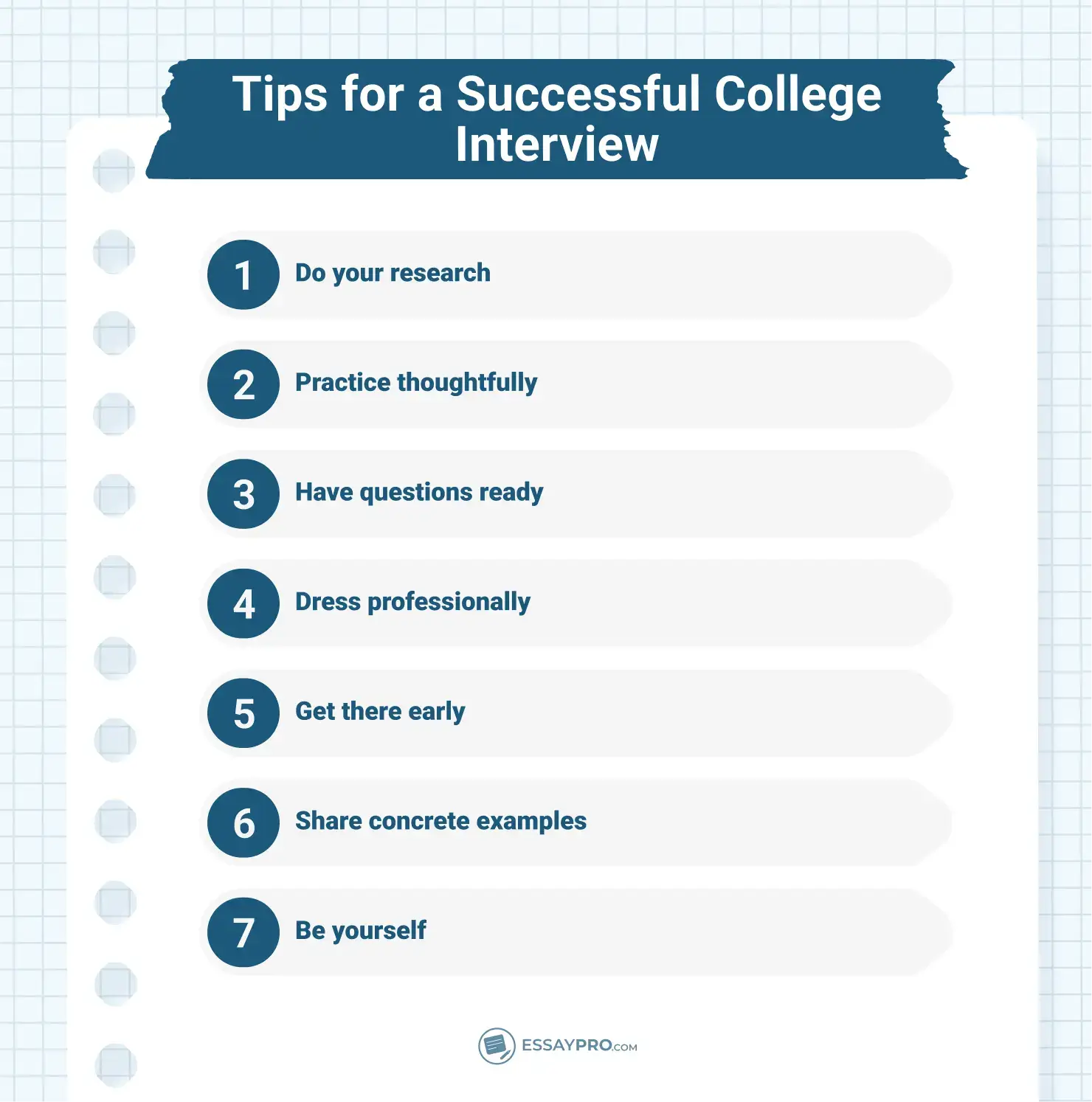
- Do your research: Investigate the school before your interview. Be prepared to discuss specific programs, courses, or opportunities that genuinely interest you.
- Practice thoughtfully: Rehearse answering typical college admission interview questions aloud so you aren’t caught off guard, but avoid memorizing responses.
- Have questions ready: Chances are, your interviewer will ask if you have any questions. Prepare 2-3 questions to ask your interviewer about the school, teachers, student life and related topics. This is your chance to show you’re interested and curious about life at the school.
- Dress professionally: Aim to look neat and put-together. You don’t need a suit, but present yourself in an attire that feels polished and appropriate.
- Get there early: Show up a few minutes early for in-person interviews, and log in to virtual interviews early as well. For virtual interviews, be sure to check your tech and connection before the interviewer arrives.
- Share concrete examples: When responding to questions, illustrate your points with specific stories and details. These make you memorable and credible.
- Be yourself: This sounds cheesy, but it’s important. Interviewers appreciate honesty and authenticity way more than perfect answers that you think they want to hear.
Final Takeaways
College interviews aren't tests you need to “stump” your interviewer on. They're conversations you should enjoy having. Do some research on the school, prepare for common questions, and have a few questions ready for them. But most importantly, just be yourself. Let the interviewer see the curious person that you are on paper shine through in conversation. Go into the interview prepared, and you'll be fantastic.
FAQs
What Are Common Questions Asked in a College Interview?
How to Answer College Interview Questions?
What Should I Say If I Haven’t Chosen a Major Yet?
How Can I Discuss a Personal Challenge Without Hurting My Application?
Nala Fox
Nala Fox is the Chief Human Resources Officer at EssayPro, with deep expertise in strategic leadership, organizational culture, talent acquisition, and employee well-being. With a forward-thinking approach to HR, Nala drives initiatives that promote inclusivity, engagement, and long-term professional growth. Under her leadership, EssayPro has implemented programs addressing employee burnout, enhancing productivity, and fostering a balanced, people-centered workplace where innovation and collaboration thrive.


.webp)