

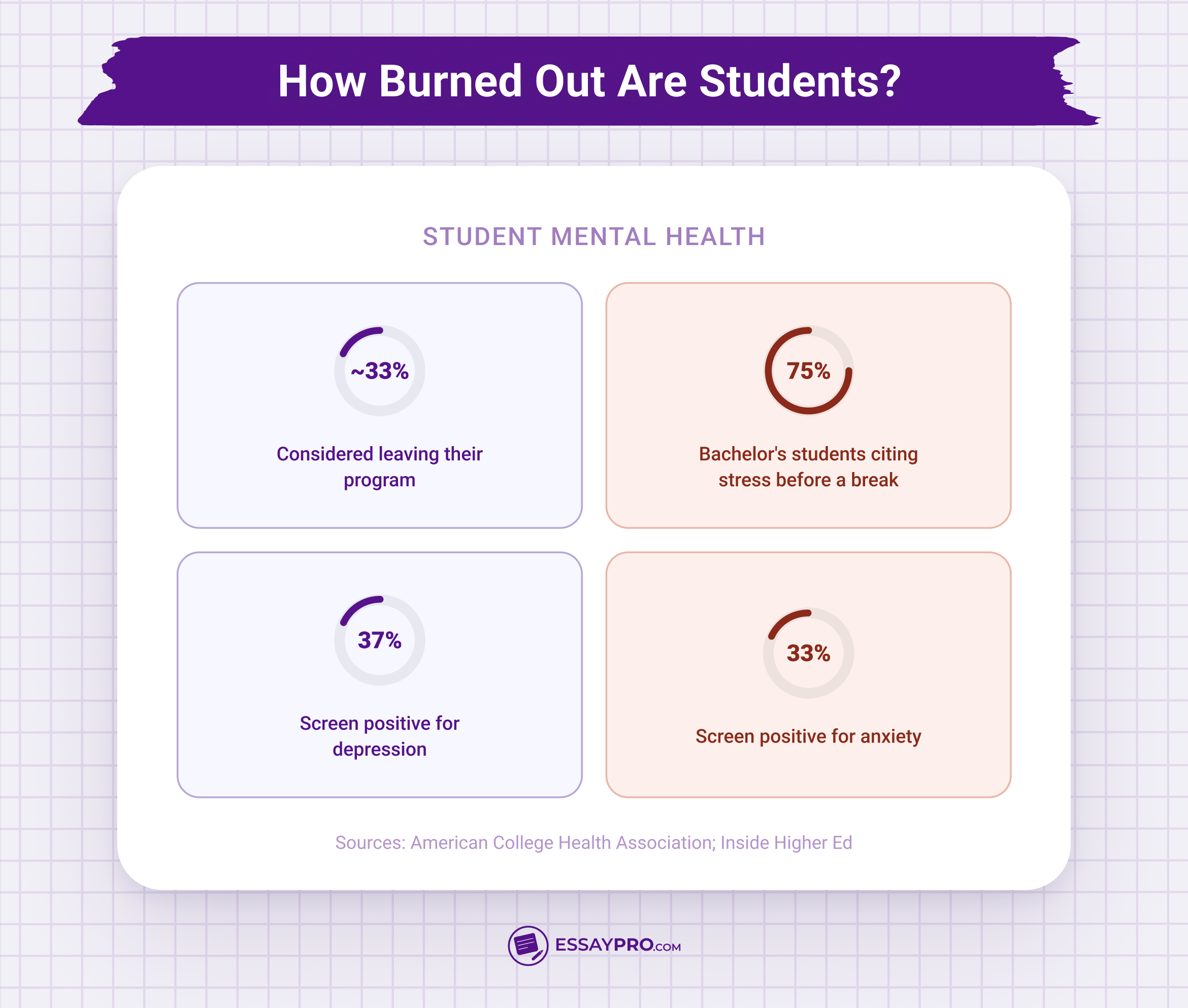
- 33% of college students have considered leaving their program, mostly due to stress.
- 75% of undergraduates work while enrolled, and a third work full-time.
- 86% of Gen Z would turn down a job requiring regular overtime.
- 78% of Gen Z say work-life balance is essential to career success.
A full course load. A part-time job. An unpaid internship. Leadership positions in three clubs. Dropping everything just feels like falling behind when everyone else is doing it too, right? Well, things are starting to change with the academic hustle culture: Roughly one-third of college students in the U.S. have considered dropping out of their programs, with mental health and emotional stress as the leading causes.
In this article, we’ll dive into student hustle culture, how burned out students are these days, what’s motivating the shift away from grind culture, and what sustainable alternatives look like.
Balancing School and Deadlines?
Get expert writing support so you can focus on what matters most without sacrificing quality.

Just how burned out are today's students?
Taken together, these data tell a cohesive story about college student burnout.
Together, these statistics indicate that burnout isn't just a temporary slump some students face. Burnout is shaping up to be a fundamental part of the collegiate experience, and one serious enough to cause significant numbers of students to consider throwing in the towel.
Recent findings on hustle culture complement our report on why Gen Z avoids working with other Gen Z employees.
What academic hustle culture looks like
On campus, academic hustle culture shows up as resume-stacking:
- Toxic productivity and unpaid internships taken purely for the line item
- Credit overloads to graduate early or double major
- A quiet belief that rest itself is a form of falling behind
It's less about any one decision and more about a mindset that equates busyness with worth.
The Lumina Foundation-Gallup research on student stress found that when students describe feeling overwhelmed, coursework rarely stands alone as the cause. It becomes unmanageable, especially when stacked on top of paid work and caregiving responsibilities, and compounded by strain in personal relationships.
Three mechanisms tend to drive the overload of productivity culture:
- Constant comparison on social media, where everyone else's internships and side projects look effortless
- A grad-school arms race, where credentials feel like a moving target
- Cost pressure, which pushes many students into paid work just to stay enrolled, on top of an already full course load
The campus version of quiet quitting
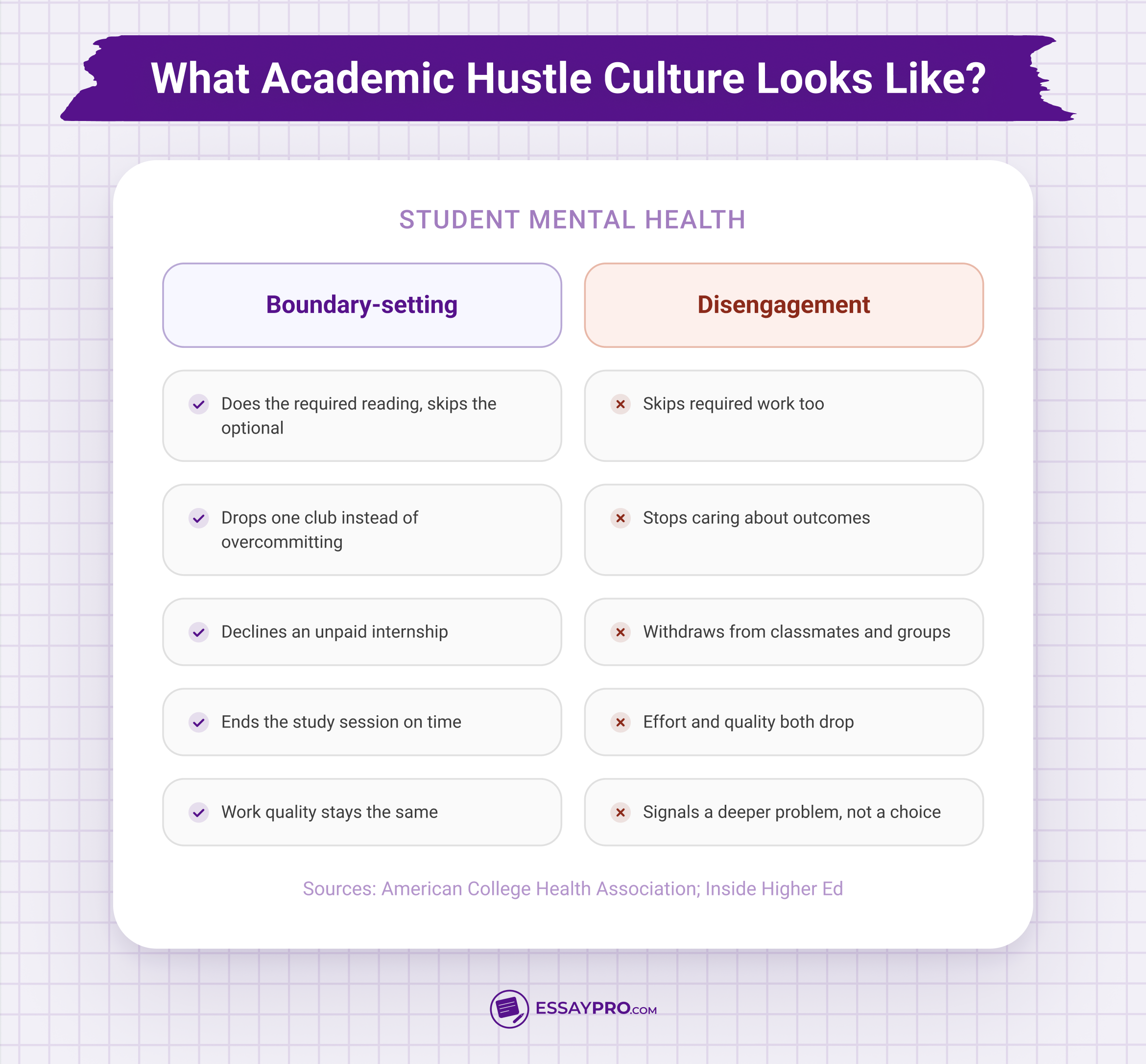
Quiet quitting in college was coined as a workplace phenomenon, but the popular rhetoric surrounding the term has since changed. While early framings equated it with slacking, research and experts in workplace psychology have settled on a definition closer to setting boundaries: doing the work you're asked to do, but not taking it upon yourself to go beyond expectations in your personal time. The key point is that quiet quitting is about setting boundaries, not doing the bare minimum.
With that mentality applied to hustle culture in college, the parallels become clear: setting boundaries means choosing what matters most and letting the rest go.
From there, the difference between that and "slacking off" comes into play: setting boundaries means the work still gets done. The effort and quality are there; what's missing is the "extra." True disengagement occurs when students care less about their work. Someone who turns down an extracurricular because they want to sleep, or who blanks off at 7 p.m. to prioritize their mental health, isn't cheating their classmates or college education. They're doing what's required of them and spending their free time how they see fit, and the data supports this logic more and more.
The double load that working students carry
Hustle culture isn't just theoretical for the approximately three-quarters of undergraduates who work while enrolled in college.
- 75% of undergraduates work while enrolled in college
- 33% of working college students hold down full-time jobs on top of a full course load
- Over 75% of working college students say they're asked to complete tasks outside their job descriptions at least once a week
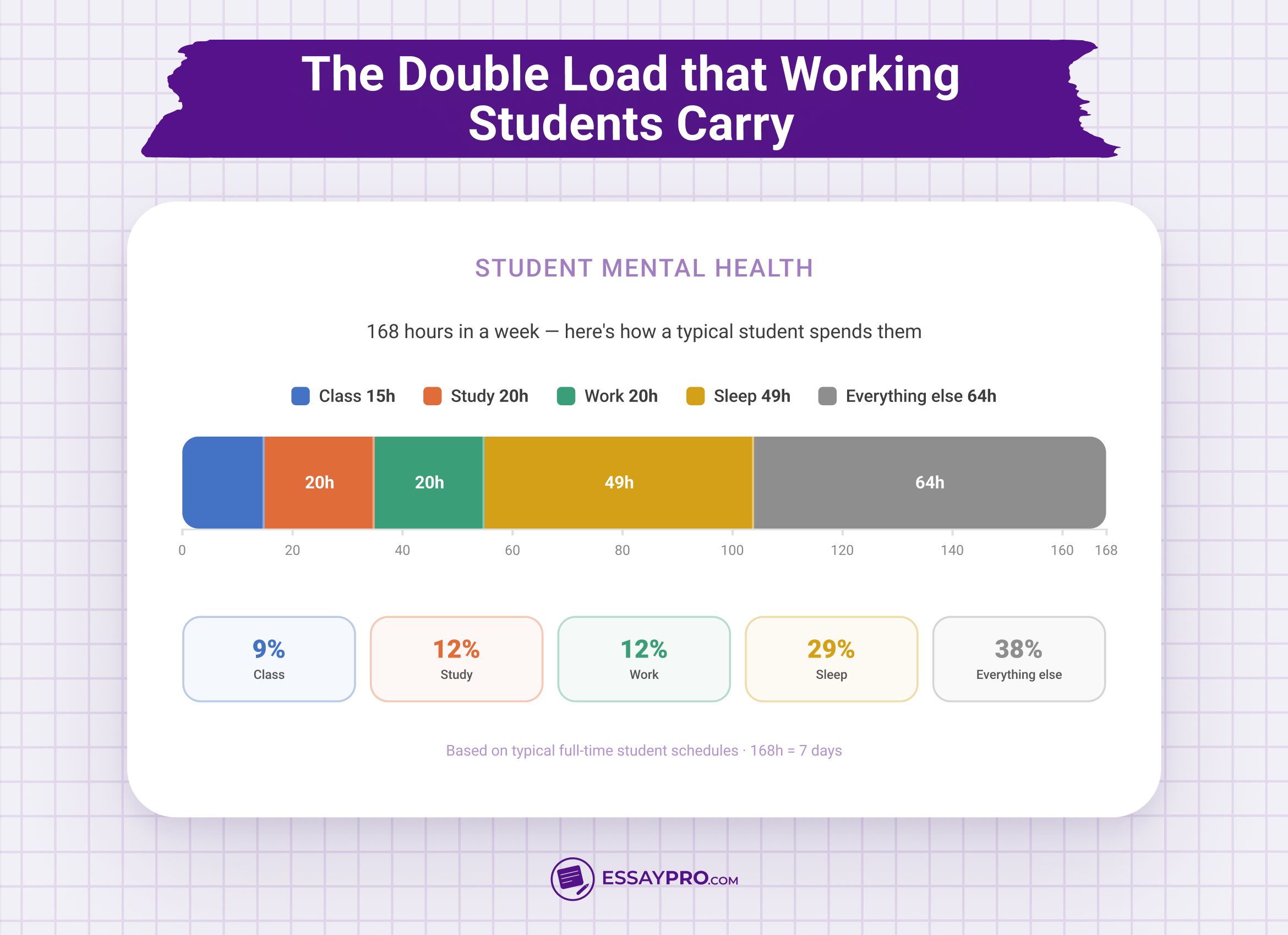
This reality significantly affects burnout statistics and student work-life balance. This mentality spans generations, including many student employees who work while taking classes.
Cost is on both sides of this debate. Financial strain is common among students who begin working, but it's also a leading factor in students deciding to leave college. They're caught in a catch-22: they need the money, but they also need the time that work takes away from them.
How Gen Z is responding to hustle culture
Today's college-goers aren't developing hard lines when they graduate and enter the workforce. Instead, they're entering jobs with boundaries they've been developing for years as students, boundaries first shaped by the college productivity pressure. The shift is clear: Gen Z is bringing student-era boundary setting into the workplace, making work-life balance table stakes.
Many would pay more to keep that balance. According to KPMG's Winter Intern Pulse Survey, Gen Z employees would trade approximately $5,000 of salary for a better work-life balance.
The students who learned to say no to the third club meeting or the unpaid internship have now graduated into entry-level jobs, already experts at safeguarding their time. What we think of as a new workplace culture is really a continuation of the boundaries they built as students, propelled by a generation that bought into grind culture less than their predecessors.
Burnout, or just a rough semester?
Some semesters are genuinely brutal: overlapping deadlines, a demanding class, a rough patch at work. That's different from burnout, which researchers generally describe through three recognized indicators:
- Persistent exhaustion that doesn't resolve with a weekend off
- A growing sense of detachment or cynicism toward schoolwork
- A reduced sense of accomplishment, even when things are technically going fine
These are patterns worth taking seriously, not a checklist for self-diagnosis. No article can tell a reader whether what they're experiencing is burnout, a hard stretch, or something else entirely; that distinction takes a conversation with a professional who can actually assess the full picture.
What matters more than labeling it is what happens next. If exhaustion, detachment, or a flattened sense of accomplishment are sticking around, campus counseling centers are a real, accessible starting point. Most colleges and universities offer a set number of free counseling sessions to enrolled students, and reaching out doesn't require having a name for what's going on first.
For students looking to earn extra income without burning out, explore these practical side hustles for college students.
What actually makes a difference
Once burnout, or the risk of it, is on the table, the instinct is often to add more: a new planner, a productivity app, a better system. Real research and student support offices point in a different direction: subtraction, not optimization.
- Reduce the course load rather than adding productivity systems: Fewer credits often do more than a better schedule ever will.
- Built in scheduled, non-negotiable rest: Protect specific blocks of time the same way you'd protect a class or a shift.
- Cut one commitment instead of trying to optimize all of them: Dropping a club or a shift often has more impact than fine-tuning everything else around it.
- Use campus academic support and writing centers: These resources are specifically designed to lighten the load for individual assignments.
- Talk to an advisor before withdrawing from anything: A quick conversation can surface options, like an incomplete or a reduced course load, that aren't obvious from the outside.
Too Much on Your Plate?
Let expert writers help with your essays and research papers while you stay focused on your priorities.
The bottom line
It's not that students are shying away from putting in the effort; rather, they're rejecting the idea that constant productivity is the measure of their worth. Saying no to one thing and guarding downtime does not mean they've given up. It means they're protecting themselves from a culture that is legitimately unsustainable, and research shows they know this sooner than previous generations did.
FAQs
What Does Quiet Quitting in College Mean?
Is Hustle Culture Bad for Students?
Are Students More Burned Out Than Workers?

Sopho Miller
is an experienced content writer who specializes in digital marketing, business, and academic topics. With a Master’s degree in Digital Marketing, she combines her expertise with a practical approach to create clear, engaging, and educational content. She crafts detailed guides and resources that support students in their academic journey. Outside of work, Sopho stays current with the latest industry trends and regularly attends workshops to further sharpen her skills.