
Theory of Knowledge is the IB course that prompts you to examine how we acquire knowledge. Though TOK can seem abstract, it is grounded in 12 distinct concepts that are referenced in both the Exhibition and the Essay. Students who internalize these concepts often achieve higher scores than those who treat TOK as merely a philosophical discussion.
In this article, we go into detail about all the 12 TOK concepts, with examples, so you can easily reference them in your assessments.
What Is a TOK Concept?
TOK key concepts are 12 foundational elements that the IB provides to help us analyze how knowledge is constructed, challenged, and understood in different areas. They’re more than just terms; each offers a distinct perspective for examining knowledge claims and generating insightful questions.
IB concepts provide students with a common ground for discussing knowledge, helping discussions avoid becoming too abstract or personal. Without concepts, TOK conversations stall. When used, concepts anchor arguments, which examiners seek in the Essay and Exhibition.
TOK Essay Still Too General?
Receive expert guidance on linking TOK concepts to stronger arguments and clearer analysis.

All 12 TOK Concepts Clearly Defined
These 12 key concepts of TOK underpin all TOK critical thinking. Every good Exhibition object and every high-scoring Essay answer derives from at least one of them. Once you learn what each one truly means, you will begin seeing them everywhere in your assessments.
.webp)
Knowledge
Knowledge is a justified belief that we know (have good reason to believe) is true. It also isn’t just information. For something to be knowledge, there should be some justification for it to be believed that it is reliable.
Real-world example: When your doctor tells you that you have the flu, it can be considered knowledge. Your doctor may not be certain, but clinical evidence, tested practices, and agreed-upon standards justify that knowledge claim.
Evidence
Evidence is information used to support or refute a knowledge claim. Criteria for acceptable evidence vary greatly across domains.
Real-world example: In a court of law, eyewitness testimony counts as evidence. In a physics experiment, it would not. The same observation carries different weight depending on the discipline.
Certainty
Certainty is the level to which we can be sure something is true. In TOK, we don’t often deal with absolutes; very little knowledge is 100% certain. Usually, it falls on a probability spectrum.
Real-world example: The age of Earth is approximately 4.5 billion years. Scientists can make this claim because they have good evidence to support it, but there is always a margin of error. It’s very likely true, but we can’t say with 100% certainty that it is true.
Many TOK investigations begin with a focused inquiry. Learn how to write a research question that encourages critical thinking.
Truth
What does it mean to call something "true"? Is truth the same across contexts? Does the person asking affect standards for truth?
Real-world example: Numbers don’t lie, so in mathematics, something is either proven to be true or false. In history books, the accepted account of an event is typically true only from one perspective.
Interpretation
Interpreting is the act of making sense of the information we’re provided. Two people can look at the same information and draw validly different conclusions.
Real-world example: Two world-trading economists could look at the exact same unemployment rates and come to different conclusions based on what they believe is important to consider.
Power
Who holds the authority to determine which knowledge is accepted? Who controls knowledge production? Who accesses knowledge?
Real-world example: For centuries, medical tests were only performed on men. But doctors used that knowledge to make universal claims about all humans. Male-centric knowledge was treated as universally true.
Justification
Why do we accept something as true? Without supporting evidence, a claim remains an opinion.
Real-world example: Just because you feel better on a special diet doesn’t mean that it actually improves mental health. Through research, testing, and scientific consensus, we can justify claims.
Responsibility
After acquiring knowledge, what obligations do we have? “Knowing” alone does not remove consequences.
Real-world example: The scientists who worked on the nuclear bomb knew what they were applying it to. There’s no separation between the research and the responsibility it incurs.
Culture
Culture influences what people value knowing. Culture shapes how knowledge is passed down and which forms of knowing are considered valid.
Real-world example: Settler colonists in North America relied on the knowledge of native peoples to understand the land. That knowledge was passed down through oral tradition for generations, but wasn’t always considered valid by colonists.
Values
What we value influences the questions we pose, the research funded, and our interpretation of data. This applies to both individuals and entire fields of study.
Real-world example: Pharma companies care about making a profit. So they only research diseases that they can create medications for and profit from.
Objectivity
Objectivity is the pursuit of knowledge with minimal personal bias. Full objectivity is rare but should remain the goal.
Real-world example: You may be completely convinced that a particular political candidate is unqualified, but you should still try to report on the election fairly.
Perspective
The position from which someone is coming when claiming knowledge. We can all view the world from different angles. There’s no neutral perspective.
Real-world example: A Japanese textbook might describe World War II differently than an American textbook would. One is not right and the other wrong; they just have different perspectives.
Students exploring knowledge and technology often seek computer science homework help alongside TOK discussions about AI and digital ethics.
How TOK Concepts Connect to Areas of Knowledge
A frequent error seen in essays is treating TOK core concepts as detached from reality. High-scoring essays reverse this, showing how a concept works differently in various Areas of Knowledge. For example, applying "certainty" to Mathematics and History yields very different results. Focus your analysis on these comparisons. Below, we outline the best concept-to-AOK links for each discipline.
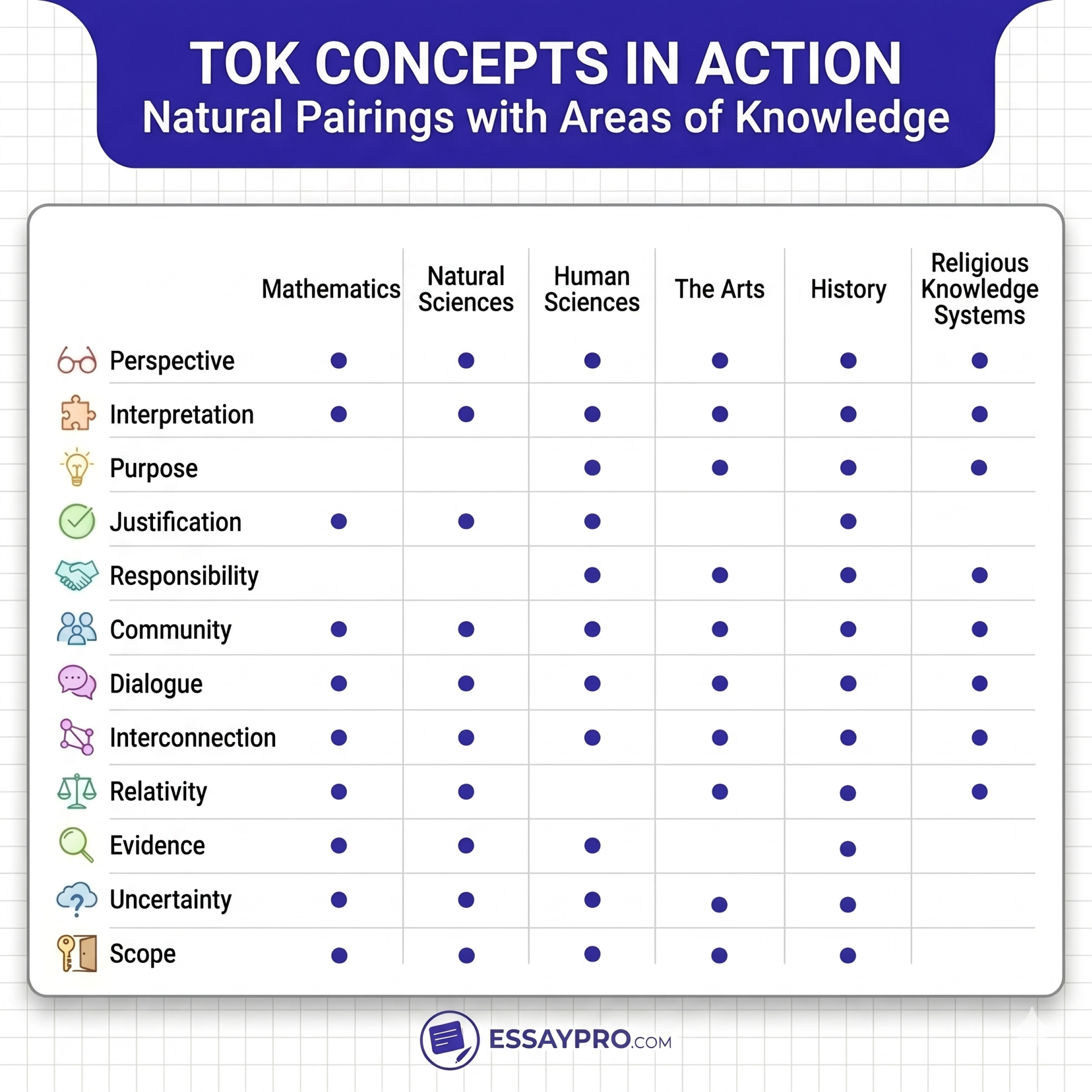
Objectivity and Evidence
Natural sciences value objectivity and evidence through replicable experiments and peer-reviewed data. TOK probes these claims: Who designs experiments? Who funds research? What gets published? Science's strong claim to objectivity makes its limitations more revealing.
Essay angle: To what extent can scientific knowledge ever be fully objective when the questions researchers ask are shaped by funding, culture, and prior assumptions?
History
History is never a neutral record. It's shaped by the author, surviving sources, and subjective judgments. Using perspective and interpretation in history lets you examine whose knowledge is preserved and whose is lost.
Essay angle: If two historical accounts of the same event contradict each other, can both be considered knowledge? What does that reveal about how historical truth is constructed?
TOK arguments share similarities with a position paper where claims must be supported with evidence and reasoning.
Mathematics
Mathematics is the Area of Knowledge closest to absolute certainty. A proven theorem holds true across all cultures and contexts. Yet TOK raises questions: Is mathematical truth discovered or invented? Do axioms qualify as knowledge if assumed, not proven? Certainty in mathematics merits examination because it is stronger here than elsewhere.
Essay angle: If mathematical truths are certain and universal, does that make mathematics a special kind of knowledge, or does it simply operate within a closed system of its own rules?
Ethics
Ethical knowledge is built on values, which are not universal. A moral position justified in one culture may be rejected in another. Ethics is therefore one of the most contested Areas of Knowledge in TOK. Justification is key here, as it examines what reasoning or evidence supports a moral claim.
Essay angle: Can ethical knowledge be justified in the same way scientific knowledge can, or does the role of values make moral claims fundamentally different from empirical ones?
The Arts
Art's meaning is never fixed. Interpretation and truth in the arts raise questions about whether any single reading is correct and what truth means in creative contexts.
Essay angle: If two people interpret the same artwork in completely opposite ways, does one of them have to be wrong? What does this suggest about the nature of knowledge in the arts?
Indigenous Knowledge Systems
Indigenous knowledge systems are one of the most important and underused resources in TOK. They raise direct questions about whose knowledge gets recognized as legitimate and why. Western scientific institutions have historically dismissed indigenous knowledge, only to later confirm through research what those communities had known for generations. Culture shapes what counts as knowledge, and power determines whose culture gets to set that standard.
Essay angle: When indigenous knowledge and scientific knowledge produce the same conclusion through completely different methods, what does that tell us about the relationship between culture and the validity of knowledge?
When deadlines pile up, some students search for pay someone to do my homework options for academic support.
How to Use TOK Concepts in TOK Exhibition?
The TOK Exhibition requires you to select three real-world objects and link each one back to only one IA prompt. The theory of knowledge concepts that you find in each object is what creates the link. Lacking an explicitly defined concept to anchor each object, the Exhibition simply devolves into a description of the objects rather than an analysis of knowledge.
Take this step-by-step:
- Select your IA prompt. Each of your three objects must link back to the same prompt. Choose one that you actually care about and that you can approach from a number of different angles.
- Determine what TOK concept your prompt most naturally links to. A prompt about bias concerns perspective or objectivity. A prompt about contradictory claims links to evidence or justification.
- Select objects that exemplify the concept, interacting with different things in different ways. One common object, one scientific object, and one cultural/historical object will usually provide the most contrast. Feel free to mix and match categories if you think of something more intriguing than the examples I provided.
- Explicitly name the concept in your commentary. Don’t make the examiner hunt for it. State the concept, describe how it is seen in the object, and tie that back into your prompt.
- Try to avoid objects that are too easy. Selecting a microscope to represent the natural sciences or a paintbrush to represent the arts will not yield a fascinating analysis. The more surprising your object is, the more depth of analysis you can provide.
Technology-related TOK topics frequently overlap with coding courses, leading students to look for do my programming assignment assistance.
How to Integrate TOK Concepts into the TOK Essay?
Remember, the 12 concepts of TOK aren’t background information for the TOK Essay. They are lenses through which you analyze your argument. For every prescribed title the IB has ever given you, you can relate to at least one concept specifically. Finding which one applies and intentionally using it in your thesis is the difference between a basic essay and a high-scoring one.
Execution formula:
Concept + Area of Knowledge + Knowledge Claim = Thesis
Example: [Perspective] shapes what historians treat as significant evidence, which means [historical knowledge] is always partial rather than complete.
Weak approach:
"Different people have different views on what counts as knowledge, and this can be seen in many areas."
No concept named. No specific AOK. Nothing for the examiner to evaluate.
Better Example: “The way that justification is used in the natural sciences and ethics illustrates that how much evidence is enough to prove a knowledge claim varies based on what each area of knowledge deems acceptable.”
Concept named. Two contrasting AOK’s. Clearly defined knowledge claims your essay can respond to.
Strong TOK essays benefit from effective conclusion sentence starters that help connect key ideas and arguments.
Struggling With TOK Explanations?
Work with IB experts to improve your TOK essay structure, examples, and reasoning.
Common Pitfalls to Avoid with TOK Concepts
A majority of middle-scoring TOK essays tend to make the same few errors. Familiarity with them before you sit down to write is far more helpful than realizing them during feedback.
- Mentioning the concept without applying it. Dropping “perspective” or “certainty” into a sentence and continuing is not a consideration of the concept as an idea. It needs to actively do something in your answer.
- Discussing only one Area of Knowledge. TOK is about comparing. An essay that examines a single concept in a single discipline misses the comparative thinking that high marks require.
- Approaching concepts like dictionary definitions that must be stated. Examiners are not looking for textbook explanations. They want to see you applying the concept to a specific knowledge claim and pushing on it.
- Discussing too many concepts without depth. One solidly explored concept will always earn more points than two barely mentioned ones. Concept coverage without conceptual depth is one of the biggest reasons capable students wind up with lower scores.
- Turning your essay into a one-way argument. If your TOK isn’t considering counterclaims, it’s not doing TOK. Every well-thought-out concept application should have a portion where you identify what complicates/asserts something different about the knowledge claim you’re making.
When discussing evidence and reliability, understanding sampling methods in research can strengthen your analysis.
Final Thoughts
TOK feels abstract until you understand what the 12 concepts actually do. They give your Essay and Exhibition a framework that examiners can follow and reward. You now have the definitions, the AOK pairings, and the common mistakes to avoid. Use the concepts deliberately, and your analysis will be stronger than most.
FAQs
What Are the TOK Concepts?
Which TOK Concepts Work Best for the Exhibition?
Can I Use Concepts Outside the Official 12?
Do I Need All 12 Concepts in My Essay or Exhibition?

.webp)