
A hypothesis in a research paper is a specific, testable prediction about a relationship between variables. To write a hypothesis in a research paper, start with a focused research question, review existing research on it, identify your variables, predict how they relate, make that prediction specific and testable, then write the final statement.
This article explains the process in six steps, from choosing a question to writing your final statement, and includes an example of hypothesis in research paper you can model.
What is a hypothesis?
A hypothesis in a research paper is a testable prediction, written before analysis, about how variables relate. For example, "Longer sleep duration is associated with higher exam scores." Every hypothesis links at least two variables:
- An independent variable you observe as the presumed cause
- A dependent variable you expect to change
In an experiment, you assign the sleep duration, for example sending one group to bed for 8 hours and another for 5 hours across seven nights, then measure the dependent variable, their score on the same 50-question final.
In an observational study, you ask 200 students how many hours they slept, record their actual exam scores, and test whether the two track together. A positive result there, say students averaging 7 hours scoring 12 points higher than those averaging 5, does not prove sleep caused the gap, because heavier studiers may also sleep more.
Hypothesis characteristics
If hypotheses have anything in common, it is these few characteristics. Without these qualities, your hypothesis can do more harm than good later on in your research.
- Testable: Able to be proven right or wrong by collecting data.
- Specific: Clearly states your variables and the predicted relationship.
- Falsifiable: There is a possibility to show that your hypothesis is false.
- Grounded: Based on what is already known or has been studied in the past, not a guess.
- Clear: Free of ambiguous language.
Analytical writing skills also apply to history assignments. Our guide on how to write a DBQ explains how to structure evidence-based arguments.

Not Sure if Your Hypothesis Works?
Get expert help turning broad ideas into clear, testable hypotheses for research assignments.

How to write a hypothesis for a research paper?
The process of writing a hypothesis for a research paper moves from a question to an evidence-informed prediction, then to a statement your methods can test. Follow these steps:
- Start with a research question.
- Review existing research.
- Identify the variables.
- Predict the relationship.
- Make the hypothesis specific and testable.
- Write the final hypothesis.
You may encounter five-step versions that combine predicting the relationship with drafting the final statement. The essential work stays the same. This six-step approach separates those tasks so you can examine your reasoning before choosing the final wording. Throughout the steps, we will use a proposed observational study of sleep duration and exam scores.
1. Start with a research question
“How does sleep affect students?” leaves two questions unanswered: which students, and what effect of sleep will you measure?
“Does good sleep make students better people?” gives you no agreed way to measure “good” or “better people.”
Asking about sleep patterns across every college in the country creates a different problem: covering all those colleges is unrealistic for a first research paper.
Narrow the question to students taking one exam: “Among undergraduates taking the same introductory psychology exam, is average nightly sleep duration during the preceding week associated with exam scores?”
You can compare these undergraduates’ average nightly sleep duration over that week with their scores on the same exam. The wording “associated with” asks whether sleep duration and scores vary together, not whether sleep causes scores to change.
If you are still choosing a subject for your paper, explore these informative essay topics for research and writing ideas.
2. Review existing research
A hypothesis is an evidence-based prediction, not a guess, so review what researchers already know before you form one. Preliminary research shows which relationships have been tested, what patterns hold across studies, and where gaps remain for your paper to address.
Rely on credible academic sources: peer-reviewed articles and scholarly reviews on sleep, cognition, and academic performance. As you read, do four things:
- Compare findings across studies
- Record conflicting results
- Note unanswered questions about sleep and exam performance
- Track how each study measured sleep and which students it examined
Search PubMed for health-related literature, and use PubMed Central for full-text articles. Let that evidence, not a hunch, shape your prediction: if studies link longer sleep with better exam performance, predict higher scores for students who sleep longer.
3. Identify the variables
Identify your variables by asking what the study changes, compares, or observes, then pin down the outcome being measured. The factor you vary or observe is the independent variable; the outcome you record is the dependent variable. In the running example:
Not every study tests direct cause and effect; many test associations instead. Because this example observes students' existing sleep patterns rather than assigning different amounts of sleep, the hypothesis should claim less. Students who sleep longer may also differ in study time, stress, or prior academic performance, and these could explain an observed relationship. Record relevant factors when your design allows, and explain how you will handle them in your methods. Your hypothesis can predict an association; it should not label that association a causal effect without a design that supports the claim.
4. Predict the rtelationship
Compare previous findings on students' average nightly sleep and exam scores, then choose the prediction type that matches them:
5. Make the hypothesis specific and testable
Test each variable for observability: can you actually measure it, and would two researchers record it the same way? If not, the term is too vague. "Better sleep improves success" fails this check twice, since "better" could mean duration, quality, or consistency, and "success" could mean grades or graduation. Replace vague wording with measurable terms:
Add population, conditions, or context wherever they sharpen the prediction: here, undergraduates in one introductory psychology course, measured the week before a specific exam. These definitions belong in your study plan; the final hypothesis does not need every procedural detail. Explain the survey questions, scoring procedures, and analysis in the methods section. Above all, the statement must be able to be supported or challenged by evidence. A reader should know which result would do each: longer sleep tracking with higher scores would support the prediction, while no association, or one in the opposite direction, would challenge it.
6. Write the final hypothesis
Collapse your working prediction into a single declarative sentence that carries the population, both variables, and the direction you expect. For the running example, the finished hypothesis reads:
"Among undergraduates taking the same introductory psychology exam, longer average nightly sleep duration during the preceding week will be associated with higher percentage scores on that exam."
It holds the group, window, and outcome without rehearsing the method. You can frame it as if/then, but you are not required to: that phrasing fits experiments well, yet it can make a correlational finding read as cause. Choose accuracy over format. Studies using inferential tests will also state a null and an alternative hypothesis:
Hypothesis format
Most hypotheses are written in the form of an “If... then…” statement. There is a reason for that. Writing a hypothesis this way forces you to write the cause before the effect. It helps you keep your prediction specific and keeps the relationship between your variables clear.
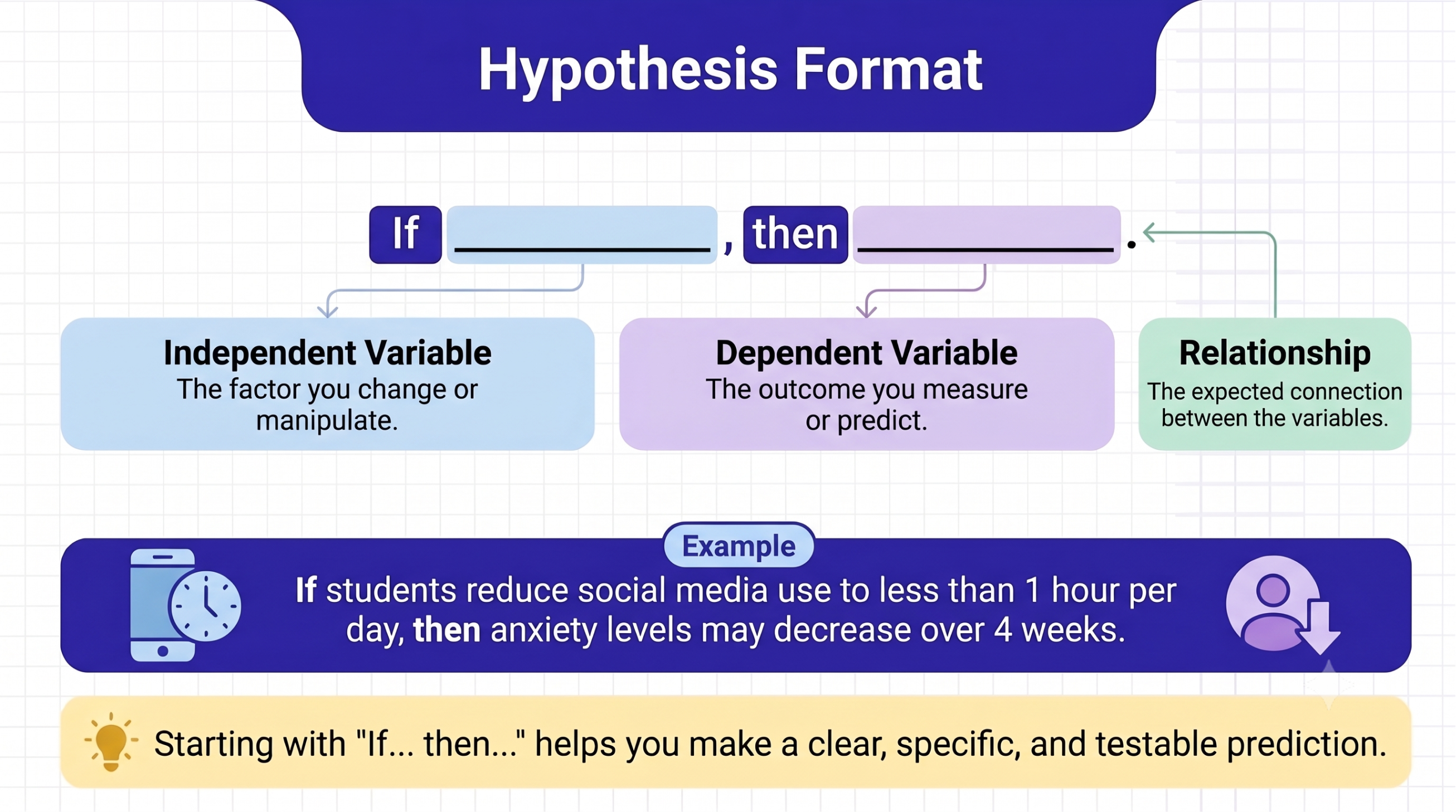
"If"[Independent Variable], "then"[dependent variable].
"If university students limit their time on social media to less than an hour a day," then "their self-reported anxiety levels will lower over a four week time period."
You will not always have to write your hypothesis in this format. There are times when your hypothesis will more precisely show the relationship between variables if you just state it as a fact. However, if you are a student just learning how to write them, this is a good formula to start with because it forces you to make your prediction specific and testable, starting with your first draft.
Types of hypothesis
There are several different types of scientific hypothesis, depending on what you intend to achieve with your research and what sort of claim you are making. It can help to determine which type you’re utilizing to ensure your study question and methods remain aligned throughout the research process.
Null Hypothesis: States that there is no relationship between the variables being studied. It is the default position that research either confirms or rejects. Null hypothesis examples: "There is no significant difference in exam performance between students who sleep six hours and those who sleep eight." / "There is no significant difference in reported stress levels between employees who exercise daily and those who do not."
Alternative Hypothesis: The direct opposite of the null. It proposes that a relationship does exist and is usually what the researcher actually expects to find. Alternative hypothesis example: "Students who sleep eight hours perform significantly better on exams than those who sleep six."
Simple Research Hypothesis: Predicts a relationship between one independent variable and one dependent variable. Straightforward and easy to test. Example: "Increased daily exercise reduces reported stress levels in university students."
Complex Hypothesis: Involves two or more variables on either side of the relationship. More difficult to test but often more realistic in reflecting how things actually work. Example: "Increased daily exercise and improved sleep quality together reduce stress levels and improve academic performance in university students."
Directional Hypothesis: Specifies not just that a relationship exists but the direction it will take, whether one variable will increase or decrease relative to another. Example: "Students who revise using spaced repetition will score higher on retention tests than those who use massed practice."
Non-directional Hypothesis: Predicts that a relationship exists between variables without specifying which direction it will go. Used when existing research does not clearly point one way. Example: "There will be a significant difference in stress levels between students who exercise daily and those who do not."
Hypothesis examples
A good hypothesis example is narrow enough that you can easily see how you would test it. It names the population, it clearly identifies the variables, states the direction of the predicted relationship, and is worded specifically enough that someone else could go off and design a study to test your hypothesis. "Stress affects performance" isn't good enough because you don't know who, how, or in what direction. Here are some effective examples:
Good vs. bad hypothesis examples
A strong hypothesis in a research paper example makes the comparison clear enough to picture the data a test would require. The pairs below show proposed statements, not findings. Each stronger version narrows the claim or swaps a vague term for a measurable one.
Precision alone does not make a study practical or ethical. The social media example needs a protocol, protections for minors, and a named measurement scale. The employee example needs employment records across the full period and attention to group differences. Pick a scope that fits your resources. Do not add detail your study cannot deliver. Before submitting, check that your hypothesis, question, and methods describe the same population and variables, with a claim your design can test. A clear sentence is the result of that alignment, not a substitute.
Struggling to start your research paper?
Expert writers. 100% original content. Deadline guaranteed.
Hypothesis vs. prediction
Students tend to confuse these two quite frequently, and to be honest, it’s understandable why. Both a hypothesis and prediction are statements that describe what you think will happen before you begin your research or experiment. The key difference is the complexity behind them. Here's how a hypothesis is different from a prediction.
- A hypothesis is an educated statement based on prior theory/research. It should be testable and explain how or why two variables are related. The purpose of a hypothesis is to make a general claim about how multiple pieces of data relate and fit into the current scientific understanding of a topic.
- A prediction is much less complex. It simply states what you think will happen. It doesn’t have to connect to previous research or explain why you think one result is more likely than another. A prediction also usually only applies to one specific situation.
To put it more simply, you can make many predictions from one hypothesis. But a prediction is only one possible outcome of one possible scenario.
Hypothesis: Students who practice retrieval when revising will remember more information after two weeks compared to students who read their notes, due to previous research done on retrieval practice.
Prediction: I predict that the students who used Quizlet will get a higher grade on Friday’s exam.
The hypothesis includes information on why we expect retrieval practice to work. The prediction just states what will happen in one specific instance. You’ll use both in a research project. However, they are not interchangeable in an academic setting.
To wrap up
Crafting a good hypothesis requires more forethought than most students initially give it. However, after determining your variables and having a research question specific enough, the statement will typically come fairly quickly. Nail that down, and the rest of your study will have something to build towards. It's worth it to take the time you need to achieve clarity.
FAQs
What is a null hypothesis?
How do you formulate a hypothesis statement?
What are the main types of hypotheses?
What is an example of a good hypothesis?
What is a simple hypothesis?
What is a good sentence starter for a hypothesis?

Adam Jason
is an expert in nursing and healthcare, with a strong background in history, law, and literature. Holding advanced degrees in nursing and public health, his analytical approach and comprehensive knowledge help students navigate complex topics. On EssayPro blog, Adam provides insightful articles on everything from historical analysis to the intricacies of healthcare policies. In his downtime, he enjoys historical documentaries and volunteering at local clinics.