

Abstract keywords are the short terms or phrases listed below an abstract to show what your paper is about. They help databases, search engines, and readers find your work, and journals also use them to match papers with reviewers. Knowing how to choose keywords for abstract writing means picking terms that are specific, accurate, and likely to match what your readers search.
This guide explains what keywords are, why they matter, the steps for choosing them, how to format them, and examples you can adapt.
If you still need to draft the abstract itself, our guide on how to write an abstract for a research paper walks through each part.

Unsure if your keywords work?
Our experts can check them against your abstract and journal rules.
What are abstract keywords?
Abstract keywords are the terms that describe the main topics of a paper. They usually sit on a line directly below the abstract, and they are also entered in a journal’s submission form and stored in database records. In APA 7 the line starts with the italicized word Keywords and a colon, followed by terms separated by commas, with no punctuation at the end.
Keywords can be single words or key phrases. A single word, such as “attendance,” is broad and returns many unrelated results. A phrase of two to four words, such as “chronic absenteeism,” pins the topic down. Utah State University shows how a topic breaks into phrases: rural communities, student engagement, and high school. Most papers use a mix.
Why keywords matter
Keywords help people find your paper. Iowa State’s guide says they are used for indexing, so readers searching databases can locate your article. Many databases search only the title, author list, and abstract, so your likely search terms should appear there too.
Journals use keywords as well. Elsevier’s editor tools rank potential reviewers partly by how well their keywords match a manuscript’s, and Taylor & Francis’s reviewer locator searches by a submission’s keywords and abstract. Vague or inaccurate keywords can therefore send your paper to the wrong reviewers.
How many keywords should an abstract have?
Most journals ask for about 3 to 8 keywords, and the exact number depends on the journal. Elsevier’s guide for authors asks for a maximum of 6. Springer’s Intensive Care Medicine requires 3 to 5, and Cambridge University Press suggests 3 to 5 unless the journal says otherwise. Some editing guidance cites 4 to 8. Universities and instructors set their own limits too, so for a thesis or class paper, check the assignment first. If you have no instructions, how many keywords for abstract writing comes down to about 4 or 5 well-chosen research paper keywords.
Writing a thesis? Our guide to the dissertation abstract explains how its length and format differ from a journal abstract.

How to choose keywords for an abstract in 6 steps
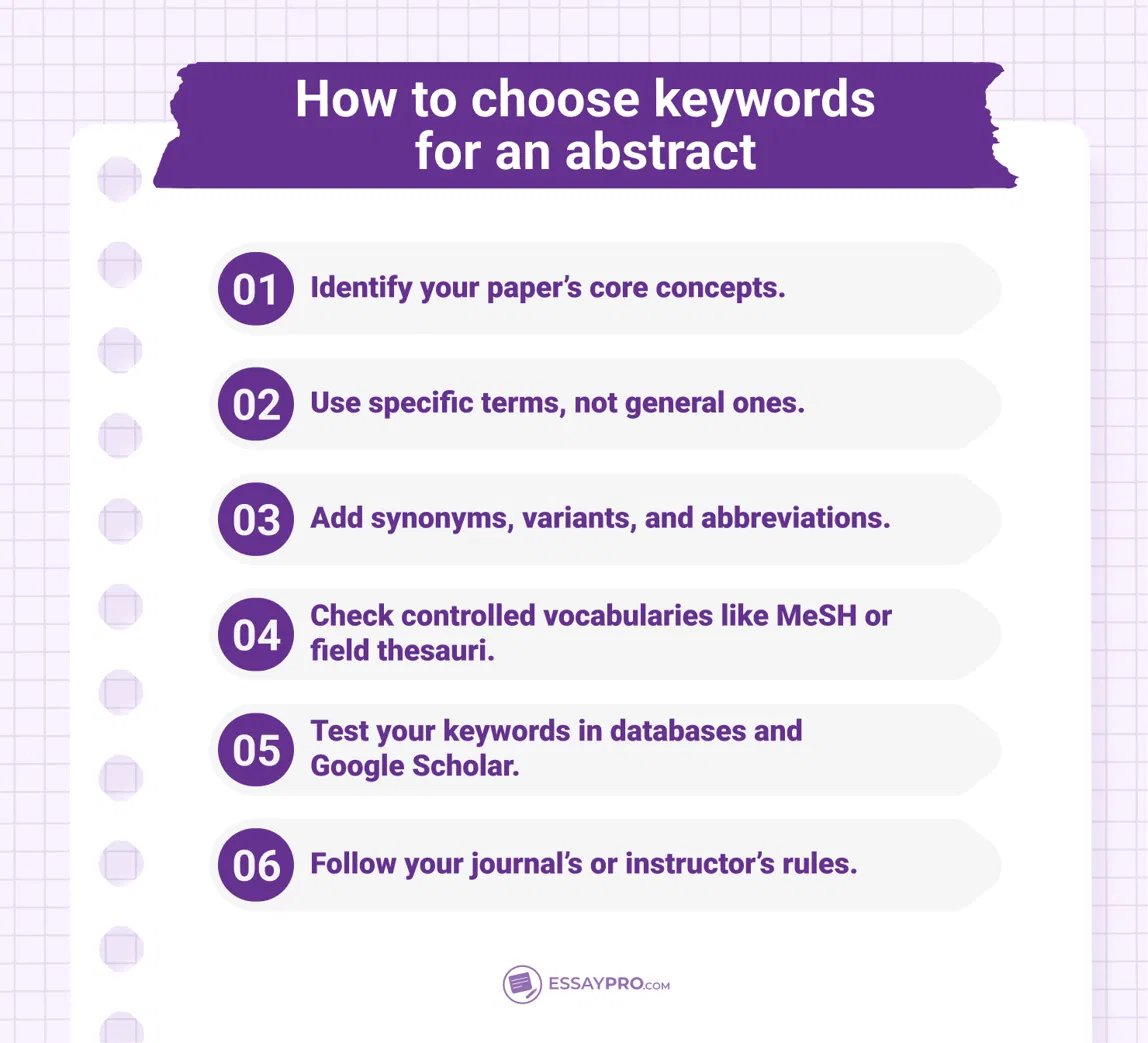
To choose keywords for an abstract, list your core concepts, make them specific, add variants, check controlled vocabularies, test them in databases, and follow the journal’s rules. Use these six steps for how to choose keywords for a research paper:
- Identify your paper’s core concepts.
- Use specific terms, not general ones.
- Add synonyms, variants, and abbreviations.
- Check controlled vocabularies like MeSH or field thesauri.
- Test your keywords in databases and Google Scholar.
- Follow your journal’s or instructor’s rules.
The examples follow one hypothetical study: a survey of high school students on sleep duration and academic performance.
Meanwhile, if you want an expert review of your abstract, try our paper writing assistance.
Step 1: Identify your paper’s core concepts
Start with your research question and abstract, and underline the main ideas. Ask what the main points of your topic are, then breaking the topic into keywords. Look for the population, the main variables, the outcome, the setting, and the method. Extract terms from your abstract, since keywords should reflect what the paper addresses. Aim for four or five core concepts before you trim.
Example: For the sleep survey, the core concepts are sleep duration, academic performance, high school students, and survey research.
The same concept list will also help you understand how to write a research proposal, since both start from a clear question.
Step 2: Use specific terms, not general ones
Replace broad words with the terms a specialist would use. Cambridge advises avoiding broad terms and targeting specific methodologies or subdisciplines. Elsevier’s guide asks authors to avoid general and plural terms and multiple concepts in one keyword. Springer Nature gives the same advice, with lists of poor and better keywords. A word like “sleep” matches thousands of unrelated papers, while “sleep duration” points to your topic.
Example: “Sleep” becomes “sleep duration,” “grades” becomes “academic performance,” and “school” becomes “high school.”
Step 3: Add synonyms, variants, and abbreviations
Readers describe the same idea in different ways, so think of synonyms, spelling variants, and common abbreviations. You do not need to list them all as keywords. Cambridge notes that a good abstract contains many, if not all, of the keywords, so variants can go in the abstract, where databases index them. Elsevier asks for sparing use of abbreviations, limited to those firmly established in the field.
Example: Adolescents may also be searched as “teenagers” or “youth,” and academic performance as “academic achievement.” Choose one as the keyword and use the others in the abstract.
Step 4: Check controlled vocabularies like MeSH or field thesauri
Controlled vocabularies are standard term lists used for indexing. The National Library of Medicine’s MeSH is a hierarchical terminology used to index PubMed, and searching it shows which official heading covers your idea. Education researchers can check the ERIC thesaurus, and psychology researchers the APA thesaurus. Some journals ask for terms from a list, so check before you submit.
Example: MeSH lists Adolescent with entry terms such as Teenagers and Youth, and it includes Academic Performance as a heading, so both are safe choices.
Step 5: Test your keywords in databases and Google Scholar
Search your candidate keywords in a library database and in Google Scholar, and see whether the top results look like your paper. If they do, readers using those terms will find similar work. If the results are off-topic or too broad, revise. Open a few relevant articles and check their keywords and subject terms, as Iowa State and Utah State suggest, and borrow terms that fit.
Example: Searching “sleep duration” and “academic performance” among adolescents may turn up related phrases such as “insufficient sleep.” Keep one only if it matches your study.
Step 6: Follow your journal’s or instructor’s rules
Your journal or instructor has the final say. Iowa State’s guide says to always follow the guidelines of the journal you are publishing in, and these differ: Elsevier allows a maximum of 6 keywords, while Springer’s Intensive Care Medicine requires 3 to 5. Under APA 7, the line begins with italicized Keywords and a colon, with commas between terms and no final punctuation. For coursework, follow the assignment.
Example (journal asks for up to 6): Keywords: sleep duration, academic performance, adolescent, high school, survey research
Need support with a full proposal, including its abstract and keywords? Our dissertation proposal writing services can guide you from topic to final draft.
Keyword examples by field
The table below gives abstract keywords examples for six hypothetical papers, each with four or five specific terms. All six papers are invented to show the pattern: a few precise core terms, plus one broader term that helps readers find the paper.
Notice that each list names the method or population as well as the topic, and keeps every term to a single idea.
Should keywords repeat words from the title?
Usually not. Many journals advise adding new terms, so the paper appears in more searches. To maximize discoverability by using terms that are not already in the title and abstract. The logic is that databases already search those fields, and Springer Nature notes that many databases search only the title, authors, and abstract. Rules vary, though. An editing guide from AJE says some journals bar title words from the keyword list, while others do not, in which case title words may still be worth including. Check your journal’s instructions.
Common mistakes when choosing keywords for abstract
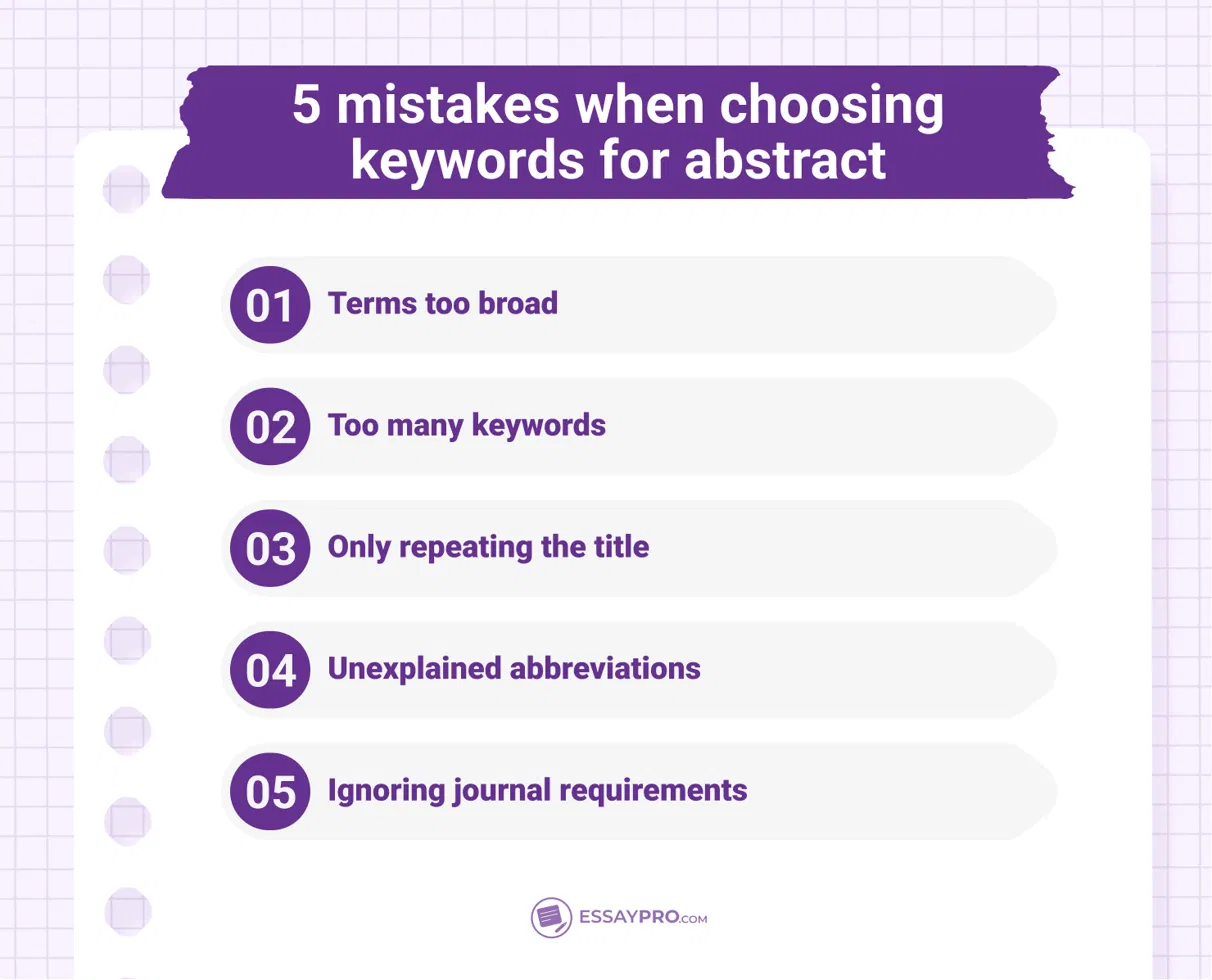
Five mistakes cause most weak keyword lists:
- Terms too broad: Replace “education” or “health” with the specific concept, such as “retrieval practice.”
- Too many keywords: Stay within the journal’s limit, which is often 3 to 6, and keep only the strongest terms.
- Only repeating the title: Add terms readers might search that do not appear in your title.
- Unexplained abbreviations: Use only abbreviations that are firmly established in your field, as Elsevier’s guide asks, or spell the term out.
- Ignoring journal requirements: Read the author guidelines for the number, format, and any required term list.
If you would like an expert to review your keywords and abstract, our research paper services can help.
Abstract keyword checklist
Review these six items before you submit:
- Each keyword reflects a core concept in your paper.
- Each term is specific, not broad.
- Common variants appear in your abstract, if not in the list.
- You checked a controlled vocabulary, such as MeSH, if your field uses one.
- A test search in a database or Google Scholar returns papers like yours.
- The list follows the journal’s or instructor’s limit, spelling, and format.
Summing up
Abstract keywords are the specific terms that tell databases, search engines, and reviewers what your paper covers. Choose them by listing your core concepts, using specific terms, adding variants, checking vocabularies like MeSH, testing searches, and following your journal’s rules. Aim for a short list that adds new terms beyond the title. Strong keywords help the right readers find your work.
FAQs
Do abstracts need key words?
How many keywords should an abstract have?
How to choose keywords for a research paper?

Nala Fox
Nala Fox is the Chief Human Resources Officer at EssayPro, with deep expertise in strategic leadership, organizational culture, talent acquisition, and employee well-being. With a forward-thinking approach to HR, Nala drives initiatives that promote inclusivity, engagement, and long-term professional growth. Under her leadership, EssayPro has implemented programs addressing employee burnout, enhancing productivity, and fostering a balanced, people-centered workplace where innovation and collaboration thrive.