Dialogue is the written record of a conversation between two or more people, and quotation marks show who said what. Putting all of this on the page with all the grammatical rules intact is usually where students become unsure because the rules change a bit between style guides, and even one comma out of place can leave a good paragraph looking careless.
Dialogue in an essay can turn a dull retelling of the events into an engaging scene the reader gets pulled into, so if you’re serious about writing, the guidelines are worth getting right. This guide covers how to write dialogue in an essay, along with the formatting rules and some practical tips for writing dialogue in an essay.
What Is Dialogue?
Dialogue is any spoken exchange in the written text. The word comes from the Greek dialogos - dia, meaning "through" or "across," fused with logos, meaning "word" or "speech." A common assumption says the "di" points to two speakers, but it doesn't, because dialogue describes meaning through words, which is why a back-and-forth among three or four people counts every bit as much as a two-person chat. There are three main types of dialogue in an essay:
- Direct dialogue. The exact words a person says, in quotation marks. "I'm not going," she said.
- Indirect dialogue. A paraphrase of what someone said, no quotation marks involved. She told him she wasn't going.
- Inner dialogue. The thoughts running through a character's head, usually shown in italics or folded into the narration. I should have said no, she thought.
Dialogue is not a standard in academic writing; you won’t need to build one when you choose informative speech topics, for example, so most assignments have almost no use for it. But there are a few exceptions:
- Argumentative essays
- Expository essays
- Analytical essays
- Research papers
- Persuasive essays
Reach out to our cheap essay writing service if you have any kind of academic paper to write.

Essays Due Soon?
Hand the hard part to expert sand get back a polished, ready-to-submit paper on time!

How to Structure Dialogue in an Essay
The good news is that, even though formatting trips many students up, there aren’t many rules to learn. Whatever style guide your teacher hands you, these ones hold true:
- Use double quotation marks for a speaker’s exact words. British style flips this and uses single marks as the default.
- New speaker, new paragraph, even when the reply is a single word.
- Punctuation stays in the quote. Commas and periods stay in the closing quotation mark in American English.
- Comma before the tag when the sentence continues past the quote. "I'll be late," she warned.
- Capitalize the first spoken word even when the line is placed in the middle of a sentence.
- Keep end marks with the speech. A question mark or exclamation point is in the quotation marks when it belongs to the spoken words themselves.
- A quote within a quote takes single quotation marks.
- Set off long quotes as an indented block with no quotation marks. Over 4 lines (MLA), 40+ words (APA), or 5 lines/100 words (Chicago).
- The dialogue tag gets punctuated with care: a comma, question mark, or exclamation point closes the quoted words before a phrase like "he said."
If you find it difficult to follow all grammatical rules when you write dialogue, our assignment writing services can take over your papers.
How to Write Dialogue in an Essay
Character, momentum, the sound of a real person talking - that's what a good line delivers, and a weak one just takes up room. The rules of writing dialogue in an essay mostly come down to a handful of habits, so here they are.
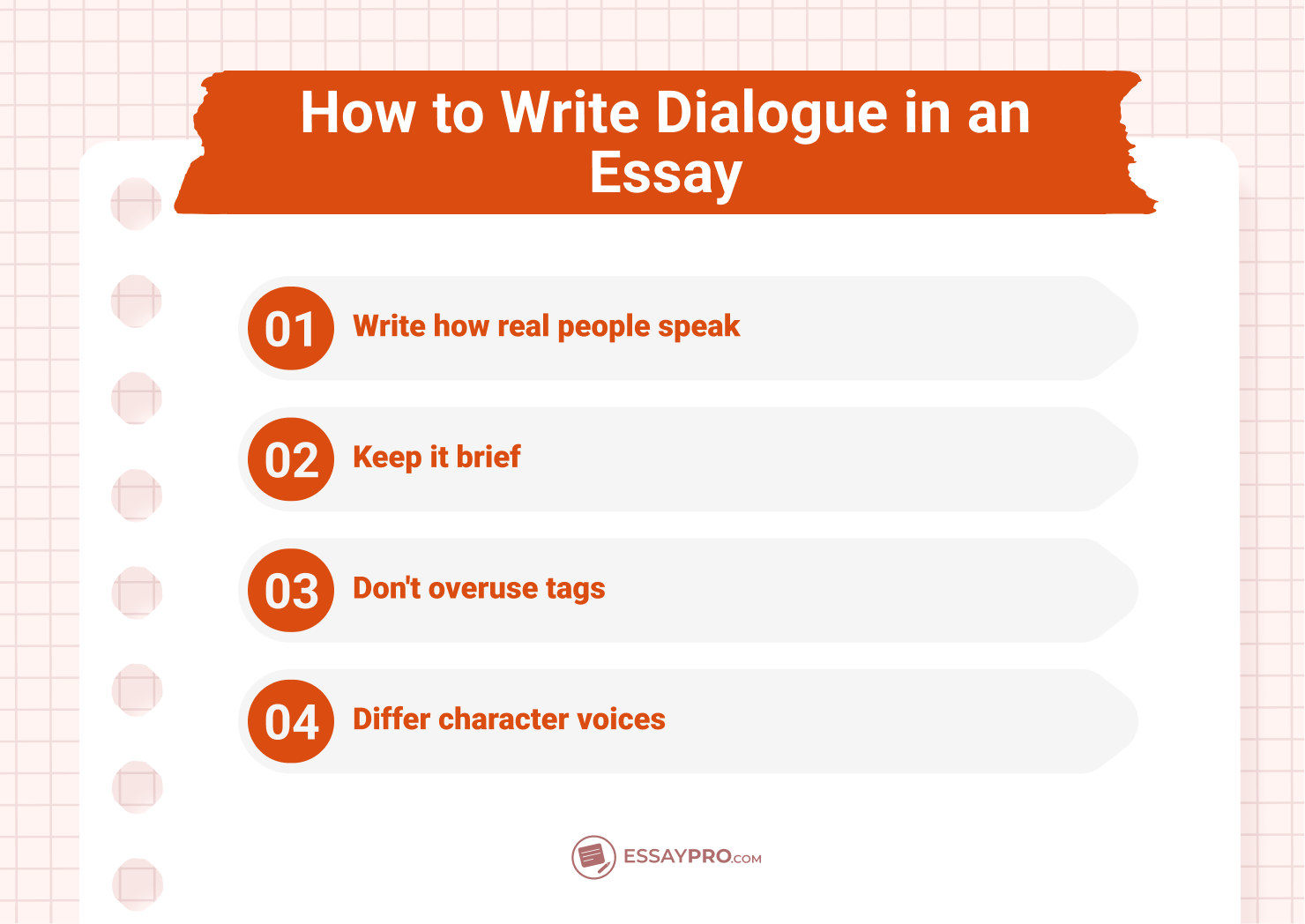
Write How Real People Speak
A test worth running when you’re learning how to write dialogue in an essay is to read your line to yourself aloud. If you'd never say it to another human, neither would your character. Nobody actually says "Are you going to accompany me to the event?" What comes out is "You coming?" Contractions, half answers, questions answered by questions are the “human” texture you’re looking for. I'd add one limit, because students hear "sound natural" and slide right into informal: a paragraph stuffed with "um" and "like" and "you know" doesn't read as authentic. It reads as annoying.
Keep It Brief
While there are definitely some cases where you need to know how to make an essay longer, six unbroken lines out of one character's mouth, and I've already skimmed to the end. So has your professor. Speeches sink faster when written than they do out loud because a reader has no voice or face to hold their interest. The fix is to interrupt the flow. Watch what a small action does here:
"I told him." She set the cup down. "Twice."
Three words of speech, one beat of movement, and the moment has more tension than a full paragraph would. Long line? Figure out its one job and cut the rest.
Don't Overuse Tags
I know "said" looks boring sitting there, but it’s better to leave it boring than go overboard with the tags. Its whole value is that readers don't notice it, so their eyes stay on the important words. The trouble starts when a writer reaches for variety and the page fills up with these:
- exclaimed
- queried
- retorted
- interjected
- opined
Every one of those drags attention onto the tag instead of the line. Two things help. First, once it's obvious who's speaking, drop the tag entirely. Second, if you catch yourself writing "she said angrily," that adverb is usually a sign the dialogue itself isn't doing the work, so fix the line, not the tag.
Differ Character’s Voices
The real test comes when you delete every tag and hand the writing to a friend. Can they still tell who's talking? If two characters swap lines with no confusion, you've got one voice wearing two names. Difference lives in the small stuff. A blunt person doesn't waste syllables:
"Fine. Go."
An anxious one can't stop qualifying:
"I mean, if that's okay? I guess we could, maybe?"
Just like a retired teacher and a bored teenager don't reach for the same words, and they shouldn't.
Writing a more research-heavy paper? You will sure need to know how to build a rrl outline example and how to pick the right sampling methods for your study.
Writing Got You Stuck?
Let us take over and turn your assignment into a paper you'll be proud to submit.
Final Thoughts
Dialogue brings essays to life when it's handled with care. Write the way people actually talk, keep exchanges short, lean on "said" when you can, and give each speaker a voice of their own. Nail the punctuation, respect your style guide, and your dialogue will read clean and confident.
A simple, short message of ‘Write my college essay for me, please’ is all that is standing between you and a polished academic paper.
FAQs
What Is Dialogue?
How to Write Dialogue in an Essay
What Are the Formatting Rules for a Dialogue in an Essay?

Adam Jason
is an expert in nursing and healthcare, with a strong background in history, law, and literature. Holding advanced degrees in nursing and public health, his analytical approach and comprehensive knowledge help students navigate complex topics. On EssayPro blog, Adam provides insightful articles on everything from historical analysis to the intricacies of healthcare policies. In his downtime, he enjoys historical documentaries and volunteering at local clinics.

.webp)