

A supplemental essay is a short, specific response that complements the standard college application. By responding to the question, the admissions officers get additional information needed to assess whether you're a good fit for their campus community. Supplemental essays usually ask about your goals, values/experiences, academic interests, or how you connect to the university. To define such an essay in one simple idea, I would explain it like this: supplemental papers are included alongside other information in the application so the committee can see the full picture of the applicant beyond the grades and data.
In this article, I will provide a general overview of supplemental essay prompts and why colleges use these questions in the first place. Beyond that, we will also walk through the writing steps about how to write a supplemental essay and specific examples so you know how to develop your response.
What Is a Supplemental Essay?
A supplemental essay is a required extra part of the application process that specific institutions ask for. Admissions will use grades and test scores to verify academic ability, and it's just as important, but supplemental essays provide better insight into how an applicant thinks, and, generally, what type of student they might be in the future.
Read also: How to write a cover letter for your college application.
Good Ideas Need Structure
Share your assignment details and get support that keeps the final paper focused and readable.

Why Do Colleges Ask for a Supplemental Essay?
Colleges often ask for writing a supplemental essay so they can learn more about an applicant's qualifications beyond polished achievements. A well-written supplemental essay can show admissions officers how your personal interests align with the institution's programs and classes, values, and student life in a manner that is specific and personal, but not necessarily found in other parts of the application.
Different Types of Supplemental Essay
There are many different types of supplemental essay questions. When you look at all the prompts, they tend to ask about one of five things: why you want to go to that school, the direction your academic life is going, what you do outside of school, what kind of community you belong to, or how you’ve handled challenges. The key is reading between the lines: in the responses to these questions, schools want to see your judgment, self-awareness, and your understanding of why you are applying to their school.
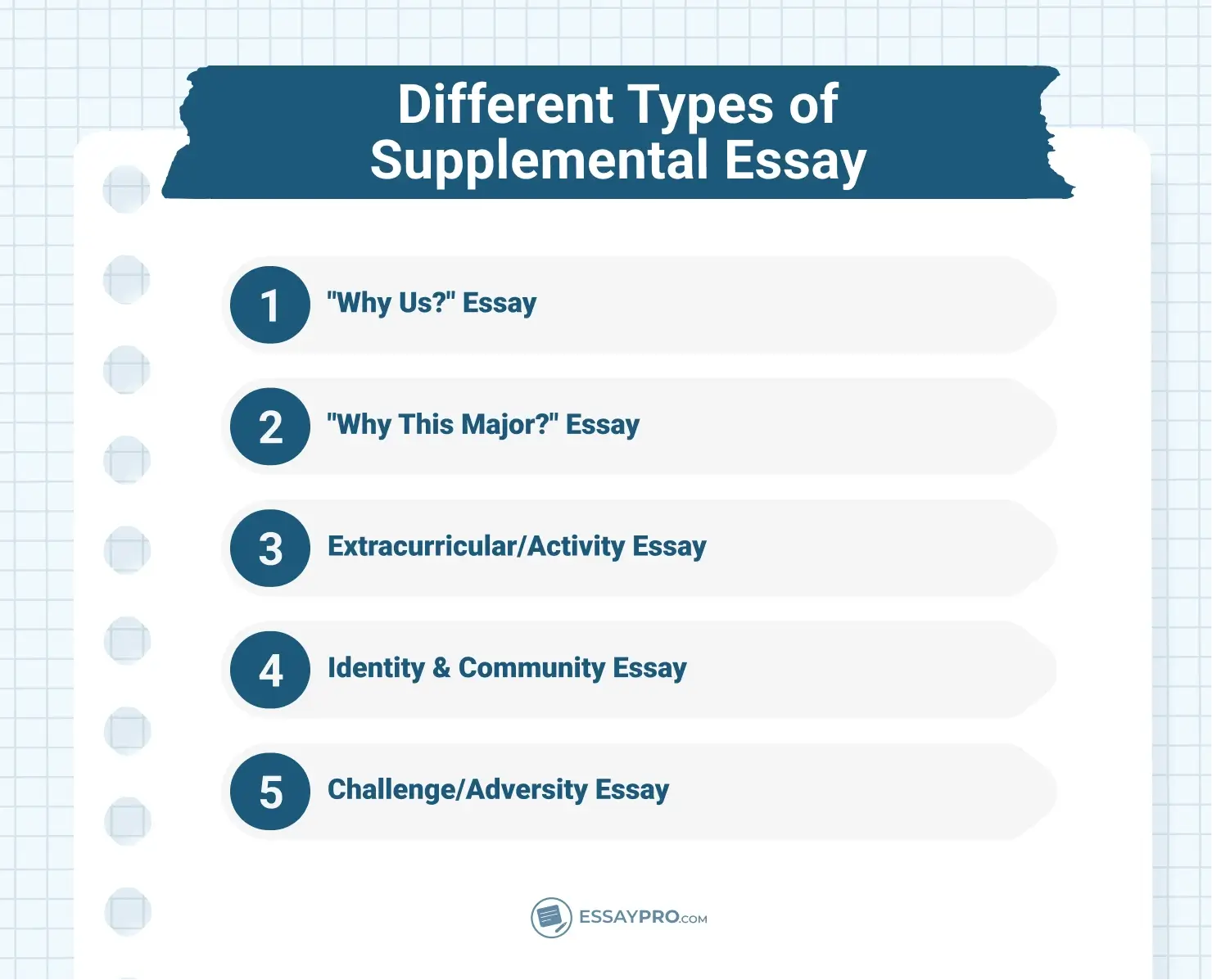
"Why Us?"
This type is the one where vague admiration for the school will quickly fade. The committee does not need yet another paragraph about “beautiful campus” or “great academic programs,” trust me, they've read that more than enough. Those sentences would work at almost any other school, so they are useless.
Sample prompt: Why are you interested in attending our university?
The ultimate goal with “Why Us?” is to demonstrate how you belong at that school based on how you would use their resources. So your answer should name something specific (i.e., a particular class, lab, professor and/or student publication, research center, freshman program, clinic, or campus event/tradition) that connects with one of your goals.
A good approach to use here is to create a small chain: what you care about, what the school offers, and what you will do there. For instance, a student interested in urban policy may connect a city planning class with what they have done as an undergrad through urban community research. This approach makes your response feel much more believable than just saying that the school has “lots of opportunities.”
"Why This Major?"
The “why this major” essay is designed to highlight the evolution of your academic interest. The school wants to know how you developed your interest in the first place, what has maintained it, and where you want it to take you next.
Sample prompt: What draws you to your intended field of study?
Unfortunately, many students’ first thought is just to write their career goal and then stop. A better response will demonstrate your curiosity. For example, you might have worked on a statistics project and discovered that there is human behavior hidden inside data. Or, maybe you worked in a family business and learned that economics is not just a set of numbers on the wall of your classroom.
So, what is the basic principle? You tell a real-life moment. Then, explain how that moment inspired an academic interest that directly correlates with your major. Also, be sure to include enough future goals to show that you are not just thinking about the major label.
Extracurricular/Activity
Be careful. This prompt might seem like you can just give a summary of a club or list your duties, mention leadership, and say, "done." Wrong. This gives you little to give the committee.
Sample prompt: Tell us about an activity that has been meaningful to you.
The purpose of this prompt is to show how you act when there is no grade attached to your decision. Are you someone who initiates things? Do you see problems and try to solve them? Will people trust you to take on responsibility? Are you someone who makes a group work together and/or function better?
Choose one activity and narrow it down to your specific role in it. A soccer captain might talk a little about winning soccer games, but mostly about rebuilding team morale after younger players quit. A volunteer tutor might focus on how they learned to teach fractions to a child who was embarrassed just by talking to them.
Choose a scene that is the best to describe how you changed others or changed as a result of your participation.
Identity & Community
This essay is asking about your "human origin." That could be culture, language, family, neighborhood, faith, disability, migration, work, art, caregiving, or could be based on a community that shares an interest. The category is wide, so the writing must be precise.
Sample prompt: Describe a community you belong to and how it has shaped you.
The goal is not to define your community in the manner of a dictionary entry, however, colleges still want to see how the environment shapes the way you act, how it determines your values, or voice.
Choose one particular small repeated detail. An example could be how Sunday dinner taught you how to resolve conflict, forgive others, and come back to the dinner table regardless. Another example could talk about how the local dance studio taught you how to associate discipline with sound, such as counts, shoes, breath, corrections. Write toward change, in short, and show how the community influenced the way you listen, lead, question, care, or participate.
Challenge/Adversity
This essay needs better organization. If the problem dominates the entire essay, the reader learns only what happened, and too little about how you responded.
Sample prompt: Describe a challenge you faced and what you learned.
Try to show resilience, or judgment, or how you have grown under pressure. The challenge could be of a serious nature, practical, academic, social, family-related, or internal. What matters more than the size of the event is the clarity of your response.
Show readers enough context to understand the difficulty, then show them how you acted as a response. What did you try? What did not work? Who assisted? How did you change your thought process/behavior? Growth is generally uneven; therefore, your essay does not necessarily need a neat happy ending.
The best approach is to avoid self-pity and false victory; show the reader that you met a difficult challenge, made decisions, and came out of that difficulty having learned more about yourself.
How to Write a Supplemental Essay?
A good process keeps supplemental essay prompts from turning into a pile of half-finished drafts. Before you write a supplemental essay, sort the work, study each college with some care, choose material that adds something new, and revise with the actual word limit in mind. To write a supplemental essay, follow these steps (which we will discuss in detail in just a minute):
- Group similar prompts before drafting.
- Track word counts, deadlines, and essay status.
- Connect each response to one specific college.
- Check that every answer adds new information.
1. Put Every Prompt in One Place First
Start by building an essay tracker. A simple spreadsheet works, where you list each college, prompt, word limit, deadline, essay type, draft status, and rough notes. Create one last column for rough notes, this will help catch early ideas before they disappear.
The tracker also keeps you from overlooking simple requirements. One school may ask for 650 words, while another may hide two 100-word responses in the portal. Once every prompt is in one place, sort them by type: “Why us?”, major, activity, community, and challenge. This helps you reuse ideas thoughtfully without copying the same answer across different schools.
The supplemental essay format you go for also depends heavily on length. A 100-word answer needs one focused point. A longer response can include context, a school detail, and a next step.
2. Make the Essay Belong to That College
A compelling supplemental essay must feel connected to the college or program. Dropping in a few random course names from the website will not pass as real research. Admissions readers can tell when a student grabbed details too quickly.
For a “Why us?” response, review department pages, course descriptions, student organizations, research programs, campus newspapers, service options, and first-year opportunities. Then choose details tied to your actual interests. A course title alone means little. A course linked to a question you already care about feels stronger.
Also explain what you will contribute. For example, public health interest could connect clinic-form translation experience to a health equity program.
3. Choose Ideas That Add Something New
Do not begin with the final draft. Begin with a rough list. Write down classes, projects, conversations, books, jobs, family duties, problems you solved, and questions that kept bothering you after the moment passed. Some of these ideas will be too small. Fine. Small ideas often become useful once you know what the prompt is really asking.
Now compare those ideas with your personal statement. This part matters more than students usually think. If your main essay already tells a long story about your family business, your supplemental essays should probably show another side of you. Maybe your academic curiosity. Maybe your role in a club. Maybe the way you think in groups.
A short essay outline helps keep the answer from wandering. For a 250-word essay, you might use this order: one specific moment, why it mattered, one college connection, and what you hope to do next. For a major essay, try a slightly different path: early interest, stronger experience, current question, relevant college resource.
The point is not to make the essay rigid. The point is to stop it from becoming a résumé paragraph with nicer sentences.
4. Draft Like a Person, Then Revise Like an Editor
The first draft should be plain. Really plain, if needed. Too many students try to sound impressive too early, and the essay turns stiff: too many abstract words, too much polish, not enough actual thought. Write the honest version first, even if it feels a little rough. Then revise with a sharper eye:
- Did you answer the prompt directly?
- Did you add something the rest of the application has not shown?
- Did you include a school-specific detail where needed?
- Did every sentence do a real job?
Word limits make vague writing less forgiving. “I care about community” gives no scene, no action, no proof. “I helped neighbors complete housing forms after school on Thursdays” does more work in fewer words.
Supplemental Essay Examples
A good essay should feel specific enough that another applicant could not easily claim it. The answer needs a clear prompt focus, a real student voice, and details that belong to the college named in the essay. Strong college supplemental essay examples also avoid résumé language. They show thinking, decisions, and fit through small but useful details.
"Why Us?" Example for Boston University
I want to study at Boston University because the school’s structure matches the way my interests actually work. I am interested in public health, but the questions that keep pulling me in are rarely limited to one department. A clinic visit can become a language access issue. A housing policy can become a health issue. A public message can succeed or fail based on one sentence.
That is why the BU Hub interests me. The chance to build general education through courses across different schools would help me study health as a human problem, not only as a science requirement. I would look for courses connected to social inquiry, communication, and civic engagement because those areas connect directly to the kind of work I have started doing in my own community.
The Cross-College Challenge also stands out because I like the idea of solving a real problem with students who do not all think through the same academic lens. In high school, I helped translate basic health forms for older neighbors, and I learned that clear information can change how safe people feel. At BU, I would want to bring that experience into team-based projects where public communication, research, and community needs meet.
Boston also makes sense for me because I want a campus that feels connected to actual city life. I would use that setting carefully. I am not looking for a college that simply sounds impressive. I am looking for a place where my interest in health equity can become coursework, field experience, and better questions.
"Why This Major?" Example for Penn State
I became interested in psychology after noticing how often people explain behavior too quickly. Someone is “lazy,” “dramatic,” “difficult,” or “unmotivated,” and the label lands before anyone asks a better question. In my sophomore year, I volunteered as a peer tutor, and one student changed how I understood learning. He knew the material during practice, then froze during every quiz. At first, I thought the problem was preparation. It was not that simple. His anxiety changed his access to what he already knew.
That experience pushed me toward psychology because I wanted a field that treats behavior as something to study carefully. I am especially interested in development, learning, and anxiety in academic settings. Penn State’s psychology major appeals to me because it combines classroom study with research opportunities, which is important for the way I learn. I do not want to only read about attention, stress, and motivation. I want to understand how researchers ask better questions about them.
The department’s emphasis on research, teaching, and service fits the kind of student I hope to become. I would like to seek undergraduate research experience after building a stronger foundation in psychology methods. I am interested in work that involves data collection, surveys, observation, and discussion with faculty or graduate students because those tasks would help me see the science behind familiar human problems.
A psychology major at Penn State would give me room to connect my interest in people with actual research habits. That is what I want most: less guessing, more disciplined attention.
Extracurricular Essay Example for Northeastern University
The most meaningful activity I joined in high school was not the one with the best title. It was our after-school tutoring group, which started as a small volunteer project and became part of my weekly routine. I worked mostly with ninth-grade students who were struggling in English and history, though the real work often started before we opened the textbook.
Some students arrived already convinced that they were bad writers. I recognized that look because I had felt it before: the blank-page panic, the overthinking, the urge to write one safe sentence and stop. My job was not to sound smart in front of them. My job was to help them find the next usable step. Sometimes that meant breaking a paragraph into two claims. Sometimes it meant asking them to explain the idea out loud before writing it down.
Over time, I became the person who made the session feel less tense. I created short planning sheets, helped younger tutors learn how to give feedback, and kept a shared folder of examples students could use when they felt stuck. The group became better because we stopped treating tutoring as answer-checking and started treating it as a conversation.
That is one reason Northeastern appeals to me. Its culture of experiential learning fits the way I already like to grow: through action, reflection, and repeated practice. With so many student organizations and opportunities for service learning, I would want to keep working in spaces where education becomes practical. I know I would bring patience, structure, and a habit of noticing when someone is confused but too embarrassed to say so.
Identity and Community Essay Example for the University of Michigan
One community that shaped me most is the group of women in my family who treat language as a shared responsibility. In our house, translation is not a formal event. It happens at the kitchen table, in pharmacy lines, during school meetings, and over the phone when someone needs the right phrase at the right moment. I grew up hearing adults pause over words because the wrong translation could make a person seem rude, careless, or less capable than they really were.
As I got older, I became part of that system. I translated emails for relatives, explained school forms, and helped younger cousins rewrite messages when they sounded too blunt in English. At first, I thought I was simply helping. Later, I understood that language can decide how much dignity a person keeps in an unfamiliar room.
This community gave me a strong sense of responsibility. It also made me careful with people. I learned to listen for what someone means before trying to improve how they say it. That habit now affects the way I work in groups, write, and respond when someone feels out of place.
At the University of Michigan, I would want to bring that experience into communities where identity, service, and learning are connected. The Michigan Community Scholars Program interests me because it focuses on social justice, intercultural competence, and meaningful community engagement. I can see myself contributing as someone who understands that inclusion often depends on ordinary acts: clearer words, patient listening, and the choice to make space for people who hesitate before speaking.
Challenge Essay Example for Yale University
During my junior year, I took on too much and admitted it too late. My classes were harder, my tutoring hours increased, and my family needed more help at home because my mother’s work schedule changed. At first, I treated the problem like a time-management issue. I made color-coded plans, stayed up later, and convinced myself that effort would fix everything.
It did not. My grades did not collapse, but my attention did. I read the same paragraph six times and remembered almost nothing. I became impatient with people who needed me. The part that embarrassed me most was how long I kept pretending I had it under control.
The turning point came after I missed a tutoring session I had promised to lead. No disaster followed, which somehow made it worse. I had become unreliable in a role I cared about. That forced me to make changes that felt uncomfortable because they were plain. I spoke with my teacher, reduced my volunteer schedule for a month, and started planning my week based on actual hours, not ideal ones. I also asked another tutor to share leadership, which I should have done earlier.
The challenge taught me that responsibility without honesty becomes its own kind of problem. I still care about doing hard things, but I now pay closer attention to capacity, communication, and follow-through.
At Yale, I would carry that lesson into academic and residential life. A demanding environment appeals to me, though I know ambition needs self-knowledge behind it. I want to contribute as a student who works seriously, asks for help before a problem spreads, and respects the commitments she makes.
Personal Statement vs. Supplemental Essay: How to Tell the Difference
A personal statement and a supplemental essay are placed within the same application, so students often treat them as similar work. But they are not. Take a look at the comparison table below to understand the differences.
Here's a quick guide on how to write a personal statement as well.
What to Avoid While Writing a Supplemental Essay
A weak supplemental essay either sounds like the student barely knows the college or it repeats information the admissions reader has already seen elsewhere. Sometimes both, which is worse. Strong essays tend to stay tighter: one prompt, one useful idea, and enough detail to make the answer believable.
- Writing that could fit any college: A good answer names specific details, then explains why these details fits your interests.
- Repeating the personal statement: If your main essay already tells a specific story, the supplemental essay should probably move elsewhere.
- Turning every experience into a life lesson: Challenge essays can become too neat. Real growth often looks more practical than dramatic.
- Listing achievements instead of explaining your role: In the essay, pick one example and show how you worked, decided, helped, led, adjusted, or learned.
- Ignoring the word limit: If the prompt gives you 150 words, get to the point early. Keep only the context the reader actually needs.
- Using school details without a personal link: A course name or professor name does not help much by itself. Show why that resource connects to your goals and intentions.
Deadlines Get Messy?
Our service helps you move through drafts faster while keeping your paper clear and organized.
Final Thoughts
Supplemental essay writing gets easier once you stop treating each prompt as a separate performance. The answers should work together with the rest of the application. Organize the prompts, research each college properly, choose material that adds range, and revise with a hard eye for vague claims. Specificity does most of the heavy lifting here.
FAQs
What Is a Supplemental Essay for College?
How Long Should a Supplemental Essay Be?
How to Write a Good Supplemental Essay?
What Should I Avoid in a Supplemental Essay?