A short essay is a compact piece of academic writing where the word count is usually between 250 and 500. The whole text must fit into roughly 3 to 5 paragraphs, that’s all a student gets. The format of short essays, from my experience, trips people up, especially on the first try, but sometimes even later on. The issue comes when what you want to cover in your paper isn’t thought out well enough, which prevents you from conveying it briefly.
If you’re on that stage of your writing process right now, unsure how to bring together your thoughts in such a short format, I’d recommend reading this guide all the way through. We will talk about the characteristics of a mini essay, along with the steps of how to write a short essay, topped off with specific examples you can adapt to your own topics.

What Is a Short Essay?
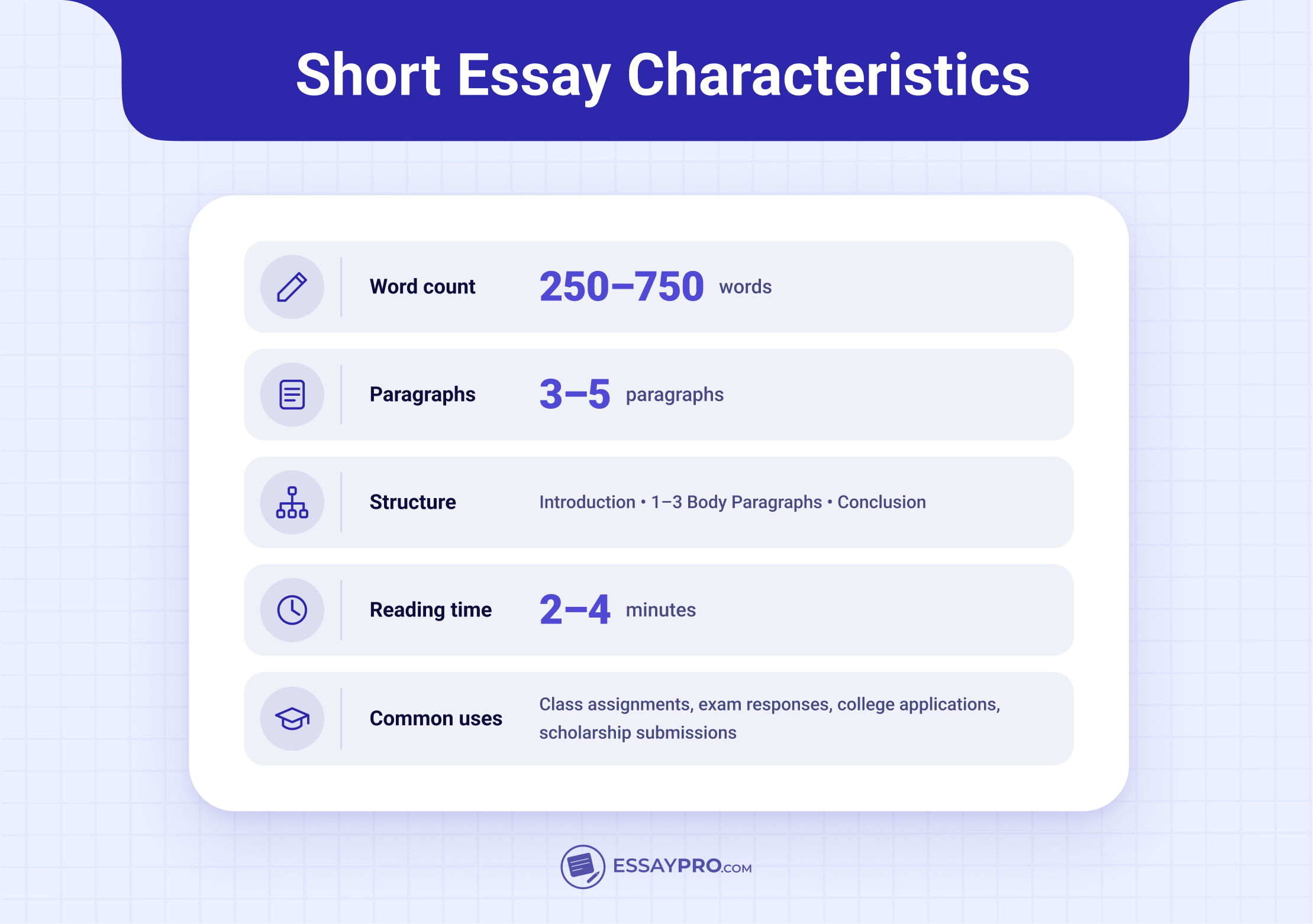
We need to get specific because "short" means different things to different professors, so the answer to how long is a short essay is anything but universal. For most assignments, you're looking at a 250 to 500 word essay, but you’ll see instructors push that ceiling closer to 750. Check your brief first, so you don’t lose marks for assuming the cap is 600 when it is really 400. Here's what sets a short essay apart:
- It commits to a single argument without drifting to side points.
- There's a clear beginning, middle, and end.
- Language stays very controlled, with repetition kept to almost nothing.
- Most of the time, subheadings and long reference lists get left out.
- You state the main point early on, often right in the opening line.

Better Drafts Start Here
Turn rough notes into a focused, well-organized paper with help from real writers!
Structure of a Mini Essay
With the length settled, your next job is learning the short essay format. While the length changes from one assignment to the next, the underlying skeleton of short essays barely does, almost to the point where it becomes routine once you do it enough. Here’s the frame I personally lean on when I’m writing a short essay:
.webp)
- Introduction: Writing a good essay introduction includes drafting a hook, some quick context, and then your thesis that announces your argument outright.
- Body paragraphs: Expect one to three. Each covers a single idea, offers evidence, then explains why the idea earns its place.
- Conclusion: Say your thesis again in different words, tie the threads together, and hand your reader something worth holding onto.
How Many Paragraphs Is a Short Essay?
The textbook answer to how long your mini essay should be is five. You get an intro, three body paragraphs, and a conclusion. A more limited word count of 250 words might be a 3 paragraph essay, and that's completely fine as well. The real and most professional advice would be to count ideas instead of paragraphs, so each point has enough room for development through evidence.
How to Write a Short Essay in 6 Steps
Here's the actual process. Writing a short essay really comes down to six moves: you understand the prompt, brainstorm, sharpen a thesis, outline, draft, and then edit. Get how to write a short essay down this way, and the short essay format stops being a puzzle you solve from scratch every time.
Step 1: Understand the Assignment
Read the prompt twice before you touch the keyboard. I've watched classmates lose easy marks because they answered a question nobody actually asked. The verb is what you're hunting for, since it dictates the whole job.
- Analyze wants you to break something down and examine the parts.
- Argue wants a side, defended.
- Compare wants similarities and differences laid out.
While you're there, note the word count, the deadline, and any formatting rules. Two careful minutes now spare you an hour of rewriting.
Step 2: Brainstorm Before You Commit
Don't lock into your first idea, because it's almost never your best. Give yourself five, maybe ten minutes to dump everything down, messy and unfiltered. Some of my strongest essays came out of the third or fourth thought, never the obvious one that arrived first. A few methods that work:
- Freewriting: five minutes nonstop, no editing allowed.
- Listing: every angle you can think of, bullet after bullet.
- Questioning: who, what, why, and the underrated "so what?"
Afterward, step back and circle whichever idea has the most in it.
Step 3: Narrow to a Sharp Thesis
Your thesis is the spine of the piece, so it has to be specific. Vague thesis, vague essay, every single time. "Social media is bad" tells the reader nothing, whereas something like "Social media harms teen sleep by disrupting bedtime routines" hands you a real claim to defend. A strong thesis tends to pull off three things at once:
- It stakes out a clear, arguable position.
- It signals your main supporting points.
- It stays within one readable sentence.
Step 4: Outline Before Drafting
Five minutes of outlining spares you from needless hours of drafting. Once outlining each time you have to write an essay becomes a habit, the writing speeds up, and the structure finally holds.
Step 5: Draft in One Go
Write the first draft fast and resist the urge to fix as you go. Perfectionism kills momentum, and a short essay is compact enough that a rough version fits into one sitting anyway. Things to hold in mind:
- Stick to the outline, though a good tangent is worth chasing.
- Drop a bracket like [check this] instead of stopping to research.
- Leave a stubborn sentence half-done and circle back.
Step 6: Edit Twice
One editing pass will not cut it; anyone with some experience in writing will tell you they found this out the hard way. Do two, and keep them separate so each has its own assignment.
- First pass: the big stuff. Does the argument hold together? Anything missing, anything off-topic?
- Second pass: the small stuff. Grammar, spelling, clunky phrasing, and word count.
Read it aloud during round two, because your ear catches slips your eye glides right over. If time allows, walk away for an hour before the final look.
Fitting your arguments in such a limited space requires controlling the language as best you can, which, in turn, needs a profound knowledge of grammar rules. For starters, learn the is vs are rules and usage examples.
Better Drafts Start Here
Turn rough notes into a focused, well-organized paper with help from real writers!
Short Essay Examples
Sometimes the fastest way to understand short essays is to simply see a few in action. Below are five examples you can learn from and borrow structure from.
Short Essay Example #1
Somewhere along the way, we decided that everything we do has to be worth something. The guitar has to become a side gig, the sourdough starter has to earn its keep on Instagram, the weekend run has to shave time off a personal best. I felt this pressure myself when I picked up watercolor painting two years ago and immediately started wondering whether I could sell prints. That instinct, I've come to believe, ruins the whole point. You should let yourself be genuinely bad at a hobby, because the freedom to do something purely for enjoyment is one of the few things left that no one can grade, sell, or optimize.
Short Essay Example #2
My phone buzzed forty times during a single dinner last week, and not one message was addressed to me specifically. That's the group chat for you. It arrived without fanfare and rewrote the rules of friendship, and most of us never stopped to ask whether we agreed to the new terms. The group chat has manufactured a form of social obligation that nobody consciously chose, and it deserves far more scrutiny than the cheerful little bubble on our screens ever invites.
Short Essay Example #3
Imagine your browser history projected onto a screen at your own funeral, every query from the past year scrolling past your grieving relatives. Most of us would be horrified, and that reaction reveals something worth examining. The gap between our search bars and our social faces is not a small inconsistency to be embarrassed about. It is evidence that we maintain two selves, a public one built for other people and a private one that only the search engine ever meets, and the honesty of that second self is something we should take more seriously rather than hide.
Short Essay Example #4
Every family gathering seems to have that one relative who hears "philosophy degree" and physically winces. I know, because I was the philosophy major fielding the winces. The assumption underneath them is that a major only counts if it maps neatly onto a job title and a starting salary. That assumption is not just narrow; it's wrong. The so-called useless major, the one in literature, history, or classics, delivers a real and measurable payoff, and dismissing it as impractical misreads both the data and the purpose of an education.
Short Essay Example #5
I'll take the advice of an anonymous username with a profile picture of a cat over my own well-meaning aunt, and I suspect I'm not alone. We read forty reviews before buying a toaster, comb through Reddit threads at 2 a.m. for medical reassurance, and trust the collective verdict of people we'll never meet. Meanwhile the friend across the table offering the same suggestion gets a polite nod and little more. This isn't a quirk or a character flaw. We trust internet strangers more than familiar people because distance strips away the social baggage that makes advice from friends so hard to hear cleanly.
Final Thoughts
Short essays reward clarity over length. You now know they run roughly 250 to 500 words across about five paragraphs, and that the writing process comes down to six steps: understand the prompt, brainstorm, sharpen a thesis, outline, draft fast, then edit twice. Nail those, and a short essay stops feeling intimidating.
FAQ
How Long Is a Short Essay?
How Do You Start a Short Essay?
How Many Paragraphs Are in a Short Essay?
What Is the Format of a Short Essay?

Annie Lambert
specializes in creating authoritative content on marketing, business, and finance, with a versatile ability to handle any essay type and dissertations. With a Master’s degree in Business Administration and a passion for social issues, her writing not only educates but also inspires action. On EssayPro blog, Annie delivers detailed guides and thought-provoking discussions on pressing economic and social topics. When not writing, she’s a guest speaker at various business seminars.