

Scope and delimitations in research describe two parts of a study’s boundaries. Scope is the full range of what a study covers. Delimitations are the limits a researcher chooses on purpose, and each limit needs a reason. Both terms differ from limitations, which fall outside a researcher’s control.
This guide defines each term, breaks scope into its building blocks, lists the questions good delimitations should answer, and maps the main types of delimitations with examples.

Papers done, pressure gone
Share the topic so we can return with a finished, correctly cited work.

What is scope in research?
Scope in research is the full set of boundaries that define what a study investigates and who its findings speak for. The scope of the study names the problem, the people, the variables, the place, the time span, and the methods used. Anything outside those limits falls beyond what the results can claim.
A clear scope answers one practical concern: the point where the findings stop being true. A study on burnout among emergency room nurses at three hospitals in Ohio during 2024 tells readers exactly that. The results describe those nurses, those hospitals, that year. A reader cannot stretch them to teachers in Texas or to the same nurses a decade later. The research problem, the population, and the measured variables all live within that boundary. A well-written scope reads like a confident claim about what the study earned the right to say.
Elements of a complete scope statement
A complete scope statement covers 8 building blocks. Each block answers a specific reader question, and a missing one leaves a hole a committee will find.
- Research problem: the issue the study sets out to solve, stated in a single sentence.
- Research questions: the exact questions the collected data will answer.
- Population and sample: the whole group the study targets, plus the smaller subset that researchers actually measure.
- Variables: the factors the study tracks, including both the suspected causes and the measured outcomes.
- Setting: the physical or organizational place where data collection happens.
- Time frame: the window the study covers, such as one semester or a three-year span.
- Methodology: the research design and the tools used to gather and analyze data.
- Theoretical framework: the existing theory the study builds on to explain its variables.
Why a clear scope matters
A defined scope earns its place by doing 4 jobs at once.
- Keeps the research focused: a fixed boundary stops the project from drifting into side topics that burn time and budget.
- Makes the workload realistic: a sample of 200 students is a plan a person can finish; a sample of all students is a fantasy.
- Shows how far the findings apply: readers learn the exact population and setting the results describe.
- Points to gaps for future research: every excluded group or variable becomes a lead for the next study.
Get help from our dissertation proposal writing services to make sure you get the funding committee’s attention.
What is delimitation in research?
Delimitations in research are the deliberate choices a researcher makes about what to include and what to exclude. A researcher locks these boundaries in before data collection starts. Each delimitation needs a reason that connects to the research goal. A boundary without a reason reads as an accident, and reviewers treat that as a weakness.
The timing is the clean line between delimitations and limitations. A researcher sets delimitations on purpose during the design stage. Research limitations appear despite good planning and fall outside the researcher’s control. Mix up the two, and a committee will catch it fast. Reviewers read the delimitations section early to judge a study’s feasibility.
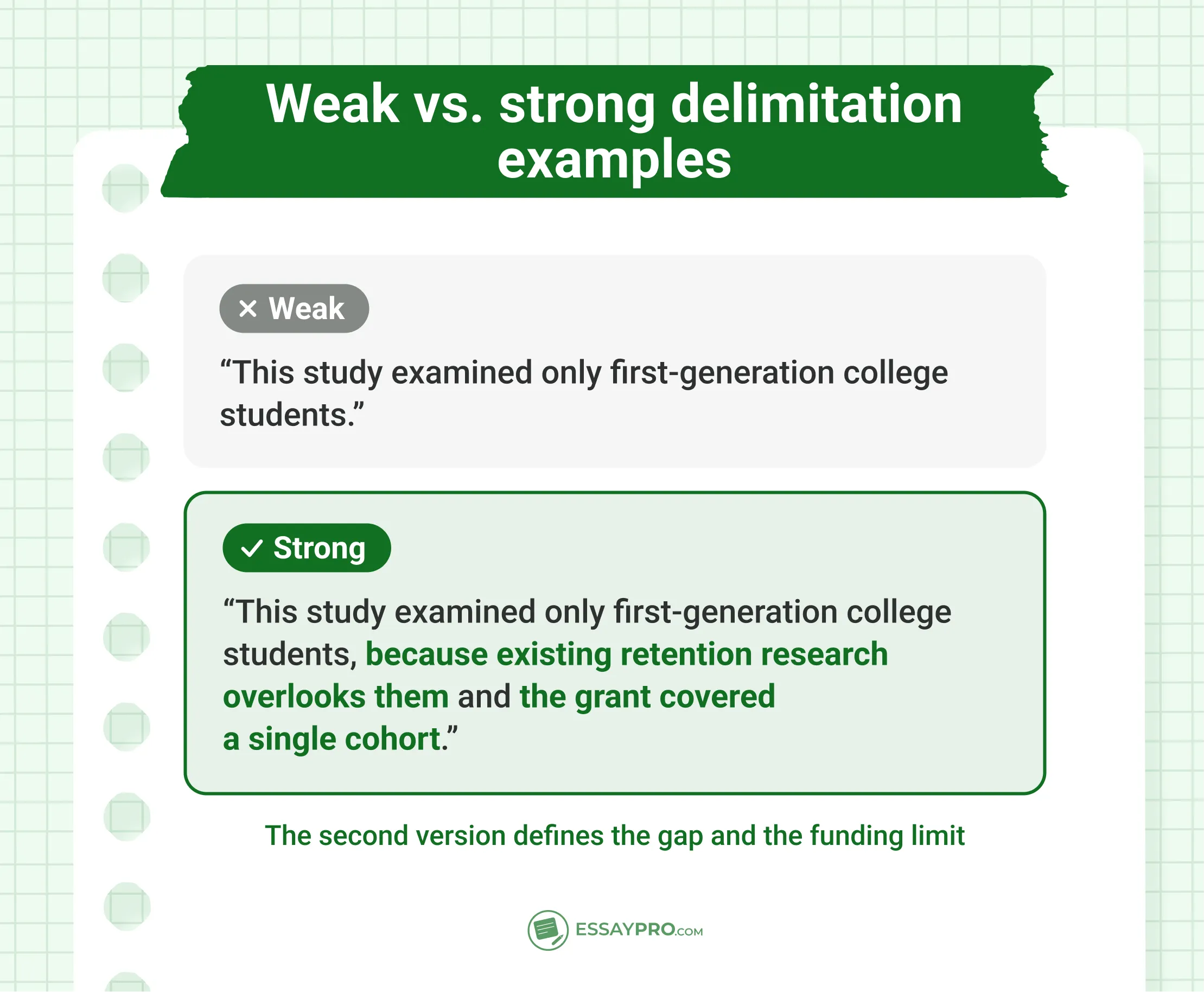
Two versions of the same boundary show the gap.
- Strong: “This study examined only first-generation college students, because existing retention research overlooks them and the grant covered a single cohort.”
- Weak: “This study examined only first-generation college students.”
The first version hands the reader a reason that points to a gap and a funding limit. The second leaves the reader guessing, and a guessing reviewer assumes the cut was lazy. Every exclusion deserves that same one-line defense.
Questions your delimitations should answer
Solid delimitations answer 5 questions before a reviewer thinks to ask them.
- What did the study exclude, and what is the reason behind each cut?
- Why did this research design fit the question best?
- Why does this theory match the study’s variables?
- Why does this time frame cover the right period for the data?
- How do these boundaries still let the research questions get a full answer?
Types of delimitations
Most delimitations fall into 6 types. Each type draws a different boundary around the study, and a strong scope statement often names 3 or 4 at once. The table pairs every type with the boundary it sets and an original example.
Find out where to find credible sources for your research paper so you can build your project on reliable data.
Scope and delimitation examples
Two scope and delimitation examples appear below, one for a quantitative study and one for a qualitative study. Each sample states its scope first, then lists the delimitations with a reason for each, and closes with a short note on why it works. Both samples run close to 120 words.
Quantitative study example
- Scope: This study measures the effect of a sleep-hygiene mobile app on final-exam scores among 180 second-year undergraduates at one public university during the 2025 spring semester. The design is a randomized controlled trial with two groups. The analysis uses a paired t-test on pre-app and post-app exam averages.
- Delimitations: The sample covers second-year students only, because course load stays consistent across that cohort. The study tracks a single outcome, exam scores, and leaves out GPA and attendance to keep the measurement clean. Data collection runs for one semester, since the app’s trial license expires after 16 weeks. The project uses one app, because the budget funded a single license.
Why it works: Every boundary names a reason, and each reason ties back to feasibility or measurement quality. A reader knows the exact population, the single outcome, the time limit, and the tool, so nobody can misread how far the results reach.
Qualitative study example
- Scope: This study explores how first-generation college students experience the financial-aid process at one community college during the 2025 fall term. The design uses semi-structured interviews with 12 students. The analysis follows thematic coding to surface recurring patterns in their accounts.
- Delimitations: The study includes first-generation students only, because their families lack prior experience with aid systems. Recruitment stays within one community college, since the researcher works there and can reach participants directly. The interviews focus on the aid application itself and set aside later questions about loan repayment. The study draws on one theoretical lens, Schlossberg’s transition theory, because it fits the moment of entry into college.
Why it works: The small sample of 12 fits the method, because qualitative interviews aim for depth, and the note states that reason plainly. Each delimitation gives a practical justification, and the single theory keeps the analysis anchored to one clear question.
How to write scope and delimitations?
A clear method for how to write scope and delimitation follows 5 steps:
- Define the problem. State the exact issue the study tackles in one sentence. A sharp problem statement sets the target the rest of the scope points at.
- Draft a broad scope. List everything the study could cover: the population, the variables, the setting, and the time span. A wide first draft is fine, because the next steps cut it back.
- Test feasibility. Check the broad scope against the clock, the budget, and the data a researcher can actually reach. A plan that needs 500 interviews and 3 months collides with reality fast.
- Apply and justify delimitations. Trim the scope to a workable size, and give each cut a one-line reason. “This study covers one region because travel funds cover one site” reads as a decision.
- Restate the final scope. Write the trimmed scope as a single clean paragraph. A reader should finish it knowing the exact boundaries and the logic behind them.
Sentence templates for scope and delimitations
Four fill-in templates cover the most common boundaries. Each one leaves blanks for the specific details of a study, and the brackets mark what to swap in.
- Scope: “This study examines ________ (variables) among ________ (population) in ________ (setting) between ________ and ________ (dates), using a ________ (design).”
- Population delimitation: “This study includes only ________ (group), because ________ (reason tied to the research goal).”
- Methodological delimitation: “Data comes from ________ (single method) only, because ________ (reason).”
- Theoretical delimitation: “The analysis draws on ________ (one theory or model) alone, because ________ (reason it fits the variables).”
Delimitations vs. limitations
Delimitations are boundaries a researcher chooses, and limitations are constraints the researcher cannot control. A researcher sets delimitations during design, before data collection. Limitations surface during or after the study, often as a surprise.
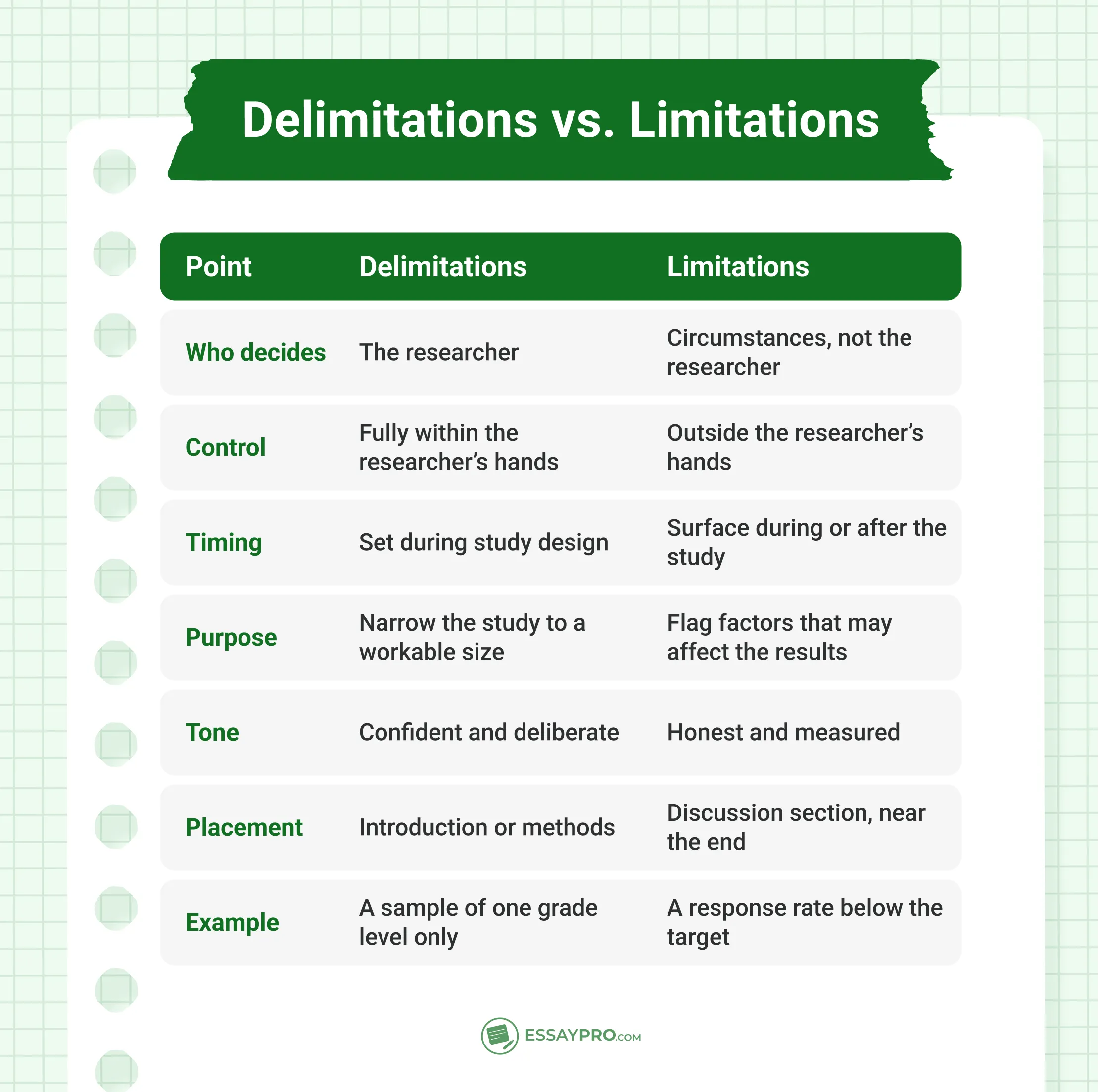
A researcher who labels these correctly signals command of the design. A researcher who swaps them signals the opposite, and reviewers notice. The two also land in different parts of a paper and call for a different tone. The table below sets them against each other across 7 points.
Scope vs. delimitations vs. limitations
Scope states what the study covers. Delimitations state what the researcher chose to exclude and why. Limitations state what went wrong outside the researcher’s control. The table maps scope and limitations against delimitations across 4 features.
Where does the scope and delimitations section go?
The scope and delimitation of the study appears in Chapter 1 of a thesis or dissertation, within the introduction or methods section of a journal article, and after the objectives in a research proposal. Limitations land later, in the discussion section. The table lists placement and typical length by document type.
If you’re going through the outline section by section, trying to figure out how to build your project, learn how to write an introduction for a research paper first.
Common mistakes in scope and delimitations
5 mistakes show up most often in scope and delimitations sections. Each one weakens the study in a specific way, and each has a direct fix.
- The limitation-delimitation mix-up. The error signals that the writer cannot separate a choice and a constraint, and reviewers lose confidence in the design. Fix: file chosen boundaries under delimitations and uncontrollable factors under limitations.
- Boundaries with no reason. An unjustified cut looks arbitrary and gives reviewers an easy objection. Fix: add a one-line reason to every inclusion and exclusion.
- A scope too broad to finish. An oversized scope stalls the project and blows past the deadline. Fix: trim the population, the variables, or the time span until the plan fits the resources.
- Delimitations that clash with the methods. A boundary that contradicts the methodology chapter makes the full design look careless. Fix: cross-check the scope against the real data collection plan.
- An apology for the boundaries. Hedging language turns deliberate choices into apparent flaws. Fix: state each delimitation as a firm decision.
We understand if you’d rather have a professional handle all parts of your assignments, so our research paper services cover all types of academic work.
Hand off the hard part
A specialist from our service will do all the heavy lifting for your academic tasks.
Final thoughts
Scope sets what a study covers, and delimitations set the boundaries a researcher draws on purpose, and each one needs a reason. Limitations stay separate, since they fall outside anyone’s control. A tight scope keeps the work focused and tells readers exactly how far the findings reach. Name every boundary, justify it, and the design reads as a set of decisions.
FAQs
What is the difference between scope and delimitation in research?
What are examples of delimitations in a qualitative study?
How long should the scope and delimitation section be?
Should scope and delimitations be written in past or future tense?

Annie Lambert
specializes in creating authoritative content on marketing, business, and finance, with a versatile ability to handle any essay type and dissertations. With a Master’s degree in Business Administration and a passion for social issues, her writing not only educates but also inspires action. On EssayPro blog, Annie delivers detailed guides and thought-provoking discussions on pressing economic and social topics. When not writing, she’s a guest speaker at various business seminars.